

Suru: the neutral verb that fits everywhere
Suru is the safest verb in Japanese. It is neutral in register, so it sounds right in a text to a friend, an email to a client and a school essay. Its polite form is shimasu, its past form is shita, and the -te form is shite. Because it is so neutral, it is the default when you are not sure how close you are to the listener.
Suru takes a direct object with o: shukudai o suru, to do homework; ryōri o suru, to cook; sōji o suru, to clean. It also describes wearing accessories, nekutai o suru, to wear a tie, and choosing something, kōhī ni suru, to go with coffee. These extended uses are why suru is worth learning deeply rather than treating it as a plain translation of do.
| Japanese | Romaji | Meaning |
|---|---|---|
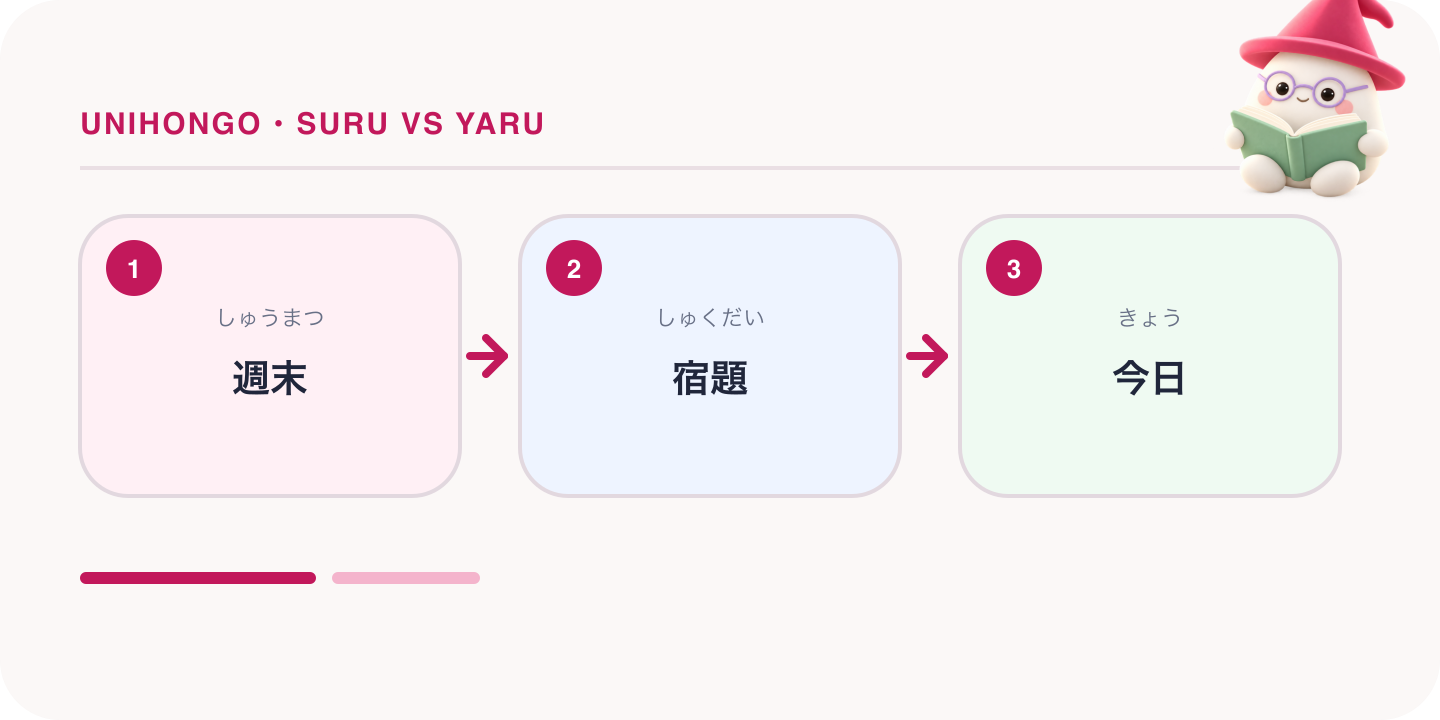
| 週末は何をしますか。 | Shūmatsu wa nani o shimasu ka. | What are you doing at the weekend? |
| 宿題をしてから寝ます。 | Shukudai o shite kara nemasu. | I'll do my homework and then go to bed. |
| 今日は私が料理をします。 | Kyō wa watashi ga ryōri o shimasu. | I'll cook today. |
| 部屋の掃除をしました。 | Heya no sōji o shimashita. | I cleaned my room. |
| 飲み物はお茶にします。 | Nomimono wa ocha ni shimasu. | I'll have tea to drink. |
Yaru: plain, physical and personal
Yaru also means to do, but with a different flavour. It is casual, so it belongs in conversations with friends, family and colleagues you are relaxed with. It also feels more hands-on and physical than suru. Shigoto o yaru, to do the work, sounds like rolling up your sleeves, whereas shigoto o suru simply reports that work happens.
The polite form yarimasu is common in relaxed workplaces, especially watashi ga yarimasu, I'll do it, when volunteering. Yarimasu sounds keener, shimasu more measured; with clients, stay with shimasu or itashimasu.
Yatta! is the shout of delight when something works out, literally I did it. Yatte oku means to do something in advance so that it is ready. Yatteru asks whether a shop or event is on: mada yatteru? Is it still open?
| Japanese | Romaji | Meaning |
|---|---|---|
| 宿題やった? | Shukudai yatta? | Did you do your homework? |
| それ、私がやります。 | Sore, watashi ga yarimasu. | I'll do that. |
| 今日は仕事をやる気がしない。 | Kyō wa shigoto o yaru ki ga shinai. | I don't feel like doing work today. |
| 準備は昨日やっておいた。 | Junbi wa kinō yatte oita. | I did the preparation yesterday, so it's ready. |
| あの店、まだやってる? | Ano mise, mada yatteru? | Is that shop still open? |
| やった!合格した! | Yatta! Gōkaku shita! | Yes! I passed! |
Yatte miru and the -te forms of yaru
The -te form of yaru, yatte, joins with helper verbs to make a family of expressions that every learner needs. Yatte miru means to try something and see how it goes. It is the standard way to accept a task you are not sure you can manage, and yatte mimasu is polite enough for the office.
Yatte kureru asks someone to do something for you, and yatte ageru offers to do it for a friend or junior. Yatte shimau, yatchau in speech, means to get something done, or to do it by mistake, depending on tone. Suru has the same combinations, shite miru, shite kureru, shite shimau, and they are a touch more formal.
| Japanese | Romaji | Meaning |
|---|---|---|
| 難しそうだけど、やってみます。 | Muzukashisō da kedo, yatte mimasu. | It looks hard, but I'll give it a try. |
| 一度やってみて。 | Ichido yatte mite. | Have a go, just once. |
| それ、やってくれる? | Sore, yatte kureru? | Could you do that for me? |
| 先にやっちゃおう。 | Saki ni yatchaō. | Let's get it done first. |
| 代わりにやってあげるよ。 | Kawari ni yatte ageru yo. | I'll do it for you instead. |
Compounds that take only suru
Here is the firmest line between the two verbs. Suru attaches directly to Sino-Japanese nouns and many loanwords to form compound verbs: benkyō suru, to study; setsumei suru, to explain; ryokō suru, to travel; kopī suru, to copy. In these compounds the noun and suru are one word, with no particle between them. Yaru can never take that slot. Benkyō yaru is wrong; benkyō o yaru, with the particle, is casual and fine.
Some compounds resist even the o-yaru version. Verbs describing abstract, mental or institutional actions sound odd with yaru: kekkon suru, to marry; sonzai suru, to exist; shinpai suru, to worry; kanshin suru, to be impressed. Yaru prefers actions with a physical or task-like feel, so shiai o yaru, to play a match, and ivento o yaru, to hold an event, are natural, while shinpai o yaru is not.
| Compound | Reading | With yaru |
|---|---|---|
| 勉強する | benkyō suru | Benkyō o yaru is casual and fine |
| 練習する | renshū suru | Renshū o yaru is casual and fine |
| 準備する | junbi suru | Junbi o yaru is casual and fine |
| 説明する | setsumei suru | Setsumei o yaru is unusual; keep suru |
| 結婚する | kekkon suru | Never with yaru |
| 心配する | shinpai suru | Never with yaru |
| 存在する | sonzai suru | Never with yaru |
| 運転する | unten suru | Unten o yaru sounds odd; keep suru |
| 試合する | shiai suru | Shiai o yaru is very common |
| コピーする | kopī suru | Kopī o yaru is unusual; keep suru |
| 旅行する | ryokō suru | Ryokō o yaru is unusual; keep suru |
A rough test: if the noun is something you can picture yourself physically doing, such as a match, a job, a rehearsal or a party, o yaru is available in casual speech. If it names a state, a feeling or a formal procedure, stay with suru.
Yaru as give: juniors, pets and plants
The second life of yaru has nothing to do with doing. It belongs to the give-and-receive family alongside ageru, kureru and morau. Ageru is the neutral verb for giving to someone else. Yaru is the version used when the receiver is clearly lower in status or not a person at all: a younger sibling, a small child, a pet, a plant.
Water and food are the classic objects. Hana ni mizu o yaru, to water the flowers; inu ni esa o yaru, to feed the dog; neko ni oyatsu o yaru, to give the cat a treat. Many speakers today use ageru even for pets and plants, because yaru can sound brusque, and mizu o ageru is now common and perfectly acceptable. Yaru remains natural, especially in older speakers and in casual male speech, and you will hear it constantly.
With people, be careful. Otōto ni yaru, to give it to my younger brother, is normal inside a family. Using yaru towards a colleague, an equal or anyone older is rude. Ageru is always safe, and for giving to a superior you need sashiageru.
| Japanese | Romaji | Meaning |
|---|---|---|
| 毎朝、花に水をやっています。 | Maiasa, hana ni mizu o yatte imasu. | I water the flowers every morning. |
| 犬にえさをやるのを忘れた。 | Inu ni esa o yaru no o wasureta. | I forgot to feed the dog. |
| これ、弟にやるつもりだ。 | Kore, otōto ni yaru tsumori da. | I'm planning to give this to my little brother. |
| 子どもにお小遣いをやった。 | Kodomo ni okozukai o yatta. | I gave the kids some pocket money. |
| 猫におやつをあげました。 | Neko ni oyatsu o agemashita. | I gave the cat a treat. |
The rougher side of yaru
Yaru has an aggressive register that suru never has. In crime dramas and gangster films, yaru is the euphemism for killing or beating someone: yatta no wa dare da, who did it. In sport it means to beat an opponent. In arguments, yatte yaru, with the second yaru as a helper, means I'll show you, I'll do it out of spite. Yatchimae is a shout of go on, do it, from a crowd.
There is also a sexual slang sense in very casual speech. None of these meanings appear in polite conversation, but they explain why yaru feels edgier than suru and why it should stay out of formal settings.
- Yatte yaru: I'll do it, with defiance or spite
- Yatte yaru zo: watch me, I'll pull it off
- Aitsu o yaru: to get him, in fights or crime stories
- Zettai ni yarareta: we got thrashed, in sport or games
The passive yarareru is common and usually harmless: shiken de yarareta, the exam got me; kaze ni yarareta, a cold knocked me out. It expresses being beaten by something, and it is fine between friends.
Polite alternatives: nasaru and itasu
When the conversation turns polite, both verbs give way to the keigo pair nasaru and itasu. Nasaru is respectful, used for actions done by the person you are honouring: a customer, a client, a teacher, a guest. Its polite form is irregular, nasaimasu, and the -te form is nasatte. Dō nasaimasu ka means what would you like to do. In compounds it replaces suru: go-riyō nasaimasu ka, will you be using it.
Itasu is humble, used for your own actions or your company's. Watashi ga itashimasu, I will do it, and go-annai itashimasu, I will show you the way. Shite orimasu is the humble progressive. Learners often over-apply itasu to other people's actions, which is a clear mistake: only you and your side itasu.
Yaru has no keigo forms of its own, so when you need respect or humility, you switch verbs. Sensei ga yarimasu is fine in a relaxed classroom, but sensei ga nasaimasu is the correct respectful form.
| Japanese | Romaji | Meaning |
|---|---|---|
| お支払いはどうなさいますか。 | O-shiharai wa dō nasaimasu ka. | How would you like to pay? |
| 先生はもう説明なさいました。 | Sensei wa mō setsumei nasaimashita. | The teacher has already explained. |
| その件は私がいたします。 | Sono ken wa watashi ga itashimasu. | I'll take care of that matter. |
| ご案内いたします。 | Go-annai itashimasu. | Allow me to show you the way. |
| 確認しておりますので、少々お待ちください。 | Kakunin shite orimasu node, shōshō o-machi kudasai. | I'm checking now, so please wait a moment. |
Mistakes learners make with suru and yaru
The most common error is using yaru with people who deserve suru: a shop assistant, a teacher, a new acquaintance. Yaru itself is not vulgar, but the mismatch of register makes you sound careless. The fix is simple: default to shimasu, and let yaru into your speech only when the other person uses it first.
The second error is attaching yaru directly to a noun, benkyō yaru or renshū yaru. Add o, and remember that some nouns refuse yaru altogether. The third error is using yaru when giving something to a friend. Yaru downward, ageru sideways, sashiageru upward.
Finally, watch the give-and-do overlap. Mizu o yaru means to water, and otōto ni yaru means to give to my brother. The particle ni usually makes the meaning clear; if you want no ambiguity, use ageru for giving and keep yaru for doing.
| Japanese | Romaji | Meaning |
|---|---|---|
| 宿題をやりましたか。 | Shukudai o yarimashita ka. | Did you do your homework? (casual polite) |
| 宿題はもう済ませましたか。 | Shukudai wa mō sumasemashita ka. | Have you already finished your homework? (more formal) |
| 友達にプレゼントをあげた。 | Tomodachi ni purezento o ageta. | I gave a present to a friend. |
| 部長に資料を差し上げました。 | Buchō ni shiryō o sashiagemashita. | I gave the documents to the department head. |
| ちょっとやってみますね。 | Chotto yatte mimasu ne. | I'll give it a quick try. |