
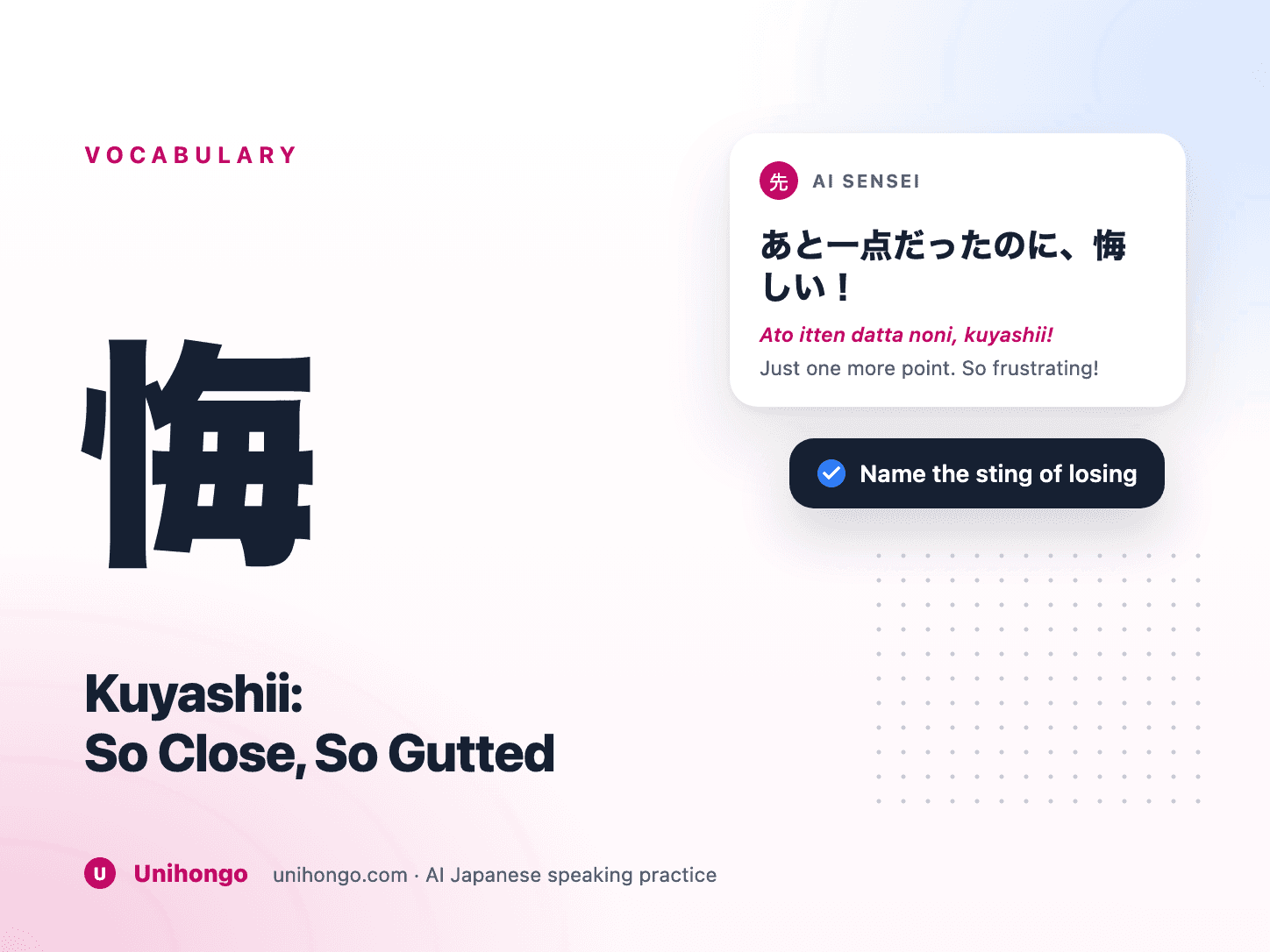
The core feeling behind kuyashii
Kuyashii describes the frustration that comes from losing, failing or being bettered, when you wanted to win and believed you could. It mixes disappointment, irritation and a strong urge to try again. The feeling is often directed at yourself: you know exactly where you went wrong, and it hurts.
Because it is linked to effort and ambition, kuyashii is common in sports, exams, competitions and games. A student who misses a passing mark by a few points, a player whose team loses in extra time, or a gamer beaten on the final level would all naturally say it.
It also appears when someone else gets the better of you: being tricked, outwitted, or made to look foolish. Here it is closer to feeling mortified or humiliated, with a hint of "I'll get you back".
| Japanese | Romaji | Meaning |
|---|---|---|
| 悔しい! | Kuyashii! | Argh, so frustrating! / I'm gutted! |
| めっちゃ悔しい。 | Meccha kuyashii. | I'm so frustrated (casual). |
| 本当に悔しいです。 | Hontō ni kuyashii desu. | It is really frustrating (polite). |
| あと一点だったのに、悔しい。 | Ato itten datta noni, kuyashii. | Just one more point and I'd have made it. So frustrating. |
| くやしー! | Kuyashī! | Argh! (stretched, very casual) |
Grammar: how to use kuyashii in sentences
Kuyashii is an i-adjective, so it conjugates like any other: kuyashikatta (was frustrating), kuyashikunai (not frustrating), kuyashikute (frustrated, and...). Its noun form kuyashisa means the frustration itself, and kuyashigaru describes someone else visibly showing frustration.
Because emotion adjectives in Japanese usually describe the speaker's own feelings, saying kare wa kuyashii can sound odd. For other people, use kuyashisō (looks frustrated), kuyashigatte iru (is showing frustration) or a quoted form such as kuyashii tte itteta.
You will also often hear kuyashii paired with noni (even though) or with a reason in the te form, explaining what made the moment sting.
| Form | Example | Meaning |
|---|---|---|
| 悔しかった | 昨日の試合は悔しかった。 | Yesterday's match was frustrating. |
| 悔しくて | 悔しくて眠れなかった。 | I was so frustrated I couldn't sleep. |
| 悔しさ | この悔しさを忘れない。 | I won't forget this frustration. |
| 悔しそう | 彼、悔しそうだったね。 | He looked frustrated, didn't he. |
| 悔しがる | 弟がすごく悔しがっている。 | My little brother is really upset about losing. |
The line kono kuyashisa o wasurenai, I won't forget this frustration, is a classic in sports interviews and anime: turning the sting into motivation.
Kuyashii, zannen and kanashii compared
These three words cover overlapping ground, and choosing the wrong one changes how you sound. Zannen is "that's a shame" or "unfortunately". It is calm, often polite, and suits announcements, bad news and situations you had little control over, such as rain cancelling an event. The zannen guide covers its polite uses in detail.
Kanashii is sadness: loss, heartbreak, a sad film. It lacks the competitive or self-critical edge of kuyashii. Kuyashii is personal and active. It suggests you cared about the result, felt close to success, and want another chance.
Imagine failing an exam by two points. Zannen deshita sounds like a teacher delivering the result. Kanashii says you feel down. Kuyashii says you are angry with yourself and will try again. All three can be true at once, but kuyashii is the one that sounds most like a competitor.
| Word | Core emotion | Typical example |
|---|---|---|
| 悔しい | Frustration at losing or falling short | Losing a final by one goal |
| 残念 | Regret, that's a shame | An event cancelled by rain |
| 悲しい | Sadness, sorrow | A friend moving far away |
| 腹が立つ | Anger at someone or something | Being treated unfairly |
| 後悔 | Regret over a past choice | Wishing you had studied more |
Kuyashii in sport, exams and games
The most familiar setting for kuyashii is competition. Athletes say it in post-match interviews, often in tears, and it is received as a sign that they gave everything. Students say it after entrance exams and club tournaments. Friends say it after losing at cards, video games or rock paper scissors.
Commentators and coaches also use related words. Oshii means "so close" and is often said by onlookers, while kuyashii is the feeling of the person who lost. Makeru means to lose, and makezugirai describes someone who hates losing.
| Japanese | Romaji | Meaning |
|---|---|---|
| 負けて悔しい。 | Makete kuyashii. | I'm frustrated that I lost. |
| 惜しい! | Oshii! | So close! |
| 次は絶対勝つ。 | Tsugi wa zettai katsu. | I'll definitely win next time. |
| 悔しいけど、相手が強かった。 | Kuyashii kedo, aite ga tsuyokatta. | It's frustrating, but they were stronger. |
| 私、負けず嫌いなんです。 | Watashi, makezugirai nan desu. | I hate losing. |
Kuyashii at work and in daily life
Adults use kuyashii outside sport too. Losing a pitch to a competitor, having a proposal rejected, or being passed over for a project can all prompt kuyashii desu among colleagues. It signals commitment and is rarely seen as unprofessional in conversation.
Daily life has smaller versions: just missing a train as the doors close, a shop selling out of the last item right before you, or thinking of the perfect reply to an argument hours too late. Using kuyashii for these light moments is natural and often humorous.
It can also express being made a fool of. If someone teases you and you cannot think of a comeback, kuyashii is the word, often with a pout.
| Japanese | Romaji | Meaning |
|---|---|---|
| コンペに負けて悔しいです。 | Konpe ni makete kuyashii desu. | We lost the bid, and it's frustrating. |
| 目の前でドアが閉まって、悔しかった。 | Me no mae de doa ga shimatte, kuyashikatta. | The doors shut right in front of me. So annoying. |
| 最後の一個が売り切れた、悔しい! | Saigo no ikko ga urikireta, kuyashii! | The last one sold out. Argh! |
| 言い返せなくて悔しい。 | Iikaesenakute kuyashii. | It's frustrating that I couldn't answer back. |
How to respond when someone says kuyashii
When a friend or teammate says kuyashii, avoid brushing it off. Japanese comfort tends to acknowledge the effort and the closeness of the result first, then look ahead. Oshikatta ne (that was so close) validates the feeling, and ganbatta ne (you did your best) praises the effort.
Be careful with zannen deshita ne in this situation. Said to someone who has just lost, it can sound distant, like a presenter reading a result. Save it for polite contexts or for news that affects you both.
With a colleague or someone senior, casual lines such as tsugi wa ikeru yo can sound too familiar. O-tsukaresama deshita (thanks for your hard work) followed by a short, polite comment on how close it was is a safer choice.
| Japanese | Romaji | Meaning |
|---|---|---|
| 惜しかったね。 | Oshikatta ne. | That was so close. |
| 頑張ったね。 | Ganbatta ne. | You worked really hard. |
| 次はいけるよ。 | Tsugi wa ikeru yo. | You'll get it next time. |
| その悔しさがあれば大丈夫。 | Sono kuyashisa ga areba daijōbu. | With that frustration, you'll be fine. |
| お疲れさまでした。本当に惜しかったです。 | O-tsukaresama deshita. Hontō ni oshikatta desu. | Great effort. It was really close. |
Common learner mistakes
The most common mistake is using kuyashii for situations with no effort or competition. If a concert you were looking forward to is cancelled, zannen or gakkari (disappointed) fits better, because you did not lose to anyone.
Another is using kuyashii for grief. Hearing about a friend's illness calls for kanashii, shinpai (worried) or tsurai, not kuyashii, unless you mean you are frustrated that you could not help.
Learners also say kare wa kuyashii desu to describe others. Use kuyashisō or kuyashigatte iru instead, or quote them.
Finally, remember that kuyashii is honest and emotional. Formal written reports usually prefer neutral phrases such as zannen nagara. A line like makoto ni kuyashii kekka to narimashita does appear in public statements, for example from sports teams, but only when the speaker intends to show emotion openly.
| Japanese | Romaji | Meaning |
|---|---|---|
| がっかりした。 | Gakkari shita. | I was disappointed. |
| 残念ながら中止になりました。 | Zannen nagara chūshi ni narimashita. | Unfortunately it has been cancelled. |
| 誠に悔しい結果となりました。 | Makoto ni kuyashii kekka to narimashita. | It was a truly frustrating result (formal statement). |