

The kanji and the verb makaseru
Omakase is written お任せ, or sometimes おまかせ in hiragana on menus and packaging. The kanji 任 means duty, responsibility or to entrust, and it appears in words like ninmu, a mission or task, sekinin, responsibility, and tannin, the teacher in charge of a class.
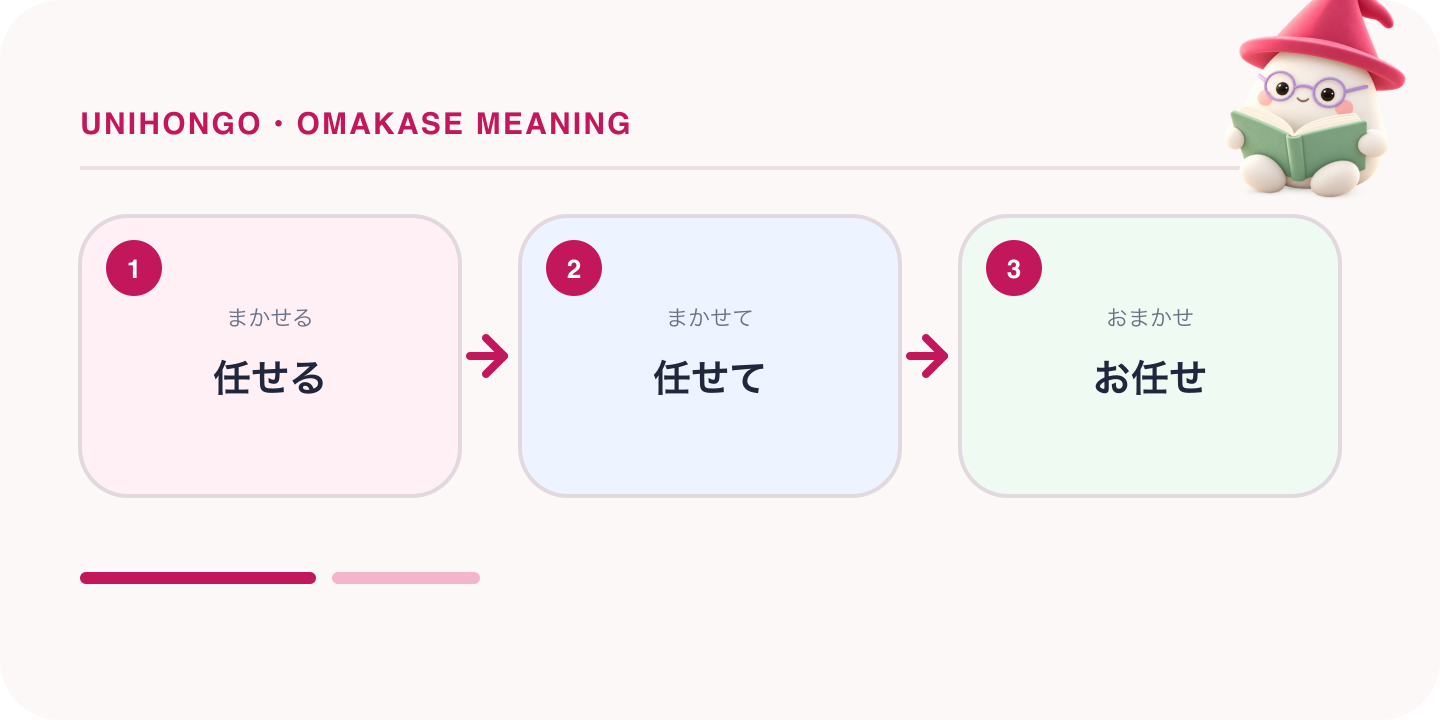
The verb makaseru means to entrust something to someone, to leave a decision or job in their hands. Its stem, makase, becomes a noun, and the honorific prefix o makes it polite. So omakase literally means the act of leaving it to you, and omakase shimasu means I will leave it to you.
The nuance is trust. When you say makaseru, you are not only letting someone choose; you are saying you believe they will choose well. That is why the word fits a sushi chef so neatly: the chef knows what arrived at the market that morning, and you do not.
| Word | Reading | Meaning |
|---|---|---|
| 任せる | makaseru | To entrust, to leave to someone |
| 任せて | makasete | Leave it to me (casual) |
| お任せ | omakase | Leaving it to someone; chef's choice |
| 任務 | ninmu | Mission, duty |
| 責任 | sekinin | Responsibility |
| 担任 | tannin | Person in charge, homeroom teacher |
Omakase at a sushi counter
At a sushi counter, omakase means the chef serves you a sequence chosen by them. Depending on the restaurant, that may be a dozen or more pieces of nigiri, sometimes with small dishes called tsumami or otsumami, a bowl of soup and a final roll or piece of tamago, the sweet omelette. The chef usually places each piece directly in front of you, often already brushed with soy sauce, so you can eat it straight away.
Some counters offer only omakase, with a fixed course and a set start time. Others have an omakase set alongside an ordinary menu. At the most modest end, a lunch omakase may just be a plate of assorted nigiri chosen by the kitchen. The word is the same; the experience depends entirely on the shop.
You may also see words like kōsu, course, and the ranked sets matsu, take and ume, pine, bamboo and plum, where matsu is usually the most expensive. These are not the same as omakase, but they solve the same problem of not having to choose every piece.
| Japanese | Romaji | Meaning |
|---|---|---|
| おまかせでお願いします。 | Omakase de onegai shimasu. | Chef's choice, please. |
| おまかせコースを予約したいです。 | Omakase kōsu o yoyaku shitai desu. | I'd like to book the omakase course. |
| 今日のおすすめは何ですか。 | Kyō no osusume wa nan desu ka. | What do you recommend today? |
| これは何ですか。 | Kore wa nan desu ka. | What is this? |
| 醤油はつけなくていいですか。 | Shōyu wa tsukenakute ii desu ka. | Is it fine without soy sauce? |
| とてもおいしいです。 | Totemo oishii desu. | It's very good. |
Okonomi: the opposite of omakase
The contrast word is okonomi, from konomi, preference or taste. Ordering okonomi means choosing each piece yourself, usually two pieces at a time, from what is on the board or in the glass case. It is the same konomi as in okonomiyaki, the savoury pancake cooked however you like it.
Many regulars mix the two: they start with omakase and finish with a few okonomi pieces they especially enjoyed. If you want another piece of something you just ate, simply ask for it again with mō hitotsu.
| Japanese | Romaji | Meaning |
|---|---|---|
| お好みで注文してもいいですか。 | Okonomi de chūmon shite mo ii desu ka. | May I order piece by piece? |
| 中トロをお願いします。 | Chūtoro o onegai shimasu. | Medium fatty tuna, please. |
| さっきの貝をもう一つください。 | Sakki no kai o mō hitotsu kudasai. | One more of that shellfish from before, please. |
| 最後に玉子をお願いします。 | Saigo ni tamago o onegai shimasu. | Tamago to finish, please. |
| わさび抜きでお願いします。 | Wasabi nuki de onegai shimasu. | Without wasabi, please. |
Wasabi nuki, without wasabi, and sabi nuki, the shorter sushi-counter version, are both understood. Chefs are used to children and guests who prefer it that way, so there is no need to apologise.
Allergies, dislikes and what to say first
Because the chef plans the sequence, the right time to mention anything you cannot eat is before the first piece. Staff often ask when you book or when you sit down: nigate na mono wa arimasu ka, is there anything you don't like? Nigate is the soft, polite word for something you find difficult, and arerugī is an allergy.
Be specific. Say which kind of seafood, such as ika, squid, tako, octopus, uni, sea urchin, ebi, shrimp, or hikarimono, the silver-skinned fish like mackerel and gizzard shad. If you have a serious allergy, say so clearly with arerugī rather than nigate, because nigate sounds like preference.
| Japanese | Romaji | Meaning |
|---|---|---|
| 苦手なものはありますか。 | Nigate na mono wa arimasu ka. | Is there anything you don't like? |
| ウニが苦手です。 | Uni ga nigate desu. | I'm not keen on sea urchin. |
| エビのアレルギーがあります。 | Ebi no arerugī ga arimasu. | I have a shrimp allergy. |
| 光り物は少し苦手です。 | Hikarimono wa sukoshi nigate desu. | I'm not very fond of silver-skinned fish. |
| 特にありません。何でも食べられます。 | Toku ni arimasen. Nan demo taberaremasu. | Nothing in particular. I can eat anything. |
Counter etiquette during an omakase meal
Omakase is relaxed at most places, but a few habits make the meal go smoothly and show respect for the chef's work. None of these are strict laws, and customs vary between shops, so follow the chef's lead when in doubt.
- Eat each piece soon after it is placed in front of you; nigiri is timed so the rice and fish are at their best.
- Hands or chopsticks are both fine for nigiri. If you use soy sauce, dip the fish side lightly, not the rice.
- If the chef has already brushed the piece with sauce or added salt or citrus, it usually needs nothing else.
- Gari, the pickled ginger, is a palate cleanser between pieces, not a topping.
- Avoid strong perfume at a counter; aroma is part of the meal for everyone around you.
- Ask before taking photos, especially at small counters. Kochira, shashin o totte mo ii desu ka is enough.
- Sushi-shop insider words like agari, tea, and oaiso, the bill, are staff jargon. Guests usually just say ocha and okaikei.
At the end, gochisōsama deshita, thank you for the meal, is the natural closing line. Saying oishikatta desu, it was delicious, to the chef directly is always welcome.
Omakase beyond the sushi counter
In Japan, omakase is not a restaurant word. It is the ordinary way to hand over any choice. At a hair salon, a vague request followed by ato wa omakase shimasu, and the rest I leave to you, is common. At a flower shop, you can give a budget and ask for an arrangement omakase de. At work, a manager might say kono ken wa anata ni makasemasu, I'll leave this matter to you.
Products use the word too. Omakase mode on a washing machine or rice cooker means an automatic setting that decides for you. Some restaurants and bakeries sell an omakase set or omakase bento, a box whose contents change day by day.
| Japanese | Romaji | Meaning |
|---|---|---|
| 髪型はおまかせします。 | Kamigata wa omakase shimasu. | I'll leave the hairstyle to you. |
| 予算は三千円で、おまかせでお願いします。 | Yosan wa sanzen-en de, omakase de onegai shimasu. | My budget is 3,000 yen; I'll leave the rest to you. |
| この件はあなたに任せます。 | Kono ken wa anata ni makasemasu. | I'll leave this matter to you. |
| 私に任せてください。 | Watashi ni makasete kudasai. | Please leave it to me. |
| 任せて! | Makasete! | Leave it to me! |
| 店員さんに任せたら、いい感じになった。 | Ten'in-san ni makasetara, ii kanji ni natta. | I left it to the staff and it turned out nicely. |
Makase in compound words: luck, wind and other people
Makase also combines with other nouns to mean leaving things to something. Some of these are neutral or poetic; others carry a slight criticism, because leaving everything to someone else can sound irresponsible.
| Japanese | Reading | Meaning | Nuance |
|---|---|---|---|
| 運任せ | unmakase | Leaving it to luck | Often slightly critical |
| 成り行き任せ | nariyuki makase | Letting things take their course | Can sound passive or relaxed |
| 風任せ | kaze makase | Going wherever the wind blows | Relaxed, travel mood |
| 人任せ | hito makase | Leaving it all to others | Critical |
| 力任せ | chikara makase | Using brute force | Neutral to critical |
| お任せ | omakase | Leaving it to someone you trust | Positive, polite |
Notice how omakase is the only one with the polite prefix. Adding o marks it as respectful trust in a specific person, which is exactly what you want to express to a chef or stylist.
The meaning abroad vs in Japan
Outside Japan, omakase usually signals a premium, reservation-only tasting menu, and the word itself has become part of the marketing. Restaurants in many countries now use it for non-Japanese cuisines too, and some software developers have borrowed it to describe frameworks that make choices for you.
In Japanese, the word does not carry that luxury feeling by itself. It carries trust. A bento whose contents the shop chooses can be omakase, and so can an inexpensive haircut. If you remember that omakase simply means I'll leave it to you, you will understand it everywhere, from the most expensive counter in Ginza to a friend offering to plan your weekend.
| Abroad | In Japan |
|---|---|
| A high-end chef's tasting menu | Any choice left to someone else, including the chef |
| Used mostly as a restaurant format name | Used for hair, gifts, tasks, appliances and food |
| Suggests luxury and exclusivity | Suggests trust; price depends entirely on the place |
| Rarely contrasted with anything | Clearly contrasted with okonomi at sushi counters |