
Nakayoshi and its family of phrases
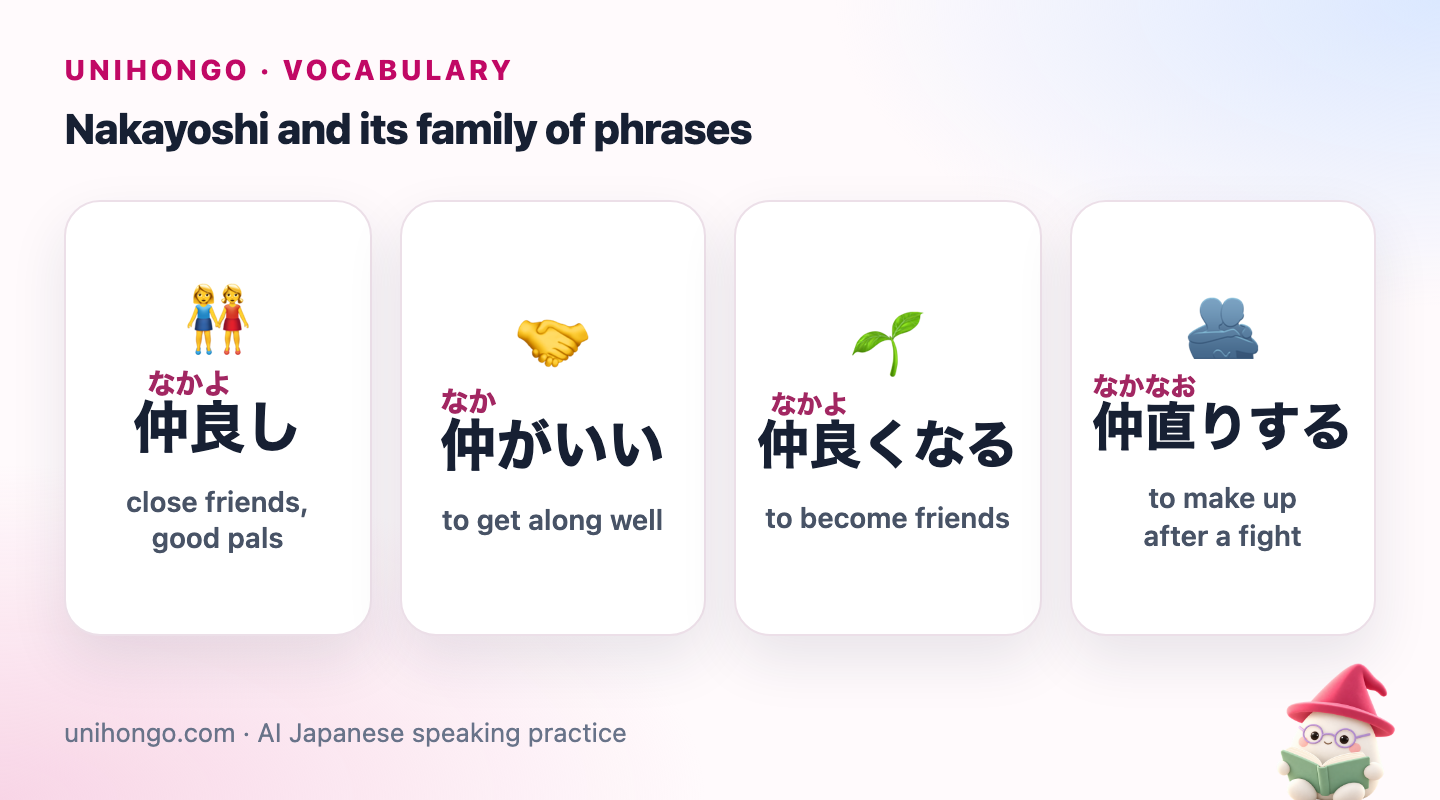
Nakayoshi itself is a noun for a close relationship or for the people in it. Its everyday companions are built from the same 仲 (naka): naka ga ii describes the relationship as good, nakayoku is the adverb form used with verbs, and nakanaori means repairing the relationship.
| Japanese | Romaji | Meaning |
|---|---|---|
| 仲良し | nakayoshi | close friends, good pals |
| 仲がいい | naka ga ii | to get along well |
| 仲良くなる | nakayoku naru | to become friends |
| 仲直りする | nakanaori suru | to make up after a fight |
The 良 in nakayoshi is the same kanji as 良い (yoi), good. Yoshi is an old adjective form that survives in set words like this, which is why the word feels a little traditional and gentle.
Saying who is close: nakayoshi and naka ga ii
Both phrases describe a relationship, so the subject is usually two people joined with to, or a group. Nakayoshi is a noun and takes desu or no; naka ga ii is a phrase with the adjective ii, so it changes like ii does: naka ga yokatta (got along), naka ga yokunai (do not get along).
You can grade the closeness with totemo, sugoku or chō for very close, and with amari and a negative for not so close. To ask about a relationship, Japanese often uses the question naka ii no? in casual speech.
| Japanese | Romaji | Meaning |
|---|---|---|
| 私たちは仲良しです。 | Watashitachi wa nakayoshi desu. | We're close friends. |
| 兄と私はとても仲がいいです。 | Ani to watashi wa totemo naka ga ii desu. | My older brother and I get along really well. |
| あの二人、仲いいよね。 | Ano futari, naka ii yo ne. | Those two are close, aren't they? (casual) |
| 昔は仲が良かったんだけど。 | Mukashi wa naka ga yokatta n da kedo. | We used to be close, though. (casual) |
| 上司とはあまり仲が良くないです。 | Jōshi to wa amari naka ga yokunai desu. | I don't really get along with my boss. |
| 仲良しの友達 | nakayoshi no tomodachi | a close friend |
Becoming friends: nakayoku naru and nakayoku suru
Nakayoku is the adverb form, so it attaches to verbs. Nakayoku naru is to become friends, and it is how Japanese people usually tell the story of a friendship: we met at a club, and we became friends. Nakayoku suru means to be on friendly terms, and nakayoku shite ne asks someone to be friends or to be kind to each other.
You will also hear nakayoku with action verbs: nakayoku asobu (play nicely), nakayoku wakeru (share fairly). Parents and teachers say these to children constantly, which is part of why the whole word family sounds warm and slightly young.
| Japanese | Romaji | Meaning |
|---|---|---|
| サークルで仲良くなりました。 | Sākuru de nakayoku narimashita. | We became friends through a university club. |
| どうやって仲良くなったの? | Dō yatte nakayoku natta no? | How did you two become friends? (casual) |
| これから仲良くしてください。 | Kore kara nakayoku shite kudasai. | I hope we'll be friends. (student introduction) |
| けんかしないで、仲良く遊んでね。 | Kenka shinaide, nakayoku asonde ne. | Parent: Don't fight, play nicely, okay? |
| お菓子は仲良く分けてね。 | Okashi wa nakayoku wakete ne. | Parent: Share the sweets fairly. |
Who says nakayoshi, and when
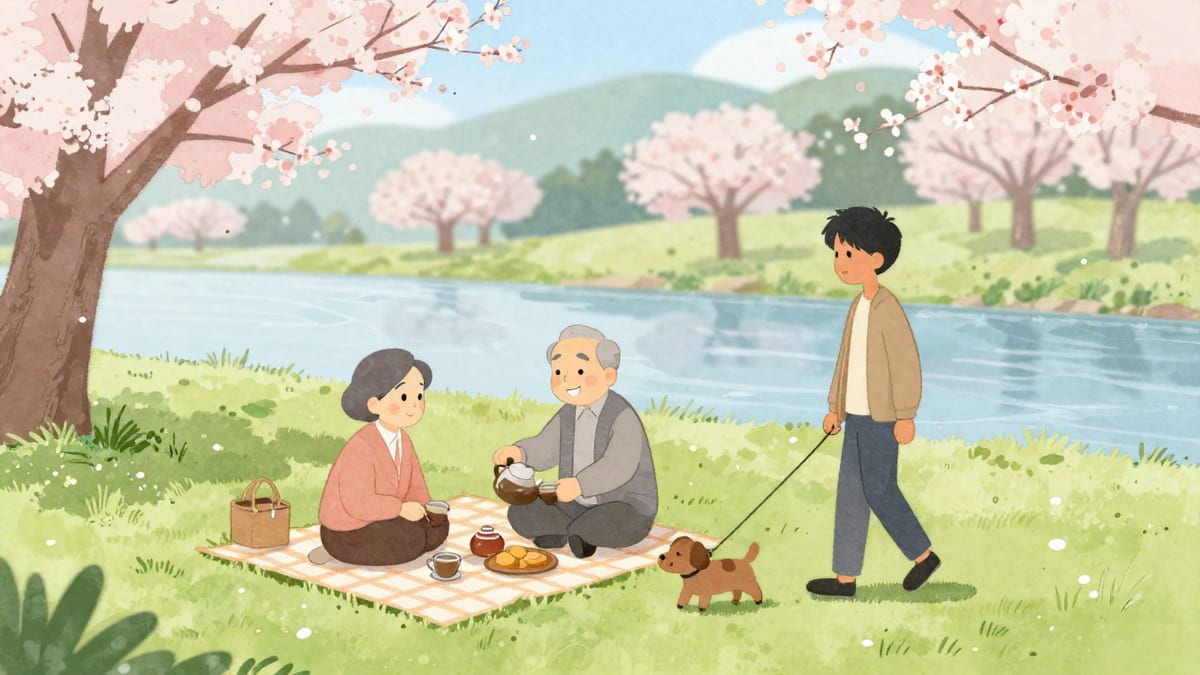
Among children and teenagers, nakayoshi is everywhere: a nakayoshi gurūpu is a group of close friends, and kids proudly announce who they are nakayoshi with. Adults use it with a smile, often about others rather than themselves: a couple who always hold hands are nakayoshi fūfu, two coworkers who lunch together every day are nakayoshi, and a photo of a cat curled up with a dog is captioned nakayoshi.
In a job interview, a business email or a serious conversation, naka ga ii or more formal phrases such as ryōkō na kankei (good relations) fit better. At work, when you join a new team, the standard line is yoroshiku onegaishimasu, not nakayoku shite kudasai, which would sound like a school pupil.
There is also a slightly teasing phrase, nakayoshi koyoshi, from a children's rhyme. Adults sometimes use it about a group that is too cosy or cliquey, so it can carry mild criticism.
| Japanese | Romaji | Meaning |
|---|---|---|
| 仲良し夫婦ですね。 | Nakayoshi fūfu desu ne. | You're such a close couple. |
| うちの猫と犬は仲良しです。 | Uchi no neko to inu wa nakayoshi desu. | Our cat and dog are best friends. |
| 仲良しグループで旅行に行った。 | Nakayoshi gurūpu de ryokō ni itta. | I went on a trip with my close group of friends. |
Fights and making up: nakanaori
Nakanaori (仲直り) is built from naka and naoru, to be fixed. It is the everyday word for making up after a quarrel, from children in a sandbox to couples and old friends. The quarrel itself is kenka, which covers anything from an argument to a physical fight.
A friendly way to suggest making up is mō nakanaori shiyō yo, come on, let's make up, and among friends a small peace offering, a snack or a drink with a short gomen ne, often does the rest.
If friends drift apart without a fight, Japanese often says soen ni naru, to become distant, or simply that they do not see each other any more.
| Japanese | Romaji | Meaning |
|---|---|---|
| 昨日、彼氏とけんかしちゃった。 | Kinō, kareshi to kenka shichatta. | I had a fight with my boyfriend yesterday. (casual) |
| もう仲直りした? | Mō nakanaori shita? | Have you made up yet? (casual) |
| ちゃんと謝って仲直りしました。 | Chanto ayamatte nakanaori shimashita. | I apologised properly and we made up. |
| 最近、疎遠になっています。 | Saikin, soen ni natte imasu. | Lately we've drifted apart. |
Mini dialogue: introducing your friend
| Japanese | Romaji | Meaning |
|---|---|---|
| こちら、大学の友達のマリアです。 | Kochira, daigaku no tomodachi no Maria desu. | You: This is Maria, my friend from university. |
| はじめまして。二人は仲がいいんですね。 | Hajimemashite. Futari wa naka ga ii n desu ne. | Coworker: Nice to meet you. You two seem close. |
| はい、一年生のときに同じクラスで仲良くなりました。 | Hai, ichinensei no toki ni onaji kurasu de nakayoku narimashita. | You: Yes, we became friends in the same class in our first year. |
| いいですね。私も仲良くしてください。 | Ii desu ne. Watashi mo nakayoku shite kudasai. | Coworker: Lovely. I hope we can be friends too. |
Practise talking about friends with Mocchi
- Ask Mocchi: Quiz me on naka ga ii, nakayoku naru and nakanaori, one question at a time. Mocchi notes which one you mix up and brings it back in a later /review.
- Write a short paragraph about your best friend and send it with /correct. Mocchi explains each fix, for example why nakayoshi no tomodachi sounds better than nakayoshi na tomodachi.
- When it feels easy, open AI Sensei, choose Hana-sensei and ask her to play a new classmate who wants to know how you met your friends.
Common learner mistakes
- Using nakayoshi as a verb. Say nakayoku naru for to become friends, not nakayoshi suru.
- Saying watashi wa Ken to nakayoshi desu in a job interview. It is correct but sounds childish there; naka ga ii or a more formal phrase fits better.
- Forgetting the conjugation of ii. The past is naka ga yokatta and the negative is naka ga yokunai, never naka ga iikatta.
- Using nakayoku shite kudasai when joining a company. Use yoroshiku onegaishimasu with colleagues.
- Confusing nakayoshi with nakama. Nakama is a companion, teammate or member of your group; nakayoshi is about warmth between specific people.