
The four words you hear in every dance class
Whatever the style, a dance class in Japan revolves around the same few ideas: you dance, you learn a routine, you memorise the moves, and you keep time with the counts. The teacher demonstrates, the class copies in the mirror, and the routine grows a few eight-counts at a time.
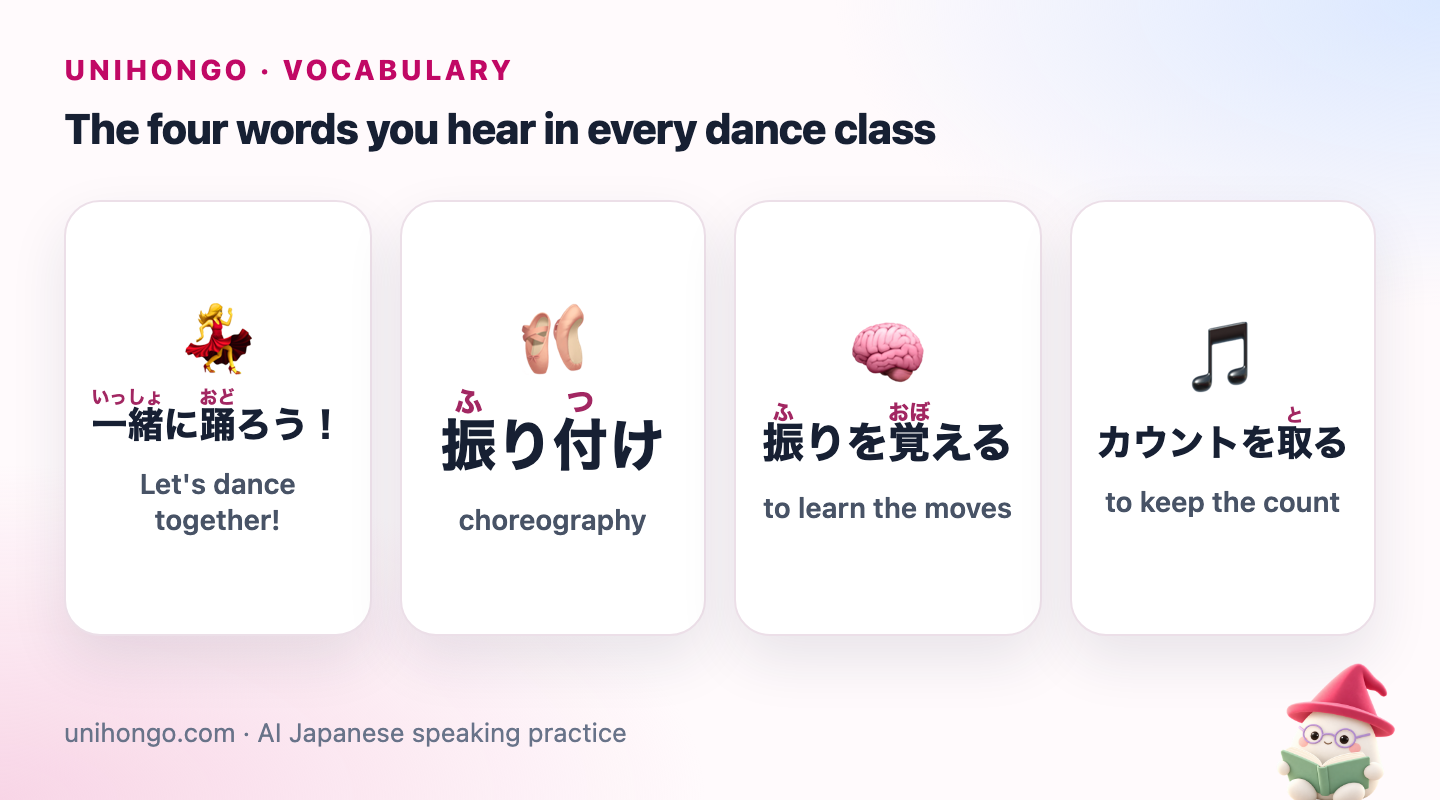
Furi (振り) comes from the verb furu, to swing or wave, and furitsuke is the act of attaching moves to music. Kaunto o toru (カウントを取る) means to take the count, to keep time; teachers say it when they want you to count in your head rather than follow the person beside you.
| Japanese | Romaji | Meaning |
|---|---|---|
| 一緒に踊ろう! | Issho ni odorō! | Let's dance together! |
| 振り付け | furitsuke | choreography |
| 振りを覚える | furi o oboeru | to learn the moves |
| カウントを取る | kaunto o toru | to keep the count |
| 振りが飛んじゃった。 | Furi ga tonjatta. | I blanked on the moves. (casual) |
Odoru, dansu, mau: which verb to use
Odoru is the default verb and works for every style, from a toddler bouncing to music to a professional ballet. Dansu suru and dansu o yaru are common for modern dance as a hobby, especially street dance. Mau is literary: it is used for graceful traditional dance, such as the dance in a noh play or at a shrine, and for things that float in the air, like snow or cherry petals. Do not use mau for your hip-hop class.
| Japanese | Romaji | Meaning |
|---|---|---|
| 週に二回ダンスをやっています。 | Shū ni nikai dansu o yatte imasu. | I dance twice a week. |
| 子供のころからバレエを習っています。 | Kodomo no koro kara barē o naratte imasu. | I've taken ballet since I was a child. |
| 桜の花びらが舞っている。 | Sakura no hanabira ga matte iru. | Cherry petals are dancing in the air. |
| 踊るのは苦手です。 | Odoru no wa nigate desu. | I'm not much of a dancer. |
| Style | Japanese | Note |
|---|---|---|
| Street dance, hip-hop | sutorīto dansu, hippu hoppu | Popular in schools and youth clubs |
| Jazz dance | jazu dansu | Common studio class for adults |
| Ballet | barē (バレエ) | Volleyball is written バレー and sounds almost the same |
| Ballroom dancing | shakō dansu (社交ダンス) | Popular with older adults; pairs and lessons |
| Japanese classical dance | nihon buyō (日本舞踊) | Taught in kimono, often by schools with long traditions |
| Festival circle dance | bon odori (盆踊り) | Summer, open to everyone |
| Yosakoi | yosakoi (よさこい) | Energetic team dance with wooden clappers, at summer festivals |
Signing up for a trial lesson
Many studios offer a taiken ressun (体験レッスン), a one-off trial class, before you join. You book it on the studio's website or by phone, and at reception you fill in a short form. Classes are often divided by level: shoshinsha (初心者, beginner), shokyū (初級, elementary), chūkyū (中級, intermediate) and jōkyū (上級, advanced). The polite phrases below cover the reception desk.
| Japanese | Romaji | Meaning |
|---|---|---|
| 体験レッスンを受けたいんですが。 | Taiken ressun o uketai n desu ga. | I'd like to take a trial lesson. |
| まったくの初心者です。 | Mattaku no shoshinsha desu. | I'm a complete beginner. |
| 初心者クラスはありますか。 | Shoshinsha kurasu wa arimasu ka. | Do you have a beginners' class? |
| 何を着ればいいですか。 | Nani o kireba ii desu ka. | What should I wear? |
| 室内シューズは必要ですか。 | Shitsunai shūzu wa hitsuyō desu ka. | Do I need indoor shoes? |
| 更衣室はどこですか。 | Kōishitsu wa doko desu ka. | Where is the changing room? |
Indoor shoes matter in Japan. Many studios ask you not to dance in the shoes you walked in with, and some ask for bare feet or socks depending on the style. Ask when you book.
Counts, moves and body parts
Dance teachers in Japan count in English with Japanese sounds, and often put ando, and, on the off-beats: wan ando tsū ando. A section of eight beats is called wan eito, one eight, and a teacher might say tsugi no wan eito, the next eight-count. Moves are mostly loanwords such as tān (turn), suteppu (step), janpu (jump) and kikku (kick), but the body parts are native Japanese words that you should learn properly.
| Japanese | Romaji | Meaning |
|---|---|---|
| 右足から | migi ashi kara | starting with the right foot |
| 左手を上げる | hidari te o ageru | to raise the left hand |
| 肩 | kata | shoulders |
| 腰 | koshi | hips, lower back |
| 膝 | hiza | knees |
| つま先 | tsumasaki | tiptoes, toes |
| かかと | kakato | heels |
| 目線 | mesen | where your eyes look |
| リズムに乗る | rizumu ni noru | to get into the rhythm |
What the teacher says
Instructions come quickly and in te-form, which here works as a short, friendly command. You rarely need to answer, but you do need to understand. Here are the lines you will hear in almost every class, from the warm-up to the final run-through.
| Japanese | Romaji | Meaning |
|---|---|---|
| まずストレッチから。 | Mazu sutoretchi kara. | Teacher: Let's start with stretching. |
| 膝を曲げて。 | Hiza o magete. | Teacher: Bend your knees. |
| 力を抜いて。 | Chikara o nuite. | Teacher: Relax, loosen up. |
| もっと大きく動いて。 | Motto ōkiku ugoite. | Teacher: Make your movements bigger. |
| 目線は前! | Mesen wa mae! | Teacher: Eyes forward! |
| 音をよく聞いて。 | Oto o yoku kiite. | Teacher: Listen carefully to the music. |
| じゃあ、曲に合わせてみよう。 | Jā, kyoku ni awasete miyō. | Teacher: Now let's try it with the music. |
| すみません、もう一回お願いします。 | Sumimasen, mō ikkai onegai shimasu. | Student: Sorry, once more, please. |
| ゆっくりでお願いできますか。 | Yukkuri de onegai dekimasu ka. | Student: Could you show it slowly? |
Notice that the teacher speaks casually and the student answers politely. That is the normal balance in most studios, even when the teacher is younger than you. After a few months, regular students often relax into a friendlier tone, but sensei stays the way to address the teacher. At the end of class, many students say arigatō gozaimashita together, sometimes with a small bow toward the teacher or the mirror.
Joining the circle at bon odori
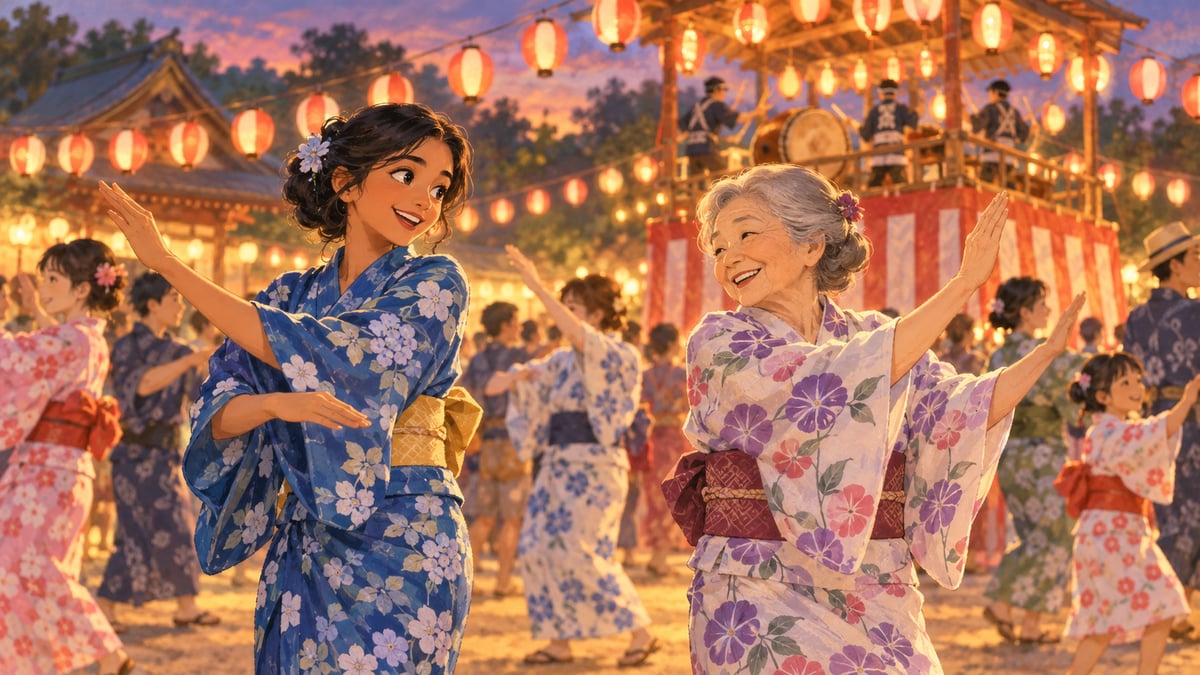
Bon odori is danced in summer, mostly in July and August around the Obon period, though the timing varies by region. People dance in a big circle, wa (輪), around a raised stage called a yagura, where drummers and singers perform. Each region and song has its own moves, and many locals learned them as children, but newcomers learn by watching, a style Japanese calls miyō mimane (見よう見まね), copying by watching.
You can join in yukata or ordinary clothes. Step into the circle where there is space, follow the person in front, and do not worry about mistakes; the moves repeat, so by the third round most people have them.
| Japanese | Romaji | Meaning |
|---|---|---|
| 私も踊ってもいいですか。 | Watashi mo odotte mo ii desu ka. | You: May I join the dance too? |
| どうぞどうぞ、輪に入って。 | Dōzo dōzo, wa ni haitte. | Local: Of course, come into the circle. |
| 振りがわからないんですが… | Furi ga wakaranai n desu ga... | You: I don't know the moves... |
| 大丈夫、前の人の真似をすればいいよ。 | Daijōbu, mae no hito no mane o sureba ii yo. | Local: It's fine, just copy the person in front. |
| 三回目でやっと覚えました! | Sankaime de yatto oboemashita! | You: I finally got it on the third round! |
| 上手、上手! | Jōzu, jōzu! | Local: Well done, well done! |
Some bon odori are part of a religious event to welcome the spirits of ancestors, and at a few historic festivals there are rules about dress or who dances where. When organisers give instructions, follow them, and if you are unsure, ask a nearby dancer: hairu tokoro wa doko desu ka, where do I join?
Common learner mistakes
- Using mau for modern dance. Mau is literary and traditional. For a class or a club, say odoru or dansu suru.
- Writing バレー when you mean ballet. Ballet is バレエ, volleyball is バレー; in speech, say barēbōru for the sport if there is any doubt.
- Saying ashi for every part of the leg. Ashi is the leg or the foot; learn hiza, kakato, tsumasaki and momo (thigh) for clear instructions.
- Answering every instruction with hai, wakarimashita. In a class, hai is enough, or just do the move.
- Dancing in outdoor shoes in a studio. Ask about indoor shoes before your first lesson.
- Waiting to be invited at bon odori. Usually you can just join politely; asking once is enough.
A short Mocchi routine before class
- Ask Mocchi: Quiz me on Japanese body-part words and dance-class instructions, one at a time. Mocchi checks each answer and keeps track of the ones you miss.
- Ask it to add the misses to your plan, so the next few daily tasks include a quick review of hiza, koshi and mesen before you forget them again.
- Turn the words into flashcards with /create-flashcards, picking a photo of each body part or move, and review them with spaced repetition on the way to the studio.
- Play Listen & Pick with your deck to train your ear for instructions said quickly over music.