

Four kami at a glance
Japanese has a limited set of syllables, so homophones are common, and kami is a classic example. In writing there is no confusion, because each meaning has its own kanji. In speech, the meanings are separated by pitch accent, by the words around them, and by compounds that only fit one meaning.
The table shows the four you will meet most often. There are others, such as kami as an old title for a provincial governor, but these four cover everyday Japanese.
| Kanji | Meaning | Common words |
|---|---|---|
| 神 | God, deity, Shinto kami | kamisama, kamidana, jinja |
| 紙 | Paper | tegami, origami, kamibukuro |
| 髪 | Hair on the head | kami no ke, maegami, kamigata |
| 上 | Upper, first, superior | kamiza, kawakami, kamihanki |
Notice that several of these words use a different reading of the same kanji. 神 is also read shin or jin, 紙 is shi, 髪 is hatsu, and 上 is usually ue or jō. Kami is only one of their readings.
神: god and the kami of Shinto
神, kami, means a god or deity. In Shinto, Japan's native religious tradition, kami are not one all-powerful god but many sacred presences: spirits of mountains, rivers, trees and rocks, forces of nature, ancestors and deified people. The phrase yaoyorozu no kami, literally eight million kami, expresses that they are countless.
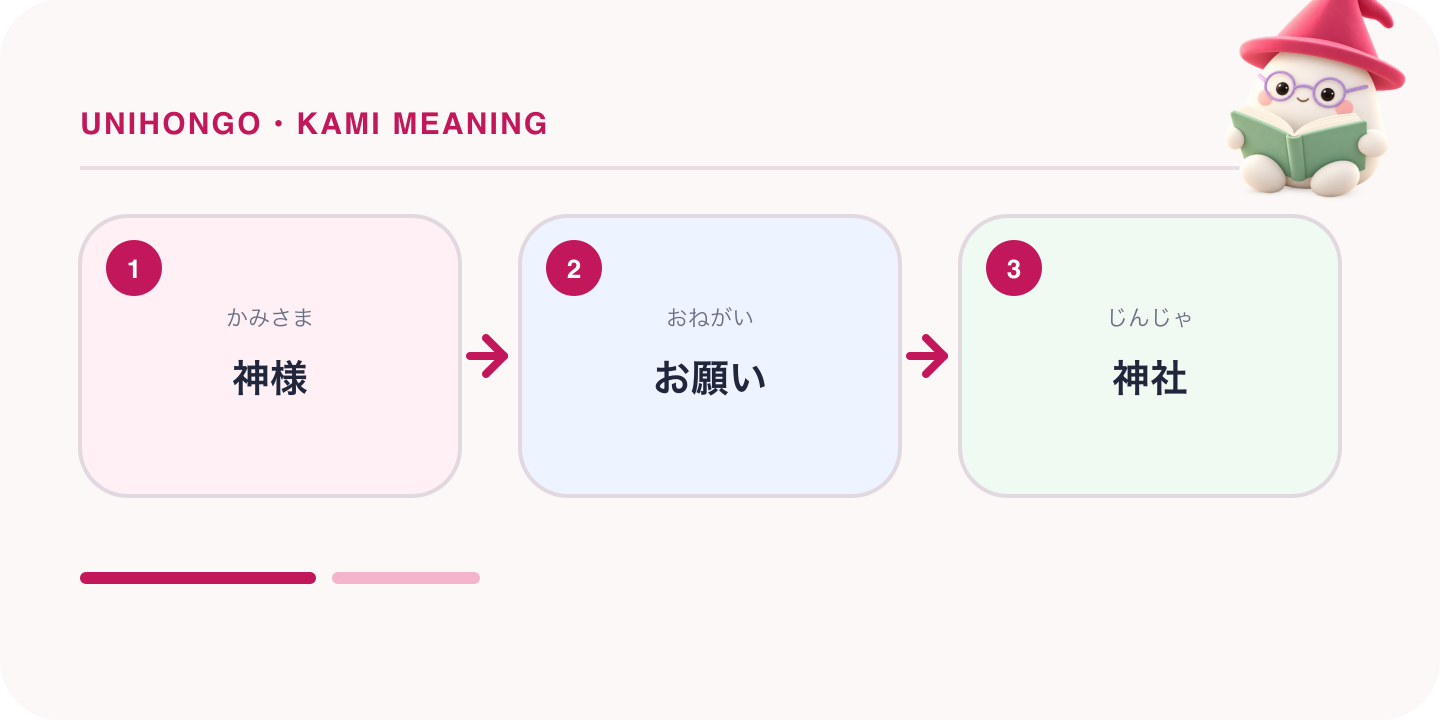
In everyday speech people usually say kamisama, adding the respectful sama. Kamisama is used for Shinto kami, for the Christian God and for gods in general, and it appears in simple prayers such as kamisama, onegai, please, God. Homes may have a kamidana, a small household shrine shelf, and a Shinto priest is a kannushi. In the word jinja, shrine, the same kanji is read jin.
| Japanese | Romaji | Meaning |
|---|---|---|
| 神様 | kamisama | God, a god (respectful) |
| 神様、お願い! | Kamisama, onegai! | Please, God! |
| 神社 | jinja | Shinto shrine |
| 神棚 | kamidana | Household shrine shelf |
| 神主 | kannushi | Shinto priest |
| 八百万の神 | yaoyorozu no kami | The countless kami of Shinto |
| 神道 | shintō | Shinto |
Kami as slang: amazing and god-tier
In modern casual Japanese, kami is used as praise for something extraordinarily good. Kami! on its own means that's amazing, and it forms compounds with a wide range of nouns. Kami-taiō is exceptionally good or generous service, often used about shop staff or celebrities who treat fans kindly. A kami-gē is a brilliant game, and a kami-kai is an outstanding episode of a series.
This slang is enthusiastic and informal. It is common among younger people and online, and you will see it in reviews and social media. Avoid it in formal settings, where subarashii, excellent, or taihen yokatta desu, it was very good, are appropriate.
| Japanese | Romaji | Meaning |
|---|---|---|
| 神! | Kami! | Amazing! Legendary! |
| 神対応 | kami-taiō | Amazingly good service or treatment |
| 神ゲー | kami-gē | A brilliant game |
| 神回 | kami-kai | An outstanding episode |
| あの店員さん、神対応だった。 | Ano ten'in-san, kami-taiō datta. | That shop assistant was amazing. |
紙: paper and its compounds
紙, kami, is paper. In compounds it often becomes -gami through the sound change called rendaku, which is why letter is tegami and folded paper is origami. The Sino-Japanese reading shi appears in words such as yōshi, a form or sheet for a particular use, and hyōshi, a book cover.
You will need paper words in daily life: kamibukuro, a paper bag, at a shop; kami-zara, paper plates, at a party; and kami no chizu, a paper map, when your phone runs out of battery. Washi is traditional Japanese paper, and kami-hikōki is a paper aeroplane.
| Japanese | Romaji | Meaning |
|---|---|---|
| 紙 | kami | Paper |
| 手紙 | tegami | Letter |
| 折り紙 | origami | Origami, folded paper |
| 紙袋 | kamibukuro | Paper bag |
| 和紙 | washi | Traditional Japanese paper |
| 用紙 | yōshi | Form, sheet |
| 紙袋に入れてもらえますか。 | Kamibukuro ni irete moraemasu ka. | Could you put it in a paper bag? |
| 紙に名前を書いてください。 | Kami ni namae o kaite kudasai. | Please write your name on the paper. |
髪: hair on the head
髪, kami, is the hair on your head. Kami no ke, literally hairs of the head, is the everyday way to talk about hair, and ke on its own means hair or fur more generally, including body hair and animal fur. At a hairdresser, kami is the key word: kami o kiru, to cut your hair, and kami o someru, to dye it. At a salon, dyeing is often called karā, from the English colour.
Useful compounds include maegami, fringe or bangs; kamigata, hairstyle; and shiraga, grey or white hair, where the kanji is read ga after shira. The Sino-Japanese reading hatsu appears in words such as sanpatsu, a haircut, and hatsuiku, hair growth, which you will see on salon menus and shampoo bottles.
| Japanese | Romaji | Meaning |
|---|---|---|
| 髪の毛 | kami no ke | Hair (on the head) |
| 前髪 | maegami | Fringe, bangs |
| 髪型 | kamigata | Hairstyle |
| 白髪 | shiraga | Grey or white hair |
| 髪を切りました。 | Kami o kirimashita. | I got my hair cut. |
| 前髪を少し短くしてください。 | Maegami o sukoshi mijikaku shite kudasai. | Please make my fringe a little shorter. |
| 髪を染める | kami o someru | To dye your hair |
上: upper, first and superior
上 is normally read ue, above, or jō, but in older and fixed words it is read kami, meaning upper, upstream, first or superior. Kamiza is the seat of honour, the most senior position in a room, opposite shimoza, the lower seat; knowing kamiza helps in business dinners and taxis, as the guide to seating order explains. Kawakami is upstream, and kamihanki is the first half of the business year.
Kamigata, written 上方, is an older name for the Kyoto and Osaka region, the area around the former imperial capital. You meet it in cultural terms such as kamigata rakugo, the Kansai style of comic storytelling. In the theatre, kamite is the right side of the stage as seen from the audience; be careful, because the same kanji 上手 read jōzu means skilful.
| Japanese | Romaji | Meaning |
|---|---|---|
| 上座 | kamiza | Seat of honour |
| 下座 | shimoza | Lower seat, nearest the door |
| 川上 | kawakami | Upstream |
| 上半期 | kamihanki | First half of the fiscal year |
| 上方 | kamigata | Kyoto and Osaka region (historical) |
| 上手 | kamite | Stage right (from the audience); also jōzu, skilful |
| どうぞ上座へ。 | Dōzo kamiza e. | Please take the seat of honour. |
It is tempting to assume 神 and 上 share an origin because gods are above us, and the idea is often repeated. Research on Old Japanese suggests the two words had different vowels at the time, so most scholars treat that link as doubtful.
Pitch accent and context: telling them apart
In standard Tokyo Japanese, 神, god, is said with a high pitch on ka that falls on mi. 紙, paper, and 髪, hair, start low on ka and rise on mi, then drop onto a following particle such as ga. So kami ga, a god, sounds high-low-low, while kami ga, paper or hair, sounds low-high-low. Pitch patterns vary by region, and Kansai speech in particular can differ, so treat this as a helpful guide rather than a rule you can always rely on.
Because paper and hair share the same pitch in standard Japanese, context does the rest, and in practice it almost always does. Verbs and nouns around the word make the meaning obvious: you write on kami, cut kami, and pray to kami. Compounds are even clearer, since tegami, maegami and kamisama each allow only one reading.
| Sentence | Which kami | Clue |
|---|---|---|
| 神社で神に祈る jinja de kami ni inoru | God | Shrine, praying |
| 紙に書く kami ni kaku | Paper | Writing on it |
| 髪を切る kami o kiru | Hair | Cutting at a salon |
| 上座に座る kamiza ni suwaru | Upper | A compound word |
| 紙が足りない kami ga tarinai | Paper | Running short of a supply |
| 髪が長い kami ga nagai | Hair | Describing length |
Be careful with okami. 女将 okami is the landlady of a traditional inn or restaurant, and 狼 ōkami, with a long o, is a wolf. Neither is a kami, and the long vowel in ōkami matters.