

Yatta as a cheer: what the word feels like
Yatta is the sound of success. Someone wins, passes, finds, finishes or gets lucky, and the word comes out with the arms going up. It is the closest Japanese has to yes, hooray or I did it, and it belongs to the moment the good thing becomes real. If you are still hoping, it is not yatta yet; if the thing happened an hour ago, it is a story rather than a cheer.
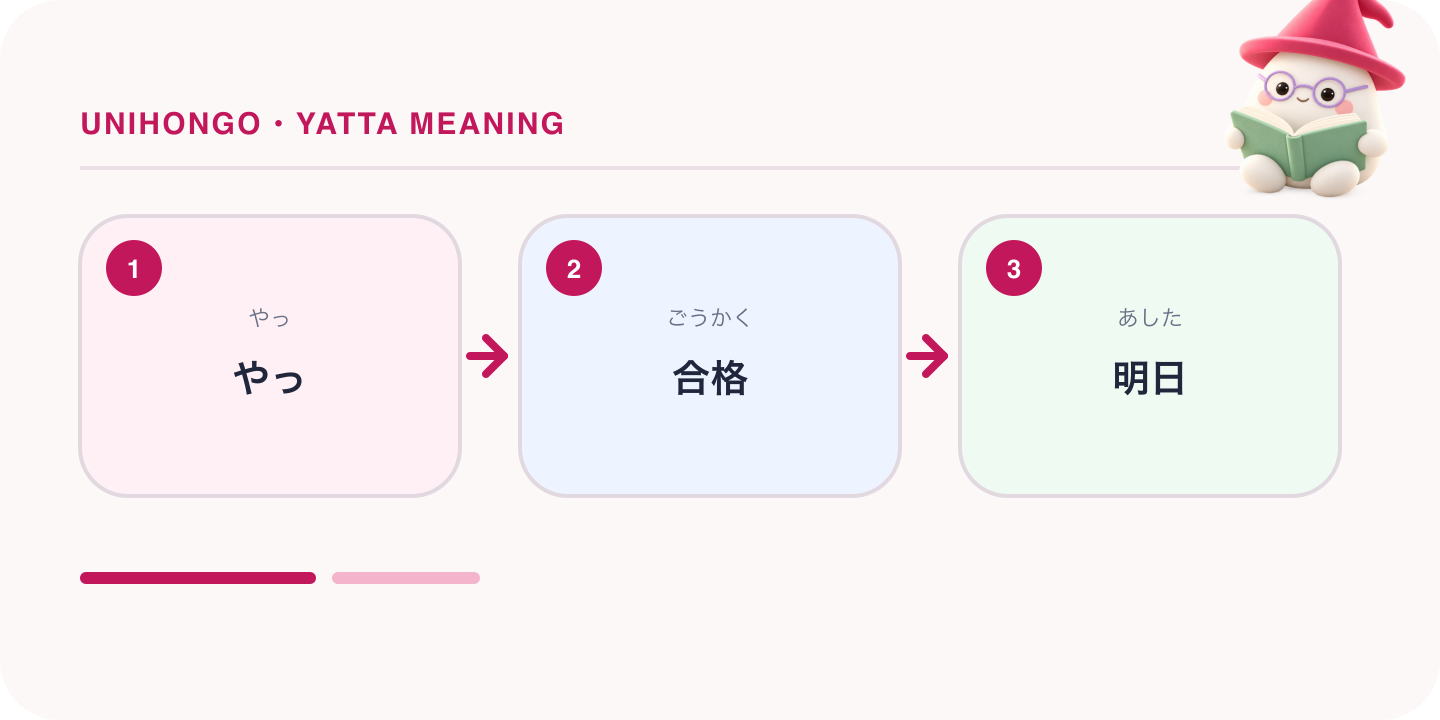
Because it is a burst of feeling, yatta usually stands alone or comes first, before any explanation: yatta, gōkaku shita, yes, I passed. It is often repeated, yatta yatta, and often stretched, yattā. On television you see it with a fist pump or a jump, and in a quiet office you might hear a whispered yatta from someone whose email finally sent.
The subject is usually the speaker or the speaker's group, but yatta also works when a team or a friend you were rooting for succeeds. If your favourite player scores, yatta is exactly right, because their success feels like yours.
| Japanese | Romaji | Meaning |
|---|---|---|
| やった!合格した! | Yatta! Gōkaku shita! | Yes! I passed! |
| やったー、明日休みだ。 | Yattā, ashita yasumi da. | Hooray, tomorrow's a day off. |
| やった、当たった! | Yatta, atatta! | I won! (a prize, a raffle) |
| やった、やっと終わった。 | Yatta, yatto owatta. | Yes, it's finally finished. |
| やったやった! | Yatta yatta! | We did it, we did it! |
| やった、雪だ。 | Yatta, yuki da. | Yay, snow! |
The grammar: the plain past of yaru
Yaru is a very common verb meaning to do, a casual cousin of suru. Its plain past is yatta, exactly like katta from kau or matta from matsu, so in ordinary sentences yatta simply means did: shukudai yatta, I did the homework; kinō nani yatta, what did you do yesterday. The cheer is the same word with the object left out and the emotion turned up. In effect, the speaker is saying did it, with the it being whatever they wanted.
This is also why yatta cannot really be made polite by conjugation. Yarimashita is a normal polite past, I did it, but said as a cheer it sounds odd, like announcing a task is complete. The feeling of the cheer lives in the plain form. When Japanese adults need a polite equivalent, they reach for a different word rather than a different ending, and the section on politeness below explains what they choose.
| Japanese | Romaji | Meaning |
|---|---|---|
| 宿題、もうやった? | Shukudai, mō yatta? | Did you do your homework yet? |
| 昨日、何やったの? | Kinō, nani yatta no? | What did you do yesterday? |
| ちゃんとやったよ。 | Chanto yatta yo. | I did it properly. |
| やることはやった。 | Yaru koto wa yatta. | I did what I could. |
| やった、やった、全部やった。 | Yatta, yatta, zenbu yatta. | Done, done, all done. |
Yatta ne: sharing the joy with someone else
Add ne and the cheer turns towards the other person. Yatta ne means you did it, well done, or we did it, didn't we, and it is the warm, natural reply when a friend or a child tells you their good news. It is softer than a bare yatta and less formal than omedetō, congratulations, so it is the everyday choice between people who are close.
Yatta ja nai, with a rising tone, is a slightly teasing version, see, you did it, and is common between friends and within families. Yatta jan is the same thing in a younger, more casual register. Parents say yatta ne to children constantly, and it also appears at the end of a shared effort, a group project finished or a hike completed, where the joy belongs to everyone.
Note the difference from yokatta ne, which means I'm glad. Yatta ne is about achievement and celebration; yokatta ne is about relief and gladness. A friend passing an exam gets yatta ne; a friend recovering from an illness gets yokatta ne.
| Japanese | Romaji | Meaning |
|---|---|---|
| 受かったの?やったね! | Ukatta no? Yatta ne! | You got in? Well done! |
| やったじゃない! | Yatta ja nai! | See, you did it! |
| やったじゃん、おめでとう。 | Yatta jan, omedetō. | You did it, congrats. |
| みんな、やったね。 | Minna, yatta ne. | We did it, everyone. |
| やったね、初めての一人旅。 | Yatta ne, hajimete no hitoritabi. | Well done, your first solo trip. |
Yatta, dekita, yoshi and other cheers compared
Japanese has several short words for a happy moment, and they are not interchangeable. Yatta celebrates that the thing happened. Dekita, the past of dekiru, says I was able to or it is done, and focuses on ability or completion; a child who finally ties their shoes shouts dekita. Yoshi is a word of resolve or approval, all right, good, here we go, used before starting or when something is going as planned; it has its own guide on this blog. Yokatta is relief, thank goodness. Sugoi is admiration, amazing.
The table below lines them up with the situation each one fits best.
| Word | Reading | Feeling and typical moment |
|---|---|---|
| やった | yatta | I did it, hooray; a hoped-for success becomes real |
| やったー | yattā | the same, stretched for extra joy |
| やったね | yatta ne | you did it, well done; sharing someone's success |
| できた | dekita | I managed it, it's done; ability or completion |
| よし | yoshi | all right, good; resolve before or approval during |
| よかった | yokatta | thank goodness, I'm glad; relief |
| すごい | sugoi | amazing; admiring someone or something |
| ばんざい | banzai | hurrah; a group cheer with arms raised |
| いえーい | iēi | yay; a playful, youthful cheer |
| ラッキー | rakkī | lucky; a small stroke of good fortune |
| おめでとう | omedetō | congratulations; formal enough for anyone |
In practice these stack: yoshi, dekita, yatta could all come out in a row as someone finishes a hard task, resolve, then completion, then celebration. Listen for the order in real speech and you will start to feel the differences.
Who says yatta, and when adults use it
Yatta is one of the first words Japanese children learn to shout, and it never quite loses that playful colour. Schoolchildren say it at sports days, in games and when a test is cancelled. Teenagers use it constantly, often as yattā or yatta ze. Adults do use it, but they choose their audience: with family, friends, teammates and close colleagues it is normal and warm; with clients, customers, teachers and senior managers it would feel out of place.
In an office, you might hear a muttered yatta at someone's desk when a stubborn bug finally goes away, or a full yatta from a team when a proposal is accepted, as long as no client is in the room. In sport, at concerts, in game shows and when a lottery number matches, adults shout it without embarrassment. The rule of thumb is simple: yatta is for people you would celebrate with, not people you need to impress.
Gendered variants exist. Yatta ze is masculine and rough, yatta wa slightly feminine and old-fashioned, and plain yatta is neutral and safe for everyone.
| Japanese | Romaji | Meaning |
|---|---|---|
| やったぜ! | Yatta ze! | Yes! (masculine, rough) |
| やったー、ボーナス出た。 | Yattā, bōnasu deta. | Yes, the bonus came through. |
| よし、やった、通った! | Yoshi, yatta, tōtta! | Right, yes, it went through! |
| 子どもみたいに「やった」って言っちゃった。 | Kodomo mitai ni yatta tte itchatta. | I said yatta like a child. |
| やった、電車間に合った。 | Yatta, densha maniatta. | Yes, I made the train. |
Yatta in texts and chats
Yatta is at home in messaging, where it appears in several spellings that signal how excited the writer is. Each version below is common on LINE, in group chats and on social media, and the choice is mostly about tone.
- やった: plain, cheerful, works for anyone you text casually
- やったー or やったぁ: stretched for more excitement, very common
- やったね: you did it, the reply to a friend's good news
- ヤッタ or ヤッター: katakana for a louder, more playful look
- やった!! with several exclamation marks: big celebration
- やったぜ: masculine, cocky, mostly among young men
- やった、やっと: yes, finally, when something took a long time
- Sticker or emoji plus やった: a raised-arms figure or party popper is typical
In a work chat with friendly colleagues, やった! is fine when a shared goal is reached. For a client or a senior manager, switch to yokatta desu, I'm glad, or ureshii desu, I'm happy, which carry the same warmth without the childlike edge.
Why yatta is rarely polite form
Learners often ask for the polite version of yatta and are surprised that there is not really one. Yarimashita exists, but it is a plain report that a task was done, not a cheer. The joy of yatta comes from its rawness: it is the sound of the moment, not a sentence addressed to a listener. Politeness in Japanese is about addressing the listener carefully, so the two ideas pull in opposite directions.
What adults do instead is describe the feeling politely. Yokatta desu, I'm glad; ureshii desu, I'm happy; hotto shimashita, I'm relieved; and, when the success involves someone else's help, arigatō gozaimasu, thank you. In a formal report or email, the whole cheer disappears and becomes buji ni kanryō shimashita, it was completed without problems. That is not a colder culture; it is the same joy expressed as gratitude and relief rather than a shout.
| Japanese | Romaji | Meaning |
|---|---|---|
| 採用が決まりました。嬉しいです。 | Saiyō ga kimarimashita. Ureshii desu. | I got the job. I'm so happy. |
| 無事に通ってよかったです。 | Buji ni tōtte yokatta desu. | I'm glad it went through without any problems. |
| ほっとしました。 | Hotto shimashita. | I'm relieved. |
| おかげさまで合格しました。 | Okagesama de gōkaku shimashita. | Thanks to you, I passed. |
| やりました! | Yarimashita! | I did it! (polite, but rare as a cheer) |
Common mistakes with yatta
The first mistake is saying yatta to someone whose success is theirs alone and whom you barely know. A colleague from another department tells you their proposal passed, and a bare yatta sounds as if you are claiming the win. Yatta ne, or better yokatta desu ne, keeps the focus on them.
The second is using yatta for relief instead of achievement. If a lost wallet turns up, the natural word is yokatta, thank goodness, not yatta. Yatta can slip in if you had been searching hard, because finding it feels like a win, but relief on its own is yokatta.
The third is timing. Yatta belongs to the instant of success. Telling a story an hour later, say ureshikatta, I was happy, or yatta to omotta, I thought yes. And do not hunt for a polite conjugation; choose a different word rather than yarimashita.
| Japanese | Romaji | Meaning |
|---|---|---|
| それはよかったですね。 | Sore wa yokatta desu ne. | I'm glad to hear that. (someone else's success, politely) |
| 財布あった。よかった。 | Saifu atta. Yokatta. | The wallet was there. Thank goodness. (relief, not yatta) |
| その時は「やった」と思いました。 | Sono toki wa yatta to omoimashita. | At that moment I thought, yes! (telling the story later) |
| 嬉しかったです。 | Ureshikatta desu. | I was happy. (polite, past) |