

The kanji: change plus good
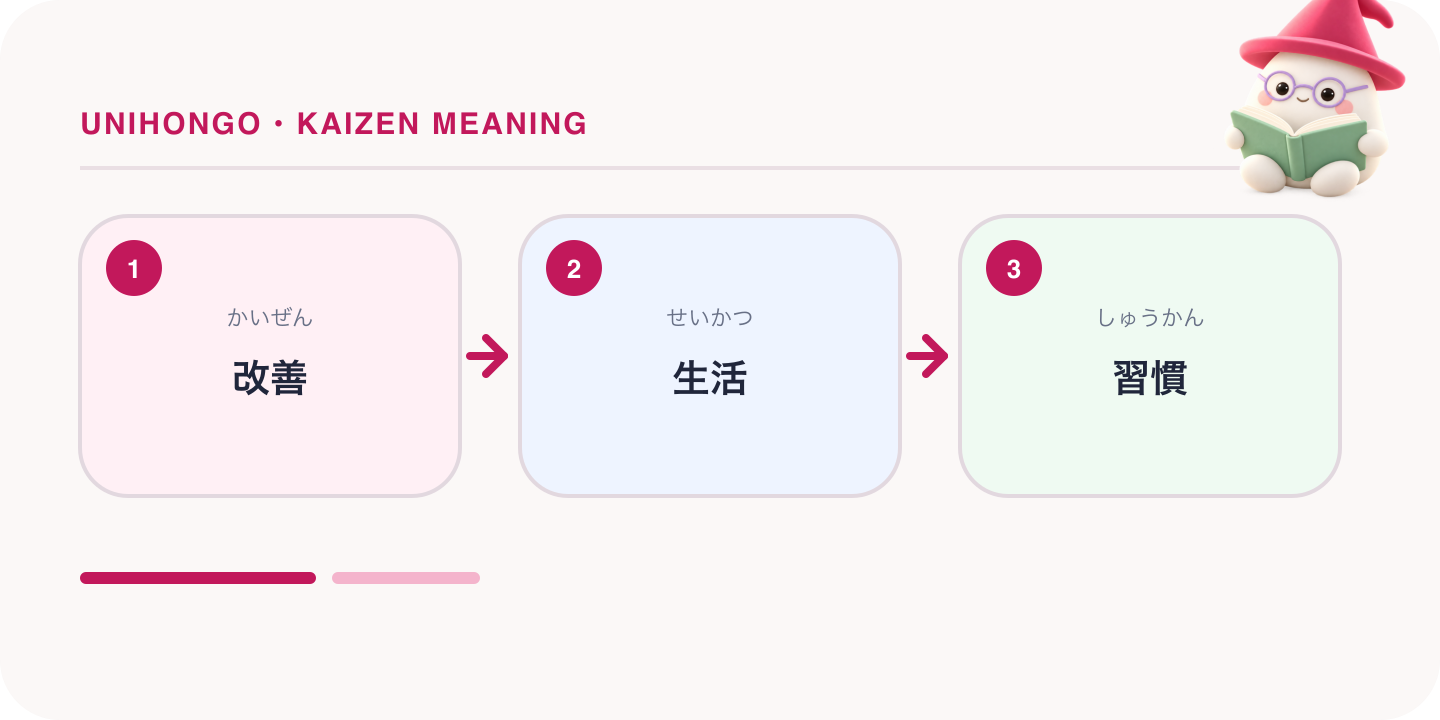
Kaizen is written 改善. The first kanji, kai, means to change, reform or revise, and appears in words like kaisatsu, the ticket gate where tickets are checked, and kaisei, a revision of a law. The second, zen, means good or goodness, as in zen'aku, good and evil.
So the word literally means changing something towards good. That tells you the key nuance: kaizen implies there was a problem or shortcoming first. You do not kaizen something that is already fine; you kaizen something that needs it.
| Kanji | Reading | Meaning | Other words |
|---|---|---|---|
| 改 | kai / arata(meru) | Change, reform, revise | 改革 kaikaku, 改正 kaisei, 改める aratameru |
| 善 | zen / yo(i) | Good, virtue | 善悪 zen'aku, 最善 saizen, 親善 shinzen |
| 改善 | kaizen | Improvement | 改善点 kaizenten, 改善策 kaizensaku |
How kaizen is used in everyday Japanese
In daily life kaizen is a slightly formal but very common word. It turns up in health advice, news about working conditions, company announcements, school reports and customer service apologies. It pairs naturally with problems: habits, conditions, situations and relationships.
The verb form is kaizen suru, to improve, and the intransitive kaizen sareru or kaizen shita describes something that got better. The phrase kaizen no yochi ga aru, there is room for improvement, is one of the most useful polite ways to say something is not good enough yet.
| Japanese | Romaji | Meaning |
|---|---|---|
| 生活習慣を改善したいです。 | Seikatsu shūkan o kaizen shitai desu. | I want to improve my lifestyle habits. |
| 睡眠の質が改善しました。 | Suimin no shitsu ga kaizen shimashita. | The quality of my sleep has improved. |
| 職場の環境を改善する必要がある。 | Shokuba no kankyō o kaizen suru hitsuyō ga aru. | The workplace environment needs improving. |
| まだ改善の余地があります。 | Mada kaizen no yochi ga arimasu. | There is still room for improvement. |
| ご指摘いただいた点は改善いたします。 | Go-shiteki itadaita ten wa kaizen itashimasu. | We will improve the points you raised. |
| 二人の関係は少しずつ改善している。 | Futari no kankei wa sukoshi zutsu kaizen shite iru. | Their relationship is gradually improving. |
Common kaizen collocations
Learning kaizen in fixed combinations is the quickest way to use it naturally. Many of these appear in news headlines, workplace documents and medical advice, so recognising them also helps your reading.
| Japanese | Reading | Meaning |
|---|---|---|
| 改善点 | kaizenten | Points to improve |
| 改善策 | kaizensaku | Measures for improvement, a fix |
| 改善案 | kaizen'an | A proposal for improvement |
| 待遇改善 | taigū kaizen | Better pay and working conditions |
| 体質改善 | taishitsu kaizen | Improving one's constitution or health; also fixing an organisation's culture |
| 業務改善 | gyōmu kaizen | Improving work processes |
| 症状の改善 | shōjō no kaizen | Improvement in symptoms |
| 改善提案 | kaizen teian | An improvement suggestion, often from staff |
How kaizen became a business philosophy abroad
After the Second World War, Japanese manufacturers, and Toyota in particular, developed ways of working in which people on the factory floor were expected to spot problems and suggest small fixes as part of their daily job. Quality circles, suggestion systems and tidy-workplace routines were all part of this culture. When foreign companies and writers studied Japanese manufacturing, they adopted the word kaizen as the name for the whole approach, and a 1980s book by the consultant Masaaki Imai helped spread it widely in English.
In that sense, kaizen came to mean continuous, incremental improvement involving everyone, as opposed to occasional big innovations. It now appears in lean manufacturing, software teams, healthcare and personal productivity books, sometimes as the idea of improving by one small step every day.
Inside Japanese companies, the same practices are real and widespread, especially in manufacturing. People talk about kaizen katsudō, improvement activities, and some firms write the word in katakana, カイゼン, to mark the specific production-system sense. But an average office worker in Japan would not think of kaizen as a foreign-style philosophy. It is simply the word for making things better.
- Kaizen katsudō: organised improvement activities at a workplace.
- QC sākuru: quality control circles, small groups that study and fix problems.
- 5S: seiri, seiton, seisō, seiketsu, shitsuke, a routine for sorting, ordering, cleaning, standardising and sustaining.
- PDCA: the plan, do, check, act cycle, widely used in Japanese workplaces.
- Genba: the actual place where work happens, where improvement is supposed to start.
Everyday Japanese vs the management meaning
The two meanings overlap, but the emphasis is different. If you use kaizen in Japanese the way productivity books use it in English, listeners will understand you, but it may sound like business jargon.
| Everyday Japanese kaizen | Kaizen as a method abroad |
|---|---|
| Improvement of any unsatisfactory situation | A philosophy of continuous small improvement |
| Used for health, conditions, relationships, service | Used mostly for organisations and personal productivity |
| Implies there was a problem to fix | Implies ongoing improvement even when things are fine |
| A normal, slightly formal word | A branded concept with its own books and training |
| Can be sudden or gradual | Specifically small, incremental steps |
Kaizen vs kairyō, kaikaku, kōjō and jōtatsu
English uses improve for almost everything. Japanese splits it into several words, and choosing the right one is a sign of real fluency. Kaizen fixes a situation or condition. Kairyō improves a product, a design or a breed. Kaikaku is structural reform. Kōjō is a rise in level, such as quality or ability. Jōtatsu is getting better at a skill.
| Japanese | Romaji | Meaning |
|---|---|---|
| 製品を改良する | seihin o kairyō suru | To improve a product |
| 政治改革 | seiji kaikaku | Political reform |
| 働き方改革 | hatarakikata kaikaku | Work-style reform |
| 品質の向上 | hinshitsu no kōjō | A rise in quality |
| 日本語が上達しました。 | Nihongo ga jōtatsu shimashita. | My Japanese has improved. |
| やり方を見直しましょう。 | Yarikata o minaoshimashō. | Let's review how we do it. |
A useful rule of thumb: if a person gets better at something, use jōtatsu or jōzu ni naru. If a thing is redesigned, use kairyō. If a bad situation gets better, use kaizen.
Using kaizen in conversation
At work, kaizen lets you raise problems without sounding like you are complaining. Framing a criticism as a kaizen proposal focuses on the fix instead of on who made the mistake, which fits Japanese workplace communication well.
In personal conversation, it is natural for habits and health: diet, sleep, posture, spending. Friends might tease you if you describe your love life as needing kaizen, but that playful use is also real.
| Japanese | Romaji | Meaning |
|---|---|---|
| 一つ改善案があるのですが。 | Hitotsu kaizen'an ga aru no desu ga. | I have one suggestion for improvement. |
| ここを改善すれば、もっと早くなると思います。 | Koko o kaizen sureba, motto hayaku naru to omoimasu. | If we improve this part, I think it will be faster. |
| 改善点があれば教えてください。 | Kaizenten ga areba oshiete kudasai. | Please tell me if there's anything I could improve. |
| 食生活を少しずつ改善しています。 | Shokuseikatsu o sukoshi zutsu kaizen shite imasu. | I'm gradually improving my diet. |
| 状況はあまり改善していません。 | Jōkyō wa amari kaizen shite imasen. | The situation hasn't improved much. |