
Shindoi, darui and kitsui at a glance
These four lines show the core of each word. Shindoi is the overall 'this is wearing me out'. Darui is the heavy body. Kitsui is the demanding slope and, in its oldest sense, the shoes that pinch. Keep these pictures in mind and most examples will fall into place.
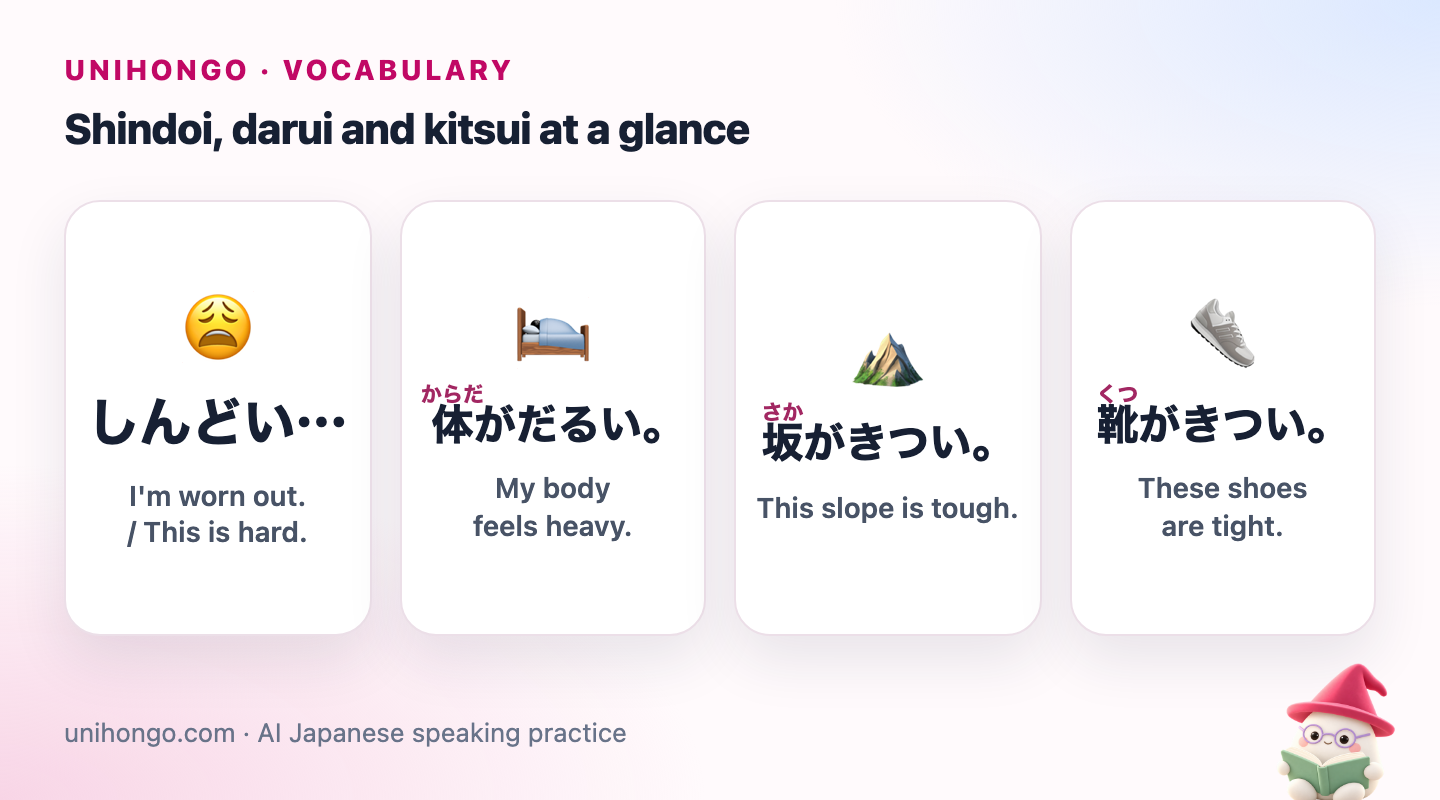
| Japanese | Romaji | Meaning |
|---|---|---|
| しんどい… | Shindoi... | I'm worn out. / This is hard. |
| 体がだるい。 | Karada ga darui. | My body feels heavy. |
| 坂がきつい。 | Saka ga kitsui. | This slope is tough. |
| 靴がきつい。 | Kutsu ga kitsui. | These shoes are tight. |
Shindoi: when something wears you out
Shindoi covers both physical and mental strain, and it often mixes the two. A long commute in a crowded train is shindoi. Caring for a sick family member while working is shindoi. A week of overtime, a hard relationship, a hot summer with no air conditioning: all shindoi. The word says less about one symptom and more about how heavy the whole thing feels.
It is generally said to have come from western Japan, especially Kansai, where it is still everywhere, and it is now used across the country in casual speech. It is usually written in hiragana. Its origin is not certain, so do not worry about a kanji for it.
Because it is honest and a little raw, shindoi works best with people you are close to, or with coworkers at your own level. With a manager, chotto shindoi desu softens it, and a more neutral sentence is often better still.
| Japanese | Romaji | Meaning |
|---|---|---|
| 今週、ほんまにしんどいわ。 | Konshū, honma ni shindoi wa. | This week is really wearing me out. (Kansai) |
| 満員電車は毎日しんどい。 | Man'in densha wa mainichi shindoi. | Packed trains every day are exhausting. |
| 最近、気持ち的にしんどい。 | Saikin, kimochiteki ni shindoi. | Lately it's hard emotionally. |
| 階段で五階まではしんどいね。 | Kaidan de gokai made wa shindoi ne. | Five floors by the stairs is a lot. |
| ちょっとしんどいです。 | Chotto shindoi desu. | I'm a bit worn out. (softer, polite) |
Honma ni is the Kansai way to say hontō ni, really. You will often hear shindoi with Kansai grammar like this, which shows where it feels most at home.
Darui: heavy, sluggish and 'what a drag'
Darui describes a body that feels heavy, slow and reluctant to move. It is the feeling you get with a fever, a hangover, after sleeping badly or on a humid afternoon. At a clinic, karada ga darui is a standard way to describe a symptom, and doctors understand it immediately.
In casual speech, especially among younger people, darui has a second life: it means a task is tedious or a drag, as in shukudai darui, homework is such a drag. In this sense it sounds lazy and a little sulky, so keep it for friends. Saying shigoto darui at the office would sound like you cannot be bothered to work.
| Japanese | Romaji | Meaning |
|---|---|---|
| 熱があって、体がだるいです。 | Netsu ga atte, karada ga darui desu. | I have a fever and feel heavy. (to a doctor) |
| 寝不足で朝からだるい。 | Nebusoku de asa kara darui. | I slept badly, so I've felt sluggish all day. |
| 宿題、だるいなあ。 | Shukudai, darui nā. | Homework is such a drag. (slang) |
| 月曜日はだるい。 | Getsuyōbi wa darui. | Mondays are a drag. |
Kitsui: tight, demanding, strict and strong
Kitsui starts from a physical picture: something squeezes you. Shoes, a waistband, a lid that will not open. From there it stretches to anything that pushes hard on you: a steep slope, a heavy schedule, a strict teacher, harsh words, a strong smell or a strong drink.
When kitsui is about a task, it is close to shindoi but more specific: the task itself is demanding. Kono shigoto wa kitsui means the work is physically or mentally hard. When kitsui is about a person, kitsui hito or kitsui iikata, it means sharp or harsh, and it is a criticism, so be careful who hears it.
| Japanese | Romaji | Meaning |
|---|---|---|
| このズボン、ちょっときつい。 | Kono zubon, chotto kitsui. | These trousers are a bit tight. |
| 今月はスケジュールがきついです。 | Kongetsu wa sukejūru ga kitsui desu. | My schedule is tight this month. (polite) |
| この仕事は体力的にきつい。 | Kono shigoto wa tairyokuteki ni kitsui. | This job is physically demanding. |
| 言い方がきついよ。 | Iikata ga kitsui yo. | That's a harsh way to put it. |
| このお酒、きついね。 | Kono osake, kitsui ne. | This drink is strong. |
Side by side: which word fits?
Many situations allow more than one word, but each adds its own colour. The table helps you pick the one that says what you actually feel.
| Situation | Natural word | Why |
|---|---|---|
| After a long, stressful week | shindoi | Overall strain, body and mind |
| Fever, heavy limbs | darui | A heavy, sluggish body |
| Climbing a steep hill | kitsui (or shindoi) | The task itself is demanding |
| Shoes that pinch | kitsui | Literally tight |
| A boring chore you avoid | darui (slang) | Feels like a drag |
| A sharp remark | kitsui | Harsh, hurts the listener |
| A painful family situation | shindoi (or tsurai) | Emotional strain |
Tsukareta, I'm tired, is the neutral word underneath all of these. If you are not sure, tsukareta is never wrong; shindoi, darui and kitsui simply tell the listener more about what kind of tired you mean.
Answering when someone says shindoi
When a friend or coworker sighs shindoi, they usually want sympathy, not a solution. The kindest replies acknowledge the feeling and give permission to rest. Muri shinaide ne, don't push yourself, is the classic line, and a warm drink or an offer of help says the rest.

| Japanese | Romaji | Meaning |
|---|---|---|
| 大丈夫?無理しないでね。 | Daijōbu? Muri shinaide ne. | Are you okay? Don't push yourself. |
| お疲れさま。少し休んだら? | Otsukaresama. Sukoshi yasundara? | Good work. Why not rest a bit? |
| 何か手伝おうか。 | Nanika tetsudaō ka. | Shall I help with something? |
| しんどいね。よく頑張ってるよ。 | Shindoi ne. Yoku ganbatteru yo. | That's hard. You're doing really well. |
| 今週しんどい… | Konshū shindoi... | Coworker: This week is killing me... |
| わかる。今日は早く帰ろう。 | Wakaru. Kyō wa hayaku kaerō. | You: I know. Let's go home early today. |
Mini dialogue: describing darui at a clinic
A clinic visit is where darui stops being slang and becomes a precise, useful word. Doctors in Japan often ask how long a symptom has lasted and whether you have a fever, so short, clear answers help. Here a patient explains how she feels; notice that she uses polite desu forms and the explanatory n desu, which sounds natural when you describe your own condition.
| Japanese | Romaji | Meaning |
|---|---|---|
| 今日はどうされましたか。 | Kyō wa dō saremashita ka. | Doctor: What brings you in today? |
| 昨日から体がだるいんです。 | Kinō kara karada ga darui n desu. | Patient: I've felt heavy and sluggish since yesterday. |
| 熱はありますか。 | Netsu wa arimasu ka. | Doctor: Do you have a fever? |
| 三十七度八分です。 | Sanjūnana do hachibu desu. | Patient: It's 37.8 degrees. |
| 食欲はどうですか。 | Shokuyoku wa dō desu ka. | Doctor: How is your appetite? |
| あまりないです。歩くのもしんどくて。 | Amari nai desu. Aruku no mo shindokute. | Patient: Not much. Even walking is hard. |
Temperatures in Japan are given in Celsius, and the decimal is often read with bu: sanjūnana do hachibu, or more simply sanjūnana ten hachi do. Both are understood.
Politeness, and common learner mistakes
At work, complaining directly can sound unprofessional, so people often describe the situation rather than their feelings. Instead of shindoi, a coworker might say that the workload is a little heavy, or ask whether a deadline could move. At a clinic, on the other hand, being direct is exactly right: the doctor needs to know how your body feels.
| Japanese | Romaji | Meaning |
|---|---|---|
| 今週は少し負担が大きいです。 | Konshū wa sukoshi futan ga ōkii desu. | The workload is a little heavy this week. |
| 締め切りを少し延ばせますか。 | Shimekiri o sukoshi nobasemasu ka. | Could the deadline move a little? |
| 朝から体がだるいんです。 | Asa kara karada ga darui n desu. | I've felt heavy since this morning. (to a doctor) |
| 息が苦しくて、坂がきついです。 | Iki ga kurushikute, saka ga kitsui desu. | I get breathless, so slopes are hard. (to a doctor) |
- Using darui at work about your job. Shigoto darui sounds like you are lazy, not tired. Use tsukareta or describe the workload.
- Calling a person kitsui casually. Kitsui hito means someone harsh or difficult, and it can get back to them.
- Using shindoi with a client. It is honest and casual; in formal situations, describe the problem or say taichō ga sukoshi warui, I'm not feeling well.
- Thinking kitsui only means difficult. For clothes, it simply means tight: kitsui desu ka? is a normal question in a shop.
- Answering shindoi with advice straight away. Acknowledge the feeling first, then offer help.
Feel the difference with AI Sensei and Mocchi
Start in Mocchi with: 'Give me six situations and ask whether shindoi, darui or kitsui fits best.' Mocchi explains each answer in plain English and keeps track of the pair you mix up most, so your next /review starts there.
Then say it for real. Ask AI Sensei, perhaps Sakura-sensei, to play a coworker at the end of a long week. Tell her how you feel with the right word, and practise the kind replies when she says shindoi back. The session report lists your corrections and the vocabulary you used.