

Cutting and cooking tools
Start with the tools you hold. The kitchen knife is hōchō, and the word covers every knife on the board, from the all-purpose santoku to the long yanagiba used for sashimi. The chopping board is manaita, historically a fish board, and the peeler is a loanword, pīrā. The word for a pan depends on its shape: a nabe is any pot with sides, from a small saucepan to the big pot used for hot-pot dinners, while a furaipan is a frying pan. A wok is chūka-nabe, a Chinese pot, and a kettle is yakan.
The small tools mix native and borrowed names. A ladle is otama, a turner is furaigaeshi, and cooking chopsticks, longer than eating chopsticks, are saibashi. A mixing bowl is a bōru, while a colander is zaru, the same word as the bamboo tray that cold soba is served on.
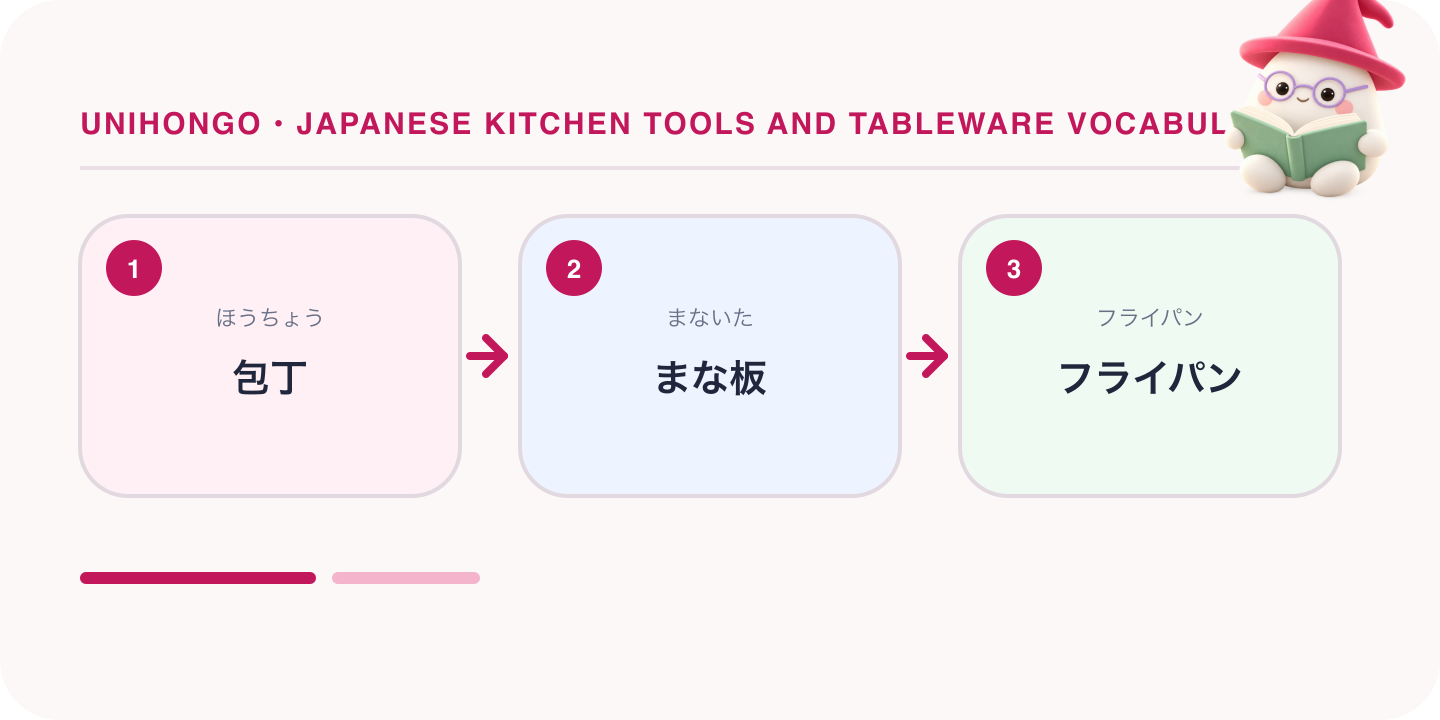
| Word | Reading | Meaning |
|---|---|---|
| 包丁 | hōchō | Kitchen knife |
| まな板 | manaita | Chopping board |
| 鍋 | nabe | Pot, saucepan |
| フライパン | furaipan | Frying pan |
| やかん | yakan | Kettle |
| お玉 | otama | Ladle |
| フライ返し | furaigaeshi | Spatula, turner |
| 菜箸 | saibashi | Cooking chopsticks |
| ボウル | bōru | Mixing bowl |
| ざる | zaru | Colander, strainer |
| ピーラー | pīrā | Peeler |
| 計量カップ | keiryō kappu | Measuring cup |
The word naifu exists too, but it means the knife you eat with. If a recipe or a flatmate says hōchō, they mean the kitchen knife; if a restaurant asks whether you want a naifu to fōku, they mean a knife and fork.
Appliances and the kitchen layout
Three appliances define a Japanese kitchen. The rice cooker is suihanki, often the most used machine in the house. The hob is konro, usually with a small grill drawer for fish, the gurīru. The microwave is denshi renji, often shortened to renji, and a toaster oven is ōbun tōsutā. A full oven is ōbun, and many Japanese kitchens do not have one, which is why so much home cooking happens on the hob.
The rest of the room is easy to name. The sink is nagashi, the extractor fan is kankisen, and the fridge is reizōko, with the freezer called reitōko. Cupboards are todana, and the cupboard for tableware is shokkidana. The kitchen itself is daidokoro in homely speech and kitchin in estate agent listings.
| Japanese | Romaji | Meaning |
|---|---|---|
| 炊飯器でご飯を炊きます。 | Suihanki de gohan o takimasu. | I cook rice in the rice cooker. |
| 電子レンジで温めてもいいですか。 | Denshi renji de atatamete mo ii desu ka. | May I heat it in the microwave? |
| このキッチンにはオーブンがありません。 | Kono kitchin ni wa ōbun ga arimasen. | This kitchen has no oven. |
| コンロは二口です。 | Konro wa futakuchi desu. | The hob has two burners. |
| 冷蔵庫の右側は私のスペースです。 | Reizōko no migigawa wa watashi no supēsu desu. | The right side of the fridge is my space. |
| 換気扇をつけてください。 | Kankisen o tsukete kudasai. | Please turn on the extractor fan. |
Chopsticks, rests and cutlery
Chopsticks are hashi, usually said with the polite o as ohashi. The small rest you put the tips on is hashioki, and disposable wooden chopsticks are waribashi, splitting chopsticks, because you snap them apart. In a family home each person has their own pair, and children learn early not to leave chopsticks standing in rice or pass food from chopsticks to chopsticks, both of which echo funeral customs.
Western cutlery uses loanwords: naifu, fōku and supūn. A soup spoon for Chinese food, the deep ceramic one, is renge, named after a lotus petal. Serving tools include the tongs, tongu, and the serving spoon, tori-wake supūn, used when a dish is shared and everyone takes a portion onto their own plate.
| Japanese | Romaji | Meaning |
|---|---|---|
| お箸をもう一膳もらえますか。 | Ohashi o mō ichizen moraemasu ka. | Could I have one more pair of chopsticks? |
| 箸置きはここに置いてください。 | Hashioki wa koko ni oite kudasai. | Please put the chopstick rests here. |
| 割り箸でいいですか。 | Waribashi de ii desu ka. | Are disposable chopsticks all right? |
| フォークとナイフはありますか。 | Fōku to naifu wa arimasu ka. | Do you have a knife and fork? |
| 取り分け用のスプーンを使ってください。 | Toriwake-yō no supūn o tsukatte kudasai. | Please use the serving spoon. |
| これは私の箸です。 | Kore wa watashi no hashi desu. | These are my chopsticks. |
Bowls, plates and cups
This is the group learners most often mix up, because English uses bowl for everything. In Japanese the rice bowl is chawan, the soup bowl is owan, and a larger deep bowl for noodles is donburi, which also names the dish itself. A flat plate of any size is sara, said as osara at the table. Small plates for soy sauce or pickles are kozara and large sharing plates are ōzara.
Cups follow the same pattern. A Japanese teacup with no handle is yunomi, a mug is magu kappu, and a drinking glass is koppu or gurasu. Koppu came from Dutch centuries ago and means an ordinary tumbler; gurasu is newer and sounds more refined, so a wine glass is a wain gurasu. A tray is obon.
| Word | Reading | Meaning |
|---|---|---|
| 茶碗 | chawan | Rice bowl |
| お椀 | owan | Soup bowl, often lacquered |
| 丼 | donburi | Large deep bowl |
| 皿 | sara | Plate |
| 小皿 | kozara | Small plate |
| 大皿 | ōzara | Large sharing plate |
| 湯のみ | yunomi | Japanese teacup |
| コップ | koppu | Glass, tumbler |
| グラス | gurasu | Glass, especially for wine |
| マグカップ | magu kappu | Mug |
| お盆 | obon | Tray |
Sara has one more use: it counts dishes in a meal. Mō hitosara, one more plate, is what you say when the sharing plate at an izakaya has run out and you want the same again.
Counters for kitchen things
Three counters do most of the work. Flat things such as plates and trays are counted with mai: ichimai, nimai, sanmai. Long thin things such as knives, spoons, forks and bottles take hon, with the usual sound changes: ippon, nihon, sanbon, yonhon, gohon, roppon. A pair of chopsticks is a zen: ichizen, nizen, sanzen. Bowls, cups and anything roundish that does not fit those shapes fall back on ko or the general counter hitotsu, futatsu, mittsu.
Sets are counted with setto or with kumi for a matched set: chawan o futakumi means two sets of rice bowls. Pots and pans take no special counter; nabe o hitotsu, one pot, is fine.
- Sara o sanmai kudasai: three plates, please
- Supūn o gohon: five spoons
- Ohashi o nizen: two pairs of chopsticks
- Chawan o yonko: four rice bowls
- Koppu o futatsu: two glasses
- Nabe o hitotsu: one pot
The counter goes after the object and its particle, before the verb: osara o nimai totte kudasai, please pass two plates. If you put the number first, sanmai no sara, it still works but sounds like a description rather than a request.
Asking where things are in a shared kitchen
Share houses, dormitories and homestays all have the same first week: you cannot find anything. The core question is X wa doko ni arimasu ka, and the answer names a place: todana no naka, inside the cupboard; hikidashi, the drawer; nagashi no shita, under the sink; ue no tana, the top shelf. Listen for ni, because it marks the location.
Borrowing and returning need their own phrases. Tsukatte mo ii desu ka asks permission to use something, and among flatmates the shorter tsukatte ii is common. When you finish, moto no tokoro ni modoshimashita, I put it back where it was, keeps the peace. Labelling your things is normal in shared kitchens, and asking dare no desu ka, whose is this, before using an unlabelled pan is the polite move.
| Japanese | Romaji | Meaning |
|---|---|---|
| フライパンはどこにありますか。 | Furaipan wa doko ni arimasu ka. | Where is the frying pan? |
| 流しの下の棚にあります。 | Nagashi no shita no tana ni arimasu. | It is on the shelf under the sink. |
| この包丁、使ってもいいですか。 | Kono hōchō, tsukatte mo ii desu ka. | May I use this knife? |
| 使い終わったら元の場所に戻してください。 | Tsukai-owattara moto no basho ni modoshite kudasai. | Please put it back where it was when you have finished. |
| この鍋は誰のですか。 | Kono nabe wa dare no desu ka. | Whose pot is this? |
| お皿はどこにしまえばいいですか。 | Osara wa doko ni shimaeba ii desu ka. | Where should I put the plates away? |
| 食器棚の二段目に入れてください。 | Shokkidana no nidanme ni irete kudasai. | Please put them on the second shelf of the cupboard. |
Buying tableware
A tableware shop is a shokki-ya, and the section in a department store or home centre is the shokki uriba. Staff will ask what you are looking for and how many, nan-mai or nan-ko depending on the object. Useful adjectives are ōkime, on the large side; chiisame, on the small side; karui, light; and jōbu, sturdy. For a matching set, ask for onaji mono, the same one.
Two practical questions matter for daily use. Denshi renji taiō means microwave safe, and shokusenki taiō means dishwasher safe; lacquered owan are usually neither, so ask.
| Japanese | Romaji | Meaning |
|---|---|---|
| 茶碗を四つ探しています。 | Chawan o yottsu sagashite imasu. | I am looking for four rice bowls. |
| 同じお皿はあと二枚ありますか。 | Onaji osara wa ato nimai arimasu ka. | Do you have two more of the same plate? |
| これは電子レンジに使えますか。 | Kore wa denshi renji ni tsukaemasu ka. | Can this go in the microwave? |
| 食洗機対応ですか。 | Shokusenki taiō desu ka. | Is it dishwasher safe? |
| もう少し軽いのはありますか。 | Mō sukoshi karui no wa arimasu ka. | Do you have a lighter one? |
| 箸置きも一緒にください。 | Hashioki mo issho ni kudasai. | I will take the chopstick rests too. |
Mistakes to avoid
The most common slip is asking for a naifu when you need a hōchō, which gets you a butter knife. The second is calling every bowl a chawan; ask for a chawan for your miso soup and a host will hand you a rice bowl. Say owan for soup and donburi for noodles.
Counters cause the rest of the trouble. Sara o sanko is understood but sounds odd, since plates are flat and take mai. Chopsticks are the reverse: hashi o nihon means two single sticks, not two pairs, so ask for nizen or, if the counter escapes you, futatsu. Finally, koppu and kappu look similar but differ: koppu is a glass, kappu is a cup with a handle.
| Japanese | Romaji | Meaning |
|---|---|---|
| ナイフじゃなくて、包丁を貸してください。 | Naifu ja nakute, hōchō o kashite kudasai. | Not a table knife, lend me the kitchen knife, please. |
| 味噌汁はお椀に入れます。 | Misoshiru wa owan ni iremasu. | Miso soup goes in the owan. |
| お箸は二膳、お皿は二枚お願いします。 | Ohashi wa nizen, osara wa nimai onegai shimasu. | Two pairs of chopsticks and two plates, please. |
| コップじゃなくてマグカップがほしいです。 | Koppu ja nakute magu kappu ga hoshii desu. | I want a mug, not a glass. |