
Handmade: the four words to start with
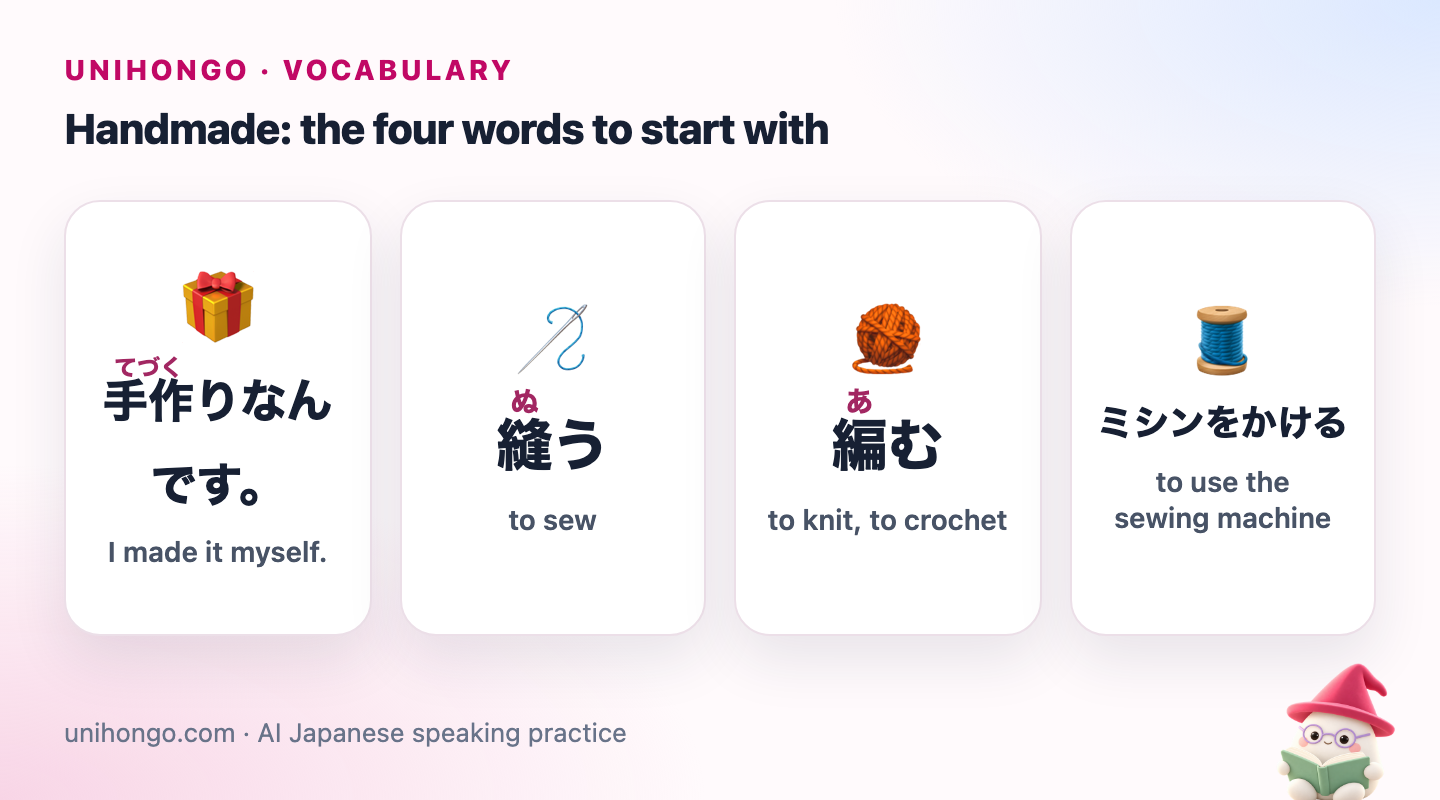
Whether you sew, knit or both, Japanese craft talk rests on a few words. Tezukuri (手作り), handmade, is what you say proudly when someone admires your bag or scarf. Nuu is to sew, by hand or machine. Amu is to knit or crochet. And mishin o kakeru, literally to put on the machine, is how people say they used the sewing machine.
Kakeru is a very flexible verb that means to run or put something on: airon o kakeru, to iron, uses it too. That is why mishin o kakeru sounds natural to Japanese ears.
| Japanese | Romaji | Meaning |
|---|---|---|
| 手作りなんです。 | Tezukuri nan desu. | I made it myself. |
| 縫う | nuu | to sew |
| 編む | amu | to knit, to crochet |
| ミシンをかける | mishin o kakeru | to use the sewing machine |
| このバッグ、自分で縫いました。 | Kono baggu, jibun de nuimashita. | I sewed this bag myself. |
Sewing tools and fabric
Sewing tools are mostly native words, many of them written with simple kanji you may already know. Hari is a needle, ito is thread, and machibari (まち針) are the pins with round heads used to hold fabric. Fabric in general is nuno (布); in a shop, fabric sold by length is usually called kiji (生地), the same word bakers use for dough. Katagami (型紙) is a sewing pattern, the paper template you trace and cut around.
| Japanese | Romaji | Meaning |
|---|---|---|
| 針 | hari | needle |
| 糸 | ito | thread |
| まち針 | machibari | dressmaker's pins |
| 裁ちばさみ | tachibasami | fabric scissors |
| 指ぬき | yubinuki | thimble |
| 生地 | kiji | fabric sold by length |
| 型紙 | katagami | sewing pattern |
| 針に糸を通す | hari ni ito o tōsu | to thread a needle |
| 布を裁つ | nuno o tatsu | to cut fabric |
Tatsu (裁つ) is the traditional verb for cutting fabric, and saidan (裁断) is the noun used in patterns and classes. Kiru, the everyday verb to cut, is fine in casual speech. Tachibasami are scissors kept only for fabric; many sewers have a household rule that nobody uses them on paper, because paper dulls the blades.
Stitches, the sewing machine and mending
Basic hand stitches have names that you meet in school home economics and in every beginner's book. Nami nui (並縫い) is a running stitch, the simplest one, and kaeshi nui (返し縫い) is a backstitch, stronger because each stitch goes back over the last. On a machine, kaeshi nui also means the reverse stitches at the start and end of a seam that stop it unravelling.
Mending is a big part of sewing at home. The most common jobs are sewing a button back on, botan tsuke, and taking up hems on trousers or skirts, susoage (裾上げ). Some clothes shops offer to do susoage for you when you buy trousers.
| Japanese | Romaji | Meaning |
|---|---|---|
| 並縫い | nami nui | running stitch |
| 返し縫い | kaeshi nui | backstitch |
| ボタンをつける | botan o tsukeru | to sew on a button |
| 裾上げをお願いできますか。 | Susoage o onegai dekimasu ka. | Could you take up the hem, please? |
| ミシンの下糸が絡まった。 | Mishin no shitaito ga karamatta. | The bobbin thread got tangled. |
| 縫い目がほつれてきた。 | Nuime ga hotsurete kita. | The seam is coming undone. |
| 刺繍 | shishū | embroidery |
Knitting and crochet
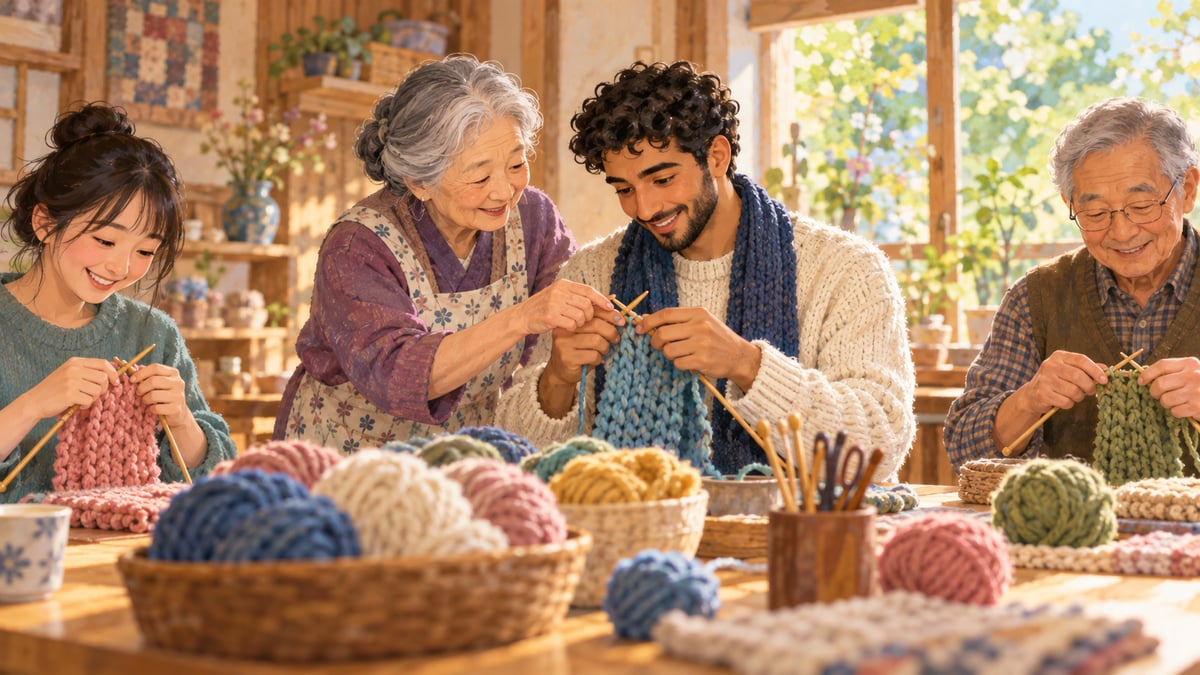
Japanese knitting patterns are famous for their charts, but the spoken vocabulary is just as useful. The first row of stitches, casting on, is tsukurime (作り目), the made stitches. A stitch is me (目), the same kanji as eye, and a row is dan (段). Knit and purl are omoteami (表編み, front knit) and uraami (裏編み, back knit). Binding off is fuseme (伏せ目), the stitches laid down.
| Japanese | Romaji | Meaning |
|---|---|---|
| 毛糸 | keito | yarn |
| 棒針 | bōbari | knitting needles |
| かぎ針 | kagibari | crochet hook |
| 作り目をする | tsukurime o suru | to cast on |
| 表編み | omoteami | knit stitch |
| 裏編み | uraami | purl stitch |
| 十段編んだ。 | Jūdan anda. | I knitted ten rows. |
| 目を落としちゃった。 | Me o otoshichatta. | I dropped a stitch. (casual) |
| ほどいてやり直す | hodoite yarinaosu | to unravel it and start again |
Popular projects follow the seasons. In autumn and winter, craft shops fill with yarn for mafurā (scarves), bōshi (hats) and tebukuro (gloves), and some people knit a scarf as a gift. In spring and summer, cotton and linen yarn come out for bags and lighter tops.
At the craft shop and in a class
In a Japanese craft shop, fabric is usually cut to order: you take the bolt to the cutting counter and say how much you want, in metres or in units of ten centimetres, depending on the shop. For thread and yarn, bring a sample of your fabric if you want an exact colour match. In a class, teachers often use polite instructions, and students are expected to ask when they are lost, so the questions below are worth learning by heart.
| Japanese | Romaji | Meaning |
|---|---|---|
| この生地を一メートルください。 | Kono kiji o ichi mētoru kudasai. | One metre of this fabric, please. |
| この色に合う糸はありますか。 | Kono iro ni au ito wa arimasu ka. | Do you have thread to match this colour? |
| 初心者でも編めますか。 | Shoshinsha demo amemasu ka. | Can a beginner knit this? |
| もう一度見せていただけますか。 | Mō ichido misete itadakemasu ka. | Could you show me once more? |
| ここからわからなくなりました。 | Koko kara wakaranaku narimashita. | I got lost from this point. |
| 上手にできていますよ。 | Jōzu ni dekite imasu yo. | Teacher: You're doing it well. |
Mini dialogue: someone admires your scarf
Handmade things invite compliments, and Japanese has a pattern for responding. Say thank you, add a small modest comment, and if they are interested, offer a detail about how you made it.
| Japanese | Romaji | Meaning |
|---|---|---|
| そのマフラー、すてきですね。 | Sono mafurā, suteki desu ne. | Coworker: That scarf is lovely. |
| ありがとうございます。実は手編みなんです。 | Arigatō gozaimasu. Jitsu wa teami nan desu. | You: Thank you. Actually, I knitted it myself. |
| えっ、自分で編んだんですか。 | E, jibun de anda n desu ka. | Coworker: What, you knitted it yourself? |
| はい、二週間かかりました。目がちょっと不揃いですけど。 | Hai, nishūkan kakarimashita. Me ga chotto fuzoroi desu kedo. | You: Yes, it took two weeks. The stitches are a bit uneven, though. |
| 全然わからないですよ。 | Zenzen wakaranai desu yo. | Coworker: You can't tell at all. |
| 今度、一緒に編み物しませんか。 | Kondo, issho ni amimono shimasen ka. | You: Would you like to knit together sometime? |
Teami (手編み), hand-knitted, is the knitting version of tezukuri. A handmade gift such as a teami no mafurā is often seen as especially thoughtful, though some people are shy about giving handmade things, so a small, practical item is a safe first gift.
Common learner mistakes
- Using amu for sewing or nuu for knitting. Nuu is with needle and thread; amu is with yarn, needles or a hook.
- Saying sōingu mashīn for a sewing machine. It may be understood, but the everyday word is mishin, and it only ever means a sewing machine.
- Asking for ūru for any yarn. Keito is yarn in general; ūru is wool specifically, and kotton is cotton.
- Using me only for eyes. In knitting, me is a stitch, so me o otosu is to drop a stitch, not to lose an eye.
- Calling all fabric nuno at the cutting counter. It is understood, but kiji is the usual word for fabric sold by length.
Stitch these words into memory
Start a chat with Mocchi with: /kanji 縫 and then /kanji 編. Mocchi shows the meaning, readings and everyday words for each, and if you ask, sets you five sentences that make you choose between nuu and amu. It keeps a note of your mix-ups, so a quiz next week will check them again.
When you are ready to talk about your craft out loud, open AI Sensei and ask Hana-sensei to play a teacher at a community knitting class: tell her what you are making, ask her to show a step again and accept a compliment the Japanese way. The session report afterwards lists your corrections and new words.