
Nantonaku meaning: without a reason you can name
Nantonaku is usually written in hiragana, though you will also see 何となく. It is built from nan (what), the quoting particle to and naku (without), so it roughly means without anything in particular. That is exactly how it feels: there was no single thing you could point to.
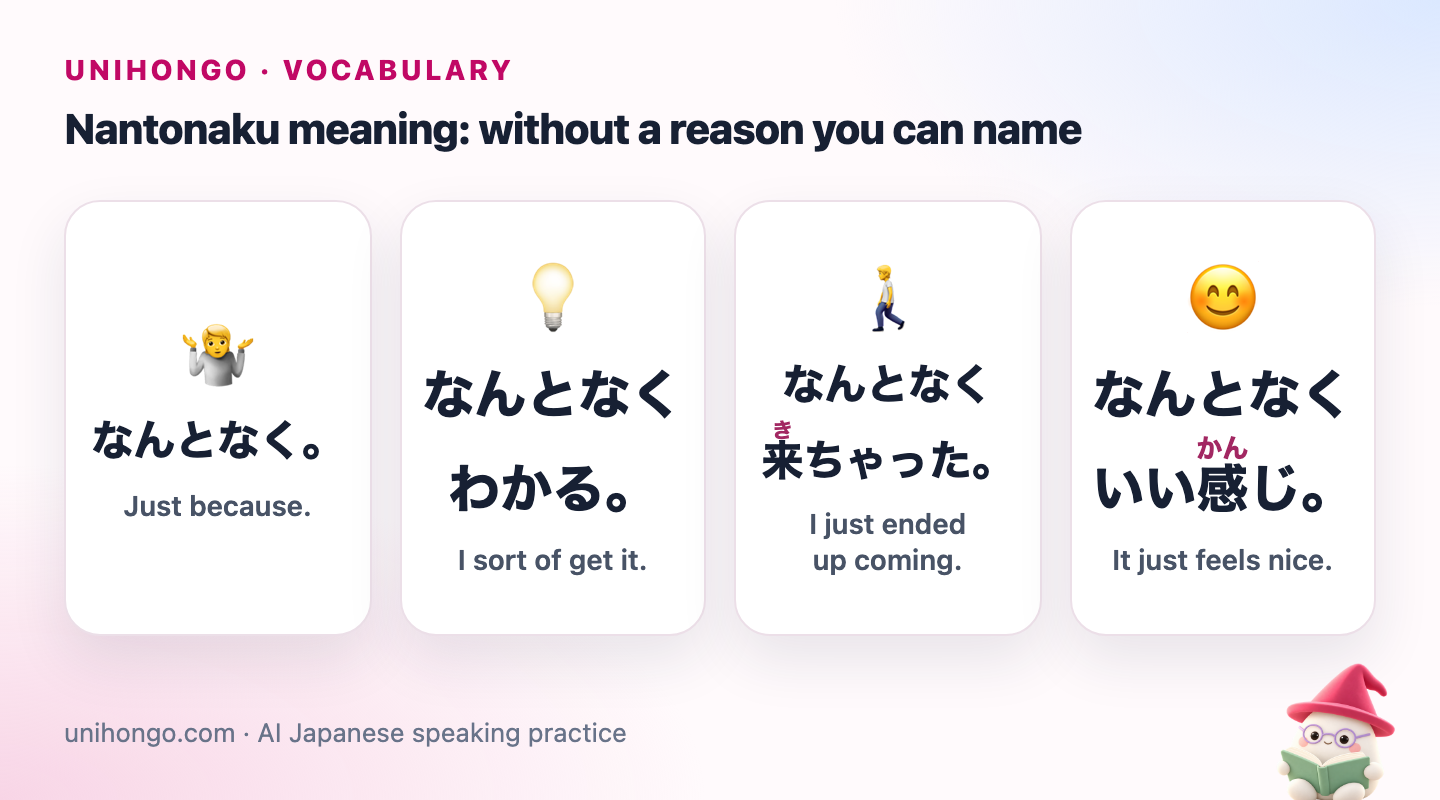
It is an adverb, so it goes before verbs and adjectives, or stands alone as an answer. These four lines show its main jobs.
| Japanese | Romaji | Meaning |
|---|---|---|
| なんとなく。 | Nantonaku. | Just because. |
| なんとなくわかる。 | Nantonaku wakaru. | I sort of get it. |
| なんとなく来ちゃった。 | Nantonaku kichatta. | I just ended up coming. |
| なんとなくいい感じ。 | Nantonaku ii kanji. | It just feels nice. |
Kichatta is a casual form of kite shimatta. Combined with nantonaku, it gives the light, slightly sheepish feeling of turning up somewhere without having planned to.
Nantonaku as an answer to 'why?'
The most famous use is as a reply to nande? or dōshite?, why? Japanese speakers say it when their choice really was based on a feeling: they picked the blue one, walked a different way home or chose a course at university without a grand plan. It is honest and casual.
The risk is that a bare nantonaku can sound like you do not want to talk. The natural fix is to add a soft second thought with demo (but), kedo (although) or ka na (I wonder). This keeps the honesty and still gives the listener something to respond to.
| Japanese | Romaji | Meaning |
|---|---|---|
| なんでそれにしたの? | Nande sore ni shita no? | Friend: Why did you pick that? |
| なんとなく。色がいいなと思って。 | Nantonaku. Iro ga ii na to omotte. | Just because. I liked the colour. |
| なんとなくだけど、楽しそうだったから。 | Nantonaku da kedo, tanoshisō datta kara. | No real reason, it just looked fun. |
| 特に理由はないんだ。 | Toku ni riyū wa nai n da. | There's no particular reason. |
Nantonaku for half-understanding and hunches
The second job is about knowing. Nantonaku wakaru means you understand the gist but could not explain it, which is a very useful thing for a learner to be able to say. Nantonaku oboeteru means you vaguely remember. Nantonaku ki ga suru means you have a hunch.
These phrases are friendly and modest. Saying nantonaku wakarimasu to a teacher shows that you are following but want a little more help, and it is often better than a confident wakarimashita that is not quite true.
| Japanese | Romaji | Meaning |
|---|---|---|
| 意味はなんとなくわかります。 | Imi wa nantonaku wakarimasu. | I roughly understand the meaning. |
| なんとなく覚えてる。 | Nantonaku oboeteru. | I vaguely remember. |
| なんとなく、雨が降る気がする。 | Nantonaku, ame ga furu ki ga suru. | I have a feeling it's going to rain. |
| なんとなく見たことがある。 | Nantonaku mita koto ga aru. | I think I've seen it somewhere. |
Nantonaku for moods
The third job describes a mood that arrives without a clear cause. Autumn evenings, a quiet Sunday or a long train ride can leave you nantonaku sabishii, somehow lonely, or nantonaku shiawase, quietly happy. It also describes things that feel right without a reason: nantonaku ii kanji, it just feels nice.
| Japanese | Romaji | Meaning |
|---|---|---|
| 秋はなんとなくさびしい。 | Aki wa nantonaku sabishii. | Autumn makes me feel a bit lonely. |
| 今日はなんとなくだるい。 | Kyō wa nantonaku darui. | I feel kind of sluggish today. |
| この店、なんとなく落ち着く。 | Kono mise, nantonaku ochitsuku. | This place feels relaxing somehow. |
Ochitsuku, to feel calm or at ease, is one of the most natural things to say about a café or a room you like, and nantonaku is the perfect partner for it.
Nantonaku, nanka, naze ka and betsu ni
Several short words translate as somehow or for some reason, and learners mix them up. The difference is whether there is a cause, whether you know it, and how much the word is simply filling a gap.
| Japanese | Romaji | Meaning |
|---|---|---|
| なぜか眠れない。 | Naze ka nemurenai. | For some reason I can't sleep. |
| なんか、変じゃない? | Nanka, hen ja nai? | Isn't it kind of weird? |
| 別に理由はないよ。 | Betsu ni riyū wa nai yo. | There's no reason, really. |
| Word | Core idea | Feels like |
|---|---|---|
| nantonaku (なんとなく) | No clear reason or no clear knowledge | Relaxed, honest, vague |
| nanka (なんか) | Something, kind of; a casual filler | Chatty, softening |
| naze ka (なぜか) | There is a cause, but I don't know it | Puzzled |
| betsu ni (別に) | Not especially; nothing much | Can sound cold or dismissive |
Betsu ni on its own, as a reply, can sound sulky, as in whatever. Nantonaku is much warmer when you genuinely have no reason.
When not to use nantonaku
- In job interviews and applications. Nantonaku as a reason for applying sounds unmotivated. Talk about a kikkake, a trigger or starting point, instead.
- When someone asks a serious question about a decision that affects them, such as why you are leaving a club. A vague answer can feel like a brush-off.
- As a way to avoid explaining something you do not understand at work. Say chotto wakarinikui tokoro ga arimasu, there's a part I find hard to follow.
- Confusing it with nantoka, which means somehow in the sense of managing to do something: nantoka maniatta, I just made it.
Replying when someone else says nantonaku
When a Japanese friend answers your why with nantonaku, they are usually not hiding anything. Pushing for a real reason can feel like an interrogation. The friendly response is to accept it, show interest in the result rather than the reason, or share that you do the same.
If you really want to know more, a soft follow-up such as nanika kikkake wa atta?, was there anything that started it?, gives them an easy way to say more without having to justify their choice.
| Japanese | Romaji | Meaning |
|---|---|---|
| そっか、なんとなくか。 | Sokka, nantonaku ka. | I see, just because. |
| わかる、私もそういうことある。 | Wakaru, watashi mo sō iu koto aru. | I get it, I do that too. |
| 何かきっかけはあった? | Nanika kikkake wa atta? | Was there anything that started it? |
| で、実際どう?楽しい? | De, jissai dō? Tanoshii? | So how is it really? Is it fun? |
Kikkake, a trigger or starting point, is the word to remember whenever someone, including you, needs a better answer than nantonaku.
Mini dialogue: why did you start learning Japanese?
It is the question every learner hears. Nantonaku is a perfectly natural first answer among friends, as long as you then share something real.
| Japanese | Romaji | Meaning |
|---|---|---|
| なんで日本語を勉強してるの? | Nande Nihongo o benkyō shiteru no? | Friend: Why are you studying Japanese? |
| うーん、最初はなんとなく。 | Ūn, saisho wa nantonaku. | You: Hmm, at first, no real reason. |
| え、なんとなく? | E, nantonaku? | Friend: What, just because? |
| でも、アニメを見て、音がきれいだと思って。 | Demo, anime o mite, oto ga kirei da to omotte. | You: But I watched anime and thought it sounded beautiful. |
| それで、話せるようになりたくなったんだ。 | Sorede, hanaseru yō ni naritaku natta n da. | You: So I wanted to be able to speak it. |
| へえ、いいね。 | Hē, ii ne. | Friend: Oh, that's nice. |