

The literal meaning: the highest
Saikō is made of two kanji: 最, most, and 高, high. Put together they mean the highest, and that is still the meaning in news, weather reports and official writing. Saikō kion is the day's highest temperature, saikō kiroku is a record high, and saikō sekininsha is the person with ultimate responsibility, such as a chief executive.
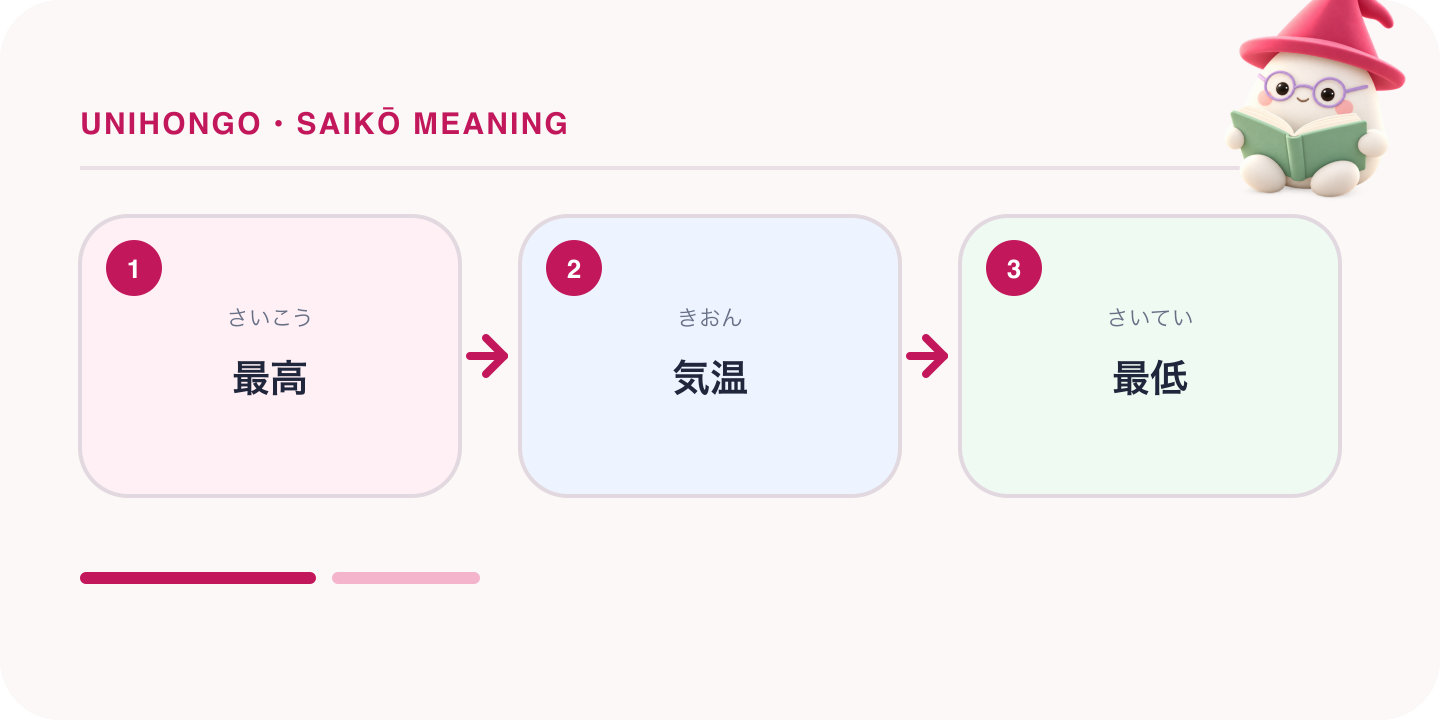
You will meet this sense constantly in Japan without thinking of it as slang at all. A weather forecast saying kyō no saikō kion wa sanjūgo do means today's high is thirty-five degrees. Its partner in these contexts is saitei, the lowest, as in saitei kion, the lowest temperature.
| Japanese | Romaji | Meaning |
|---|---|---|
| 最高気温 | saikō kion | Highest temperature of the day |
| 最低気温 | saitei kion | Lowest temperature of the day |
| 過去最高 | kako saikō | Highest ever, a record high |
| 最高記録 | saikō kiroku | Best record, all-time best |
| 最高裁判所 | saikō saibansho | Supreme Court |
| 今日の最高気温は35度です。 | Kyō no saikō kion wa sanjūgo do desu. | Today's high is 35 degrees. |
Saikō! as a reaction: the best, amazing
In conversation, saikō is how people say something is the best, awesome or perfect. It is a heartfelt, happy word. The first sip of cold beer after work, a view from a mountain top, a surprise day off: all of these are saikō. On its own, saikō! works like English This is the best! or Perfect!, and it often comes with a sigh of satisfaction.
It is also used about people. Anata wa saikō or kimi wa saikō da yo means you're the best, said to a friend who did something kind. Saikō no tomodachi is a best friend in the sense of a wonderful friend, and saikō no ichinichi is a perfect day.
Because it is so positive, saikō is a good word for learners to have ready. It makes your reactions sound natural and warm instead of just saying ii desu ne every time.
| Japanese | Romaji | Meaning |
|---|---|---|
| 最高! | Saikō! | The best! Amazing! |
| この景色、最高だね。 | Kono keshiki, saikō da ne. | This view is amazing, isn't it? |
| 仕事の後のビールは最高! | Shigoto no ato no bīru wa saikō! | Beer after work is the best! |
| 君は最高だよ。 | Kimi wa saikō da yo. | You're the best. |
| 最高の一日だった。 | Saikō no ichinichi datta. | It was a perfect day. |
| 最高の気分! | Saikō no kibun! | I feel fantastic! |
Saikō ni: extremely, the most
Add ni and saikō becomes an adverb meaning extremely or as ... as it gets. Saikō ni tanoshikatta means it was hugely fun, and saikō ni oishii means incredibly tasty. It is stronger than totemo and more enthusiastic than sugoku, and it sounds young and upbeat without being slang.
Saikō ni often combines with adjectives of feeling and quality: tanoshii, fun; oishii, tasty; kakkoii, cool; kirei, beautiful; shiawase, happy. It can also modify a noun phrase indirectly, as in saikō ni ii tenki, perfect weather.
| Japanese | Romaji | Meaning |
|---|---|---|
| 最高に楽しかった! | Saikō ni tanoshikatta! | It was so much fun! |
| このラーメン、最高においしい。 | Kono rāmen, saikō ni oishii. | This ramen is incredibly good. |
| 最高にかっこいい。 | Saikō ni kakkoii. | Seriously cool. |
| 今、最高に幸せです。 | Ima, saikō ni shiawase desu. | I'm as happy as I've ever been. |
| 最高にいい天気だね。 | Saikō ni ii tenki da ne. | The weather is perfect, isn't it? |
Polite forms: saikō desu and saikō deshita
Saikō is a na-adjective style word, so it takes desu and deshita in polite speech. Saikō desu, it's the best, and saikō deshita, it was wonderful, are fine with colleagues, teachers and hosts, especially when you are thanking them for an experience. A guesthouse owner who asks how the dinner was will be pleased to hear saikō deshita.
In more formal settings, such as speaking to a client or writing a thank-you email, many people choose words that sound more measured: subarashii, wonderful, or kekkō na, fine and splendid. Saikō is not rude, but it carries personal excitement, which may not match a formal tone.
| Form | Example | Register |
|---|---|---|
| 最高! saikō! | Just the reaction | Casual |
| 最高だね saikō da ne | Isn't it the best? | Casual, with friends |
| 最高です saikō desu | It's the best | Polite |
| 最高でした saikō deshita | It was wonderful | Polite, past |
| 素晴らしかったです subarashikatta desu | It was wonderful | Polite, more measured |
| 大変素晴らしい時間でした taihen subarashii jikan deshita | It was a truly wonderful time | Formal |
Saikō versus ichiban, sugoi and yabai
Learners often reach for ichiban when they mean saikō. Ichiban means number one, and it is about ranking: kono mise ga ichiban oishii, this shop is the tastiest, compared with others. Saikō is about how good something feels, and needs no comparison: kono mise wa saikō, this shop is amazing. Ichiban suki means my favourite; saikō means it is excellent.
Sugoi means impressive or amazing, often with a sense of surprise, and it is used about skills and achievements as well as things. Yabai is slang that can mean amazing or terrible depending on context. Saikō is always positive (unless sarcastic) and focuses on your own satisfaction.
| Word | Core idea | Example |
|---|---|---|
| 最高 saikō | The best, deeply satisfying | Onsen wa saikō! Hot springs are the best! |
| 一番 ichiban | Number one, ranked first | Kore ga ichiban suki. This is my favourite. |
| すごい sugoi | Impressive, amazing | Nihongo, sugoi ne! Your Japanese is impressive! |
| やばい yabai | Wow (good or bad), slang | Kono kēki, yabai! This cake is insane! |
| 素晴らしい subarashii | Wonderful, splendid | Subarashii enso deshita. It was a wonderful performance. |
A handy combination: ichiban saikō is sometimes heard in casual speech as an extra-strong the very best, but it is redundant, so it is better to pick one word in careful speech.
The opposite: saitei and saiaku
The literal opposite of saikō is saitei, the lowest. Like saikō, it has a technical meaning, as in saitei kion or saitei chingin, minimum wage, and an emotional one. In speech saitei means awful, rock bottom, and when said about a person it is a strong criticism: saitei! or saitei na hito means a terrible person, someone who has behaved in a despicable way. It is harsh, so use it with care.
Saiaku, the worst, is the more common way to describe bad situations: missing the last train, rain on a festival day, losing your wallet. Saiaku! is a natural exclamation for bad luck, like English That's the worst! or Nightmare!
| Japanese | Romaji | Meaning |
|---|---|---|
| 最低! | Saitei! | That's awful! You're terrible! |
| あの人、最低だね。 | Ano hito, saitei da ne. | That person is the worst. |
| 最低賃金 | saitei chingin | Minimum wage |
| 最悪! | Saiaku! | That's the worst! Nightmare! |
| 雨で最悪の一日だった。 | Ame de saiaku no ichinichi datta. | The rain made it a terrible day. |
| 最悪の場合 | saiaku no baai | In the worst case |
Slang and ironic uses: saikō ka yo and saikō desu ka
Saikō also appears in jokes. Saikō ka yo, literally is it the best?!, is a tsukkomi, a comedic retort, used when something is ridiculous in an amusing way. A friend who turns up to a picnic with a whole watermelon and no knife might hear saikō ka yo. It mixes teasing and genuine fondness.
Online and in fan culture you will see saikō written サイコー in katakana, or stretched out as saikōōō to show excitement. Saikō ka? with rising intonation can also be a sincere question in casual speech, as in kono wain, saikō ja nai?, isn't this wine amazing?
Tone matters with sarcasm. Said flatly after something goes wrong, saikō da ne can mean oh great, just perfect, exactly as in English. If you are not sure the listener will catch the irony, stick to saiaku.
| Japanese | Romaji | Meaning |
|---|---|---|
| 最高かよ。 | Saikō ka yo. | You've got to be kidding, that's brilliant. (teasing) |
| サイコー! | Saikō! | Awesome! (energetic, casual writing) |
| これ、最高じゃない? | Kore, saikō ja nai? | Isn't this amazing? |
| 雨か。最高だね。 | Ame ka. Saikō da ne. | Rain. Just perfect. (sarcastic) |
How to respond when someone says saikō
If a friend says saikō! about something you are enjoying together, the natural response is to agree and share the feeling: hontō ni saikō da ne, it really is the best, or ne, saikō!, right, the best! If someone says you are saikō, a modest reply such as sonna koto nai yo, that's not true, or a simple arigatō with a smile works well.
When a host asks dō deshita ka?, how was it?, saikō deshita followed by a detail makes the answer warm and specific: saikō deshita. Toku ni onsen ga yokatta desu, it was wonderful, especially the hot spring.
| Japanese | Romaji | Meaning |
|---|---|---|
| 本当に最高だね。 | Hontō ni saikō da ne. | It really is the best. |
| ね、最高! | Ne, saikō! | Right? The best! |
| そんなことないよ。ありがとう。 | Sonna koto nai yo. Arigatō. | Oh, not really. Thanks. |
| 最高でした。特に温泉が良かったです。 | Saikō deshita. Toku ni onsen ga yokatta desu. | It was wonderful, especially the hot spring. |
Common learner mistakes with saikō
- Using ichiban when you mean saikō: ichiban oishii compares, saikō is simply delighted.
- Saying saikō! bare to a boss or client: add desu or deshita, or choose subarashii.
- Forgetting ni before adjectives: say saikō ni tanoshii, not saikō tanoshii.
- Mixing up saitei and saiaku: saitei about a person is a strong insult; saiaku describes bad luck.
- Missing the long vowel: a clipped saiko can sound like saiko, psycho, so stretch the final vowel to saikō.
- Reading every saikō da ne as sincere: flat intonation after a mishap is often sarcastic.