
Four words the whole story stands on
Kaizoku (海賊) joins umi's kanji 海, sea, to zoku (賊), bandit. Add ō (王), king, and you have the title the hero is chasing. Mugiwara (麦わら), straw, is his hat and his nickname. Akuma no mi (悪魔の実), devil fruit, is the source of the strange powers in the story.
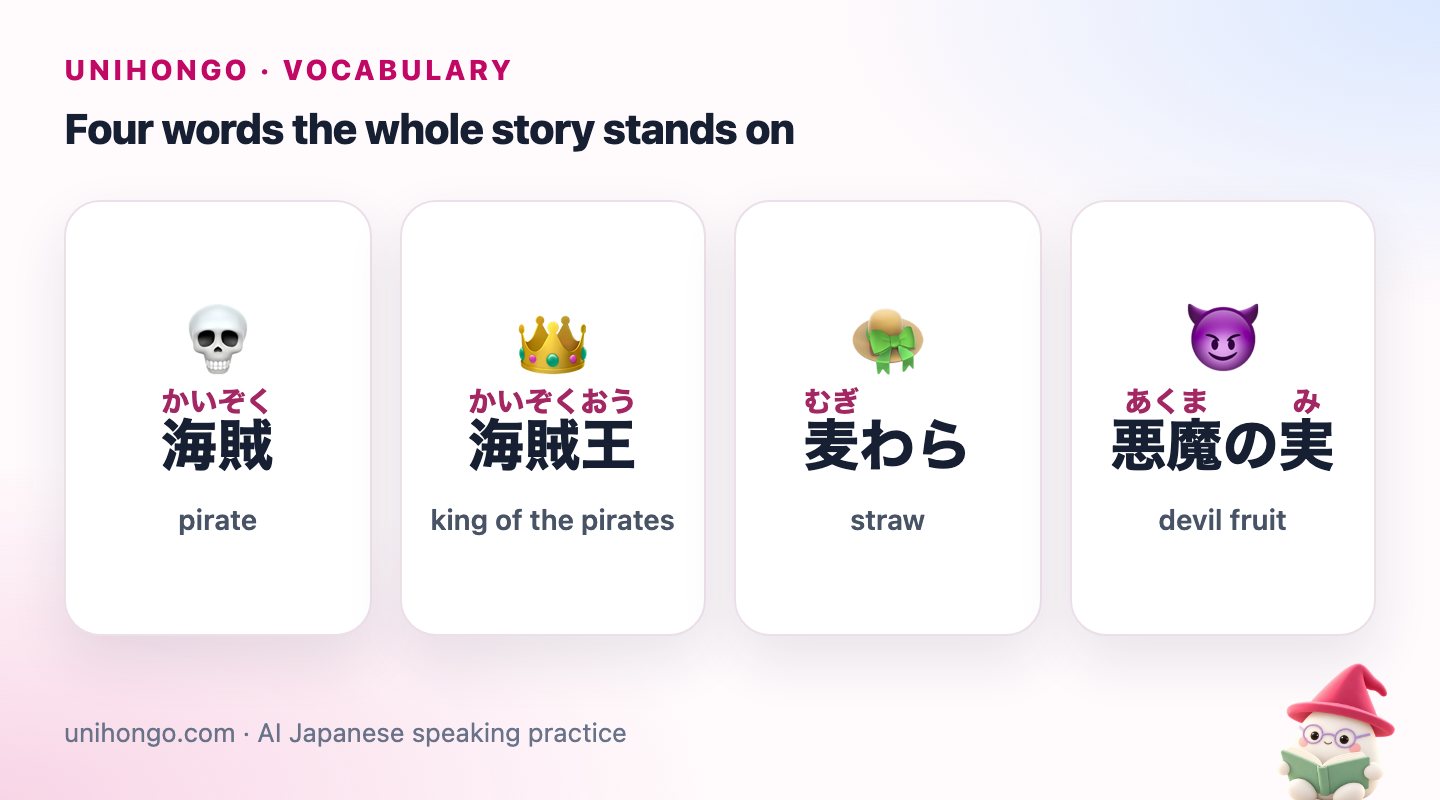
| Japanese | Romaji | Meaning |
|---|---|---|
| 海賊 | kaizoku | pirate |
| 海賊王 | kaizokuō | king of the pirates |
| 麦わら | mugiwara | straw |
| 悪魔の実 | akuma no mi | devil fruit |
| 麦わら帽子 | mugiwara bōshi | straw hat |
| 一味 | ichimi | a gang, a crew |
Nakama (仲間), companion or crewmate, is the series' most loved word and has its own article on this blog. Here it is enough to know that it means the people on your side.
Kaizoku-ō ni ore wa naru: why the word order is unusual
A neutral Japanese sentence starts with the topic and ends with the verb: ore wa kaizoku-ō ni naru, as for me, pirate king, will become. The hero says it differently. He throws the goal to the front, kaizoku-ō ni, and only then adds ore wa naru.
Japanese allows this because particles, not position, show each word's job. Ni still marks the result of becoming and wa still marks the topic, wherever they stand. The verb normally stays at the end. Moving a phrase to the front makes it the thing the listener hears first, so the line lands like: king of the pirates, that is what I am going to be.
Note the tone as well. Ore is a rough male I, and naru is the plain form with no masu. It is a declaration, not a polite statement of plans.
| Japanese | Romaji | Meaning |
|---|---|---|
| 海賊王に俺はなる! | Kaizokuō ni ore wa naru! | King of the pirates, that's what I'll be! |
| 俺は海賊王になる。 | Ore wa kaizokuō ni naru. | I will be king of the pirates. (neutral order) |
| 私は医者になります。 | Watashi wa isha ni narimasu. | I will become a doctor. (polite) |
| 医者に私はなります。 | Isha ni watashi wa narimasu. | A doctor is what I will become. (emphatic) |
Who does what on the ship
Every crew member has a job title, and most are useful kanji compounds. The ending shi (士) marks a trained specialist and shu (手) a person who performs a role, the same shu as in senshu, athlete.
| Japanese | Romaji | Meaning |
|---|---|---|
| 船長 | senchō | captain |
| 航海士 | kōkaishi | navigator |
| 剣士 | kenshi | swordsman |
| 狙撃手 | sogekishu | sniper |
| コック | kokku | cook |
| 船医 | sen'i | ship's doctor |
Senchō is ship plus chief. The same chō (長) ends shachō, company president, and tenchō, shop manager, so the pattern is worth learning once.
Bounties, treasure and the Navy
The world of the story runs on a few more nouns. Takara (宝) is treasure. Bōken (冒険) is adventure, written with 冒, to brave, and 険, steep or dangerous. Kaigun (海軍), the pirates' great opponent, is the standard Japanese word for a navy; English editions call it the Marines.
Pirates are ranked by kenshōkin (懸賞金), the reward on their heads, printed on a tehaisho (手配書), a wanted poster.
| Japanese | Romaji | Meaning |
|---|---|---|
| 宝 | takara | treasure |
| 冒険 | bōken | adventure |
| 海軍 | kaigun | the Navy |
| 懸賞金 | kenshōkin | bounty, prize money |
| 手配書 | tehaisho | wanted poster |
| 航海 | kōkai | a voyage |
Devil fruit words: akuma, mi and gomu
Each fruit is named by doubling a short word and adding no mi. The hero ate the Gomu Gomu no Mi, and gomu (ゴム) is the everyday Japanese word for rubber, as in wagomu, a rubber band. Do not confuse it with gamu (ガム), chewing gum.
People with fruit powers cannot swim. Japanese has a neat everyday word for a non-swimmer, kanazuchi (金槌), literally a hammer, because a hammer sinks straight to the bottom.
| Japanese | Romaji | Meaning |
|---|---|---|
| 悪魔 | akuma | devil, demon |
| 実 | mi | fruit or nut on a plant |
| ゴム | gomu | rubber |
| 私はカナヅチです。 | Watashi wa kanazuchi desu. | I can't swim at all. |
Pirate speech: zo, ze and rough verbs
The crew speak plain-form Japanese with rough masculine endings. Zo pushes a statement at the listener: iku zo, we are going. Ze does the same with a cooler, more relaxed swagger. Adjectives ending in ai slur to ē: urusai becomes urusē, sugoi becomes sugē.
The verb yaru is typical of this style. It is a rougher suru, to do, and yatte yaru means I will do it, just watch me. In neutral speech, yaru is fine among friends, as in shukudai o yaru, to do homework, but suru and shimasu are always safer.
| Japanese | Romaji | Meaning |
|---|---|---|
| 行くぞ! | Iku zo! | Let's go! (rough) |
| 出航だ! | Shukkō da! | Set sail! |
| 宴だ! | Utage da! | Time for a feast! |
| 腹減った。 | Hara hetta. | I'm starving. (rough) |
| うるせえ! | Urusē! | Shut up! (very rough) |
| やってやる! | Yatte yaru! | I'll do it, just watch! |
| 行きましょう。 | Ikimashō. | Let's go. (polite) |
| お腹が空きました。 | Onaka ga sukimashita. | I'm hungry. (polite) |
The last two lines are what a learner should say. Enjoy the rough versions with your ears and keep them for close friends who talk the same way.
Everyday uses: bōken, takaramono, fune
Away from the sea, these words are ordinary. Bōken is any risky new step, such as changing jobs. Takaramono (宝物) is a treasured thing: a child's drawing, a gift from a grandparent. Fune (船) is a ship or boat, and funayoi is seasickness. Kaizoku turns up in kaizokuban (海賊版), a pirated copy.
| Japanese | Romaji | Meaning |
|---|---|---|
| これは私の宝物です。 | Kore wa watashi no takaramono desu. | This is my treasure. |
| 船で島に行きました。 | Fune de shima ni ikimashita. | I went to the island by boat. |
| 船酔いしやすいです。 | Funayoi shiyasui desu. | I get seasick easily. |
| 留学は大きな冒険でした。 | Ryūgaku wa ōkina bōken deshita. | Studying abroad was a big adventure. |
| 一番好きなキャラクターは誰ですか。 | Ichiban suki na kyarakutā wa dare desu ka. | Who is your favourite character? |
| 何巻まで読みましたか。 | Nankan made yomimashita ka. | Which volume are you up to? |