
What hara hachi bu means
The phrase is built from three simple pieces: 腹 (hara), the belly or stomach; 八 (hachi), eight; and 分 (bu), one tenth. Stomach at eight tenths means you stop eating while you could still eat a little more. In everyday speech people add 目 (me), a suffix that marks a point on a scale, and say hara hachibunme.
It is advice, not a rule. Nobody counts percentages; it simply means stopping before you feel stuffed.
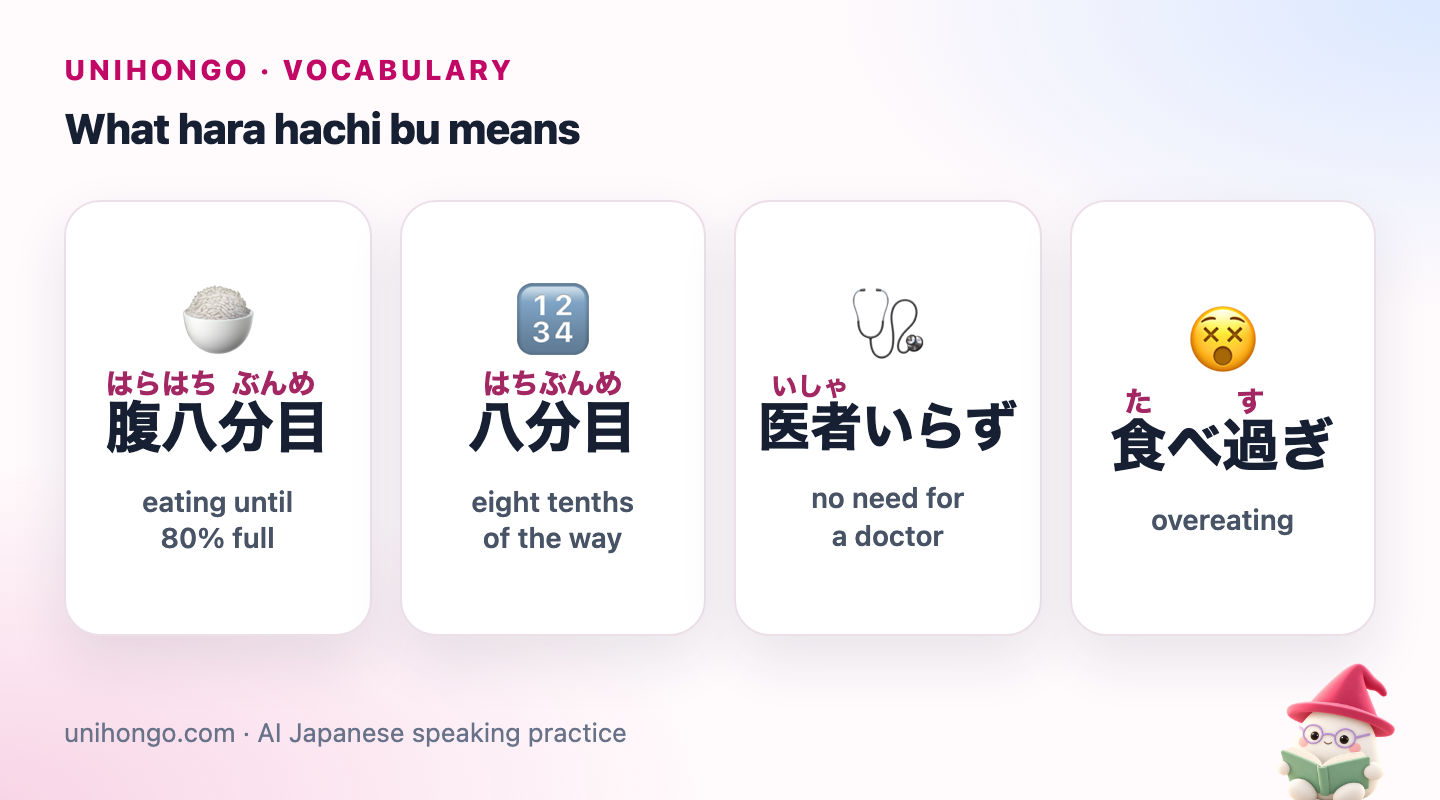
| Japanese | Romaji | Meaning |
|---|---|---|
| 腹八分目 | hara hachibunme | eating until 80% full |
| 八分目 | hachibunme | eight tenths of the way |
| 医者いらず | isha irazu | no need for a doctor |
| 食べ過ぎ | tabesugi | overeating |
Reading it right: bu, fun and pun
The kanji 分 has several readings, and this phrase uses the less common one. In time, 分 is fun or pun, a minute: happun is eight minutes. As a fraction, 分 is bu, a tenth, and it appears in several useful expressions about chances, progress and cherry blossoms.
Knowing this one reading unlocks a little family of phrases. Gobu gobu, five tenths and five tenths, means fifty-fifty, and kubu kurin, nine tenths and nine hundredths, means almost certainly.
| Japanese | Romaji | Meaning |
|---|---|---|
| 腹八分 | hara hachibu | eighty percent full (short form) |
| 八分 | happun | eight minutes |
| 五分五分 | gobu gobu | fifty-fifty |
| 八分咲き | hachibuzaki | eighty percent in bloom (flowers) |
| 九分九厘 | kubu kurin | almost certainly |
The proverb and where the idea comes from
The full saying is hara hachibunme ni isha irazu: if you keep your stomach at eight tenths, you will not need a doctor. Some people add a second half about eating even less, but versions vary, and the short form is the one you will hear.
Advice to eat moderately has a long history in Japan. Edo-period health writing, such as Kaibara Ekiken's Yōjōkun, is often quoted for recommending that people stop before they are full. In modern Japan the phrase is used by parents, doctors and anyone trying to cut down, usually lightly, as a reminder rather than a strict diet.
| Japanese | Romaji | Meaning |
|---|---|---|
| 腹八分目に医者いらず | hara hachibunme ni isha irazu | eat to 80% full and you won't need a doctor |
| 健康のために腹八分目を心がけています。 | Kenkō no tame ni hara hachibunme o kokorogakete imasu. | For my health, I try to stop at 80% full. |
| 祖母がいつも腹八分目と言っていた。 | Sobo ga itsumo hara hachibunme to itte ita. | My grandmother always said eat to 80% full. |
| 何事も腹八分目 | nanigoto mo hara hachibunme | moderation in all things |
The phrase also travels beyond food. Nanigoto mo hara hachibunme, everything at eight tenths, is said about work, shopping or even friendships: stop before you overdo it, and you will enjoy it longer.
Using it at the table
The phrase comes up most naturally when someone offers you more food, or when you explain why you are stopping. Japanese hosts often offer second helpings more than once, out of kindness, and guests often decline gently at first. Lead with thanks and a compliment, then give your reason. Hara hachibunme sounds sensible and a little humorous, which softens the refusal.
With friends, the phrase can also be a joke: someone who has just eaten three plates says hara hachibunme, and everyone laughs.
Customs about leftovers vary by family. In many homes it is polite to finish every grain of rice in your bowl, and leaving food can look wasteful. When in doubt, finish what is already on your plate and decline the next serving, rather than leaving food behind.
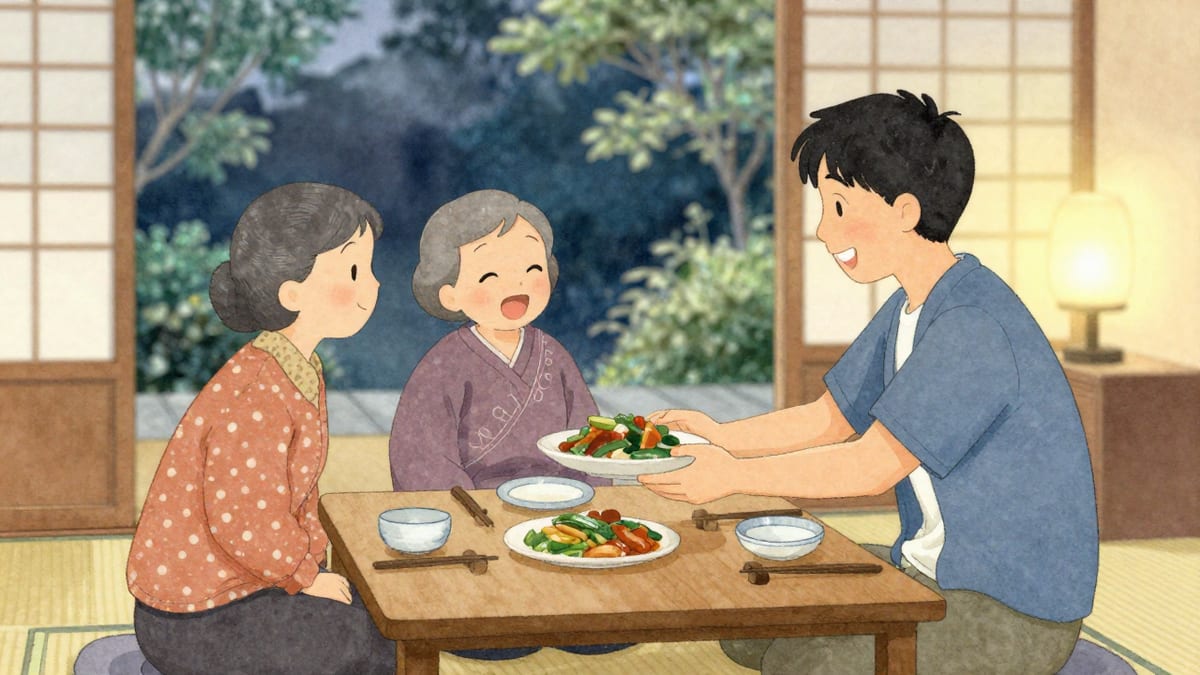
| Japanese | Romaji | Meaning |
|---|---|---|
| もう少しいかがですか。 | Mō sukoshi ikaga desu ka. | Host: Would you like a little more? |
| ありがとうございます。とてもおいしかったです。 | Arigatō gozaimasu. Totemo oishikatta desu. | Thank you. It was delicious. |
| もう腹八分目なので、やめておきます。 | Mō hara hachibunme na node, yamete okimasu. | I'm at about 80% full, so I'll stop there. |
| もう十分いただきました。 | Mō jūbun itadakimashita. | I've had plenty, thank you. (polite) |
| 腹八分目って言うしね。 | Hara hachibunme tte iu shi ne. | Well, they do say eat to 80% full. (casual) |
Hara or onaka?
Both mean stomach. Onaka is the soft, everyday word that everyone uses: onaka ga suita, onaka ga itai. Hara is blunter and is used in casual masculine speech, such as hara hetta, I'm starving, and in many idioms and set phrases. Hara hachibunme is one of those set phrases, so it sounds fine from anyone.
Hara also appears in idioms about feelings, because the belly was traditionally seen as the seat of true intentions. These are common and good to recognise.
| Japanese | Romaji | Meaning |
|---|---|---|
| お腹が空いた。 | Onaka ga suita. | I'm hungry. (neutral) |
| 腹減った。 | Hara hetta. | I'm starving. (rough, casual) |
| 腹が立つ。 | Hara ga tatsu. | It makes me angry. |
| 腹黒い人 | haraguroi hito | a scheming person |
| 腹を割って話そう。 | Hara o watte hanasō. | Let's talk frankly, heart to heart. |
Words for full, too full and small eaters
| Japanese | Romaji | Meaning |
|---|---|---|
| お腹いっぱい | onaka ippai | full |
| 満腹 | manpuku | completely full (written, formal) |
| 食べ過ぎた。 | Tabesugita. | I ate too much. |
| 少食 | shōshoku | a small eater |
| 大食い | ōgui | a big eater |
| おかわり | okawari | a second helping |
Okawari is the word you hear when you hold out your rice bowl for more, and okawari jiyū in a restaurant means free refills, often of rice.
Mini dialogue: one more plate?
| Japanese | Romaji | Meaning |
|---|---|---|
| もう一皿取ってこようかな。 | Mō hito sara totte koyō ka na. | Friend: Maybe I'll grab one more plate. |
| 私はやめとく。腹八分目って言うし。 | Watashi wa yametoku. Hara hachibunme tte iu shi. | You: I'll pass. They say stop at 80% full. |
| えらいね。でもデザートは? | Erai ne. Demo dezāto wa? | Friend: Good for you. But what about dessert? |
| デザートは別腹! | Dezāto wa betsubara! | You: Dessert goes in a separate stomach! |
Rehearse the second-helping moment
- Ask Mocchi: /kanji 腹. You get the meaning, readings and common words, and Mocchi will remember to check the bu reading of 分 in a later /review.
- Then ask Mocchi to quiz you on happun, hachibunme and gobu gobu, one at a time, until the readings stop tripping you up.
- Finally, open AI Sensei with Sakura-sensei, ask her to play a host mother who keeps offering more food, and practise saying thank you, praising the meal and stopping at eight tenths.
Common learner mistakes
- Reading 八分 as happun in this phrase. It is hachibu, eight tenths; happun is eight minutes.
- Refusing food with only a health reason. Thank your host and praise the meal first, then mention hara hachibunme.
- Using hara everywhere. Say onaka ga itai at the clinic and onaka ga suita in polite company; keep hara for set phrases.
- Treating it as a strict rule. It is gentle advice, and Japanese people quote it with a smile as often as seriously.
- Calling it an Okinawan word only. It is used throughout Japan.