
Why every relative has two names
Japanese vocabulary builds in a distinction between your own group and everybody else's. When you talk about your family to an outsider, you lower your own side by using plain words such as haha, chichi, and ani. When you talk about their family, you raise it with the polite set: okāsan, otōsan, onīsan. Nothing about the relationship changes; only the social direction of the sentence does.
This is the same instinct behind humble and honorific verbs, so if you have met keigo before, the logic will feel familiar. The practical consequence is small but constant. Saying watashi no okāsan wa kangoshi desu to a new colleague is understood, but it lands the way calling your own work outstanding does in English. Haha wa kangoshi desu is the sentence a native speaker would use.
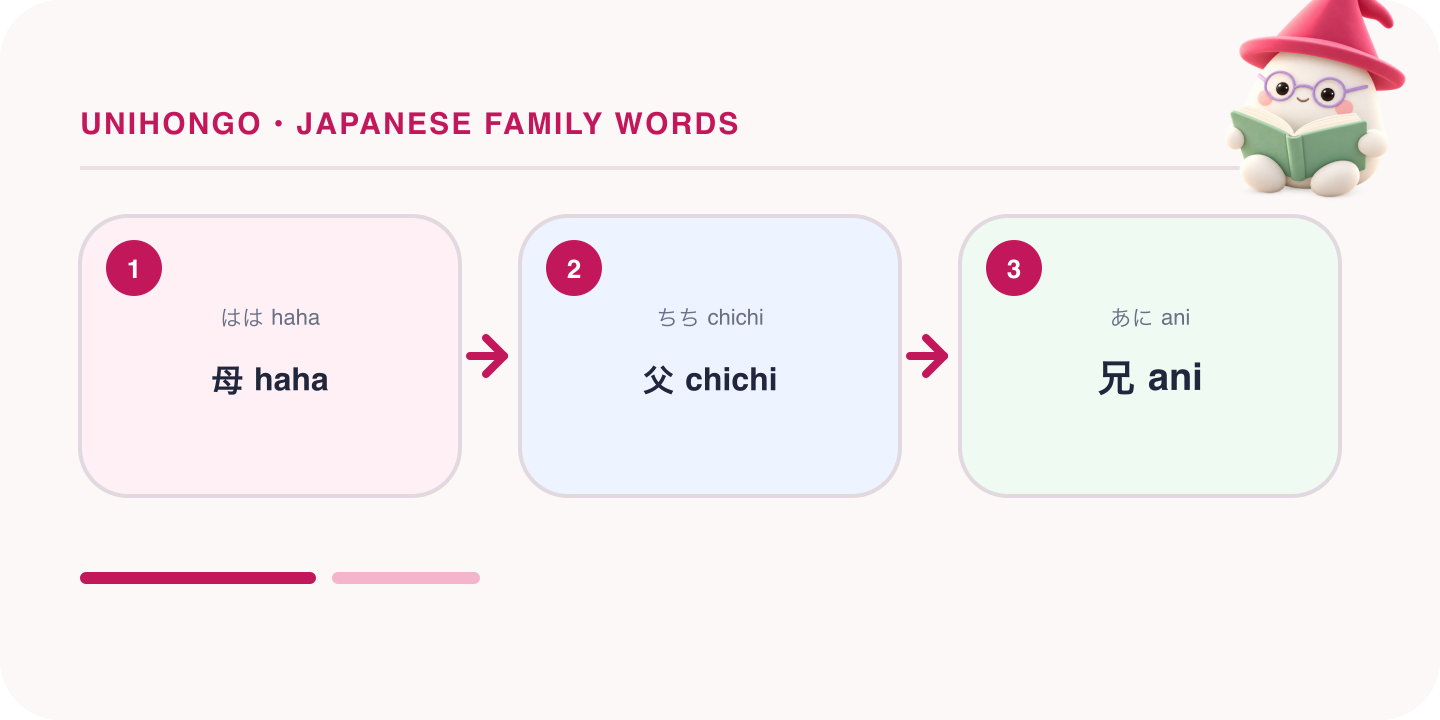
The two sets side by side
| Relative | Your family (plain) | Their family (polite) |
|---|---|---|
| Family | 家族 kazoku | ご家族 gokazoku |
| Parents | 両親 ryōshin | ご両親 goryōshin |
| Mother | 母 haha | お母さん okāsan |
| Father | 父 chichi | お父さん otōsan |
| Older brother | 兄 ani | お兄さん onīsan |
| Older sister | 姉 ane | お姉さん onēsan |
| Younger brother | 弟 otōto | 弟さん otōto-san |
| Younger sister | 妹 imōto | 妹さん imōto-san |
| Siblings | 兄弟 kyōdai | ご兄弟 gokyōdai |
| Grandfather | 祖父 sofu | おじいさん ojīsan |
| Grandmother | 祖母 sobo | おばあさん obāsan |
| Uncle | おじ oji | おじさん ojisan |
| Aunt | おば oba | おばさん obasan |
| Husband | 夫 otto | ご主人 goshujin |
| Wife | 妻 tsuma | 奥さん okusan |
| Son | 息子 musuko | 息子さん musuko-san |
| Daughter | 娘 musume | お嬢さん ojōsan |
| Child | 子供 kodomo | お子さん okosan |
Two shortcuts make the table easier to hold. Most polite forms are simply the plain word wrapped in o and san, or prefixed with go for the group words, so gokazoku and goryōshin follow one rule. And the younger siblings barely change at all: otōto becomes otōto-san. The pairs worth memorising as raw vocabulary are haha and okāsan, chichi and otōsan, sofu and ojīsan, sobo and obāsan.
Talking about your own family
These are the sentences you will produce most often, because a conversation partner asks about your family long before you ask about theirs. Keep everything in the plain set and add wa to mark who you are describing. Note that Japanese usually drops watashi no in front of a family word: haha already means my mother, and adding the possessive sounds heavy unless you are contrasting your mother with someone else's.
| Japanese | Romaji | Meaning |
|---|---|---|
| 母は看護師です。 | Haha wa kangoshi desu. | My mother is a nurse. |
| 父は東京で働いています。 | Chichi wa Tōkyō de hataraite imasu. | My father works in Tokyo. |
| 兄は二十五歳です。 | Ani wa nijūgo-sai desu. | My older brother is twenty-five. |
| 妹は大学生です。 | Imōto wa daigakusei desu. | My younger sister is a university student. |
| 両親は北海道に住んでいます。 | Ryōshin wa Hokkaidō ni sunde imasu. | My parents live in Hokkaido. |
| 祖母は今年九十歳になります。 | Sobo wa kotoshi kyūjussai ni narimasu. | My grandmother turns ninety this year. |
Asking about someone else's family
Switch to the polite set and the question sounds warm rather than nosy. Ogenki desu ka works for any family member you have met before, and it is a standard piece of small talk when you see a colleague again after a break. If you have never met the person, keep the question general with gokazoku rather than asking about individuals.
| Japanese | Romaji | Meaning |
|---|---|---|
| お母さんはお元気ですか? | Okāsan wa ogenki desu ka? | How is your mother? |
| ご家族は何人ですか? | Gokazoku wa nan-nin desu ka? | How many people are in your family? |
| ご両親はどちらに住んでいますか? | Goryōshin wa dochira ni sunde imasu ka? | Where do your parents live? |
| お子さんはおいくつですか? | Okosan wa oikutsu desu ka? | How old is your child? |
| 奥さんもいらっしゃいますか? | Okusan mo irasshaimasu ka? | Is your wife coming as well? |
Expect the answer to come back in the plain set, because the other person is now talking about their own side. Hearing haha wa genki desu right after you said okāsan is the clearest demonstration of the rule you will ever get, and it is a good moment to notice the switch rather than assume you misheard the word.
Counting your family and the kyodai question
The standard opener is nan-nin kazoku desu ka, and the standard answer packs the number straight onto kazoku: yonin kazoku desu. People are counted with nin, but the first two are irregular, giving hitori, futari, sannin, yonin, gonin. The wider system of counters has its own guide; for family talk these five numbers cover almost everything you need.
The follow-up is nearly always about siblings. Kyōdai wa imasu ka asks whether you have any, and the natural answer names the specific relationship with a counter: ane ga hitori imasu. If you are an only child, hitorikko desu is the ready-made reply and usually prompts a friendly follow-up question, so have one extra sentence about your parents prepared.
| Japanese | Romaji | Meaning |
|---|---|---|
| 何人家族ですか? | Nan-nin kazoku desu ka? | How many people are in your family? |
| 四人家族です。 | Yonin kazoku desu. | There are four of us. |
| 兄弟はいますか? | Kyōdai wa imasu ka? | Do you have any brothers or sisters? |
| 姉が一人います。 | Ane ga hitori imasu. | I have one older sister. |
| 兄が二人と妹が一人います。 | Ani ga futari to imōto ga hitori imasu. | I have two older brothers and one younger sister. |
| 一人っ子です。 | Hitorikko desu. | I am an only child. |
| 犬も一匹います。 | Inu mo ippiki imasu. | We have a dog as well. |
Describing your family in a self-introduction
A self-introduction that mentions family gives your listener something to ask about, which is exactly what you want early in a conversation. A reliable shape is three sentences: how many people, who they are, and one detail that invites a question. Announce the topic with kazoku o shōkai shimasu if you are speaking to a group, and simply start describing if it is a one-to-one chat.
| Japanese | Romaji | Meaning |
|---|---|---|
| 家族を紹介します。 | Kazoku o shōkai shimasu. | Let me introduce my family. |
| 父と母と弟と私の四人家族です。 | Chichi to haha to otōto to watashi no yonin kazoku desu. | There are four of us: my father, my mother, my younger brother, and me. |
| 家族はみんな福岡にいます。 | Kazoku wa minna Fukuoka ni imasu. | My family are all in Fukuoka. |
| 弟とよく一緒にサッカーをします。 | Otōto to yoku issho ni sakkā o shimasu. | I often play football with my younger brother. |
| 家族と月に一回電話します。 | Kazoku to tsuki ni ikkai denwa shimasu. | I call my family once a month. |
Ages, jobs, and where they live
Ages use sai, with a few sound changes worth learning as fixed items: issai, hassai, jussai, hatachi for twenty. Jobs are simplest as a noun plus desu, and shigoto o shite imasu covers the cases where you do not know the exact job title in Japanese. Asking an adult's age directly can feel intrusive, so oikutsu desu ka is the softer form, and it is far safer aimed at a child than at your colleague's mother.
| Japanese | Romaji | Meaning |
|---|---|---|
| 父は五十二歳です。 | Chichi wa gojūni-sai desu. | My father is fifty-two. |
| 姉は二十歳です。 | Ane wa hatachi desu. | My older sister is twenty. |
| 母は銀行で働いています。 | Haha wa ginkō de hataraite imasu. | My mother works at a bank. |
| 兄はエンジニアの仕事をしています。 | Ani wa enjinia no shigoto o shite imasu. | My older brother works as an engineer. |
| お仕事は何をされていますか? | Oshigoto wa nani o sarete imasu ka? | What do you do for work? |
| 祖父は去年退職しました。 | Sofu wa kyonen taishoku shimashita. | My grandfather retired last year. |
In-laws and the wider family
For relatives by marriage, Japanese puts giri no in front of the ordinary word, so giri no ani is a brother-in-law. Parents-in-law have their own short forms, gifu and gibo, though many speakers simply say shujin no haha for my husband's mother. Beyond the immediate circle, itoko covers cousins of either gender, oi is a nephew, mei is a niece, and shinseki is the general word for relatives.
| Japanese | Romaji | Meaning |
|---|---|---|
| 義理の兄が二人います。 | Giri no ani ga futari imasu. | I have two brothers-in-law. |
| 主人の母は大阪に住んでいます。 | Shujin no haha wa Ōsaka ni sunde imasu. | My husband's mother lives in Osaka. |
| いとこが三人います。 | Itoko ga sannin imasu. | I have three cousins. |
| 先月、姪が生まれました。 | Sengetsu, mei ga umaremashita. | My niece was born last month. |
| お正月に親戚が集まります。 | Oshōgatsu ni shinseki ga atsumarimasu. | The relatives gather at New Year. |
What families actually call each other at home
Inside the house, the polite set takes over completely. Children call their parents okāsan and otōsan, or the warmer okāchan and otōchan, and address older siblings as onīchan and onēchan rather than by name. Younger siblings are called by their given name, often with chan or kun. Nobody at home says ani or haha out loud, which is why learners who only hear family conversation adopt the wrong set for formal use.
Parents commonly refer to themselves in the third person when speaking to small children, so a mother may say okāsan ga yaru yo rather than watashi ga. Men often shorten the words to kāsan and tōsan as they get older. All of this is casual speech, so the sentences below drop desu and masu; the polite-versus-casual guide covers when that switch is safe.
| Japanese | Romaji | Meaning |
|---|---|---|
| お母さん、ただいま。 | Okāsan, tadaima. | Mum, I'm home. |
| お父さん、これ持って。 | Otōsan, kore motte. | Dad, hold this. |
| お兄ちゃん、待って。 | Onīchan, matte. | Wait for me, big brother. |
| お姉ちゃん、宿題手伝って。 | Onēchan, shukudai tetsudatte. | Sis, help me with my homework. |
| おばあちゃんに電話した? | Obāchan ni denwa shita? | Did you call Grandma? |
Onisan and obasan for people you do not know
Family words stretch beyond the family. Ojisan and obasan are used for middle-aged strangers, ojīsan and obāsan for elderly ones, and onīsan and onēsan for young adults, especially staff in markets, casual restaurants, and street food stalls. The tone is friendly rather than formal, and the choice reveals how old you think the person is, which is precisely the risk.
The safe default is sumimasen, which gets attention without guessing anyone's age. Calling a woman in her thirties obasan is a genuine misstep, and staff in shops and restaurants are addressed as sumimasen or, when they are serving you, not addressed at all. Use onēsan only where you can hear other customers doing the same, and never in an office.
| Japanese | Romaji | Meaning |
|---|---|---|
| すみません、これはいくらですか? | Sumimasen, kore wa ikura desu ka? | Excuse me, how much is this? |
| お姉さん、おすすめは何ですか? | Onēsan, osusume wa nan desu ka? | Excuse me, what do you recommend? |
| おじさん、ありがとうございました。 | Ojisan, arigatō gozaimashita. | Thank you very much, sir. |
| おばあさん、お手伝いしましょうか? | Obāsan, otetsudai shimashō ka? | Shall I help you, madam? |
A drill that fixes the two sets
- Say your six closest relatives in the plain set, then immediately in the polite set.
- Answer nan-nin kazoku desu ka out loud every day until the number needs no thought.
- Prepare one detail per person so a follow-up question never leaves you silent.
- Shadow a family conversation from a drama and mark every san word you hear at home.
- Record yourself introducing your family in sixty seconds and check for stray watashi no.