

The frequency scale from always to never
Think of the words as a ladder. At the top is itsumo, always, and just below it yoku, often. Tokidoki, sometimes, sits in the middle and tamani, occasionally, a step lower. Below that the verb flips to negative: amari, not much or not often; mettani, rarely, hardly ever; hotondo, almost never; and zenzen, never at all. The negative is not optional. Amari and zenzen do not mean anything on their own; they measure how far the negative verb goes.
Two more words fill gaps. Taitei, usually, sits between itsumo and yoku and describes what you normally do rather than what you always do. Shotchū is a colloquial constantly, often with a mildly complaining tone, as in shotchū okureru, he is always late. Keep shotchū for friends and use itsumo in polite settings.
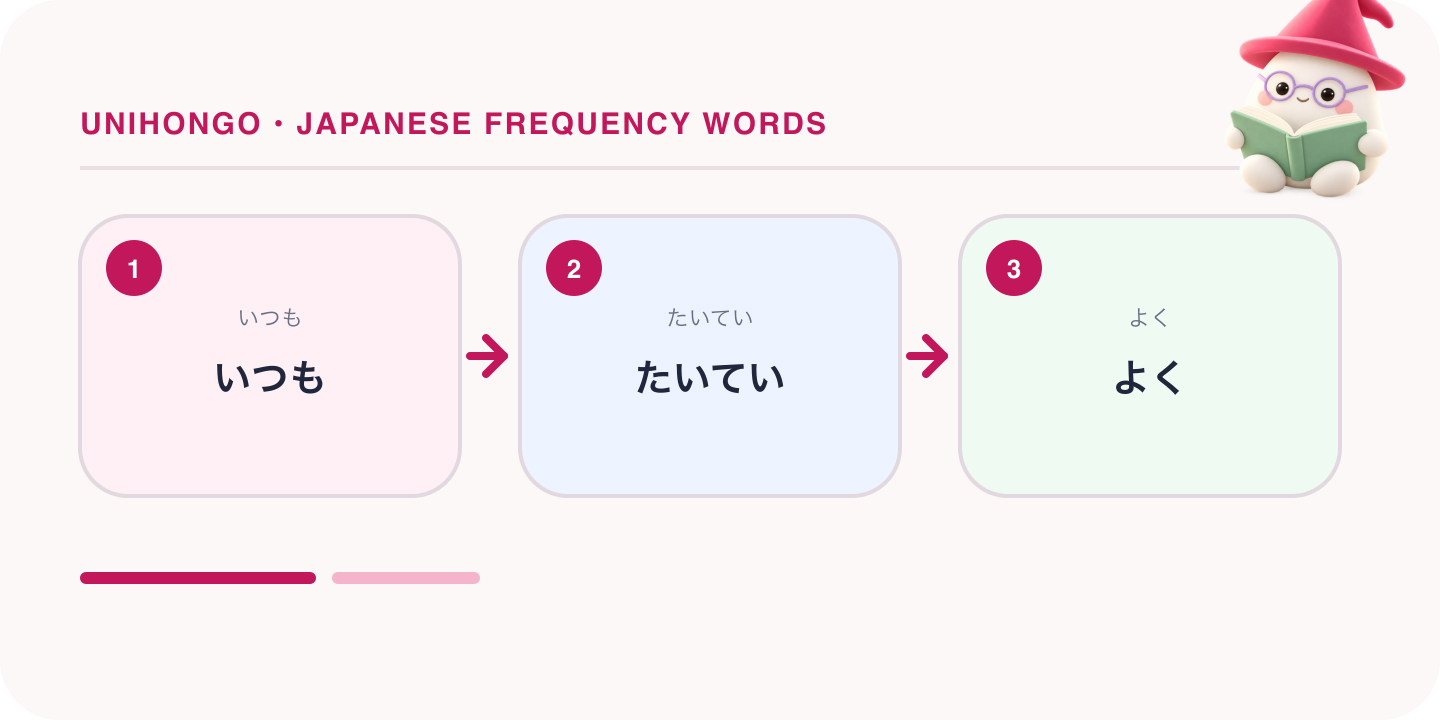
| Word | Reading | Meaning |
|---|---|---|
| いつも | itsumo | Always |
| たいてい | taitei | Usually |
| よく | yoku | Often |
| ときどき | tokidoki | Sometimes |
| たまに | tamani | Occasionally |
| あまり | amari | Not much, not often (with negative) |
| めったに | mettani | Rarely (with negative) |
| ほとんど | hotondo | Almost never (with negative) |
| ぜんぜん | zenzen | Never, not at all (with negative) |
| しょっちゅう | shotchū | Constantly (casual) |
Hotondo is the odd one out because it also works positively with nouns: hotondo no hito, most people. As a frequency adverb with a verb, though, hotondo ikimasen, I almost never go, is the normal pattern.
The positive group: itsumo, yoku, tokidoki, tamani
The top four take an ordinary verb and can also appear in the past. Itsumo describes a fixed habit and is also used for the usual thing: itsumo no, the usual, is what you say to order your regular coffee. Yoku is the most useful word on the list because it covers often and also well: yoku nemashita means I slept well, and yoku ikimasu means I go often. Context tells the listener which one you mean.
Tokidoki is the everyday sometimes. Tamani is quieter and less frequent, and it sounds modest, which suits Japanese conversation: tamani ryōri shimasu does not claim much. All four can be used in questions with a positive verb, yoku kimasu ka, do you come often, and the answer usually repeats the word.
| Japanese | Romaji | Meaning |
|---|---|---|
| 朝はいつもコーヒーを飲みます。 | Asa wa itsumo kōhī o nomimasu. | I always drink coffee in the morning. |
| 週末はたいてい家にいます。 | Shūmatsu wa taitei ie ni imasu. | I am usually at home at the weekend. |
| 友達とよくラーメンを食べに行きます。 | Tomodachi to yoku rāmen o tabe ni ikimasu. | I often go for ramen with friends. |
| ときどき映画を見ます。 | Tokidoki eiga o mimasu. | I sometimes watch films. |
| たまに実家に帰ります。 | Tamani jikka ni kaerimasu. | I occasionally go back to my parents' home. |
| ここにはよく来るんですか。 | Koko ni wa yoku kuru n desu ka. | Do you come here often? |
The negative group: amari, mettani, hotondo, zenzen
Below tamani the verb must be negative, and the strength of the adverb sets how strong the denial is. Amari is mild: amari terebi o mimasen, I do not watch much television. Mettani is stronger and a little more written or careful: mettani kaze o hikimasen, I hardly ever catch colds. Hotondo is almost never, and zenzen is a flat never. Zenzen is also the strongest not at all with adjectives, zenzen oishikunai, not tasty at all.
These words also soften bad news. Amari sukija nai, I do not like it much, is the polite Japanese way to say you dislike something, and it is far more common than kirai. In the same way, amari wakarimasen, I do not really understand, is gentler than wakarimasen alone. If you want to strengthen a plain negative, put zenzen in front of it; if you want to soften it, use amari.
| Japanese | Romaji | Meaning |
|---|---|---|
| 最近あまり運動していません。 | Saikin amari undō shite imasen. | I have not been exercising much recently. |
| お酒はめったに飲みません。 | Osake wa mettani nomimasen. | I hardly ever drink alcohol. |
| テレビはほとんど見ません。 | Terebi wa hotondo mimasen. | I almost never watch television. |
| 納豆はぜんぜん食べません。 | Nattō wa zenzen tabemasen. | I never eat natto. |
| 辛い物はあまり好きじゃないです。 | Karai mono wa amari suki ja nai desu. | I do not much like spicy food. |
| ぜんぜん分かりませんでした。 | Zenzen wakarimasen deshita. | I did not understand at all. |
Every-day words: mainichi, maishū and friends
The prefix mai means every, and it attaches to the time units: mainichi, every day; maishū, every week; maitsuki, every month; maitoshi or mainen, every year. It also attaches to parts of the day: maiasa, every morning; maiban, every evening; and to occasions, maikai, every time. These are nouns of time, so they take no particle: mainichi hashirimasu, not mainichi ni.
Days of the week can be made habitual with the plural marker or with mai: maishū getsuyōbi, every Monday, or simply getsuyōbi ni, on Mondays, which in a habitual sentence already means every Monday. Ichinichi oki means every other day, and futsuka ni ikkai, once every two days, means the same thing. Heijitsu, weekdays, and shūmatsu, weekends, round out the set: heijitsu wa mainichi, every weekday.
| Word | Reading | Meaning |
|---|---|---|
| 毎日 | mainichi | Every day |
| 毎朝 | maiasa | Every morning |
| 毎晩 | maiban | Every evening |
| 毎週 | maishū | Every week |
| 毎月 | maitsuki | Every month |
| 毎年 | maitoshi | Every year |
| 毎回 | maikai | Every time |
| 一日おき | ichinichi oki | Every other day |
| 平日 | heijitsu | Weekdays |
| 週末 | shūmatsu | Weekends |
Maitoshi and mainen are both readings of the same kanji and both are correct. Maitoshi is a little more common in speech.
Counting: shū ni ikkai and the kai pattern
For an exact frequency, Japanese counts occasions with kai and attaches them to a period with ni: shū ni ikkai, once a week; tsuki ni nikai, twice a month; nen ni ikkai, once a year; ichinichi ni sankai, three times a day. The period comes first and the count comes last, the opposite of English. The sound changes in kai are the same as in other counters: ikkai, nikai, sankai, yonkai, gokai, rokkai, nanakai, hachikai or hakkai, kyūkai, jukkai.
You can make the count vague with kurai or gurai after it, shū ni nikai gurai, about twice a week, and stretch it with a range, shū ni ni-sankai, two or three times a week. Do is a near-synonym for kai in counting, ichido, nido, and it works in the same pattern, tsuki ni ichido, though kai is more common for habits. To ask, replace the number with nan: shū ni nankai.
| Japanese | Romaji | Meaning |
|---|---|---|
| 週に二回ジムに行きます。 | Shū ni nikai jimu ni ikimasu. | I go to the gym twice a week. |
| 月に一回くらい美容院に行きます。 | Tsuki ni ikkai kurai biyōin ni ikimasu. | I go to the hairdresser about once a month. |
| 年に一回、国に帰ります。 | Nen ni ikkai, kuni ni kaerimasu. | I go back to my country once a year. |
| 一日に三回、薬を飲んでください。 | Ichinichi ni sankai, kusuri o nonde kudasai. | Please take the medicine three times a day. |
| 週に何回、日本語を勉強していますか。 | Shū ni nankai, Nihongo o benkyō shite imasu ka. | How many times a week do you study Japanese? |
| 週に二、三回です。 | Shū ni ni-sankai desu. | Two or three times a week. |
Word order and combining the words
Frequency words are adverbs of time, so they sit early in the sentence: after the topic, before the object and verb. Watashi wa yoku eiga o mimasu is the neutral order. Moving the adverb to the front, yoku eiga o mimasu, is fine and slightly emphasises it. Putting it right before the verb, eiga o yoku mimasu, is also natural and puts the weight on how often. The negative group prefers to stay near the verb.
An adverb and a counting pattern rarely appear together in one clause, because they answer the same question; choose one. Taitei and itsumo happily precede a time of day, itsumo asa shichi-ji ni okimasu, I always get up at seven.
- Topic, frequency, object, verb: watashi wa tokidoki sushi o tabemasu
- Frequency first for emphasis: itsumo asa shichi-ji ni okimasu
- Count after the period: tsuki ni nikai, not nikai ni tsuki
- Negative words close to the verb: amari sushi o tabemasen
- Mai words take no particle: mainichi hashirimasu
Build every sentence in the neutral order first; most learners never need more than the topic-frequency-object-verb pattern in conversation.
Answering how-often questions
The question you will hear most is dono kurai, how often, or its casual cousin dore kurai, followed by the verb: dono kurai ryōri shimasu ka. A good answer gives a frequency word or a counting pattern, then optionally adds why. Shū ni sankai gurai desu ne, about three times a week, with a soft ne, sounds natural. If the honest answer is rarely, mettani shimasen sounds a bit stiff, so most people soften it: amari shinai desu ne.
Answers often come with a contrast: heijitsu wa amari, shūmatsu wa yoku, not much on weekdays, often at weekends. The wa in each half marks the contrast. Zenzen alone can be a complete answer to a yes-or-no question, zenzen, meaning not at all, and so can tokidoki, sometimes, or mainichi, every day.
| Japanese | Romaji | Meaning |
|---|---|---|
| どのくらい料理をしますか。 | Dono kurai ryōri o shimasu ka. | How often do you cook? |
| 平日はあまりしないけど、週末はよくします。 | Heijitsu wa amari shinai kedo, shūmatsu wa yoku shimasu. | Not much on weekdays, but often at weekends. |
| 運動は週に何回くらいしていますか。 | Undō wa shū ni nankai kurai shite imasu ka. | About how many times a week do you exercise? |
| 最近はほとんどしていません。 | Saikin wa hotondo shite imasen. | Lately I have hardly done any. |
| 日本語を毎日話しますか。 | Nihongo o mainichi hanashimasu ka. | Do you speak Japanese every day? |
| ときどきです。もっと話したいです。 | Tokidoki desu. Motto hanashitai desu. | Sometimes. I want to speak more. |
Mistakes that give learners away
The classic error is amari or zenzen with a positive verb: amari ikimasu is not Japanese. If you catch yourself starting with amari, make the verb end in masen. The reverse is also a slip: tokidoki ikimasen, sometimes I do not go, is grammatical but means something different from tokidoki ikimasu, and learners often produce it by accident when they mean the positive.
Second, particles. Mainichi ni and maishū ni are wrong; these words are bare. Third, the counting order: nikai ni shū is English order and will not be understood. Fourth, yoku in a negative sentence changes meaning: yoku wakarimasen means I do not understand well, not I do not often understand. If you want to say you rarely understand something, use amari or mettani.
| Japanese | Romaji | Meaning |
|---|---|---|
| あまり行きません。 | Amari ikimasen. | I do not go often. Not amari ikimasu. |
| 毎日勉強します。 | Mainichi benkyō shimasu. | I study every day. No particle after mainichi. |
| 週に二回です。 | Shū ni nikai desu. | Twice a week. Period first, count last. |
| よく分かりません。 | Yoku wakarimasen. | I do not quite understand. |