
The four moments of every wave
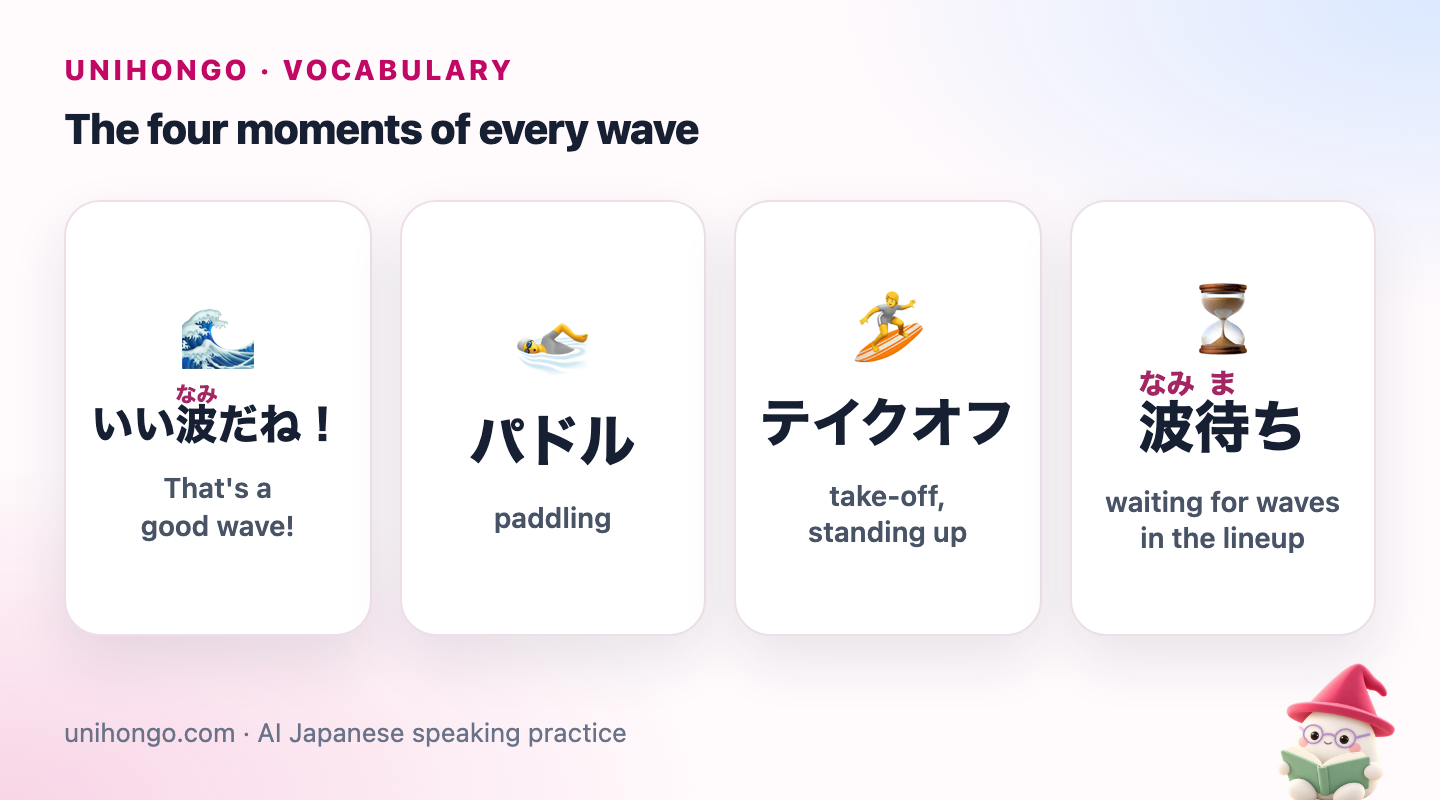
Every ride follows the same steps: you wait for a wave, paddle to catch it, stand up and ride. Japanese surfers name these moments with a mix of native words and loanwords. Namimachi, wave waiting, is the time you spend sitting on your board in the lineup; padoru is paddling; teikuofu is the moment you stand up. Ii nami da ne, that's a good wave, is the line you will hear most often from the people next to you.
| Japanese | Romaji | Meaning |
|---|---|---|
| いい波だね! | Ii nami da ne! | That's a good wave! |
| パドル | padoru | paddling |
| テイクオフ | teikuofu | take-off, standing up |
| 波待ち | namimachi | waiting for waves in the lineup |
| 波に乗る | nami ni noru | to ride a wave |
| 沖に出る | oki ni deru | to paddle out |
| 立てた! | Tateta! | I stood up! (casual) |
Oki means the open water away from the shore, and oki ni deru, to go out to the oki, is how surfers say paddle out. The beach side is kishi or simply hamabe.
Boards, wetsuits and gear
Gear words are almost all katakana. A surfboard is sāfubōdo, usually shortened to bōdo, and surfers also say ita, plank, especially in shops and among friends. Rongu bōdo and shōto bōdo are long and short boards, and beginners usually start on a soft, wide board, sofuto bōdo.
A wetsuit is wettosūtsu, often just wetto. Japanese surf shops sell wetsuits by type: a fullsuit, furu sūtsu, covers the whole body for cold water, while a short-sleeve, short-leg suit is often called a supuringu, spring suit.
| Japanese | Romaji | Meaning |
|---|---|---|
| サーフボード | sāfubōdo | surfboard |
| 板 | ita | board (casual surfer word) |
| ウェットスーツ | wettosūtsu | wetsuit |
| リーシュコード | rīshu kōdo | leash |
| ワックス | wakkusu | board wax |
| フィン | fin | fin |
| 板を借りたいです。 | Ita o karitai desu. | I'd like to rent a board. |
| リーシュは付けましたか。 | Rīshu wa tsukemashita ka. | Instructor: Did you attach your leash? |
Wave size, wind and tide
The body-part wave scale is one of the most useful things to learn. It is used in surf reports, nami jōhō, and in conversation, and it measures the face of the wave against a surfer standing on the board. Ranges are normal: koshi mune means somewhere between waist and chest.
Wind and tide matter just as much. Ofushoa, offshore wind, blows from the land and makes waves clean; onshoa, onshore wind, blows from the sea and makes them messy. Uneri is swell, and setto is a set, the bigger waves that come in groups.
| Japanese | Romaji | Meaning |
|---|---|---|
| 今日は腰胸ぐらいです。 | Kyō wa koshi mune gurai desu. | Today it's about waist to chest. |
| オフショアで面がきれい。 | Ofushoa de men ga kirei. | Offshore wind, so the surface is clean. |
| うねりが入ってきた。 | Uneri ga haitte kita. | The swell is coming in. |
| 満潮 | manchō | high tide |
| 干潮 | kanchō | low tide |
| Word | Japanese | Rough wave height |
|---|---|---|
| Knee | hiza | Small, good for beginners |
| Thigh | momo | Small but rideable |
| Waist | koshi | Fun size for most surfers |
| Chest | mune | Good waves, some power |
| Shoulder | kata | Powerful for beginners |
| Head | atama | Big; atama ōbā is bigger than head height |
Men, surface, describes the face of the waves: men ga kirei, clean surface, is good; men ga arete iru, the surface is choppy, is bad. Surfers check the tide times as carefully as the wave size, because many spots work best at a certain tide.
Actions in the water
Some of the most expressive surfing words are about what goes wrong. Makareru, to be rolled up, is what happens when a wave tumbles you underwater, and it is used with sympathy and laughter: makareta! Dorufin surū, dolphin through, is the Japanese name for a duck dive under an incoming wave.
| Japanese | Romaji | Meaning |
|---|---|---|
| 巻かれた! | Makareta! | I got tumbled by the wave! |
| ドルフィンスルー | dorufin surū | duck dive |
| 波を待つ | nami o matsu | to wait for a wave |
| 波を逃した。 | Nami o nogashita. | I missed the wave. |
| パーリングしちゃった。 | Pāringu shichatta. | I nosedived. (the nose went under) |
| もっと前を見て! | Motto mae o mite! | Instructor: Look further ahead! |
| 今だ、パドル! | Ima da, padoru! | Instructor: Now, paddle! |
Pāringu, pearling, is when the nose of the board dives under the water and you fall forward. Instructors repeat a few short commands in every beginner lesson: padoru!, tatte!, stand up!, and mae o mite!, look ahead!
Lineup etiquette and maenori
Surf etiquette is international, and Japanese surfers take it seriously. The surfer closest to the peak, pīku, where the wave starts to break, has priority. Taking off in front of them is maenori, a drop-in, and it is the fastest way to make the lineup unfriendly. Local surfers, rōkaru, may also have unwritten customs at their home spot, so watch before you paddle out.
If you drop in by accident, pull off the wave and apologise clearly. A short, sincere sumimasen is enough, and most surfers will accept it. Beginners are expected to stay in the smaller, less crowded waves, away from the main peak.
| Japanese | Romaji | Meaning |
|---|---|---|
| すみません、前乗りしちゃいました。 | Sumimasen, maenori shichaimashita. | Sorry, I dropped in on you. |
| 気をつけます。 | Ki o tsukemasu. | I'll be careful. |
| ピークはどこですか。 | Pīku wa doko desu ka. | Where is the peak? |
| 初心者はどこで練習すればいいですか。 | Shoshinsha wa doko de renshū sureba ii desu ka. | Where should beginners practise? |
| 離岸流に気をつけて。 | Rigan ryū ni ki o tsukete. | Watch out for rip currents. |
Your first surf lesson
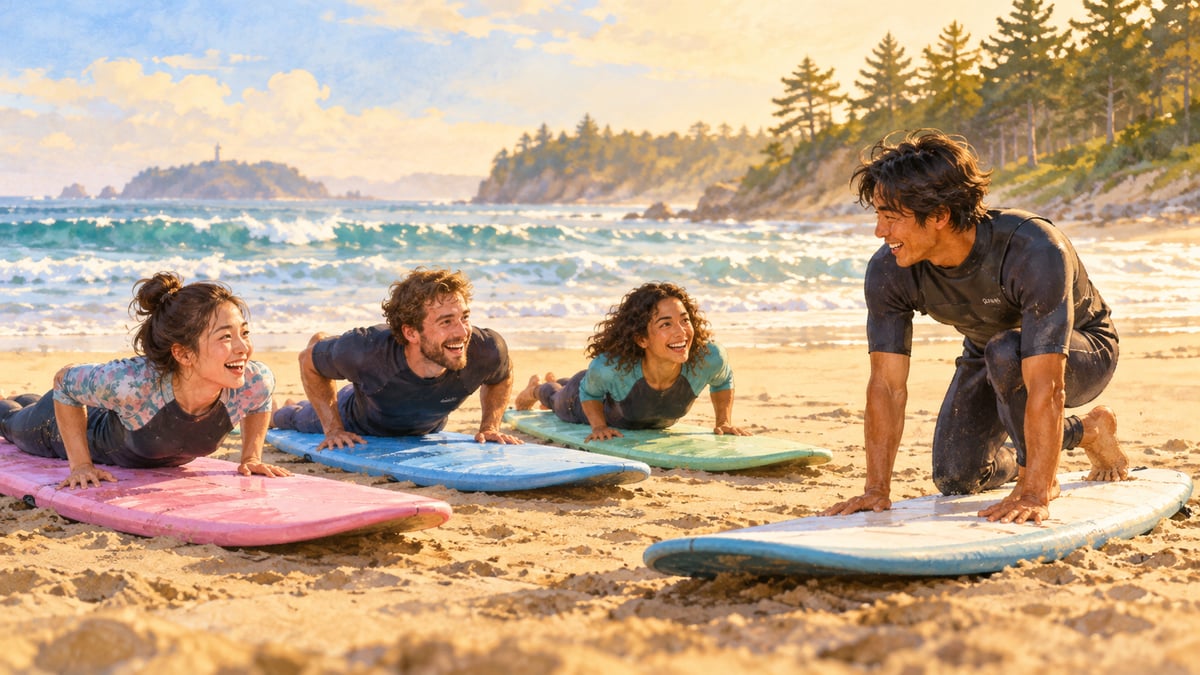
Surf schools in Japan usually start on the sand: how to lie on the board, how to paddle and how to pop up, before you go in the water. The staff will ask your height and foot size to choose a board and wetsuit, and whether you can swim. Answer simply and honestly; it is about your safety.
| Japanese | Romaji | Meaning |
|---|---|---|
| サーフィンは初めてです。 | Sāfin wa hajimete desu. | It's my first time surfing. |
| 泳ぐのは大丈夫です。 | Oyogu no wa daijōbu desu. | I can swim fine. |
| 身長は百七十センチです。 | Shinchō wa hyaku nanajū senchi desu. | My height is 170 centimetres. |
| もう一回見せてもらえますか。 | Mō ikkai misete moraemasu ka. | Could you show me once more? |
| 怖かったけど、楽しかったです! | Kowakatta kedo, tanoshikatta desu! | It was scary, but so much fun! |
Mini dialogue: chatting in the lineup
| Japanese | Romaji | Meaning |
|---|---|---|
| 今日はいい波ですね。 | Kyō wa ii nami desu ne. | You: The waves are good today. |
| 朝のほうがよかったですよ。風が入ってきました。 | Asa no hō ga yokatta desu yo. Kaze ga haitte kimashita. | Local surfer: It was better this morning. The wind has picked up. |
| よく来るんですか。 | Yoku kuru n desu ka. | You: Do you come here often? |
| 毎週末です。潮が上げてきたら、また良くなりますよ。 | Maishūmatsu desu. Shio ga agete kitara, mata yoku narimasu yo. | Local surfer: Every weekend. When the tide comes in, it'll get good again. |
| じゃあ、もう少し待ってみます。 | Jā, mō sukoshi matte mimasu. | You: Then I'll wait a bit longer and see. |
Lineup chat is usually short and friendly, and polite desu and masu forms are the safe choice with strangers. Shio ga michiru, the tide comes in, and shio ga hiku, the tide goes out, are the standard tide verbs, and surfers and anglers often say shio ga agete kita, the tide is rising. Keep talking to a minimum when a set is coming: everyone is focused on the waves.
Turn the wave scale into a speaking habit
Ask Mocchi for /vocab surfing words, starting with the wave sizes and the wind and tide words. Mocchi explains each one, notes which ones you confuse, such as kata and koshi, and can fold a short daily review into your plan before a surf trip.
Then rehearse the lesson in AI Sensei. Pick Haru-sensei, ask for the role of a surf school instructor, and answer questions about your level, height and swimming, then ask how to pop up. Ask the Sensei to speak more slowly on the first try.
Common learner mistakes
- Giving wave size in metres or feet. Japanese surfers will understand, but the body-part scale is what they use.
- Saying nami o noru. The particle is ni: nami ni noru.
- Paddling straight to the main peak on your first day. Stay in the smaller waves and watch first.
- Not apologising after a drop-in. Say sumimasen, maenori shichaimashita right away.
- Using sāfā for the board. A sāfā is the person; the board is bōdo or ita.