

The kanji and the taste behind shibui
Shibui is an i-adjective written 渋い. The kanji 渋 on its own is read shibu and refers to the astringent substance in some plants, above all the tannins in persimmons. It carries the water radical on the left, and in its compounds it often suggests something that does not flow smoothly: a taste that grips the tongue, traffic that will not move, a person who will not agree.
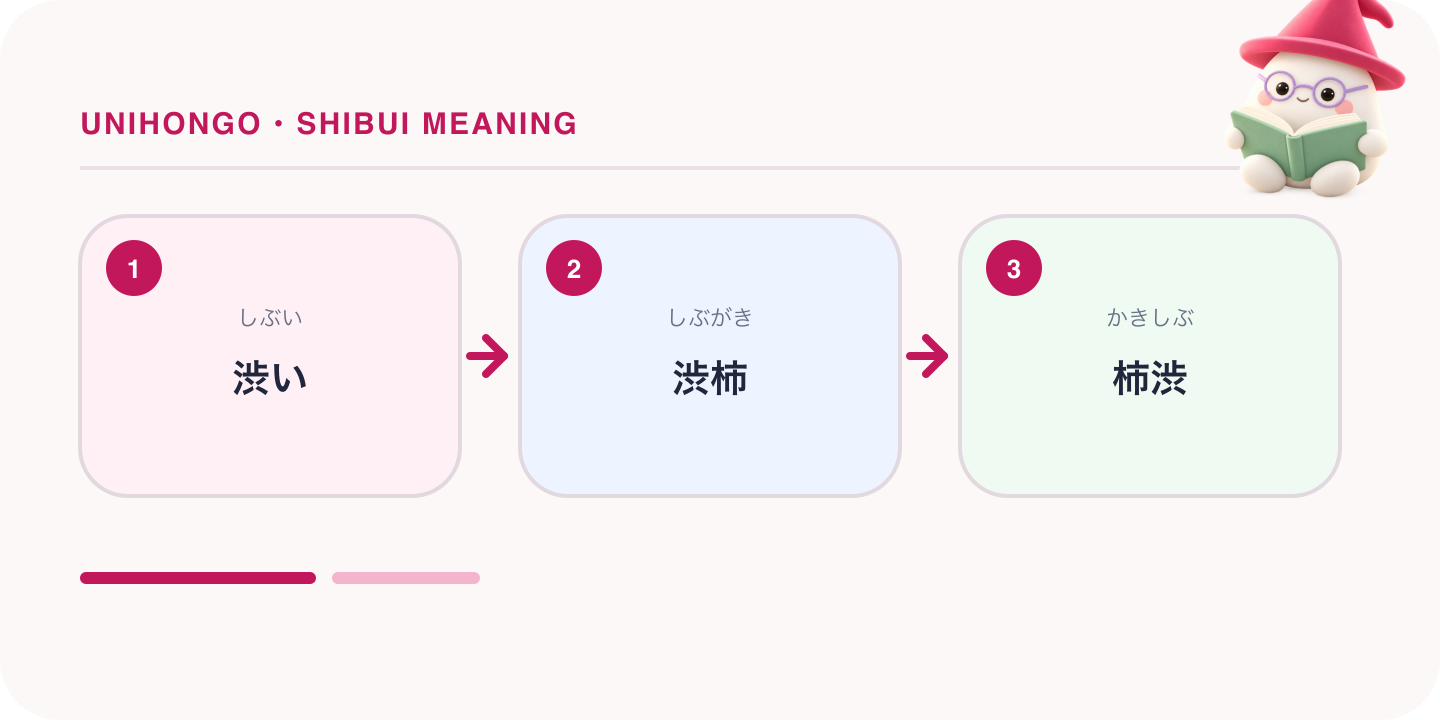
The classic example of the taste is the shibugaki, an astringent persimmon variety that is too harsh to eat raw. These persimmons are traditionally peeled and dried into hoshigaki, which removes the astringency and leaves them sweet. The persimmon juice itself, kakishibu, has long been used as a dye and a protective coating for paper, wood and fabric, which gives it a brownish tone that many people still associate with the word.
When a Japanese person tastes something shibui, they mean the drying, slightly rough feeling on the tongue and gums. Over-brewed green tea, young red wine and unripe fruit are all described this way.
| Word | Reading | Meaning |
|---|---|---|
| 渋い | shibui | Astringent; understated; sullen; stingy |
| 渋 | shibu | Astringent substance, especially persimmon tannin |
| 渋柿 | shibugaki | Astringent persimmon |
| 柿渋 | kakishibu | Fermented persimmon juice used as dye and coating |
| 渋み | shibumi | Astringency; refined, mellow depth |
| 渋さ | shibusa | The quality of being shibui |
Shibui as a taste word
Food and drink are where you hear shibui most literally. Japanese tea drinkers pay close attention to the balance of umami, sweetness, bitterness and astringency, and a pot of sencha left to steep too long becomes shibui. Wine descriptions in Japanese also use shibumi for tannins, and a cheap unripe fruit can simply be shibukute taberarenai, too astringent to eat.
Shibui and nigai, bitter, are often confused by learners. Bitterness is a flavour; astringency is a sensation of dryness and grip. Black coffee is mainly nigai, while strong tea tends to be both. When you are not sure, describing the feeling helps: kuchi no naka ga kawaku kanji, a feeling like your mouth is drying out.
| Japanese | Romaji | Meaning |
|---|---|---|
| このお茶、ちょっと渋いね。 | Kono o-cha, chotto shibui ne. | This tea is a bit astringent. |
| 長く淹れすぎて渋くなった。 | Nagaku iresugite shibuku natta. | I let it steep too long and it went astringent. |
| この柿は渋くて食べられない。 | Kono kaki wa shibukute taberarenai. | This persimmon is too astringent to eat. |
| 渋みのある赤ワインが好きです。 | Shibumi no aru aka wain ga suki desu. | I like red wine with some tannin. |
| 苦いというより渋いです。 | Nigai to iu yori shibui desu. | It's more astringent than bitter. |
Shibui as praise: understated and quietly cool
The meaning that travelled abroad is the aesthetic one. Something shibui is restrained rather than flashy, mature rather than cute, and good in a way you notice slowly. Dark indigo, charcoal, deep brown and moss green are shibui colours; neon pink is not. A plain leather wallet that has aged well, a jazz record from a small label and a quiet old coffee shop can all be shibui.
People are called shibui too, and this is one of the most common uses today. A shibui actor is usually an older man or woman with presence and depth rather than glamour. A shibui choice at karaoke is an older enka or folk song rather than the latest hit. When a friend says shibui shumi da ne, you have mature taste, it is usually admiring, with a slight hint of surprise that someone your age likes that sort of thing.
In sport and games, a shibui play is an unflashy but clever move that experts appreciate: a well-judged bunt, a defensive tackle, a quiet pass that sets up a goal. The common thread is excellence that does not shout.
| Japanese | Romaji | Meaning |
|---|---|---|
| その色、渋いですね。 | Sono iro, shibui desu ne. | That colour is really tasteful. |
| 渋い趣味だね。 | Shibui shumi da ne. | You have mature, refined taste. |
| あの俳優、年を取って渋くなった。 | Ano haiyū, toshi o totte shibuku natta. | That actor has become more distinguished with age. |
| 渋い選曲ですね。 | Shibui senkyoku desu ne. | What a cool, understated song choice. |
| 渋いプレーだった。 | Shibui purē datta. | That was a subtle, skilful play. |
| この喫茶店、渋い雰囲気だね。 | Kono kissaten, shibui fun'iki da ne. | This coffee shop has a quietly cool atmosphere. |
The less flattering meanings: sullen, stingy and strict
Shibui has a negative side that learners need to recognise. A shibui kao is a sour or displeased face, the expression of someone who has just tasted something unpleasant or heard bad news. Shibui kao o suru means to pull a face, often to show reluctance without saying no.
Shibui can also describe a person or organisation that is tight with money or approval. A company whose bonuses are shibui is ungenerous; a teacher whose marking is shibui is strict; a shibui reaction from a client is a lukewarm one. In business Japanese you may hear that the response was shibui, meaning the other side did not look keen.
Context almost always makes the meaning obvious. If the subject is a person's clothes, taste or presence, it is praise. If it is a face, money, a score or a reaction, it is not.
| Japanese | Romaji | Meaning |
|---|---|---|
| 部長が渋い顔をしていた。 | Buchō ga shibui kao o shite ita. | The department head looked displeased. |
| うちの会社はボーナスが渋い。 | Uchi no kaisha wa bōnasu ga shibui. | My company is stingy with bonuses. |
| あの先生は採点が渋い。 | Ano sensei wa saiten ga shibui. | That teacher is a strict marker. |
| お客さんの反応は渋かったです。 | O-kyakusan no hannō wa shibukatta desu. | The client's reaction was lukewarm. |
| 買取の査定が渋かった。 | Kaitori no satei ga shibukatta. | The trade-in valuation was stingy. |
Shibushibu: doing things reluctantly
Repeat the stem and you get shibushibu, written 渋々, an adverb meaning reluctantly or grudgingly. It pictures someone going ahead with a face like they have bitten into an astringent persimmon. It is common in speech, stories and news reports, and often pairs with verbs of agreeing, accepting and going.
A related verb is shiburu, to hold back or be reluctant, as in okane o shiburu, to be unwilling to spend money, or henji o shiburu, to be slow to give an answer. The noun jūtai, traffic congestion, uses the same kanji for the idea of something not moving smoothly, and it is one of the most useful compounds for daily life in Japan.
| Japanese | Romaji | Meaning |
|---|---|---|
| 渋々引き受けた。 | Shibushibu hikiuketa. | I took it on reluctantly. |
| 子どもは渋々宿題を始めた。 | Kodomo wa shibushibu shukudai o hajimeta. | The child grudgingly started their homework. |
| 彼は渋々承諾した。 | Kare wa shibushibu shōdaku shita. | He agreed reluctantly. |
| お金を出し渋る。 | Okane o dashishiburu. | To be reluctant to pay. |
| 高速道路が渋滞している。 | Kōsoku dōro ga jūtai shite iru. | The expressway is congested. |
| 渋滞に巻き込まれた。 | Jūtai ni makikomareta. | I got caught in traffic. |
Notice the reading of 渋滞: it is jūtai, not shibutai. In this compound the kanji 渋 takes its on-reading jū, a classic trap for learners who have just learned shibui and try to read every 渋 as shibu.
Shibusa, shibumi and the Western idea of shibui
The nouns shibusa and shibumi both turn the adjective into a quality. Shibusa is the plain nominal form, the shibui-ness of something, and appears in phrases such as otona no shibusa, grown-up understated cool. Shibumi has two uses: the astringent element in a taste, and a refined, mellow depth in a person or thing. In everyday Japanese you will meet the taste meaning more often.
Shibui became known to Western designers in the twentieth century, partly through writing about Japanese folk crafts, where plain, sturdy, anonymous objects were praised for their shibusa, and partly through American design magazines that promoted it as a style. In English it came to mean a specific look: muted colours, natural materials and simple forms.
That picture is fair, but narrower than the Japanese word. In Japan, shibui is not a style you pick from a catalogue so much as a judgement you make about something that feels mature and quietly good. It is also used every day about tea, faces, bosses and traffic, which the design meaning leaves out.
| Western usage | Japanese usage |
|---|---|
| A design style of muted, natural objects | A judgement of quiet, mature quality in things and people |
| Always positive | Positive or negative depending on the subject |
| Rarely about taste in food | Very often about tea, fruit and wine |
| Sounds refined and exotic | Sounds casual; you hear it among friends every day |
Related words and how they differ
Shibui sits in a family of Japanese words for style and taste. Its natural opposite is hade, flashy or showy, and its gentler cousin is jimi, plain or low-key. Jimi can be neutral or slightly negative, like dull, while shibui adds a sense of quality and depth. Iki is a stylish, sophisticated chic associated with Edo townspeople, and aji ga aru means something has character from age or use.
| Japanese | Romaji | Meaning |
|---|---|---|
| 派手 | hade | Flashy, showy, loud |
| 地味 | jimi | Plain, low-key, sometimes dull |
| 粋 | iki | Chic, stylish, sophisticated |
| 味がある | aji ga aru | Has character or charm |
| 落ち着いた色 | ochitsuita iro | A calm, muted colour |
| 大人っぽい | otonappoi | Grown-up, mature-looking |
| 侘び寂び | wabi-sabi | The quiet beauty of simplicity and age |
Using shibui naturally in conversation
Shibui is one of the easiest aesthetic words for learners to use because it is ordinary, friendly and flexible. Use it about clothes, music, cafés, older actors, craft objects and choices that show taste. Add ne to share the feeling, and it becomes a small compliment that invites a conversation about why the other person likes that thing.
Be careful using it about a person's appearance directly, especially a younger person. Calling a twenty-year-old shibui can be heard as saying they seem older than they are. It is safer to praise their choice: sono tokei, shibui desu ne, that watch is very understated and cool.
| Japanese | Romaji | Meaning |
|---|---|---|
| いい意味で渋いですね。 | Ii imi de shibui desu ne. | It's understated in a good way. |
| 渋いお店を知っていますね。 | Shibui o-mise o shitte imasu ne. | You know some quietly great places. |
| 年を取ったら渋い大人になりたい。 | Toshi o tottara shibui otona ni naritai. | When I'm older I want to be a quietly cool adult. |
| この器、渋くていいですね。 | Kono utsuwa, shibukute ii desu ne. | This dish has a lovely subdued feel. |
| 渋すぎて若い人には分からないかも。 | Shibusugite wakai hito ni wa wakaranai kamo. | It might be too understated for young people to get. |
Ii imi de, in a good way, is a useful safety net. Adding it before shibui removes any doubt that you might mean sullen or stingy.