

The kanji: delicious plus taste
Umami is made of two parts. Umai is an adjective meaning delicious, tasty, and it can be written 旨い or 美味い. The second part, mi, written 味, means taste or flavour, and appears in words like aji, taste, ajimi, tasting food while cooking, and shumi, a hobby, which is literally a taste for something.
Japanese turns many adjectives into nouns with the suffix mi. Amai, sweet, becomes amami, sweetness. Nigai, bitter, becomes nigami, bitterness. In the same way umai becomes umami, the quality of tastiness. Knowing this pattern helps you understand a whole family of flavour nouns at once.
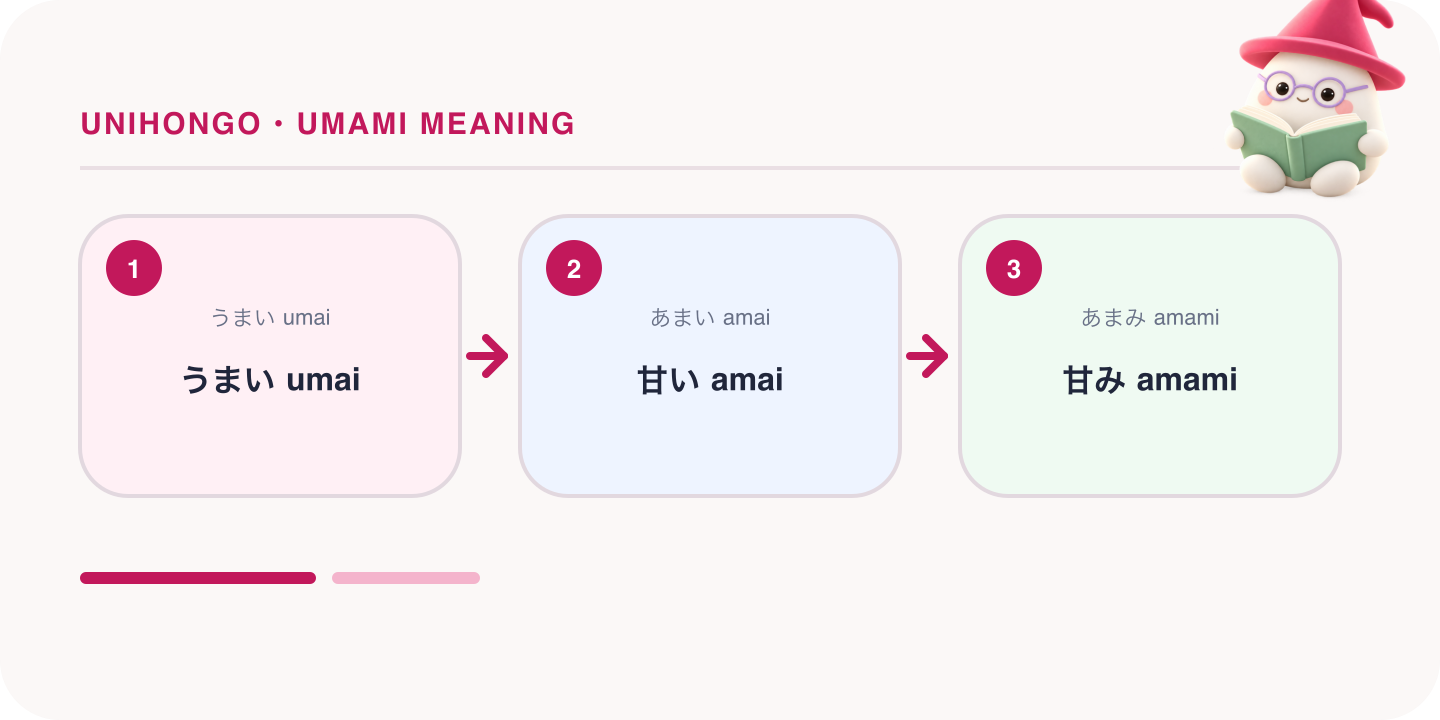
| Adjective | Meaning | Noun with mi | Meaning of noun |
|---|---|---|---|
| うまい umai | Delicious | うま味 umami | Savoury taste, tastiness |
| 甘い amai | Sweet | 甘み amami | Sweetness |
| 苦い nigai | Bitter | 苦み nigami | Bitterness |
| 辛い karai | Spicy hot | 辛み karami | Spiciness |
| 酸っぱい suppai | Sour | 酸味 sanmi | Acidity, sourness |
Umai vs oishii
Both umai and oishii mean delicious. Oishii is the safe, polite, neutral choice for anyone in any situation. Umai is more casual and direct, and traditionally sounds more masculine, although many people of all genders use it among friends, especially with an exclamation: umai!
Umai written 上手い also means skilful, as in e ga umai, good at drawing. The two meanings share a sense of something done well. In polite conversation, including with a chef or host, stick to oishii desu and use umai with friends.
| Japanese | Romaji | Meaning |
|---|---|---|
| このラーメン、うまい! | Kono rāmen, umai! | This ramen is great! |
| とてもおいしいです。 | Totemo oishii desu. | It's very delicious. |
| 彼は料理がうまい。 | Kare wa ryōri ga umai. | He's good at cooking. |
| うま味がたっぷりですね。 | Umami ga tappuri desu ne. | It's full of umami, isn't it. |
Where the word came from: kombu dashi
In 1908, the Japanese chemist Ikeda Kikunae isolated glutamate from kombu, the kelp used for dashi, and argued that its taste was distinct from the four tastes recognised at the time. He proposed the name umami for it, and his work led to the production of monosodium glutamate as a seasoning.
Later researchers in Japan identified other umami substances: inosinate, abundant in katsuobushi, the dried and smoked bonito used for dashi, and guanylate, found in dried shiitake. Cooks had long combined kombu with katsuobushi, and science later showed that glutamate and these other substances strengthen each other, which is why a combined dashi tastes deeper than either ingredient alone.
Umami took a long time to be accepted internationally as a basic taste, but it is now standard in food science, and the Japanese word is used in English, French, Spanish and many other languages without translation.
- Glutamate, gurutamin-san: kombu, tomatoes, aged cheese, soy sauce, miso.
- Inosinate, inoshin-san: katsuobushi, niboshi, meat and fish.
- Guanylate, guaniru-san: dried shiitake and some other dried mushrooms.
Dashi vocabulary
If umami has a home, it is dashi, the stock at the base of miso soup, noodle broths, simmered dishes and many sauces. Japanese has a precise vocabulary for it. Making dashi is dashi o toru, literally taking dashi, because the flavour is extracted from the ingredients.
Ichiban dashi, first dashi, is the delicate first extraction, used for clear soups. Niban dashi, second dashi, is made by simmering the used ingredients again for stronger, everyday cooking. Awase dashi combines two ingredients, usually kombu and katsuobushi. Many households today use dashi no moto, instant granules, or dashi packs, and that is completely normal.
| Japanese | Romaji | Meaning |
|---|---|---|
| 昆布でだしを取ります。 | Konbu de dashi o torimasu. | I make dashi from kombu. |
| だしが効いていますね。 | Dashi ga kiite imasu ne. | You can really taste the dashi. |
| このつゆは鰹だしですか。 | Kono tsuyu wa katsuo dashi desu ka. | Is this broth made with bonito dashi? |
| Japanese | Reading | Meaning |
|---|---|---|
| 出汁 / だし | dashi | Japanese stock |
| 昆布 | konbu / kombu | Kelp |
| 鰹節 | katsuobushi | Dried, smoked bonito, shaved into flakes |
| 煮干し | niboshi | Small dried sardines |
| 干し椎茸 | hoshi shiitake | Dried shiitake mushrooms |
| 合わせだし | awase dashi | Dashi combining two ingredients |
| 一番だし | ichiban dashi | First, delicate extraction |
| だしの素 | dashi no moto | Instant dashi granules |
The basic taste words: amai, karai, suppai, nigai, shoppai
Japanese describes the basic tastes with short, common adjectives. They are among the first food words children learn, and you will hear them constantly in restaurants, supermarkets and cooking shows.
Karai needs special care. Its main meaning is spicy hot, as with chilli or wasabi, but it can also mean salty, especially in western Japan and in the compound shiokarai. If you want to be clear about chilli heat, pirikara, pleasantly spicy, and gekikara, extremely spicy, are common on menus.
| Japanese | Romaji | Meaning |
|---|---|---|
| 甘い | amai | Sweet |
| 辛い | karai | Spicy hot; salty in some contexts |
| 酸っぱい | suppai | Sour |
| 苦い | nigai | Bitter |
| しょっぱい | shoppai | Salty |
| 塩辛い | shiokarai | Salty |
| このカレー、ちょっと辛すぎる。 | Kono karē, chotto karasugiru. | This curry is a bit too spicy. |
| 味噌汁が少ししょっぱいです。 | Misoshiru ga sukoshi shoppai desu. | The miso soup is a little salty. |
| 辛さは選べますか。 | Karasa wa erabemasu ka. | Can I choose the spice level? |
Amai also has figurative meanings: a lenient person is amai, and a naive idea is amai kangae. Nigai can describe a bitter memory, nigai omoide. Learning these extensions makes the core words stick.
Richness, lightness and koku
Beyond the basic tastes, Japanese food talk leans heavily on words for richness and lightness. Kotteri describes heavy, rich food such as thick pork-bone ramen; assari and sappari describe light, clean-tasting food. Many ramen shops let you choose between kotteri and assari broths.
Koku is a word for richness, body and depth, and koku ga aru, it has body, is a very common compliment for curry, stew, coffee and beer. Food scientists use the related term kokumi for a sense of richness and lingering depth linked to certain compounds, but in ordinary conversation people rarely say kokumi. Say koku ga aru and you will sound natural.
| Japanese | Romaji | Meaning |
|---|---|---|
| こってりしたラーメンが好きです。 | Kotteri shita rāmen ga suki desu. | I like rich ramen. |
| あっさりした味ですね。 | Assari shita aji desu ne. | It has a light flavour, doesn't it. |
| さっぱりしたものが食べたい。 | Sappari shita mono ga tabetai. | I want something light and refreshing. |
| このカレーはコクがありますね。 | Kono karē wa koku ga arimasu ne. | This curry has real depth. |
| 味が濃いです。 | Aji ga koi desu. | The flavour is strong. |
| 味が薄いです。 | Aji ga usui desu. | The flavour is weak. |
How Japanese people use umami today
In everyday Japanese, umami appears mostly in cooking and food writing. People say that simmering draws out the umami, that dried ingredients concentrate it, or that a good tomato is packed with it. Supermarket packaging and recipe sites use umami seibun, umami components, and umami ga gyūtto, umami packed in tight.
The word can also be figurative. Umami can mean the profitable or attractive part of something, as in a deal with a lot of umami for one side. The related umai hanashi means a deal that sounds too good to be true, and people warn each other: umai hanashi ni wa ura ga aru, there is a catch behind every sweet deal.
| Japanese | Romaji | Meaning |
|---|---|---|
| じっくり煮ると、うま味が出ます。 | Jikkuri niru to, umami ga demasu. | If you simmer it slowly, the umami comes out. |
| 干すことでうま味が凝縮されます。 | Hosu koto de umami ga gyōshuku saremasu. | Drying concentrates the umami. |
| トマトはうま味成分が多い。 | Tomato wa umami seibun ga ōi. | Tomatoes are rich in umami components. |
| うまい話には裏がある。 | Umai hanashi ni wa ura ga aru. | There's a catch behind every too-good deal. |
Going beyond oishii
Learners often use oishii for everything. It is never wrong, but combining it with one specific word makes your Japanese sound far more natural and makes the cook happier. Try naming one quality of the food, then giving your overall verdict.
- Texture words: sakusaku, crisp and flaky; mochimochi, chewy and springy; torotoro, meltingly soft; fuwafuwa, light and fluffy.
- Aroma: kaori ga ii, it smells lovely; kōbashii, toasty, roasted aroma.
- Temperature and freshness: atsuatsu, piping hot; shinsen, fresh.
- Balance: amasa to shoppasa no baransu ga ii, the balance of sweet and salty is good.
- Umami: umami ga fukai, the umami is deep; dashi ga kiite iru, the dashi comes through.
A natural pattern is one detail plus oishii: sakusaku de oishii, crisp and delicious, or dashi ga kiite ite oishii desu, the dashi really comes through and it's delicious.