
What gacha means, in four words
A gacha is a draw where you pay, with money or in-game currency, and receive a random character or item. The name was borrowed straight from the capsule toy machine: you put in a coin, turn the handle with a gacha-gacha clatter, and take whatever capsule falls out. Mobile games copied the thrill and kept the word.
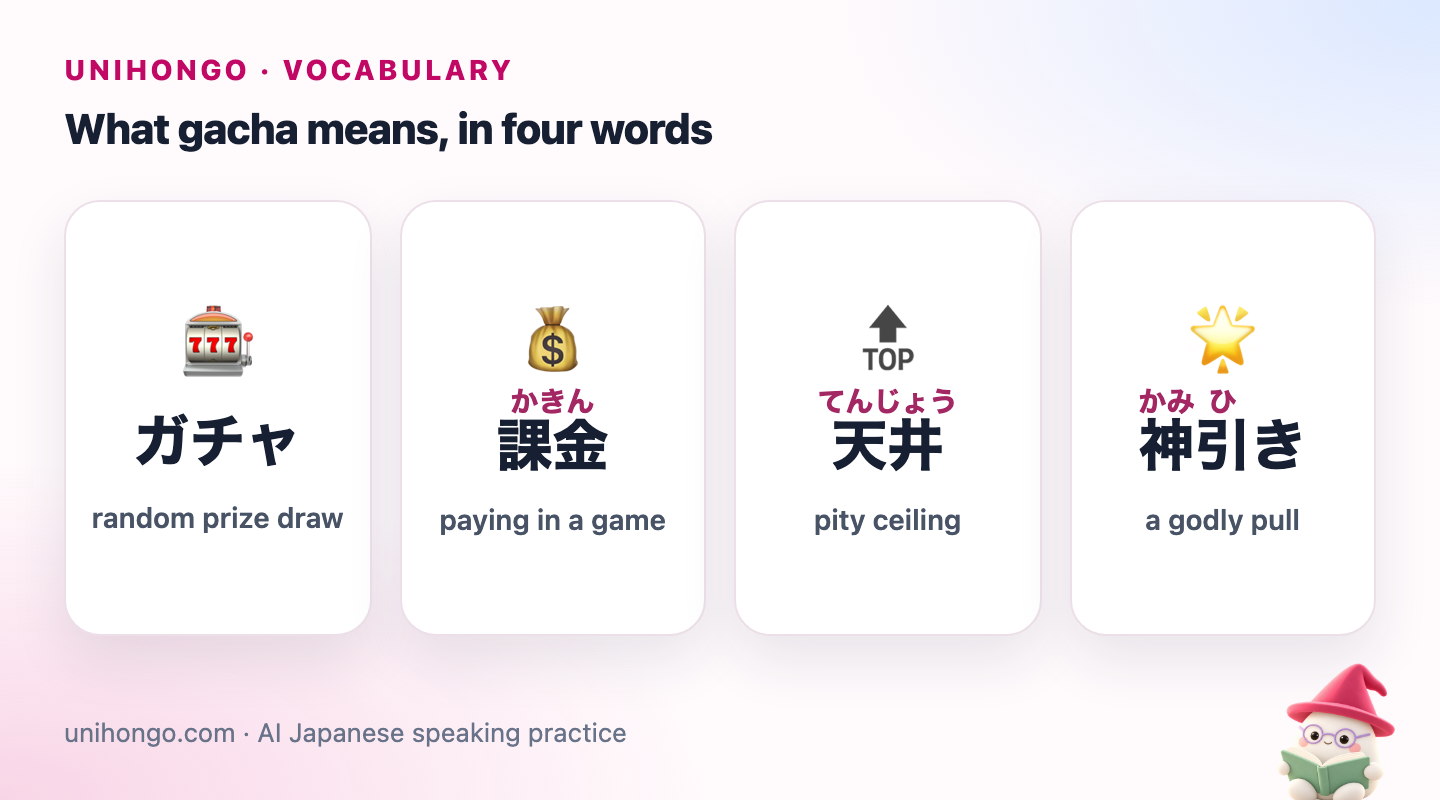
| Japanese | Romaji | Meaning |
|---|---|---|
| ガチャ | gacha | random prize draw |
| 課金 | kakin | paying in a game |
| 天井 | tenjō | pity ceiling |
| 神引き | kamihiki | a godly pull |
| 無課金 | mukakin | playing without paying |
| 爆死 | bakushi | spending big, getting nothing |
The original: gachagacha, gachapon, kapuseru toi
Capsule toy machines stand in rows in Japanese stations, shopping centres and specialist shops. Most take hundred-yen coins, and the prizes range from tiny food models to animal figures in odd poses. Adults buy them as happily as children.
Three names are in use. Gachagacha (ガチャガチャ) is the most common in conversation. Gachapon (ガチャポン) adds the pon of the capsule landing. Toy companies use their own registered names for their machines, so the neutral term on signs and in news reports is kapuseru toi (カプセルトイ). When you get a toy you already have, the word is kabutta (かぶった), it overlapped.
| Japanese | Romaji | Meaning |
|---|---|---|
| ガチャガチャ | gachagacha | capsule toy machine |
| ガチャポン | gachapon | capsule toy machine |
| カプセルトイ | kapuseru toi | capsule toy (neutral term) |
| ガチャガチャを回す | gachagacha o mawasu | to turn the capsule machine |
| 何が出るかな。 | Nani ga deru ka na. | I wonder what will come out. |
| またかぶった。 | Mata kabutta. | I got a duplicate again. |
| 百円玉に両替できますか。 | Hyaku-en dama ni ryōgae dekimasu ka. | Can I get change in 100-yen coins? |
Pulling: hiku, mawasu, tanpatsu, jūren
Two verbs describe using a gacha. Hiku (引く), to pull or draw, is the verb for drawing lots and cards. Mawasu (回す), to turn, comes from the handle of the real machine. Both are normal: gacha o hiku, gacha o mawasu.
A single pull is tanpatsu (単発), literally a single shot. Ten at once is jūren (10連), ten in a row. Games advertise a featured character as pikkuappu, and the drop rate is kakuritsu (確率), the ordinary word for probability.
| Japanese | Romaji | Meaning |
|---|---|---|
| ガチャを引く | gacha o hiku | to pull the gacha |
| 単発 | tanpatsu | a single pull |
| 10連 | jūren | a ten-pull |
| 確率 | kakuritsu | drop rate, probability |
| ピックアップ | pikkuappu | featured, rate-up |
| 限定キャラ | gentei kyara | limited character |
| 推しが出ない。 | Oshi ga denai. | My favourite won't drop. |
Paying: kakin, mukakin and everything between
Kakin (課金) originally describes what the company does: it charges a fee. Players turned it around, so kakin suru now means to pay, and a kakin-sha is a paying player. The word has no moral tone on its own; it is how much that gets discussed.
Mukakin (無課金) uses mu (無), without, the same kanji as in muryō, no charge. Between nothing and a lot, players joke about bikakin (微課金), spending a tiny amount. In-game currency is often just called ishi (石), stones, whatever the game's official name for it is.
| Japanese | Romaji | Meaning |
|---|---|---|
| 課金する | kakin suru | to spend money in a game |
| 微課金 | bikakin | spending just a little |
| 石 | ishi | gems (literally stones) |
| 無課金で遊んでいます。 | Mukakin de asonde imasu. | I play without spending. |
| 今月はもう課金しません。 | Kongetsu wa mō kakin shimasen. | I won't spend any more this month. |
Luck: kamihiki, bakushi and the ceiling
Kamihiki (神引き) joins kami, god, to hiki, a pull: a draw so lucky it feels divine. Its opposite is bakushi (爆死), literally death by explosion, net slang for a spectacular failure. In gacha it means pouring in resources and walking away with nothing you wanted.
Tenjō (天井) softens the pain. It is the pull count at which the game hands you the featured prize regardless of luck. Outside games, tenjō is simply a ceiling, and the idiom tenjō shirazu (天井知らず), knowing no ceiling, describes prices that keep climbing.
| Japanese | Romaji | Meaning |
|---|---|---|
| 神引きした! | Kamihiki shita! | I got a godly pull! |
| また爆死した。 | Mata bakushi shita. | I blew everything and got nothing again. |
| 天井まで回した。 | Tenjō made mawashita. | I pulled all the way to the pity. |
| 天井まであと10連です。 | Tenjō made ato jūren desu. | Ten more pulls until the pity. |
| この部屋は天井が高い。 | Kono heya wa tenjō ga takai. | This room has a high ceiling. |
The first three lines are plain-form slang for friends and social media. To a non-player or a senior colleague, say atarimashita, I won it, or zenzen dame deshita, no luck at all.
Risemara, SSR, rogubo: the abbreviations
Japanese gaming slang loves four-beat clippings. Risemara (リセマラ) is risetto marason, reset marathon: reinstalling a new game again and again to repeat the opening pulls until a strong character appears. Rogubo (ログボ) is roguin bōnasu, the login bonus you collect each day.
Rarity is shown in Latin letters. R is rare, SR super rare, and SSR sits above them, usually explained as Super Special Rare. Other games count stars instead, read hoshi: hoshi go is five stars.
| Japanese | Romaji | Meaning |
|---|---|---|
| リセマラ | risemara | rerolling a new account |
| ログボ | rogubo | login bonus |
| SSRキャラ | esu esu āru kyara | a top-rarity character |
| 星5 | hoshi go | five-star |
| イベント | ibento | event |
| スタミナ | sutamina | stamina, energy to play stages |
| 周回 | shūkai | farming, repeating a stage |
| スタミナが足りない。 | Sutamina ga tarinai. | I don't have enough stamina. |
| イベントは今日までです。 | Ibento wa kyō made desu. | The event ends today. |
Gacha outside games: when life is a random draw
The word has become a general metaphor for luck you cannot control. The best-known example is oya gacha (親ガチャ), the parent gacha: the idea that the family you are born into is a random pull. It became a much-discussed buzzword in Japan in the early 2020s, and not everyone likes it.
The pattern is productive. New employees talk about haizoku gacha (配属ガチャ), the lottery of which department they are assigned to. You can attach gacha to almost any noun and be understood, usually with a wry tone. It is slang, so keep it for casual talk.
| Japanese | Romaji | Meaning |
|---|---|---|
| 親ガチャ | oya gacha | the luck of which parents you get |
| 配属ガチャ | haizoku gacha | the luck of your job placement |
| 運がいい | un ga ii | to be lucky |
| 運が悪い | un ga warui | to be unlucky |