
One sound, five kanji
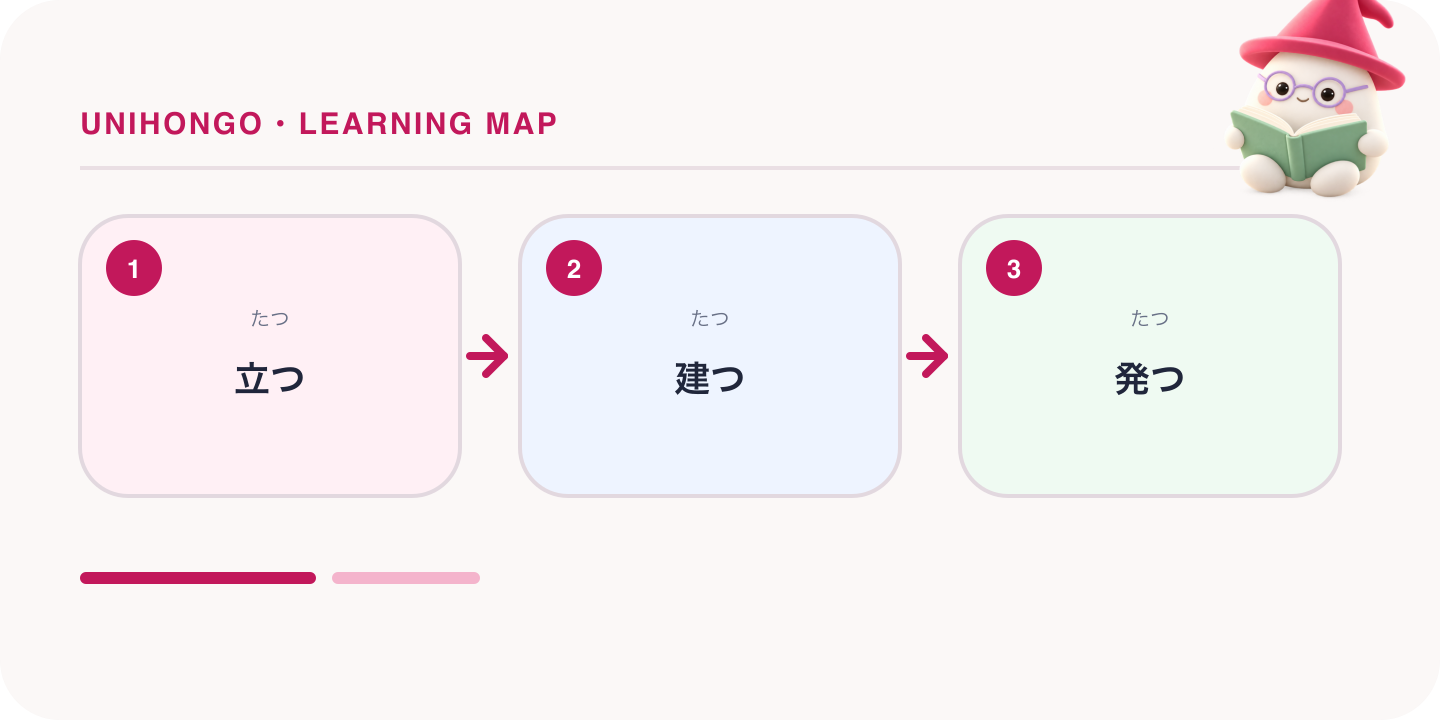
There is a single image at the bottom of most of these verbs: something coming upright or coming into being. In 立つ a person, a rumour or a plan rises. In 建つ a building rises. In 発つ a traveller sets out. 経つ belongs to a different root and simply means passing through, applied to time. 断つ is the odd one out in every way: it is transitive, it takes o, and it means severing something rather than raising it.
Grammatically all of them are godan verbs ending in tsu, and they conjugate identically: tachimasu, tachimashita, tatanai, tatte, tatta. The te form is where beginners stumble, because the tsu drops and a small tsu appears, giving tatte rather than tachite. The potential form is tateru, which is spelled and pronounced exactly like the transitive verb 立てる, so kono ki wa mada tateru can mean either this tree can still stand or someone can still stand it up. Context decides.
Since spoken Japanese shows you no kanji, the practical skill is reading the noun. Jikan, nen and tsukihi mean time is passing. Ie, biru and manshon mean a building is going up. Uwasa, yotei and mitōshi mean something has taken shape. Ashi, seki and mae ni mean somebody is standing. Learn the collocations and the kanji sort themselves out.
The full sense table
| Japanese | Romaji | Meaning |
|---|---|---|
| 家が建ちました。 | Ie ga tachimashita. | A house went up. (建つ) |
| 時間が経ちました。 | Jikan ga tachimashita. | Time has passed. (経つ) |
| 席を立ちました。 | Seki o tachimashita. | I got up from my seat. (立つ) |
| 東京を発ちました。 | Tōkyō o tachimashita. | I left Tokyo. (発つ) |
| お酒を断ちました。 | O-sake o tachimashita. | I gave up alcohol. (断つ) |
| 予定が立ちました。 | Yotei ga tachimashita. | The schedule has come together. (立つ) |
| Sense | Kanji | Transitivity | Example |
|---|---|---|---|
| Stand, be standing | 立 | Intransitive, ga | 前に立ちます mae ni tachimasu |
| Leave one's seat | 立 | Intransitive, o for the place | 席を立ちます seki o tachimasu |
| Smoke or steam rises | 立 | Intransitive, ga | 湯気が立ちます yuge ga tachimasu |
| Waves get up | 立 | Intransitive, ga | 波が立ちます nami ga tachimasu |
| A rumour spreads | 立 | Intransitive, ga | 噂が立ちます uwasa ga tachimasu |
| A plan takes shape | 立 | Intransitive, ga | 予定が立ちます yotei ga tachimasu |
| Goosebumps rise | 立 | Intransitive, ga | 鳥肌が立ちます torihada ga tachimasu |
| Be useful | 立 | Set phrase with ni | 役に立ちます yaku ni tachimasu |
| Get angry | 立 | Set phrase with ga | 腹が立ちます hara ga tachimasu |
| Stand out, be conspicuous | 目立 | Intransitive, ga | よく目立ちます yoku medachimasu |
| A building goes up | 建 | Intransitive, ga | 家が建ちます ie ga tachimasu |
| Time passes | 経 | Intransitive, ga | 三年が経ちます san-nen ga tachimasu |
| Depart from a place | 発 | Intransitive, o for the origin | 東京を発ちます Tōkyō o tachimasu |
| Cut off a habit or supply | 断 | Transitive, o | お酒を断ちます o-sake o tachimasu |
| Sever for good | 絶 | Transitive, o | 消息を絶ちます shōsoku o tachimasu |
| Stand something upright | 立て | Transitive, o | 傘を立てます kasa o tatemasu |
| Make a plan | 立て | Transitive, o | 計画を立てます keikaku o tatemasu |
| Set a goal | 立て | Transitive, o | 目標を立てます mokuhyō o tatemasu |
| Make a sound | 立て | Transitive, o | 音を立てます oto o tatemasu |
| Lose one's temper | 立て | Transitive set phrase, o | 腹を立てます hara o tatemasu |
| Put something to use | 役立て | Transitive, o | 経験を役立てます keiken o yakudatemasu |
| Build a house | 建て | Transitive, o | 家を建てます ie o tatemasu |
| Stand up from sitting | 立ち上が | Intransitive, ga | 急に立ち上がります kyū ni tachiagarimasu |
| Stop walking | 立ち止ま | Intransitive, ga | 立ち止まります tachidomarimasu |
| Drop in somewhere | 立ち寄 | Intransitive, ni | 店に立ち寄ります mise ni tachiyorimasu |
| Get back on one's feet | 立ち直 | Intransitive, ga | 失敗から立ち直ります shippai kara tachinaorimasu |
| Be composed of | 成り立 | Intransitive, kara | 三部から成り立ちます san-bu kara naritachimasu |
Read the transitivity column together with the particle. Everything intransitive takes ga for the thing that rises, appears or elapses, and everything in the tateru row takes o for the thing a person acts on. The two exceptions are worth memorising as shapes rather than rules: seki o tatsu and Tōkyō o tatsu use o for the place left behind, exactly as basu o orimasu does.
Notice that 断つ sits in the transitive column while sounding like all the intransitive ones. That is the single most useful fact in the table, because it means a sentence with o in front of tachimasu is either about leaving a place or about cutting something off, and nothing else.
Since nothing in the sound distinguishes these verbs, train the collocation rather than the kanji. Say the six lines below aloud and notice that the only clue is the noun and the particle in front of the verb. When you can hear the difference between ie ga tachimashita and jikan ga tachimashita without translating, the whole family is under control.
Standing, rising and taking shape with 立つ
The physical sense is the one beginners meet first, and it behaves as expected: mae ni tatte kudasai, ichi-jikan tatte imashita. The state of standing uses tatte imasu, since tachimasu on its own describes the moment of rising rather than the position. Seki o tatsu is the exception in particle terms, marking the seat you get up from with o.
From there the verb extends to anything that rises into view. Steam and smoke rise, waves get up, a rumour spreads, goosebumps come out. The extension that matters most in daily life is the planning one: yotei ga tatsu and mitōshi ga tatsu mean a schedule or an outlook has come together by itself, and the negative mitōshi ga tatanai is the standard way to say you cannot see how something will resolve.
| Japanese | Romaji | Meaning |
|---|---|---|
| 前に立ってください。 | Mae ni tatte kudasai. | Please stand at the front. |
| 電車で一時間立っていました。 | Densha de ichi-jikan tatte imashita. | I stood for an hour on the train. |
| 席を立って、ご挨拶しました。 | Seki o tatte, go-aisatsu shimashita. | I got up from my seat and greeted them. |
| 台所から湯気が立っています。 | Daidokoro kara yuge ga tatte imasu. | Steam is rising from the kitchen. |
| 風が強くて、波が立っています。 | Kaze ga tsuyokute, nami ga tatte imasu. | The wind is strong and the waves are up. |
| 変な噂が立っているようです。 | Hen na uwasa ga tatte iru yō desu. | It seems an odd rumour is going around. |
| やっと来月の予定が立ちました。 | Yatto raigetsu no yotei ga tachimashita. | Next month's schedule has finally come together. |
| 見通しが立たなくて、困っています。 | Mitōshi ga tatanakute, komatte imasu. | I cannot see how it will turn out and I am stuck. |
| その話を聞いて、鳥肌が立ちました。 | Sono hanashi o kiite, torihada ga tachimashita. | Hearing that story gave me goosebumps. |
建つ and 建てる: buildings only
建 is narrow and easy: it is used when a structure goes up. Ie ga tatsu, biru ga tatsu, manshon ga tatsu. The transitive partner ie o tateru is what a person or a company does, and the passive tateraremashita is common in descriptions of when something was constructed. If the thing rising is not a building or a monument, this is the wrong kanji.
In speech there is no way to tell ie ga tachimashita from a standing sense, and no need: houses do not stand up on their own in any other reading. What does need care is the pair. A learner who says ie ga tatemashita has mixed the intransitive noun with the transitive verb; the two correct sentences are ie ga tachimashita, a house went up, and ie o tatemashita, we built a house.
| Japanese | Romaji | Meaning |
|---|---|---|
| 駅前に新しいビルが建ちました。 | Ekimae ni atarashii biru ga tachimashita. | A new building has gone up in front of the station. |
| 来年、ここにマンションが建つそうです。 | Rainen, koko ni manshon ga tatsu sō desu. | Apparently a block of flats will be built here next year. |
| いつか自分の家を建てたいです。 | Itsuka jibun no ie o tatetai desu. | One day I would like to build my own house. |
| この家は三十年前に建てられました。 | Kono ie wa sanjū-nen mae ni tateraremashita. | This house was built thirty years ago. |
経つ: the sense learners least expect
経つ takes a length of time as its subject, marked with ga, and means that the time has elapsed. Nihon ni kite kara san-nen ga tachimashita is the standard way to say how long you have been somewhere, and it is far more natural than trying to build the sentence with imasu or arimasu. The pattern is fixed: a te kara clause, then a period, then tachimashita.
Three habits make it useful straight away. Jikan ga tatsu no wa hayai desu ne is a stock line of small talk and a polite way to close a catch-up. Mada go-fun shika tatte imasen is how you say hardly any time has gone by, using shika with the negative. And toki ga tateba is the conditional that begins a lot of gentle advice, roughly with time you will.
Written Japanese often leaves this verb in kana as たつ, partly because 経 is not in every writer's active set. Recognise it in either form, and when you write, kana is perfectly acceptable.
| Japanese | Romaji | Meaning |
|---|---|---|
| 日本に来てから三年が経ちました。 | Nihon ni kite kara san-nen ga tachimashita. | Three years have passed since I came to Japan. |
| 時間が経つのは早いですね。 | Jikan ga tatsu no wa hayai desu ne. | Time really does go quickly. |
| まだ五分しか経っていません。 | Mada go-fun shika tatte imasen. | Only five minutes have gone by. |
| 卒業して、まもなく一年が経ちます。 | Sotsugyō shite, mamonaku ichi-nen ga tachimasu. | It will soon be a year since I graduated. |
| 時が経てば、忘れられますよ。 | Toki ga tateba, wasureraremasu yo. | With time you will be able to forget. |
| 引っ越してから、どのくらい経ちましたか。 | Hikkoshite kara, dono kurai tachimashita ka. | How long has it been since you moved? |
発つ: setting out from a place
発つ means to depart, and the place you leave takes o rather than kara: Tōkyō o tachimasu. It has a slightly formal, slightly literary tone, which is why announcements and travel writing use it more than everyday conversation, where shuppatsu shimasu or deru would be normal. It is worth recognising because the kanji 発 shows up everywhere else in travel vocabulary: shuppatsu, hassha, jūji-hatsu for a ten o'clock departure.
When you do use it, keep the time and the means in their usual slots. Ashita no asa Tōkyō o tachimasu puts the time first, and the flight or train takes de as with any transport sentence. The plain form before a noun works normally too, so tatsu mae ni is a clean way to say before I leave.
| Japanese | Romaji | Meaning |
|---|---|---|
| 明日の朝、東京を発ちます。 | Ashita no asa, Tōkyō o tachimasu. | I leave Tokyo tomorrow morning. |
| 六時の便で発つ予定です。 | Roku-ji no bin de tatsu yotei desu. | I am due to depart on the six o'clock flight. |
| 大阪へ発つ前に、ご連絡します。 | Ōsaka e tatsu mae ni, go-renraku shimasu. | I will be in touch before I set off for Osaka. |
| 彼はもう日本を発ちました。 | Kare wa mō Nihon o tachimashita. | He has already left Japan. |
断つ: cutting something off
断つ is transitive and takes o, and it means putting an end to something that was continuing. The commonest use is quitting: o-sake o tatsu, tabako o tatsu, amai mono o tatsu. It is stronger and more deliberate than yameru, and it suits a decision made on medical advice or out of resolve, which is why it appears in New Year sentences about what you have given up.
The other everyday use is cutting a line of contact or supply. Renraku o tatsu is to break off contact, kankei o tatsu is to end a relationship, and kyōkyū ga tatareru, in the passive, is what happens to water or power in a disaster. Note the sister verb 絶つ, which is final rather than interrupted: shōsoku o tatsu means to vanish without trace. In casual writing both are often left as たつ.
| Japanese | Romaji | Meaning |
|---|---|---|
| 医者に言われて、お酒を断ちました。 | Isha ni iwarete, o-sake o tachimashita. | On my doctor's advice I gave up alcohol. |
| たばこを断って、一年になります。 | Tabako o tatte, ichi-nen ni narimasu. | It has been a year since I quit smoking. |
| 甘いものを断つのは難しいです。 | Amai mono o tatsu no wa muzukashii desu. | Giving up sweet things is hard. |
| 彼とは連絡を断っています。 | Kare to wa renraku o tatte imasu. | I have cut off contact with him. |
| 台風で水の供給が断たれました。 | Taifū de mizu no kyōkyū ga tataremashita. | The water supply was cut off by the typhoon. |
立てる: the transitive side
立てる is what a person does to make something stand or come about. Physically it stands an object upright: kasa o tateru, hashira o tateru. Abstractly it produces something that then exists: keikaku o tateru for a plan, yotei o tateru for a schedule, mokuhyō o tateru for a goal, oto o tateru for a noise. That last one is the polite-notice verb, so oto o tatenaide kudasai is what a library sign says.
Two pairs deserve drilling because they contrast so cleanly with the intransitive versions. Yotei ga tachimashita means the schedule came together; yotei o tatemashita means I drew it up. Hara ga tachimashita means anger rose in me, close to I got annoyed; hara o tatemashita means I let myself get angry, which sounds more like a choice and often carries a note of regret. Yakudateru, from yaku ni tatsu, is the transitive of usefulness: kono keiken o shigoto ni yakudatetai desu.
| Japanese | Romaji | Meaning |
|---|---|---|
| 週末に旅行の計画を立てます。 | Shūmatsu ni ryokō no keikaku o tatemasu. | I will plan the trip at the weekend. |
| 傘はここに立ててください。 | Kasa wa koko ni tatete kudasai. | Please stand your umbrella here. |
| 大きな音を立てないでください。 | Ōkina oto o tatenaide kudasai. | Please do not make a loud noise. |
| まず、今年の目標を立てましょう。 | Mazu, kotoshi no mokuhyō o tatemashō. | First let us set this year's goals. |
| 腹を立てても、何も変わりません。 | Hara o tatete mo, nani mo kawarimasen. | Getting angry changes nothing. |
| この経験を仕事に役立てたいです。 | Kono keiken o shigoto ni yakudatetai desu. | I want to put this experience to use in my work. |
The set phrases you will hear every week
Several fixed expressions are built on 立つ and are far more common than the literal standing sense. Yaku ni tatsu is the ordinary way to say useful, and its humble version o-yaku ni tateru is what you say when someone thanks you: o-yaku ni tatete yokatta desu. Hara ga tatsu is the standard verb for being annoyed, taking ni for the cause: sono iikata ni hara ga tachimashita.
Tachiba, literally a standing place, is the noun for someone's position or point of view, and it powers two very useful sentences. Watashi no tachiba mo wakatte kudasai asks for understanding without accusing anyone, and aite no tachiba ni tatte kangaeru, to think from the other person's standpoint, is a phrase you will hear in any workplace training. Medatsu, to stand out, completes the set.
| Japanese | Romaji | Meaning |
|---|---|---|
| この辞書はとても役に立ちます。 | Kono jisho wa totemo yaku ni tachimasu. | This dictionary is very useful. |
| お役に立てて、うれしいです。 | O-yaku ni tatete, ureshii desu. | I am glad I could be of help. |
| その言い方には腹が立ちました。 | Sono iikata ni wa hara ga tachimashita. | That way of putting it annoyed me. |
| 赤い看板がよく目立ちます。 | Akai kanban ga yoku medachimasu. | The red sign really stands out. |
| 私の立場も分かってください。 | Watashi no tachiba mo wakatte kudasai. | Please understand my position too. |
| 相手の立場に立って考えましょう。 | Aite no tachiba ni tatte kangaemashō. | Let us think from the other person's point of view. |
Compound verbs that start with tachi
Tatsu also opens a family of compounds where the first half keeps the sense of rising or being on your feet. Tachiagaru is standing up from a seated position, and it is also the verb used for a computer starting. Tachidomaru is stopping where you are, tachiyoru is dropping in somewhere on the way, and tachinaoru is getting back on your feet after a setback. Naritatsu, to be made up of, keeps the idea of holding together.
These are ordinary conversation words rather than advanced vocabulary, and they conjugate as normal godan verbs. Tachiyoru in particular is worth adopting early, since kaeri ni konbini ni tachiyorimasu is a sentence you can use most days, and it sounds noticeably more natural than saying you went to the shop and came back.
| Japanese | Romaji | Meaning |
|---|---|---|
| 名前を呼ばれて、立ち上がりました。 | Namae o yobarete, tachiagarimashita. | My name was called and I stood up. |
| 立ち止まって、地図を見ました。 | Tachidomatte, chizu o mimashita. | I stopped and looked at the map. |
| 帰りにコンビニに立ち寄ります。 | Kaeri ni konbini ni tachiyorimasu. | I will drop by the convenience store on the way home. |
| 失敗から立ち直るのに時間がかかりました。 | Shippai kara tachinaoru no ni jikan ga kakarimashita. | It took time to get over the failure. |
| このチームは五人から成り立っています。 | Kono chīmu wa go-nin kara naritatte imasu. | This team is made up of five people. |
Mistakes to avoid
- Using arimasu for elapsed time. It is san-nen ga tachimashita, not san-nen ga arimashita.
- Marking the seat or the city with kara. Seki o tatsu and Tōkyō o tatsu both take o for the place left behind.
- Mixing the pair in building sentences. Ie ga tachimashita is a house went up; ie o tatemashita is we built one.
- Saying hara o tachimashita for being annoyed. The intransitive set phrase is hara ga tachimashita.
- Building the te form as tachite. Tatsu gives tatte and tatta, with the small tsu.
- Treating yaku ni tatsu as transitive. The thing that is useful takes ga or wa, and the person helped takes ni.
- Reaching for 発つ in casual speech. Shuppatsu shimasu or demasu sounds more natural in ordinary conversation.