

The kanji 間 and its readings
The kanji 間 shows a gate, 門, with the sun, 日, inside it. An older form of the character had the moon, 月, in the gate instead, and it is commonly explained as light shining through a gap in a gate. Whether or not you like the story, it is a good picture of the idea: a gap that lets something through.
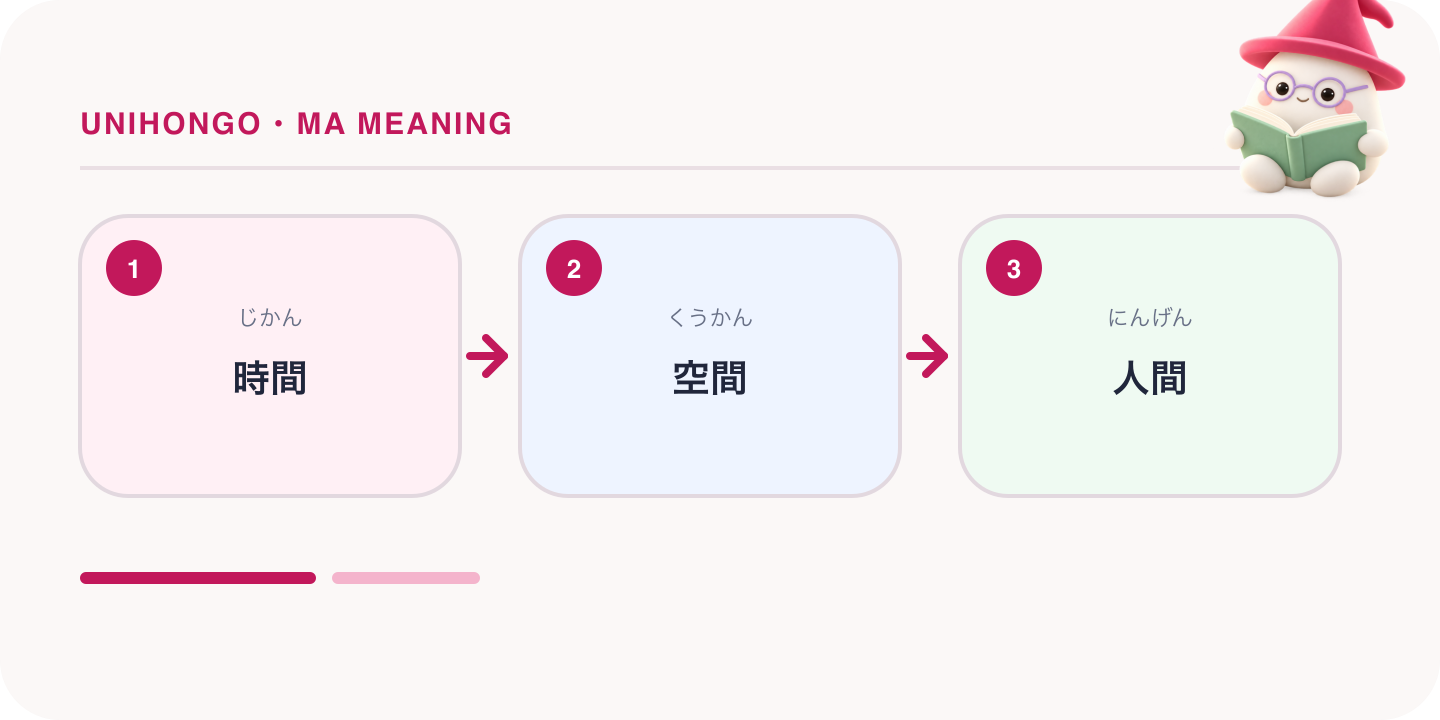
The kanji is one of the first learners meet, because it appears in jikan, time. It has four readings you will use regularly. Ma is the native reading in words about gaps, rooms and timing. Aida is the native reading for between and during. Kan is the on-reading in many compound nouns, and ken appears in ningen, human being, and a few other words.
| Word | Reading | Meaning |
|---|---|---|
| 間 | ma | Interval, space, pause, timing; room |
| 間 | aida | Between, during, a gap |
| 時間 | jikan | Time |
| 空間 | kūkan | Space |
| 人間 | ningen | Human being |
| 世間 | seken | Society, the world, people at large |
| 居間 | ima | Living room |
Ma as meaningful space in art
In Japanese ink painting, large areas of the paper are often left blank. That empty paper can become mist, water, sky or simply silence, and it is part of the composition rather than unused space. The same principle appears in calligraphy, where the white around and inside the characters matters as much as the black strokes, and in ikebana, where the space between branches shapes the arrangement.
Designers and artists talk about ma o ikasu, making use of ma, and yohaku, blank margin, when they want to describe this. Yohaku no bi, the beauty of blank space, is a phrase you will see in writing about painting, graphic design and even web layout.
| Japanese | Romaji | Meaning |
|---|---|---|
| 余白 | yohaku | Blank space, margin |
| 余白の美 | yohaku no bi | The beauty of blank space |
| 間を生かす | ma o ikasu | To make good use of space or pauses |
| このデザインは余白が効いている。 | Kono dezain wa yohaku ga kiite iru. | The blank space in this design really works. |
| 水墨画 | suibokuga | Ink wash painting |
Ma in architecture and the Japanese house
In traditional Japanese buildings, ma is also a room and a measurement. Rooms are named with ma: tokonoma is the alcove for a scroll and flowers, chanoma is the family sitting room of older homes, hiroma is a large hall, and washitsu may be described as a six-mat room. Sliding doors, fusuma and shōji, let rooms join or separate, so the space between them is flexible rather than fixed.
Ken, another reading of 間, was a traditional unit for the distance between pillars, roughly 1.8 metres, and it still survives in building and in the size of tatami mats. The engawa, a veranda-like strip between the rooms and the garden, is often cited as a perfect example of ma: neither inside nor outside, but a space that connects both.
Ma as an architectural idea became better known abroad partly through an exhibition organised by the architect Arata Isozaki in the late 1970s, titled Ma: Space-Time in Japan, which presented ma as a way of thinking about space and time together.
| Japanese | Romaji | Meaning |
|---|---|---|
| 床の間 | tokonoma | Decorative alcove in a tatami room |
| 茶の間 | chanoma | Family sitting room (older homes) |
| 広間 | hiroma | Large hall, reception room |
| 居間 | ima | Living room |
| 縁側 | engawa | Veranda strip between room and garden |
| 六畳間 | rokujōma | A six-tatami room |
Ma in music, theatre and comedy
Performers in Japan talk about ma constantly. In traditional music and Noh, the silence between drum beats or phrases is part of the rhythm, and holding it well is a sign of skill. In rakugo, the comic storytelling art, and in modern manzai comedy duos, ma is timing: the length of a pause before a punchline decides whether the audience laughs.
This is where the everyday meaning of ma as timing comes from. Ma ga ii, good timing, and ma ga warui, bad timing, began as judgements about rhythm and have become normal ways of talking about luck and awkwardness in daily life.
| Japanese | Romaji | Meaning |
|---|---|---|
| 間の取り方がうまい。 | Ma no torikata ga umai. | They are great at timing their pauses. |
| 落語は間が命だ。 | Rakugo wa ma ga inochi da. | In rakugo, timing is everything. |
| 一拍間を置く | ippaku ma o oku | To pause for a beat |
| 間を取る | ma o toru | To leave a pause, to pace yourself |
Everyday words built on ma
Most of the time, Japanese speakers use ma without thinking about aesthetics at all. These are some of the most common expressions, and several are essential for daily life.
Ma ni au means to be in time, or to be sufficient. Ma ga warui means bad timing or an awkward situation, and it can also describe a person who always turns up at the wrong moment. Manuke, literally ma slipping out, means a fool or a silly blunder. Machigai, mistake, is written with the same kanji. Itsu no ma ni ka means before you knew it, and ma mo naku, shortly, is heard in every train announcement.
| Japanese | Romaji | Meaning |
|---|---|---|
| 終電に間に合った。 | Shūden ni ma ni atta. | I made the last train. |
| 締め切りに間に合わない。 | Shimekiri ni ma ni awanai. | I won't make the deadline. |
| 今日は間が悪かった。 | Kyō wa ma ga warukatta. | The timing was bad today. |
| 間抜けなミスをした。 | Manuke na misu o shita. | I made a daft mistake. |
| 間違えました。 | Machigaemashita. | I made a mistake. |
| いつの間にか寝ていた。 | Itsu no ma ni ka nete ita. | Before I knew it, I had fallen asleep. |
| 間もなく電車が参ります。 | Ma mo naku densha ga mairimasu. | A train will arrive shortly. |
Aida is the other everyday reading. Eki to ginkō no aida, between the station and the bank, and natsuyasumi no aida, during the summer holidays, are patterns you will use from the beginner level onwards.
Ma in conversation: pauses and silence
Japanese conversation has its own ma. Short pauses before answering, a moment of silence after a serious remark, and the rhythm of aizuchi, listening noises such as un, ee and naruhodo, all shape how comfortable a conversation feels. A reply that comes too fast can sound careless, while a thoughtful pause can show that you are taking the question seriously.
At the same time, long silence in casual settings can be awkward, and Japanese has a phrase for that too: ma ga motanai, when there is not enough to fill the time and silence becomes uncomfortable. Knowing both sides helps you read the room, kūki o yomu, rather than rushing to fill every gap.
| Japanese | Romaji | Meaning |
|---|---|---|
| 間が持たない。 | Ma ga motanai. | The silence is getting awkward. |
| 少し間を置いてから答える。 | Sukoshi ma o oite kara kotaeru. | Answer after a short pause. |
| そうですね、 | Sō desu ne, | Let me see, (a thoughtful filler) |
| 間を空けずに話す | ma o akezu ni hanasu | To speak without any pause |
| 絶妙な間 | zetsumyō na ma | Perfect timing, an exquisite pause |
Ma as a concept versus ma as a word
Outside Japan, ma is often explained as a philosophy of emptiness, sometimes with the claim that it is a uniquely Japanese way of seeing the world. Japanese artists and architects do write about ma in this deep sense, but for most speakers it is first of all a common word for space and timing.
| Aspect | Aesthetic idea | Everyday use |
|---|---|---|
| Space | Meaningful emptiness in painting and rooms | Rooms such as ima and tokonoma |
| Time | The charged pause in music and theatre | Being in time: ma ni au |
| People | The relationship between things | Ningen, seken, aida |
| Feeling | Tension, balance and rhythm | Ma ga warui, ma ga motanai, manuke |
Seeing both columns is what makes ma interesting. The aesthetic idea is not something exotic added on top of the language; it grows out of how ordinary Japanese already thinks about gaps, rooms and timing.
Common learner mistakes with 間
Because one kanji carries so many readings and meanings, learners tend to trip over the same points. Keep these in mind.
- Reading every 間 as ma. In jikan, kūkan and ningen it is kan or ken, and in between-sentences it is usually aida.
- Confusing ma ni au with au. Ma ni au is be in time; au on its own means meet or match.
- Using manuke lightly about a person. It is an insult; use it about your own blunders instead.
- Treating ma as only visual. Timing and pauses are at least as important as space.
- Filling every silence. A short pause is natural in Japanese conversation and often shows care.