
What akogare means
Akogare is a noun for the feeling of being drawn towards an ideal. The object can be a person, a place, a way of life or a role, but it is always something you see as better, brighter or more beautiful than where you stand now, and something you do not yet have.
That is why the word sounds hopeful rather than sad. Akogare is close to the English idea of a role model or a dream, and it often explains why people start something: they saw a senior play the guitar, or watched a film set in Hokkaido, and the akogare stayed with them.
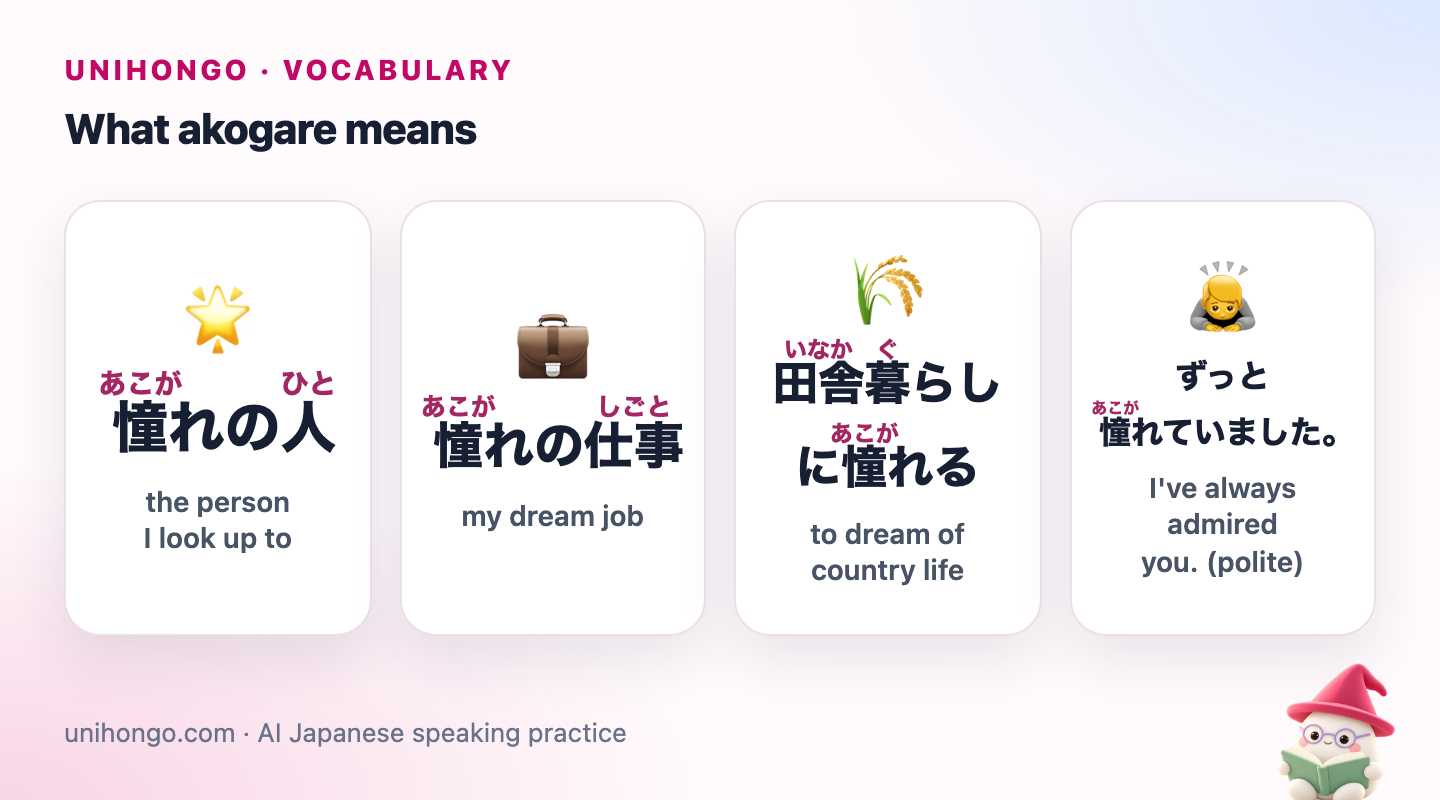
| Japanese | Romaji | Meaning |
|---|---|---|
| 憧れの人 | akogare no hito | the person I look up to |
| 憧れの仕事 | akogare no shigoto | my dream job |
| 田舎暮らしに憧れる | inaka gurashi ni akogareru | to dream of country life |
| ずっと憧れていました。 | Zutto akogarete imashita. | I've always admired you. (polite) |
The forms: akogare, akogareru and akogare no
The kanji is 憧, which has the heart radical on the left, and it is read akoga in this word. 憧 joined the official list of everyday kanji in 2010, so you will see it in newspapers and on the covers of magazines, although some people still write the word in hiragana, あこがれ. Older dictionaries trace the verb to classical akugaru, used for a heart drifting away from where it belongs, which is a lovely way to remember it.
In modern Japanese you need three shapes. The verb akogareru is used mostly in the te iru form, because the longing is a state that continues. The noun akogare appears with no to describe a noun. And the set phrase akogare no mato, the target of admiration, describes someone everyone looks up to.
| Japanese | Romaji | Meaning |
|---|---|---|
| 憧れる | akogareru | to long for, to look up to |
| パリに憧れています。 | Pari ni akogarete imasu. | I've long been drawn to Paris. |
| 子供のころ、パイロットに憧れていた。 | Kodomo no koro, pairotto ni akogarete ita. | As a kid, I dreamed of being a pilot. (casual) |
| 彼女はクラスの憧れの的だった。 | Kanojo wa kurasu no akogare no mato datta. | She was the one the whole class admired. |
| 都会への憧れ | tokai e no akogare | a longing for city life |
Three kinds of longing
People. The most familiar use is a person you look up to: a senior at school or work, a coach, an artist, an older cousin. In school stories, akogare no senpai is a classic figure, admired from across the gym or the music room. The admiration can be pure respect, or it can have a little crush in it, and the word does not force you to say which.
Places and lifestyles. Many Japanese people say they have akogare for living abroad, for a quiet life in the countryside, for a café-filled neighbourhood or for living alone. Learners use it the other way: many fell for Japan through an akogare for its cities, food or anime.
Roles and objects. A dream job, a dream car, a brand you have wanted for years. Advertising loves the word, because akogare no sells an ideal rather than a product.
| Japanese | Romaji | Meaning |
|---|---|---|
| 憧れの先輩がいます。 | Akogare no senpai ga imasu. | There's a senior I really look up to. |
| 日本の着物文化に憧れています。 | Nihon no kimono bunka ni akogarete imasu. | I've always been drawn to kimono culture. |
| 一人暮らしに憧れる。 | Hitorigurashi ni akogareru. | I dream of living on my own. |
| 憧れの職業は看護師です。 | Akogare no shokugyō wa kangoshi desu. | My dream profession is nursing. |
| 憧れのブランドのバッグを買った。 | Akogare no burando no baggu o katta. | I bought a bag from a brand I'd always wanted. |
Telling someone you admire them
Saying akogare to the person themselves is common and kind, especially when you finally meet a senior, a teacher or an artist whose work brought you to the field. The polite line zutto akogarete imashita, I have always admired you, sounds sincere at a workplace, a workshop or a club. Between close friends, a casual version with a smile is fine.
The person who hears it usually answers modestly, because accepting praise too directly can feel awkward in Japanese. Expect a laugh, a denial, or a humble thank-you. You do not need to insist; simply smile and say one concrete thing you admire.
| Japanese | Romaji | Meaning |
|---|---|---|
| 先輩のこと、ずっと憧れていました。 | Senpai no koto, zutto akogarete imashita. | I've always looked up to you, senpai. |
| 田中さんは私の憧れです。 | Tanaka san wa watashi no akogare desu. | Ms Tanaka is my role model. |
| そんな、照れるなあ。 | Sonna, tereru nā. | Senior: Oh, stop, you're making me blush. (casual) |
| ありがとう。うれしいです。 | Arigatō. Ureshii desu. | Senior: Thank you, that makes me happy. |
| 恐縮です。 | Kyōshuku desu. | To a client or stranger: I'm honoured, you're too kind. (very polite) |
Akogare, sonkei, suki, urayamashii and yume
Akogare overlaps with several words learners already know. The difference is where the feeling points: at the ideal, at the person's merit, at the thing itself, at what someone else has, or at a goal you plan to reach.
| Japanese | Romaji | Meaning |
|---|---|---|
| 父を尊敬しています。 | Chichi o sonkei shite imasu. | I respect my father. |
| 先輩に憧れています。 | Senpai ni akogarete imasu. | I look up to my senior. |
| 羨ましいなあ。 | Urayamashii nā. | I'm so jealous. (casual) |
| カフェを開くのが夢です。 | Kafe o hiraku no ga yume desu. | My dream is to open a café. |
| Word | Focus | Typical use |
|---|---|---|
| akogare (憧れ) | An ideal you long for, still out of reach | A senior you look up to, a dream life |
| sonkei (尊敬) | Respect for character or achievement | Parents, a boss, a teacher you know well |
| suki (好き) | Liking, from mild to romantic | Foods, hobbies, people |
| urayamashii (羨ましい) | Envy of what someone else has | A friend's holiday, a colleague's skill |
| yume (夢) | A goal or dream you aim for | Becoming a doctor, opening a café |
Notice the particles: sonkei suru takes o, akogareru takes ni. Urayamashii is about envy, so it is not a compliment in the same way; akogare admires without wanting to take anything away.
Mini dialogue: meeting the designer you admire
| Japanese | Romaji | Meaning |
|---|---|---|
| 実は、入社前から山本さんに憧れていたんです。 | Jitsu wa, nyūsha mae kara Yamamoto san ni akogarete ita n desu. | You: Actually, I've admired you since before I joined. |
| え、本当?照れるなあ。 | E, hontō? Tereru nā. | Senior: Really? That's embarrassing. |
| 山本さんのデザインを見て、この会社に入りたいと思いました。 | Yamamoto san no dezain o mite, kono kaisha ni hairitai to omoimashita. | You: Seeing your designs made me want to join this company. |
| ありがとう。じゃあ、一緒にいいものを作ろうね。 | Arigatō. Jā, issho ni ii mono o tsukurō ne. | Senior: Thanks. Then let's make something good together. |
Make akogare yours with Mocchi
Open Mocchi and type: /correct, then three sentences about your own akogare, for a person, a place and a job. Mocchi fixes the particles and explains each change, keeps a note if you keep writing o instead of ni, and brings that point back in a later quiz, so the mistake gets less common over time.
Then ask Mocchi to /create-flashcards for akogare no hito, akogare no shigoto and the other lines here, picking a photo of your own dream place for each card. Spaced repetition does the rest: the line you hesitate on comes back sooner.
Common learner mistakes
- Using o with the verb. Nihon o akogarete imasu is wrong; say Nihon ni akogarete imasu.
- Using akogare for something you already have. Once you live in Kyoto, your akogare for Kyoto has become a reality; talk about suki or ki ni itte iru instead.
- Translating akogare as envy. Envy is urayamashii; akogare admires without resentment.
- Using akogare as a love confession. It can sound like admiration from afar rather than a wish to date; suki desu is the clearer confession.
- Using the plain dictionary form for an ongoing feeling. Akogarete imasu is the natural way to say you admire someone now; akogareru on its own sounds like a general statement.