
The rule: whose family, and who is listening
Japanese draws a line between inside and outside. Your own family is inside, and when you talk about them to an outsider, such as a teacher, a coworker or a new acquaintance, you use plain, modest words: 母 (haha), 父 (chichi). Other people's families are outside, and you use polite words with お〜さん: お母さん (okāsan), お父さん (otōsan).
The twist is that inside the family, people often call each other with the polite set. A child calls out okāsan! in the kitchen, and a mother may say okāsan about herself when talking to her children. So the polite word has two jobs: someone else's mother, and Mum.
| Japanese | Romaji | Meaning |
|---|---|---|
| うちの母です。 | Uchi no haha desu. | This is my mother. (introducing her to others) |
| 家族 | kazoku | family |
| 両親 | ryōshin | my parents |
| ご家族 | gokazoku | your family (polite) |
| ご両親 | goryōshin | your parents (polite) |
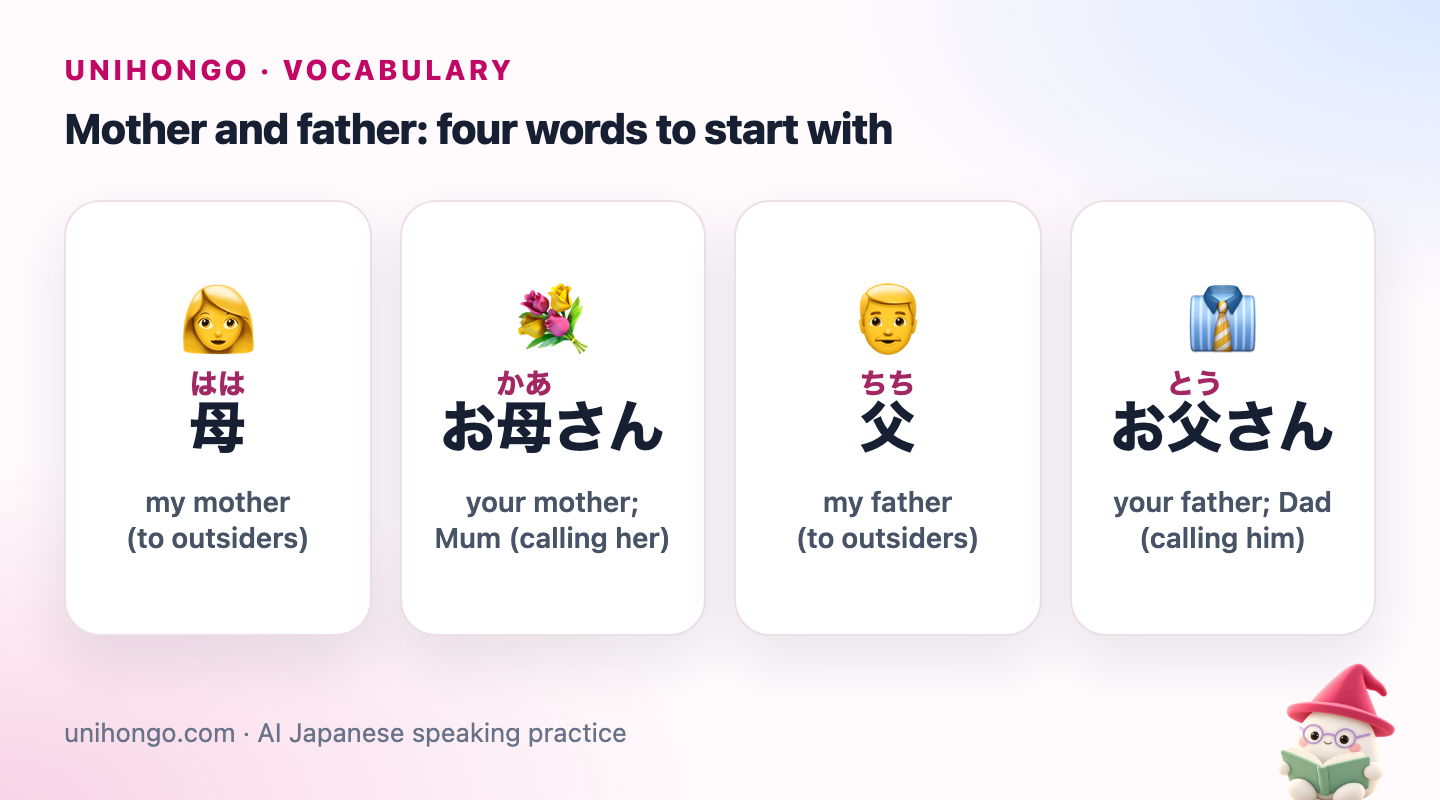
Mother and father: four words to start with
| Japanese | Romaji | Meaning |
|---|---|---|
| 母 | haha | my mother (to outsiders) |
| お母さん | okāsan | your mother; Mum (calling her) |
| 父 | chichi | my father (to outsiders) |
| お父さん | otōsan | your father; Dad (calling him) |
| ママ | mama | Mum, Mummy (casual, at home) |
| パパ | papa | Dad, Daddy (casual, at home) |
| 母は東京に住んでいます。 | Haha wa Tōkyō ni sunde imasu. | My mother lives in Tokyo. (to a coworker) |
| お母さんはお元気ですか。 | Okāsan wa ogenki desu ka. | How is your mother? (polite) |
Among friends, many adults also say uchi no okan or uchi no oyaji, casual and slightly rough words for mum and dad, or simply okāsan about their own mother. That is fine with close friends, but at work or in an interview, haha and chichi are expected. Calling your own mother okāsan in a job interview is a classic slip that interviewers notice.
Grandparents, aunts, uncles and cousins
The same inside and outside rule applies to the wider family. The plain words, sofu and sobo, sound quite formal, so in casual talk many people say uchi no ojīchan or uchi no obāchan even about their own grandparents.
| Japanese | Romaji | Meaning |
|---|---|---|
| 祖父 | sofu | my grandfather (to outsiders) |
| 祖母 | sobo | my grandmother (to outsiders) |
| おじいさん | ojīsan | your grandfather; an elderly man |
| おばあさん | obāsan | your grandmother; an elderly woman |
| おじ | oji | my uncle |
| おば | oba | my aunt |
| いとこ | itoko | cousin |
| 甥 | oi | nephew |
| 姪 | mei | niece |
| 親戚 | shinseki | relatives |
| 孫 | mago | grandchild |
Be careful with the long vowels: おじいさん (ojīsan) is grandfather, but おじさん (ojisan) is uncle or a middle-aged man; おばあさん (obāsan) is grandmother, but おばさん (obasan) is aunt or a middle-aged woman. In writing, uncle and aunt have two kanji each, depending on whether they are older or younger than your parent: 伯父 and 叔父 for uncle, 伯母 and 叔母 for aunt. In speech, both are simply oji and oba.
Brothers and sisters: older and younger
Japanese has no single word for brother or sister. You always say whether the sibling is older or younger. At home, older siblings are usually called by a title, onīchan or onēchan, while younger siblings are called by their name. This reflects the importance of age order in many Japanese families, though plenty of siblings simply use names or nicknames.
| Japanese | Romaji | Meaning |
|---|---|---|
| 兄弟はいますか。 | Kyōdai wa imasu ka. | Do you have any brothers or sisters? |
| 姉が一人と弟が二人います。 | Ane ga hitori to otōto ga futari imasu. | I have one older sister and two younger brothers. |
| 一人っ子です。 | Hitorikko desu. | I'm an only child. |
| 長男 | chōnan | eldest son |
| 末っ子 | suekko | youngest child |
| Sibling | Your own (to outsiders) | Someone else's | Calling them at home |
|---|---|---|---|
| Older brother | 兄 (ani) | お兄さん (onīsan) | お兄ちゃん (onīchan) or a nickname |
| Older sister | 姉 (ane) | お姉さん (onēsan) | お姉ちゃん (onēchan) or a nickname |
| Younger brother | 弟 (otōto) | 弟さん (otōtosan) | His name |
| Younger sister | 妹 (imōto) | 妹さん (imōtosan) | Her name |
Husbands, wives and children
Spouse words are where Japanese is changing fastest. Traditional words such as 主人 (shujin, literally master) for your own husband and 家内 (kanai, literally inside the house) for your own wife are still used, especially by older people, but many people now prefer the neutral 夫 (otto) and 妻 (tsuma). 嫁 (yome), literally bride or daughter-in-law, is widely used casually for one's own wife, especially in western Japan, but some people dislike it. When in doubt, choose otto and tsuma.
| Japanese | Romaji | Meaning |
|---|---|---|
| 夫 | otto | my husband (neutral) |
| 妻 | tsuma | my wife (neutral) |
| ご主人 | goshujin | your husband (polite) |
| 奥さん | okusan | your wife (polite) |
| 旦那さん | dannasan | your husband (friendly) |
| 息子 | musuko | my son |
| 娘 | musume | my daughter |
| 息子さん | musukosan | your son |
| 娘さん | musumesan | your daughter |
| お子さん | okosan | your child (polite) |
Okosan wa nansai desu ka, how old is your child, is a very common small-talk question for parents. Your own children are simply kodomo: Kodomo ga futari imasu, I have two children.
In-laws and blended families
For in-laws, Japanese adds 義理の (giri no), in-law or by marriage, or the prefix 義 (gi). The same words are used for step-relatives. In conversation, many people call their spouse's parents okāsan and otōsan directly, the same as their own parents, which surprises some learners at first.
| Japanese | Romaji | Meaning |
|---|---|---|
| 義理の母 | giri no haha | my mother-in-law; my stepmother |
| 義父 | gifu | my father-in-law; my stepfather |
| 義理の姉 | giri no ane | my sister-in-law (older) |
| 妻の両親 | tsuma no ryōshin | my wife's parents |
| 主人の実家に帰ります。 | Shujin no jikka ni kaerimasu. | I'm going back to my husband's family home. |
実家 (jikka) is your family home, where your parents live. It is a key word around holidays such as New Year and Obon, when many people go back to their own jikka or their spouse's.
Mini dialogues: at work and at a friend's home
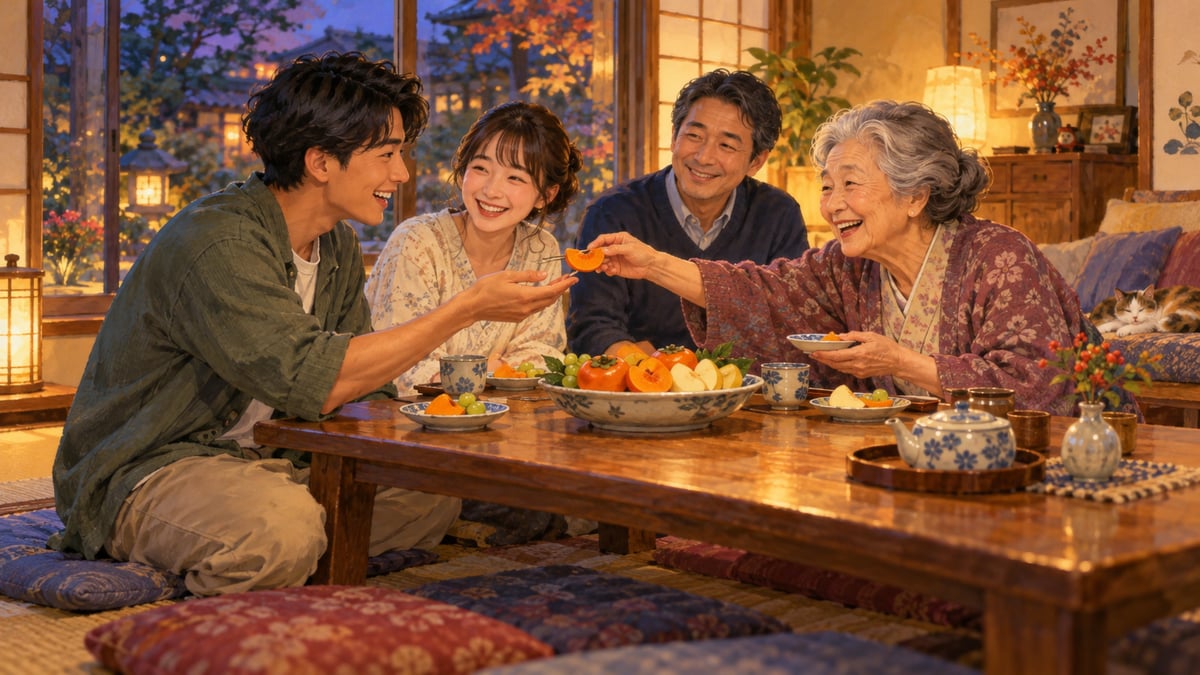
In the first dialogue, you talk about your family to a coworker. In the second, you meet a friend's family, and the words for the same people change.
| Japanese | Romaji | Meaning |
|---|---|---|
| 週末は何をしましたか。 | Shūmatsu wa nani o shimashita ka. | Coworker: What did you do at the weekend? |
| 母が日本に来たので、京都に行きました。 | Haha ga Nihon ni kita node, Kyōto ni ikimashita. | You: My mother came to Japan, so we went to Kyoto. |
| いいですね。お母さんは初めての日本ですか。 | Ii desu ne. Okāsan wa hajimete no Nihon desu ka. | Coworker: Lovely. Is it your mother's first time in Japan? |
| はい。父も来たがっていました。 | Hai. Chichi mo kitagatte imashita. | You: Yes. My father wanted to come too. |
| いらっしゃい。どうぞ上がって。 | Irasshai. Dōzo agatte. | Friend's mother: Welcome. Come on in. |
| お邪魔します。これ、母からです。 | Ojama shimasu. Kore, haha kara desu. | You: Thank you for having me. This is from my mother. |
| まあ、ありがとう。お母さんによろしくね。 | Mā, arigatō. Okāsan ni yoroshiku ne. | Friend's mother: Oh, thank you. Say hello to your mother. |
Notice that the friend's mother calls your mother okāsan, because to her, your mother is outside her family. You keep saying haha. Between friends of the same age, you would call your friend's grandmother obāchan if the family does, and her parents okāsan and otōsan, or with the family name: Tanaka-san no okāsan.
Drill the switch with Mocchi
Ask Mocchi: Give me ten situations and make me choose between haha, okāsan and mama. Mocchi sets up a coworker, a friend's parent or a phone call home, tells you why each answer fits, and keeps track of the switches you get wrong, so they show up again in your next /review. When you are ready, use /kaiwa and Mocchi will suggest a family roleplay for AI Sensei. Hana-sensei can play your friend's mother welcoming you home, and the session report shows every time you slipped into the wrong set.
Common learner mistakes
- Saying watashi no okāsan to a teacher or coworker. Use haha.
- Calling a friend's mother anata no haha. Say okāsan, or Tanaka-san no okāsan.
- Mixing ojisan (uncle, middle-aged man) and ojīsan (grandfather, old man). The long vowel changes the meaning.
- Asking burazā wa imasu ka. Use kyōdai wa imasu ka, and say older or younger in the answer.
- Using omae or anata to address your parents. Japanese family members address each other by role or name.