

The eleven core location words
These words are all nouns. That is the key idea: in Japanese you do not say on the desk but the desk's top-area. Because they are nouns, they can be marked with any particle, used on their own in a short answer, and modified by other nouns with no.
Learn them in natural pairs, because the pairs are easier to remember and you will often need the opposite in the same conversation: ue and shita, naka and soto, mae and ushiro. Yoko, tonari and soba all describe nearness and need a section of their own. Aida and mukai complete the set.
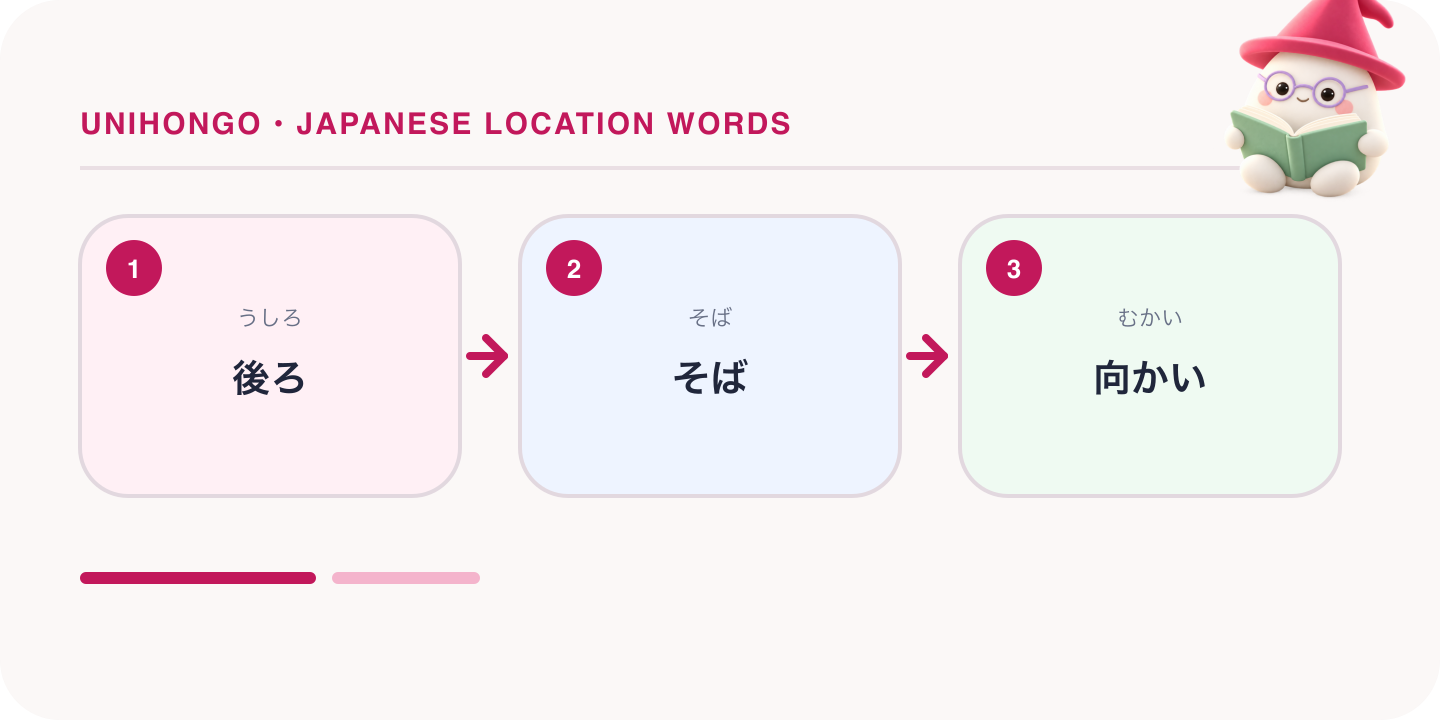
| Word | Reading | Meaning |
|---|---|---|
| 上 | ue | On, above, the top |
| 下 | shita | Under, below, the bottom |
| 中 | naka | Inside, in, the middle |
| 外 | soto | Outside |
| 前 | mae | In front of |
| 後ろ | ushiro | Behind, at the back |
| 横 | yoko | At the side of, beside |
| 隣 | tonari | Next to (something of the same kind) |
| そば | soba | Near, close by |
| 間 | aida | Between |
| 向かい | mukai | Opposite, across from |
The X no Y ni arimasu pattern
The standard way to say where something is has three parts. First the reference object, then no, then the location word, then ni, and finally arimasu for things or imasu for people and animals. The thing you are locating is marked with ga if it is new information, or wa if it is already the topic.
Compare two word orders. Tsukue no ue ni hon ga arimasu answers what is on the desk and introduces the book. Hon wa tsukue no ue ni arimasu answers where the book is. Both use exactly the same location phrase; only the focus changes. In casual speech, arimasu becomes aru and imasu becomes iru, and a question can be as short as kagi wa? with the answer tēburu no ue.
| Japanese | Romaji | Meaning |
|---|---|---|
| 机の上に本があります。 | Tsukue no ue ni hon ga arimasu. | There is a book on the desk. |
| 本は机の上にあります。 | Hon wa tsukue no ue ni arimasu. | The book is on the desk. |
| ベッドの下に猫がいます。 | Beddo no shita ni neko ga imasu. | There is a cat under the bed. |
| かばんの中に財布があります。 | Kaban no naka ni saifu ga arimasu. | My wallet is in the bag. |
| 子どもたちは外にいます。 | Kodomotachi wa soto ni imasu. | The children are outside. |
| 駅の前にバス停があります。 | Eki no mae ni basutei ga arimasu. | There is a bus stop in front of the station. |
| ドアの後ろに傘があります。 | Doa no ushiro ni kasa ga arimasu. | There is an umbrella behind the door. |
| 鍵はどこですか。テーブルの上です。 | Kagi wa doko desu ka. Tēburu no ue desu. | Where are the keys? On the table. |
Yoko, tonari and soba: which one?
All three can translate as next to or beside, and learners mix them up constantly. The difference is about what kind of things are involved and how close they are.
Tonari is for two things of the same category side by side in a row: houses on a street, seats on a train, people in a queue, shops in an arcade. Tonari no hito is the person next to you, and otonari-san is a friendly way to say your next-door neighbour. Using tonari for a pen next to a building sounds odd, because they are not the same kind of thing.
Yoko means the side, left or right, of anything. It does not care whether the two things are similar. A bin at the side of a vending machine, a note at the side of a page, a bag at the side of a chair all use yoko. It also appears in yoko ni naru, to lie down, and yoko-muki, sideways.
Soba means near or in the vicinity, without saying which side. It is looser than the other two. Eki no soba is near the station, perhaps a street away. Chikaku is very similar and slightly more common in everyday speech for a general neighbourhood; soba feels a little closer and more personal, as in itsumo soba ni iru, always by your side.
| Japanese | Romaji | Meaning |
|---|---|---|
| 私の家の隣にコンビニがあります。 | Watashi no ie no tonari ni konbini ga arimasu. | There's a convenience store next door to my house. |
| 隣の席、空いていますか。 | Tonari no seki, aite imasu ka. | Is the seat next to you free? |
| 自動販売機の横にゴミ箱があります。 | Jidō hanbaiki no yoko ni gomibako ga arimasu. | There's a bin beside the vending machine. |
| 駅のそばに安いホテルがあります。 | Eki no soba ni yasui hoteru ga arimasu. | There's a cheap hotel near the station. |
| 駅の近くに住んでいます。 | Eki no chikaku ni sunde imasu. | I live near the station. |
Aida and mukai: between and opposite
Aida needs two reference points joined by to: A to B no aida. It works for places and also for time, as in san-ji to yo-ji no aida, between three and four o'clock. On its own, aida can also mean while, but that is a grammar pattern rather than a location word.
Mukai means the place facing you across something, usually a road. Mukai no mise is the shop opposite, and mukai-gawa is the other side. You will hear it constantly in directions, along with michi o watatte, cross the road. Shōmen is related and means directly in front, facing you head on.
| Japanese | Romaji | Meaning |
|---|---|---|
| 銀行と郵便局の間に本屋があります。 | Ginkō to yūbinkyoku no aida ni hon'ya ga arimasu. | There's a bookshop between the bank and the post office. |
| 三時と四時の間に来てください。 | San-ji to yo-ji no aida ni kite kudasai. | Please come between three and four. |
| ホテルの向かいにカフェがあります。 | Hoteru no mukai ni kafe ga arimasu. | There's a café opposite the hotel. |
| 道の向かい側です。 | Michi no mukai-gawa desu. | It's on the other side of the road. |
| 改札の正面にあります。 | Kaisatsu no shōmen ni arimasu. | It's right in front of the ticket gates. |
Ni or de with location words
The location phrase itself stays the same, but the particle after it depends on the verb. Use ni with verbs of existence and position: aru, iru, sumu, suwaru and oku. Use de when the location is the stage where an action happens: taberu, matsu, asobu, kau.
So kōen no naka ni inu ga imasu describes where the dog is, while kōen no naka de inu to asobimasu describes where you play with the dog. Direction verbs such as iku and hairu often take ni or e: heya no naka ni hairu, go into the room.
| Japanese | Romaji | Meaning |
|---|---|---|
| 駅の前で待っています。 | Eki no mae de matte imasu. | I'm waiting in front of the station. |
| 駅の前にいます。 | Eki no mae ni imasu. | I'm in front of the station. |
| 箱の中に入れてください。 | Hako no naka ni irete kudasai. | Please put it in the box. |
| 木の下で昼ご飯を食べました。 | Ki no shita de hirugohan o tabemashita. | We ate lunch under a tree. |
| 窓のそばに座ってもいいですか。 | Mado no soba ni suwatte mo ii desu ka. | May I sit by the window? |
Useful collocations and set expressions
Location words combine with other nouns and verbs in fixed ways that are worth learning as chunks. Many of them have meanings that go beyond simple position.
| Expression | Reading | Meaning |
|---|---|---|
| 目上の人 | meue no hito | Someone senior to you |
| 年上 / 年下 | toshiue / toshishita | Older / younger |
| 上の階 / 下の階 | ue no kai / shita no kai | The floor above / below |
| 家の中 | ie no naka | Indoors, inside the house |
| 外で食べる | soto de taberu | To eat out |
| 海外 | kaigai | Overseas, abroad |
| 前の日 | mae no hi | The day before |
| 後ろの席 | ushiro no seki | The back seat |
| 横になる | yoko ni naru | To lie down |
| お隣さん | otonari-san | Next-door neighbour |
| すぐそば | sugu soba | Right nearby |
| 真ん中 | mannaka | The very middle |
Notice that naka and mannaka differ: naka is inside, while mannaka is the exact centre. Heya no mannaka ni tēburu ga arimasu means the table is in the middle of the room.
Common mistakes
- Dropping no: say tsukue no ue, not tsukue ue. The no is required because ue is a noun.
- Putting the location word first as in English: on the desk is tsukue no ue, reference object first, location word second.
- Using tonari for unlike objects: a lamp beside a sofa is sofā no yoko, not sofā no tonari.
- Mixing arimasu and imasu: a person under a tree imasu, a bench under a tree arimasu.
- Using ni with action verbs: resutoran no naka ni tabemasu is wrong; the action takes de.
- Overusing naka with places: Nihon no naka ni sunde imasu sounds odd; just say Nihon ni sunde imasu.
- Reading 上 as jō or 下 as ka in these phrases: on their own as location nouns they are read ue and shita.
How to review location words
Location words stick best when you connect them to real space rather than to a word list. Label objects in your home for a week and say the full sentence each time you pass them: reizōko no ue ni kagi ga arimasu. Describe the route from your door to the nearest station using mae, tonari and mukai. When you read a map, name what is opposite and between.
For quick recall, Unihongo's free learning games let you review the vocabulary in short rounds, which is ideal for pairs like ue and shita or mae and ushiro that are easy to swap under pressure. Mix the game rounds with speaking: a word you can recognise in a game still needs to come out of your mouth in a sentence.
- Day 1: ue, shita, naka, soto with objects on your desk
- Day 2: mae, ushiro, yoko with furniture and people
- Day 3: tonari, soba, aida, mukai with buildings on a map
- Day 4: full sentences with arimasu and imasu, then ni versus de
- Day 5: describe your street from memory, then check it