
Chanto meaning: properly, as it should be
Chanto is an adverb that describes doing something the right way, completely and without cutting corners. Its core image is a standard: there is a proper way to eat, sleep, clean, listen or work, and chanto means meeting it.
Because standards involve expectations, the feeling of chanto depends heavily on the speaker. From a parent it is care, from a frustrated partner it is nagging, and about a person it is praise. These four lines show the range.
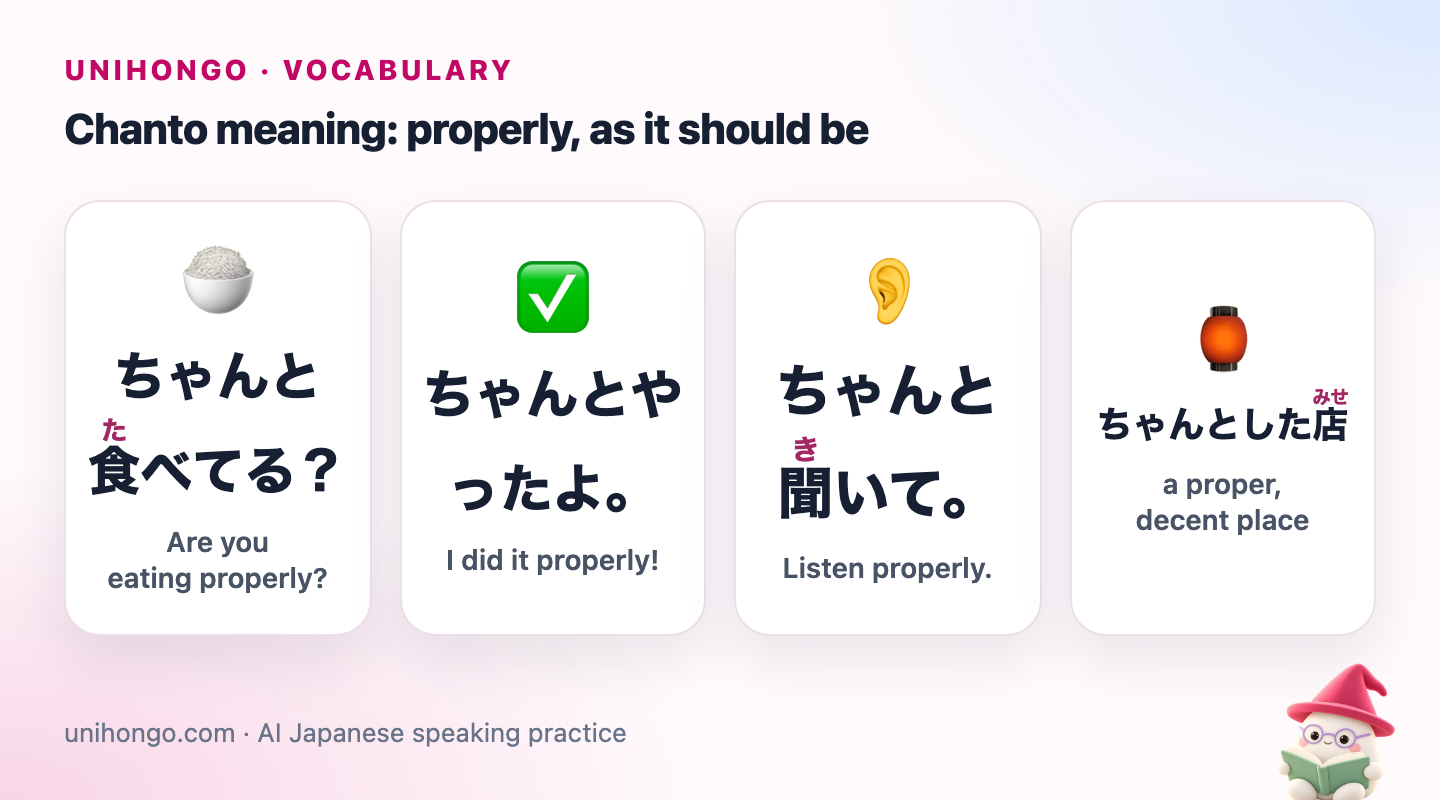
| Japanese | Romaji | Meaning |
|---|---|---|
| ちゃんと食べてる? | Chanto tabeteru? | Are you eating properly? |
| ちゃんとやったよ。 | Chanto yatta yo. | I did it properly! |
| ちゃんと聞いて。 | Chanto kiite. | Listen properly. |
| ちゃんとした店 | chanto shita mise | a proper, decent place |
Chanto often pairs with suru: chanto suru means to do things properly or to get your life in order, and chanto shite! means behave yourself or pull yourself together. Tone tells you whether it is advice or a scolding.
The caring chanto: are you looking after yourself?
Parents, grandparents and caring friends use chanto to check that you are living well, especially if you live alone or abroad. These questions are not tests. They are a way of saying I care about you, and the best response is a warm, honest answer with a small detail.
| Japanese | Romaji | Meaning |
|---|---|---|
| ちゃんと寝てる? | Chanto neteru? | Are you sleeping properly? |
| ちゃんと暖かくしてね。 | Chanto atatakaku shite ne. | Make sure you keep warm. |
| うん、ちゃんと自炊してるよ。 | Un, chanto jisui shiteru yo. | Yes, I'm cooking for myself properly. |
| 心配しないで。大丈夫だから。 | Shinpai shinaide. Daijōbu dakara. | Don't worry. I'm fine. |
The nagging chanto: do it right!
The same word becomes a nag when the speaker thinks you are not doing something properly. Chanto shinasai, do it properly, is a classic parent-to-child line, and adults use chanto shite or chanto ... te yo with family, partners and close friends. It implies criticism, so it belongs to relationships close enough to handle it.
| Japanese | Romaji | Meaning |
|---|---|---|
| ちゃんとしなさい。 | Chanto shinasai. | Behave properly. (parent to child) |
| ちゃんと片付けてよ。 | Chanto katazukete yo. | Tidy up properly, will you? |
| 説明書をちゃんと読んで。 | Setsumeisho o chanto yonde. | Read the instructions properly. |
| ちゃんと話を聞いてる? | Chanto hanashi o kiiteru? | Are you actually listening to me? |
A good-humoured way to reply is hai, hai, all right, all right, though repeating hai can also sound cheeky. Gomen, chanto suru, sorry, I'll do it properly, is the peaceful option.
Chanto shita: proper, decent, respectable
Before a noun, chanto becomes chanto shita, and it describes something that meets a proper standard. A chanto shita restaurant is a real, decent place rather than a quick snack stand. A chanto shita job is a stable, proper job. A chanto shita person is responsible, reliable and well brought up, which is genuine praise.
Chanto shite iru, often chanto shiteru, works the same way after a person: ano hito wa chanto shiteru, she is very together.
| Japanese | Romaji | Meaning |
|---|---|---|
| ちゃんとした店で食べたい。 | Chanto shita mise de tabetai. | I want to eat at a proper restaurant. |
| 彼はちゃんとした人だよ。 | Kare wa chanto shita hito da yo. | He's a decent, reliable guy. |
| 若いのに、ちゃんとしてるね。 | Wakai noni, chanto shiteru ne. | So young and so responsible. |
| ちゃんと覚えていてくれたんだ。 | Chanto oboete ite kureta n da. | You actually remembered. |
Chanto, kichinto and shikkari
Three adverbs share the idea of doing something well, and they often translate the same way in English. The differences are in focus and tone. Kichinto is about neatness and precision, and sounds a little more formal. Shikkari is about firmness and strength, of a grip, a person or an effort. Chanto is the general, everyday word.
| Japanese | Romaji | Meaning |
|---|---|---|
| きちんと確認いたします。 | Kichinto kakunin itashimasu. | I will check it carefully. (business) |
| しっかり持ってください。 | Shikkari motte kudasai. | Please hold on tightly. |
| しっかりした人ですね。 | Shikkari shita hito desu ne. | She's very dependable, isn't she? |
| Word | Focus | Tone and typical use |
|---|---|---|
| chanto (ちゃんと) | Properly, as expected | Everyday; care, nagging, praise |
| kichinto (きちんと) | Neat, orderly, precise | Slightly formal; rules, manners, business |
| shikkari (しっかり) | Firm, solid, reliable | Effort, grip, a dependable person |
| tadashiku (正しく) | Correctly | Neutral; instructions and rules |
Common mistakes with chanto
- Telling a superior or a customer to do something chanto. Chanto kiite kudasai sounds like a scolding even with kudasai. Ask politely for attention instead: sumimasen, chotto yoroshii desu ka.
- Using chanto shita for things that are simply good. A delicious meal is oishii; chanto shita shokuji is a proper, balanced meal, not necessarily a tasty one.
- Forgetting the small n in pronunciation. It is cha-n-to, three beats, with the n held as its own beat.
- Taking every chanto as criticism. From an older person, chanto tabeteru? is almost always care. Answer warmly rather than defensively.
Chanto as 'actually' and 'as it should be'
Chanto has a subtler job that dictionaries often miss: it can stress that something really is the way it should be, often in contrast to what someone assumed. Chanto aru yo means it is there, all right, in reply to someone who thought it was missing. Chanto setsumei shita noni means but I did explain it properly, with a hint of frustration.
This use is defensive or reassuring depending on tone. Said brightly, it reassures. Said with noni at the end, it complains that your proper effort was not recognised.
| Japanese | Romaji | Meaning |
|---|---|---|
| 鍵?ちゃんとあるよ。 | Kagi? Chanto aru yo. | The key? It's right here. |
| ちゃんと説明したのに。 | Chanto setsumei shita noni. | But I explained it properly. |
| ちゃんと予約してあります。 | Chanto yoyaku shite arimasu. | The booking is all in order. |
| ちゃんと届いたよ、ありがとう。 | Chanto todoita yo, arigatō. | It arrived safely, thanks. |
Chanto todoita, it arrived properly, is a very common reply when someone sends you a parcel or a message. It reassures them that nothing went wrong.
Mini dialogue: are you eating properly?
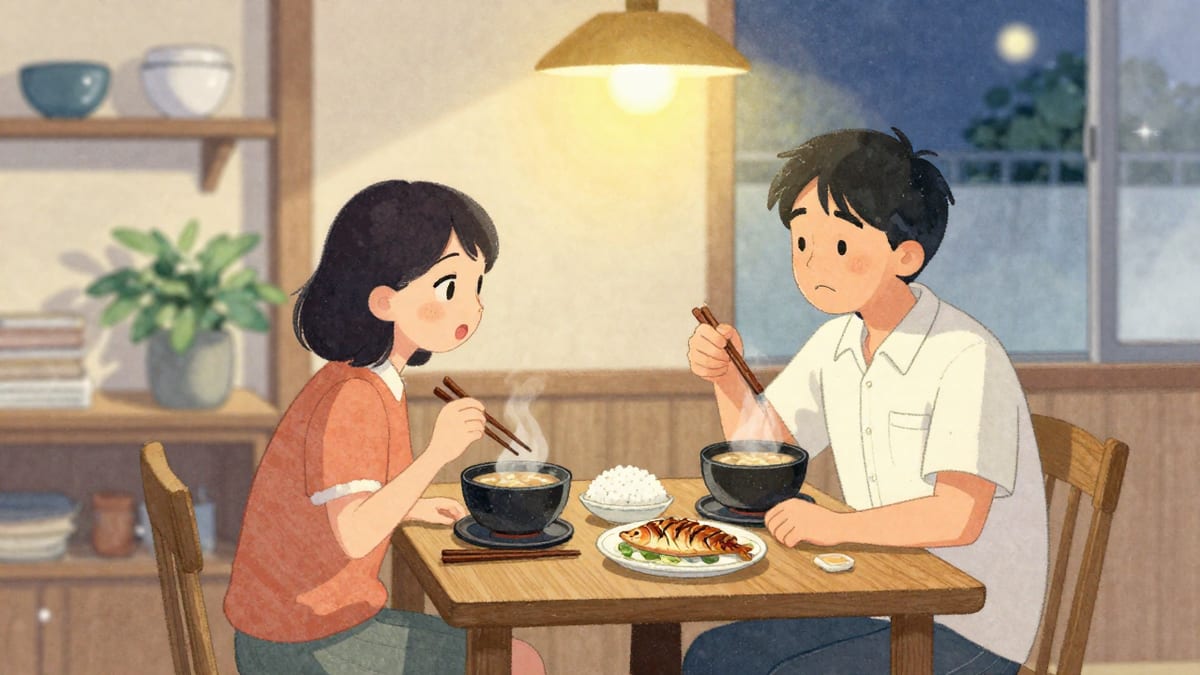
You have been working late for weeks, and a Japanese friend who has known you since you arrived notices. Chanto is how she shows she cares, and your answer should be honest and reassuring.
| Japanese | Romaji | Meaning |
|---|---|---|
| 最近、疲れてない? | Saikin, tsukarete nai? | Friend: You seem tired lately. |
| ちゃんと食べてる? | Chanto tabeteru? | Friend: Are you eating properly? |
| 正直、あんまりちゃんと食べてないかも。 | Shōjiki, anmari chanto tabete nai kamo. | You: Honestly, maybe not that well. |
| コンビニのご飯ばっかりで。 | Konbini no gohan bakkari de. | You: It's all convenience store food. |
| だめだよ。今日は一緒にちゃんとしたご飯を食べよう。 | Dame da yo. Kyō wa issho ni chanto shita gohan o tabeyō. | Friend: That won't do. Let's have a proper meal together today. |
| ありがとう。助かる。 | Arigatō. Tasukaru. | You: Thanks. That really helps. |