

Three ways to spell a carrot
The first thing to understand about produce vocabulary is that the spelling on a shop sign does not always match the spelling in your textbook. A carrot is ninjin. In a dictionary it is written 人参, in a children's book it is にんじん, and on a supermarket label it may well be ニンジン. All three are the same word. Shops and recipe sites often use katakana for native produce words because the kanji can be hard to read quickly, and katakana stands out on a label.
Loanwords are simpler. Banana, tomato, kiwi, remon and pīman, green pepper, came into Japanese from other languages and are always written in katakana. If you see a produce word in katakana, it might be either type; if you see one in hiragana or kanji, you can be sure it is native. The tables below give the most common spelling you will see in shops, with the kanji in the notes where it is worth knowing.
| Japanese | Romaji | Meaning |
|---|---|---|
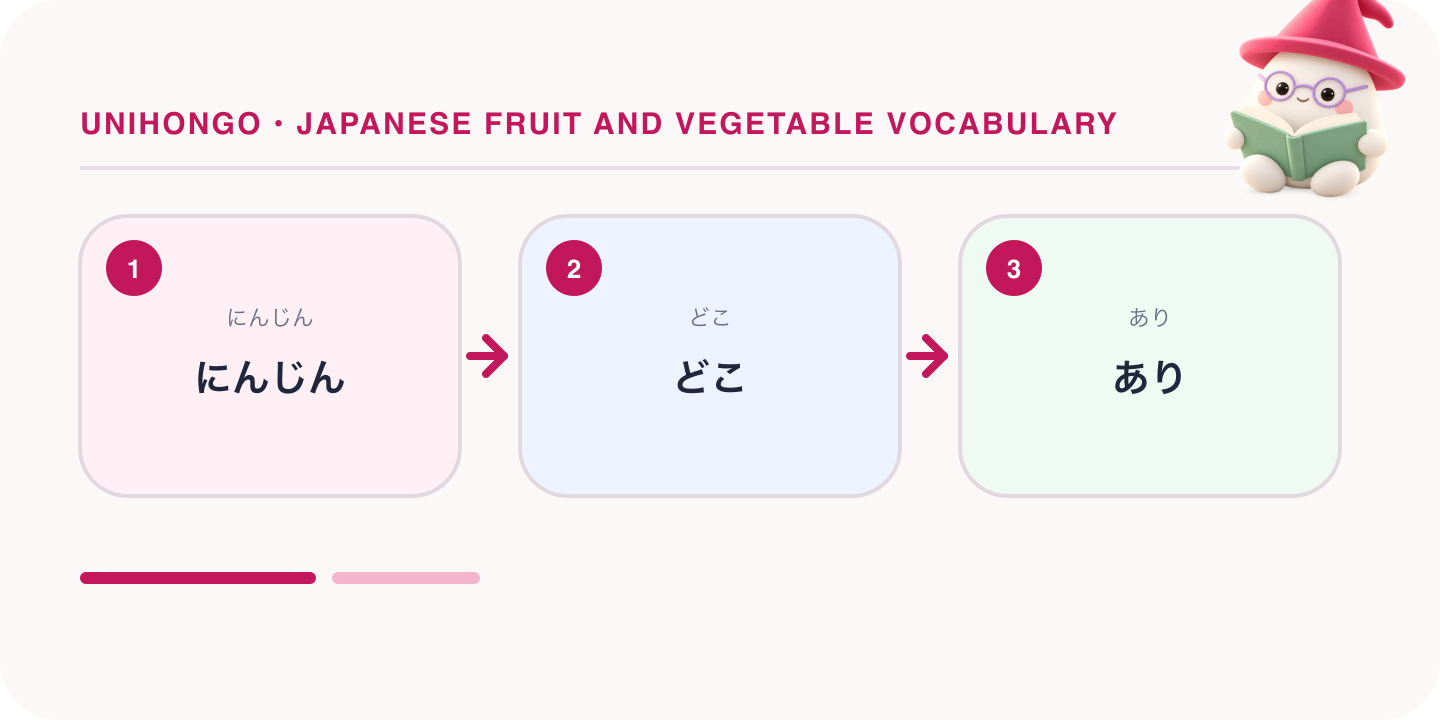
| にんじんはどこにありますか。 | Ninjin wa doko ni arimasu ka. | Where are the carrots? |
| これは何という野菜ですか。 | Kore wa nan to iu yasai desu ka. | What is this vegetable called? |
| 漢字ではどう書きますか。 | Kanji de wa dō kakimasu ka. | How do you write it in kanji? |
| バナナはカタカナで書きます。 | Banana wa katakana de kakimasu. | Banana is written in katakana. |
| 果物と野菜は別の売り場です。 | Kudamono to yasai wa betsu no uriba desu. | Fruit and vegetables are in separate sections. |
Fruit: from mikan to gift melons
Japanese fruit vocabulary mixes old native words with loanwords, and the seasons matter a great deal. Mikan, the small easy-peel mandarins, fill every home in winter; strawberries peak from winter to spring; peaches and watermelon belong to summer; and grapes, persimmons and nashi pears mark autumn. Melons and some grapes are also sold as luxury gifts in beautiful boxes, which explains the famous high prices you may have heard about.
| Word | Reading | Meaning |
|---|---|---|
| りんご | ringo | Apple; kanji 林檎 is rarely used |
| みかん | mikan | Mandarin orange; the winter fruit |
| いちご | ichigo | Strawberry; kanji 苺 |
| ぶどう | budō | Grapes; kanji 葡萄 |
| もも | momo | Peach; kanji 桃 |
| なし | nashi | Japanese pear, round and crisp; kanji 梨 |
| かき | kaki | Persimmon; kanji 柿 |
| すいか | suika | Watermelon; often sold by the slice |
| バナナ | banana | Banana; loanword, always katakana |
| レモン | remon | Lemon; loanword |
| メロン | meron | Melon; the classic gift fruit |
| キウイ | kiui | Kiwi fruit; loanword |
Two words that trip people up: nashi is a Japanese pear, round like an apple, while a Western pear is yōnashi. Similarly, an orange in the Western sense is orenji, not mikan. Ume, the Japanese apricot used for umeboshi, is usually sold green and unripe for pickling rather than for eating fresh.
Vegetables: daikon, negi and the katakana crowd
Vegetable vocabulary has the same split. Daikon, negi, hakusai and gobō are native words with kanji you will see on menus, while tomato, pīman, kyabetsu and retasu are loanwords in katakana. A few words look like loanwords but are not: jagaimo, potato, comes from Jakarta plus imo, tuber, and is written in hiragana or katakana.
| Word | Reading | Meaning |
|---|---|---|
| 大根 | daikon | Long white radish; grated, simmered or pickled |
| にんじん | ninjin | Carrot; kanji 人参 |
| じゃがいも | jagaimo | Potato |
| 玉ねぎ | tamanegi | Onion; literally ball negi |
| ねぎ | negi | Leek or spring onion; kanji 葱 |
| 白菜 | hakusai | Chinese cabbage; the hotpot vegetable |
| きゅうり | kyūri | Cucumber; kanji 胡瓜 |
| なす | nasu | Aubergine; kanji 茄子 |
| ほうれん草 | hōrensō | Spinach |
| トマト | tomato | Tomato; loanword |
| キャベツ | kyabetsu | Cabbage; loanword |
| ピーマン | pīman | Green pepper; from French piment |
Mushrooms are kinoko as a group, with shiitake, shimeji, enoki and maitake sold separately in small packs. Sweet potato is satsumaimo, and pumpkin is kabocha. Soybeans in the pod are edamame, and bean sprouts, moyashi, are one of the cheapest things in any supermarket.
Counters for buying produce
Once you know the words, you need to count them, and produce uses four counters more than any others. Ko counts roundish and small items: apples, tomatoes, onions, potatoes and mikan. Hon counts long items: carrots, cucumbers, bananas, daikon and negi. Tama, literally ball, counts heads of cabbage, lettuce and hakusai, and is also used for whole melons and watermelons. Fukuro counts bags, which matters because a lot of supermarket produce is pre-bagged: three potatoes in a net, a bag of mikan, a bag of shimeji.
The pronunciation changes are the ones you already know from other counters. Ko gives ikko, niko, sanko, yonko, goko, rokko. Hon gives ippon, nihon, sanbon, yonhon, gohon, roppon. Tama uses the native numbers: hitotama, futatama, then mittama or san-tama. Fukuro also uses native numbers for one and two, hitofukuro and futafukuro, then sanpukuro or san-fukuro. Bunches of grapes and bananas can be counted with fusa: hitofusa, futafusa.
| Japanese | Romaji | Meaning |
|---|---|---|
| りんごを三個ください。 | Ringo o sanko kudasai. | Three apples, please. |
| きゅうりは一本いくらですか。 | Kyūri wa ippon ikura desu ka. | How much is one cucumber? |
| キャベツを一玉お願いします。 | Kyabetsu o hitotama onegai shimasu. | One head of cabbage, please. |
| みかんを一袋買いました。 | Mikan o hitofukuro kaimashita. | I bought a bag of mandarins. |
| バナナを一房ください。 | Banana o hitofusa kudasai. | One bunch of bananas, please. |
| 大根は半分でも売っていますか。 | Daikon wa hanbun demo utte imasu ka. | Do you sell daikon by the half? |
Shun: talking about what is in season
Shun is the peak of a fruit or vegetable's season, and it is a real part of everyday conversation. Signs at a yaoya say ima ga shun, now is the season, restaurants advertise shun no yasai, and people ask each other whether the strawberries are good yet. Seasonal produce is cheaper and better, so learning to ask about it saves money and makes small talk easy.
The vocabulary around shun is small. Hashiri is the very first produce of a season, sold at a premium; sakari or shun is the peak; and nagori is the tail end. Ima no jiki, this time of year, and kisetsu, season, appear in the same conversations. Kokusan means domestically grown and is printed on almost every label, with the prefecture name next to it, because shoppers care where their food comes from.
| Japanese | Romaji | Meaning |
|---|---|---|
| 今、旬の野菜は何ですか。 | Ima, shun no yasai wa nan desu ka. | What vegetables are in season now? |
| いちごはもう出ていますか。 | Ichigo wa mō dete imasu ka. | Are strawberries out yet? |
| 秋は柿とぶどうがおいしいです。 | Aki wa kaki to budō ga oishii desu. | Persimmons and grapes are delicious in autumn. |
| これは国産ですか。 | Kore wa kokusan desu ka. | Is this grown in Japan? |
| この時期のトマトは甘いですね。 | Kono jiki no tomato wa amai desu ne. | Tomatoes at this time of year are sweet, aren't they? |
| 夏はすいかが一番です。 | Natsu wa suika ga ichiban desu. | In summer, watermelon is the best. |
At the supermarket and the yaoya
Supermarket produce shopping is mostly silent: you pick, you bag, you pay at the till. The phrases you need are for finding things and for reading labels. Yasai uriba, the vegetable section, and kudamono uriba, the fruit section, are usually near the entrance. Labels show the price, whether it is per item, ikko, per bag, hitofukuro, or per pack, ippakku, and often a sticker saying otoku, good value, or waribiki, discount.
A yaoya is different. The owner may greet you, tell you what is good today and give you a discount if you buy several things. Prices are usually per item or per bag, and it is fine to ask which of two melons is riper or how to cook something you have not seen before. Bargaining is not expected, but rounding down a few yen when you buy a lot is common in older shops. A greengrocer at a market may call out yasui yo, cheap, and oishii yo, tasty, to draw you in.
| Japanese | Romaji | Meaning |
|---|---|---|
| 野菜売り場はどこですか。 | Yasai uriba wa doko desu ka. | Where is the vegetable section? |
| これは一個の値段ですか、一袋の値段ですか。 | Kore wa ikko no nedan desu ka, hitofukuro no nedan desu ka. | Is this the price for one, or for a bag? |
| どちらのほうが熟れていますか。 | Dochira no hō ga urete imasu ka. | Which one is riper? |
| 今日は何がおすすめですか。 | Kyō wa nani ga osusume desu ka. | What do you recommend today? |
| これはどうやって食べるんですか。 | Kore wa dō yatte taberu n desu ka. | How do you eat this? |
| 全部でいくらですか。 | Zenbu de ikura desu ka. | How much is it all together? |
| 袋はいりません。 | Fukuro wa irimasen. | I don't need a bag. |
Describing and cooking your produce
Once you have shopped, you will want to talk about what you bought. Adjectives for produce are simple and useful: shinsen, fresh; amai, sweet; suppai, sour; nigai, bitter; shakishaki, crisp; and yawarakai, soft. Ripe is urete iru, and unripe is mada aoi, still green, even for fruit that is not green.
Cooking words come up next. Kiru is to cut, and produce is often cut in specific ways: usugiri, thin slices; sengiri, julienne; and rangiri, rough chunks. Muku is to peel, suru is to grate, and daikon-oroshi, grated daikon, is a word in its own right. Yuderu is to boil, itameru is to stir-fry, niru is to simmer and yaku is to grill or roast. A separate post on cooking verbs goes deeper; here it is enough to be able to say what you did with your carrots.
- Peeling and cutting: muku (peel), kiru (cut), sengiri (julienne), usugiri (thin slices)
- Grating and squeezing: suru or oroshi (grate), shiboru (squeeze, for lemons)
- Cooking: yuderu (boil), itameru (stir-fry), niru (simmer), yaku (grill)
- Preserving: tsukeru (pickle), hosu (dry), reitō suru (freeze)
- Describing: shinsen (fresh), amai (sweet), suppai (sour), urete iru (ripe)
A natural sentence for a home cook: Nasu o usugiri ni shite, gomaabura de itamemashita, I sliced the aubergine thinly and stir-fried it in sesame oil. Once you can build that pattern, any vegetable and any verb slot in.
Common mistakes with produce vocabulary
The most common mistake is using the wrong counter, usually hon for something round or ko for something long. It rarely stops communication, but it does mark you as a beginner, so the fix is to link each new produce word to its counter when you learn it: ringo ikko, kyūri ippon, kyabetsu hitotama.
Another is confusing nashi with a Western pear, or mikan with an orange, and then being surprised at what arrives. A third is reading a katakana label like ニンジン and assuming the word must be foreign; it is just a spelling choice. Finally, learners sometimes translate a bag of potatoes as a sack and ask for a fukuro when they mean a hako, box, or a netto, net bag. If the sign says hitofukuro, that is what you are buying.
| Japanese | Romaji | Meaning |
|---|---|---|
| すみません、一本じゃなくて一個ください。 | Sumimasen, ippon ja nakute ikko kudasai. | Sorry, not one long one, I mean one round one. |
| 梨と洋梨は違いますよね。 | Nashi to yōnashi wa chigaimasu yo ne. | Nashi and Western pears are different, aren't they? |
| これは袋で売っていますか、ばらで売っていますか。 | Kore wa fukuro de utte imasu ka, bara de utte imasu ka. | Do you sell these by the bag, or individually? |
| 熟れすぎているものは避けたいです。 | Uresugite iru mono wa saketai desu. | I want to avoid ones that are overripe. |
| この漢字は何と読みますか。 | Kono kanji wa nan to yomimasu ka. | How do you read this kanji? |