

Nomu for drinks: water, tea, coffee and alcohol
The core meaning is to drink. Mizu o nomu, drink water; o-cha o nomu, drink tea; kōhī o nomu, drink coffee. The object takes o and the verb is a u-verb: nomimasu, nonde, nonda, nomanai, and the potential nomeru. Japanese has no separate verb for sip, gulp or sup; adverbs do that work, so gokugoku nomu is to gulp and chibichibi nomu is to sip slowly.
With no object, nomu often means to drink alcohol. Kinō nomisugita, I drank too much yesterday, and nomeru hito, someone who can hold their drink, both leave sake unsaid. If you do not drink, the set phrase is o-sake wa nomemasen, I cannot drink, which uses the potential and sounds gentler than a flat nomimasen.
In older speech tabako o nomu meant to smoke, which you may still hear from elderly speakers; the modern verb is suu.
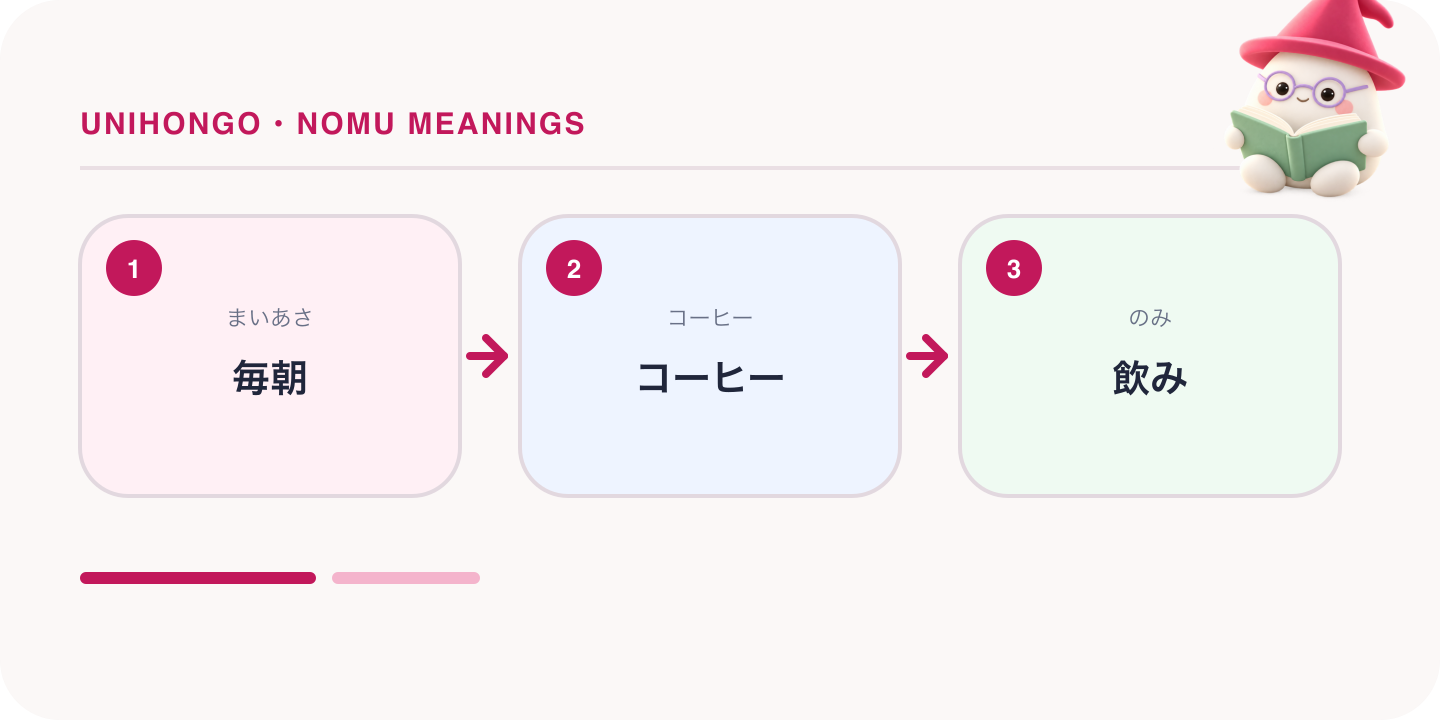
| Japanese | Romaji | Meaning |
|---|---|---|
| 毎朝コーヒーを飲みます。 | Maiasa kōhī o nomimasu. | I drink coffee every morning. |
| 水を一杯いただけますか。 | Mizu o ippai itadakemasu ka. | Could I have a glass of water? |
| 昨日は飲みすぎました。 | Kinō wa nomisugimashita. | I drank too much yesterday. |
| お酒はあまり飲めません。 | O-sake wa amari nomemasen. | I can't really drink alcohol. |
| 何か飲みますか。 | Nani ka nomimasu ka. | Would you like something to drink? |
| 熱いのでゆっくり飲んでください。 | Atsui node yukkuri nonde kudasai. | It's hot, so drink it slowly. |
Kusuri o nomu: taking medicine
Japanese takes medicine by drinking it, whatever its form. Kusuri o nomu is the only natural phrase for tablets, capsules, powders and syrups. Learners who say kusuri o taberu are understood but sound odd, and kusuri o toru sounds like an English translation. The pharmacist's instructions use the same verb: shokugo ni nonde kudasai, take it after meals; ichinichi sankai, three times a day.
Other forms of medicine take other verbs. Creams and ointments are nuru, to apply; eye drops are sasu; patches are haru; injections are utsu. Sapurimento, supplements, and bitamin are nomu, because they are swallowed. Asking whether someone is on medication uses the te iru form: kusuri wa nonde imasu ka, are you taking any medicine, which a doctor or pharmacist will ask at the first visit.
| Japanese | Romaji | Meaning |
|---|---|---|
| この薬は食後に飲んでください。 | Kono kusuri wa shokugo ni nonde kudasai. | Please take this medicine after meals. |
| 今、何か薬を飲んでいますか。 | Ima, nani ka kusuri o nonde imasu ka. | Are you taking any medicine at the moment? |
| 朝、薬を飲むのを忘れました。 | Asa, kusuri o nomu no o wasuremashita. | I forgot to take my medicine this morning. |
| 目薬をさしてください。 | Megusuri o sashite kudasai. | Please put in the eye drops. |
| この薬は一日二回、一錠ずつです。 | Kono kusuri wa ichinichi nikai, ichijō zutsu desu. | This medicine is one tablet twice a day. |
Swallowing, accepting a demand and other extended meanings
Because nomu is about the throat rather than the liquid, it covers swallowing. Nomikomu, with komu added, means to swallow down and is the verb for a pill that will not go down or food eaten whole: ame o nomikonde shimatta, I swallowed the sweet by accident. Tsuba o nomu, swallow saliva, describes tension, and iki o nomu, catch your breath, describes surprise.
The most surprising use is accepting a demand. Yōkyū o nomu, accept the demands; jōken o nomu, accept the conditions; teian o nomu, accept a proposal. The image is of swallowing something whole, without objection, and it appears in news reports about negotiations, in business and in sport. It is neutral in tone and belongs to the language of bargaining: you nomu what the other side has laid on the table.
Two further uses are worth recognising. Nomareru, the passive, means to be swallowed up or overwhelmed: nami ni nomareru, swallowed by a wave; fun'iki ni nomareru, overwhelmed by the atmosphere. And nomikomi ga hayai, quick on the uptake, shows the idea of taking something in.
| Japanese | Romaji | Meaning |
|---|---|---|
| 錠剤が大きくて飲み込めません。 | Jōzai ga ōkikute nomikomemasen. | The tablet is too big to swallow. |
| 会社は組合の要求を飲みました。 | Kaisha wa kumiai no yōkyū o nomimashita. | The company accepted the union's demands. |
| その条件は飲めません。 | Sono jōken wa nomemasen. | We can't accept those conditions. |
| 緊張して、つばを飲みました。 | Kinchō shite, tsuba o nomimashita. | I swallowed nervously. |
| 初めての舞台で雰囲気に飲まれました。 | Hajimete no butai de fun'iki ni nomaremashita. | I was overwhelmed by the atmosphere at my first performance. |
| 彼は飲み込みが早いですね。 | Kare wa nomikomi ga hayai desu ne. | He's a quick learner, isn't he? |
Nomi ni iku, nomimono and the nomu family
The stem nomi builds a family of words you will meet every week. Nomi ni iku, go for a drink, is the standard invitation among colleagues. Nomimono is a drink as a thing, the heading on every menu, while nomi-hōdai is all you can drink. Nomiya is a small bar, nomisugi is drinking too much, and nomikai is an organised drinking party, which has its own etiquette and its own guide on this blog.
Compounds with nomu as the second element are also common: tachinomi, standing and drinking at a counter bar; hitonomi, a mouthful; ikkinomi, downing a drink in one go. Nomikata, the way of drinking, is what a pharmacist explains and what a sake sommelier discusses.
| Word | Reading | Meaning |
|---|---|---|
| 飲み物 | nomimono | A drink, drinks; the drinks section of a menu |
| 飲みに行く | nomi ni iku | Go out for a drink |
| 飲み放題 | nomihōdai | All you can drink for a set time |
| 飲み屋 | nomiya | A small bar or pub |
| 飲み会 | nomikai | An organised drinking party |
| 飲みすぎ | nomisugi | Drinking too much |
| 飲み込む | nomikomu | Swallow down; take in, understand |
| 立ち飲み | tachinomi | Standing bar, drinking at a counter |
| 飲み方 | nomikata | The way to drink or take something |
| 一気飲み | ikkinomi | Downing a drink in one go |
| 飲料 | inryō | Beverage, the formal word on labels |
| 飲食 | inshoku | Eating and drinking, as in inshokuten, a restaurant |
Inryō and inshoku use the on reading in, seen in 飲料水, inryōsui, drinking water, and 飲食禁止, inshoku kinshi, no eating or drinking.
Nomu or taberu: soup, yoghurt, ice and jelly
The dividing line between nomu and taberu is chewing. If it goes down without chewing, nomu; if you chew it, taberu. That is why miso soup is nomu, because you lift the bowl and drink it, while a chunky stew eaten with a spoon can be taberu. Sūpu o taberu for a thick vegetable soup is not wrong, and sūpu o nomu is always safe; ask a Japanese friend and you may get either answer.
Yoghurt, ice cream, jelly and pudding are taberu, because you use a spoon. Drinkable yoghurt is nomu, and the product is even called nomu yōguruto. Smoothies are nomu. Ramen broth is nomu, and sūpu made nomu, drinking the whole broth, is a compliment to the chef. Shaved ice is taberu even though it melts.
- Misoshiru o nomu: miso soup, drunk from the bowl
- Sūpu o nomu or taberu: sipped from a cup, nomu; spooned with chunks, often taberu
- Yōguruto o taberu: yoghurt with a spoon; nomu yōguruto is drunk
- Zerī o taberu: jelly and pudding are eaten
- Aisu o taberu: ice cream, however fast it melts
- Sumūjī o nomu: smoothies and shakes are drunk
Nonde imasu: right now or as a habit
Nonde imasu carries two meanings that English separates. Ima kōhī o nonde imasu is I am drinking coffee right now, an action in progress. Maiban o-sake o nonde imasu is I drink alcohol every evening, a habit. The form is the same; the time word decides. Without a time word, listeners usually hear the habit when the topic is alcohol or medicine, and the action when the topic is a cup in your hand.
This matters at the clinic. When the doctor asks o-sake wa nonde imasu ka, they mean do you drink, in general. The answers are hai, tokidoki nomimasu, yes, sometimes; mainichi nomimasu, every day; or nomimasen, I don't. For last night specifically, use the past: kinō wa nomimashita. For medicine, kusuri o nonde imasu means I am currently on medication.
| Japanese | Romaji | Meaning |
|---|---|---|
| 今、お茶を飲んでいます。 | Ima, o-cha o nonde imasu. | I'm drinking tea right now. |
| お酒は飲んでいますか。 | O-sake wa nonde imasu ka. | Do you drink alcohol? |
| 週末だけ飲んでいます。 | Shūmatsu dake nonde imasu. | I only drink at the weekend. |
| 血圧の薬を飲んでいます。 | Ketsuatsu no kusuri o nonde imasu. | I'm on blood pressure medication. |
| 最近はお酒を飲んでいません。 | Saikin wa o-sake o nonde imasen. | I haven't been drinking lately. |
Keigo: meshiagaru, itadaku and o-nomi ni naru
In polite settings nomu changes shape. For what a customer, a guest or a senior drinks, use the honorific meshiagaru, which covers both eating and drinking: nani o meshiagarimasu ka, what will you have; dōzo meshiagatte kudasai, please go ahead. The o-nomi ni naru pattern is also honorific and specific to drinking: o-nomimono wa nani ni nasaimasu ka is what staff say.
For your own drinking, use the humble itadaku: kōhī o itadakimasu when accepting a cup, and o-saki ni itadakimasu if you start before others. Itadakimasu before a meal is the same verb. In an office, offering a drink is o-nomimono wa ikaga desu ka, and asking permission to drink is nonde mo yoroshii desu ka.
| Japanese | Romaji | Meaning |
|---|---|---|
| お飲み物は何になさいますか。 | O-nomimono wa nani ni nasaimasu ka. | What would you like to drink? |
| どうぞ召し上がってください。 | Dōzo meshiagatte kudasai. | Please go ahead and have some. |
| コーヒーをいただきます。 | Kōhī o itadakimasu. | I'll have a coffee, thank you. |
| お先にいただきます。 | O-saki ni itadakimasu. | I'll start before you, if I may. |
| お水をお持ちしましょうか。 | O-mizu o o-mochi shimashō ka. | Shall I bring you some water? |
Learner mistakes and how to fix them
The first mistake is kusuri o taberu; medicine is always nonde. The second is nomu for anything eaten with a spoon: yoghurt, jelly and ice cream are taberu. The third is nomimasu ka as an invitation. Nomimasu ka asks whether someone drinks at all; the invitation is nomi ni ikimasen ka or issho ni nomimasen ka, with the negative that makes it an offer.
Fourth, learners use meshiagaru about themselves or itadaku about a customer; keep the direction straight. Fifth, the te form is nonde, not nomite, and the volitional is nomō, not nomiyō. Sixth, o-sake o nomimasen can sound like a refusal on principle; o-sake wa nomemasen, using the potential and wa, is the gentle way to say you do not drink and leaves nobody feeling judged.
| Japanese | Romaji | Meaning |
|---|---|---|
| 薬を飲みましたか。 | Kusuri o nomimashita ka. | Did you take your medicine? |
| 今夜、飲みに行きませんか。 | Kon'ya, nomi ni ikimasen ka. | Shall we go for a drink tonight? |
| すみません、お酒は飲めないんです。 | Sumimasen, o-sake wa nomenai n desu. | Sorry, I can't drink alcohol. |
| ヨーグルトを食べてから薬を飲みます。 | Yōguruto o tabete kara kusuri o nomimasu. | I'll take the medicine after eating some yoghurt. |
| もう一杯飲もうか。 | Mō ippai nomō ka. | Shall we have one more? |