
One word, two jobs
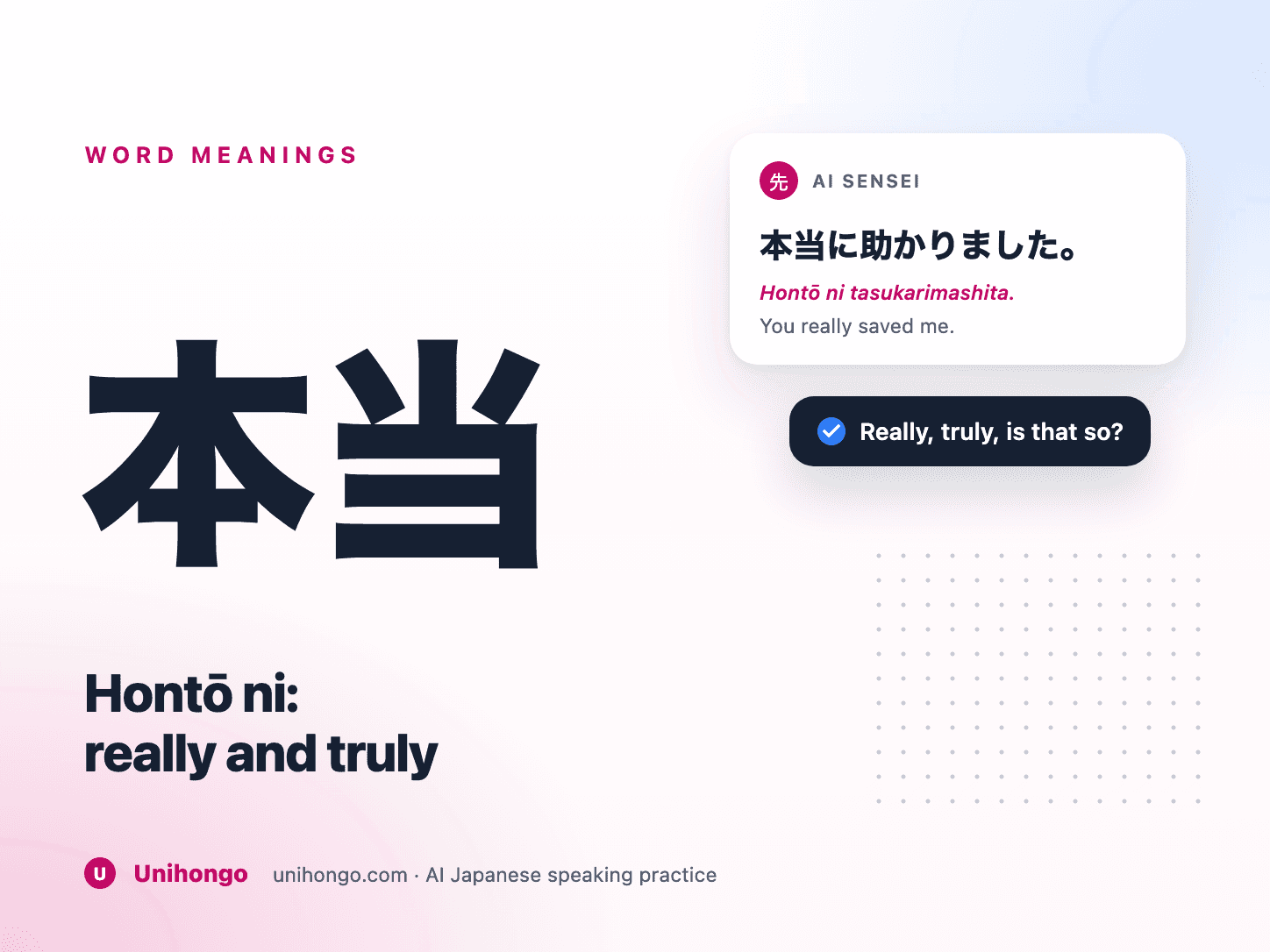
Hontō is written 本当, literally the real thing. On its own it is a noun: the truth. Add ni and it becomes the adverb really, which is the form learners use most.
The two jobs are easy to tell apart by position. Before another word, hontō ni intensifies. Alone, usually with a question intonation, hontō? reacts.
| Japanese | Romaji | Meaning |
|---|---|---|
| 本当 | hontō | Truth, the real thing |
| 本当です。 | Hontō desu. | It's true. |
| 本当においしい。 | Hontō ni oishii. | It's really delicious. |
| 本当? | Hontō? | Really? |
| 本当の話です。 | Hontō no hanashi desu. | It's a true story. |
Hontō ni as an intensifier
Placed before an adjective, a verb or a whole phrase, hontō ni adds sincerity as well as strength. It suggests you mean it, which is why it appears so often in thanks and apologies.
It combines most naturally with feelings, judgements and experiences, which is where sincerity matters: how tired you are, how kind someone was, how sorry you feel.
| Japanese | Romaji | Meaning |
|---|---|---|
| 本当に疲れました。 | Hontō ni tsukaremashita. | I'm really exhausted. |
| 本当にきれいですね。 | Hontō ni kirei desu ne. | It's truly beautiful, isn't it? |
| 本当に助かりました。 | Hontō ni tasukarimashita. | You really saved me. |
| 本当にありがとうございます。 | Hontō ni arigatō gozaimasu. | Thank you so much, truly. |
| 本当に申し訳ありません。 | Hontō ni mōshiwake arimasen. | I am truly sorry. |
Hontō? as a reaction
As a reaction, the meaning lives in the voice. A bright rising hontō? is pleased surprise. A slower, lower hontō? with a pause before it sounds doubtful, closer to are you sure?
Politeness changes the form, not the move. With friends, hontō? or hontō ni? is fine. With a teacher or a colleague you do not know well, add desu ka.
| Japanese | Romaji | Meaning |
|---|---|---|
| え、本当? | E, hontō? | What, really? (casual) |
| 本当に? | Hontō ni? | Seriously? (casual) |
| 本当ですか。 | Hontō desu ka. | Is that true? (polite) |
| うそ、本当に? | Uso, hontō ni? | No way, really? (casual, excited) |
| そうなんですか。 | Sō nan desu ka. | Oh, is that so? (soft, polite) |
| Reaction | Register | What it signals |
|---|---|---|
| Hontō? | Casual | Surprise, sometimes doubt |
| Hontō ni? | Casual | Stronger surprise |
| Hontō desu ka | Polite | Surprise, safe with anyone |
| Sō nan desu ka | Polite | Interest without questioning the facts |
Honto and hontoni: the casual versions
In relaxed speech the long vowel shortens, and you will hear honto and hontoni constantly among friends. Messages often write it in hiragana as ほんと.
In formal writing, businesses often replace hontō ni with makoto ni, especially in thanks and apologies. You will read it far more often than you will say it.
| Japanese | Romaji | Meaning |
|---|---|---|
| ほんと? | Honto? | For real? (casual) |
| ほんとに楽しかった。 | Hontoni tanoshikatta. | It was so much fun. (casual) |
| ほんとそれ。 | Honto sore. | So true. (casual agreement) |
| 誠にありがとうございます。 | Makoto ni arigatō gozaimasu. | We sincerely thank you. (formal) |
Hontō ni, maji and the other intensifiers
Hontō ni sits in the middle of a family of words that all push meaning upward. Maji belongs to young, casual speech, and the maji and gachi guide on this blog covers that end in detail.
For learners, hontō ni is the safe all-rounder. It works with friends, teachers and customers, and nobody will find it too slangy or too stiff.
| Word | Register | Best for |
|---|---|---|
| Hontō ni | Neutral | Sincere emphasis anywhere |
| Totemo | Neutral | Plain degree: very |
| Sugoku | Casual to neutral | Strong feeling in speech |
| Maji de | Slang | Friends only |
| Makoto ni | Formal, written | Business thanks and apologies |
Answering when someone asks hontō?
When someone reacts with hontō?, they usually want a confirmation plus a little more detail. A bare hai ends the moment; a confirmation with a reason keeps the conversation going.
If the listener sounds doubtful, yo adds assurance. With friends, uso ja nai yo, I am not lying, is a playful way to insist.
| Japanese | Romaji | Meaning |
|---|---|---|
| 本当ですよ。 | Hontō desu yo. | It really is true. |
| 本当だよ。 | Hontō da yo. | It's true, I promise. (casual) |
| うそじゃないよ。 | Uso ja nai yo. | I'm not lying. (casual) |
| 本当です。昨日、見ました。 | Hontō desu. Kinō, mimashita. | It's true. I saw it yesterday. |
The fourth line is the pattern to copy: confirm, then give one concrete detail.
Making it automatic
Hontō ni becomes natural quickly because you meet reasons to use it every day. The hard part is the reaction, since it has to come out instantly when someone tells you something.
Rehearsing short exchanges where news arrives without warning trains that reflex. After a conversation with an AI Sensei in Unihongo, the corrections in the session report show where a reaction came out in the wrong register, such as a bare hontō? to someone you should have answered politely.
- Use hontō ni before feelings and judgements, not plain facts.
- React with hontō? among friends and hontō desu ka with everyone else.
- Follow your reaction with a question.
- Confirm with hontō desu yo plus one detail.