
Why isolated word lists fade
A bare list stores a Japanese word next to an English one and nothing else. When you later need the word, your memory has exactly one path to it, and that path runs through English at the moment when you are trying to speak without translating. The result is familiar: you recognise the word instantly when you see it, and it is completely unavailable when you open your mouth in a shop.
Words that survive are stored with hooks. A sound, a sentence rhythm, a particle, a place, a person who said it to you, a mistake you made with it. Each hook is another route back to the word, and routes are what retrieval is made of. This is why one word learned inside a sentence you have said aloud six times beats ten words highlighted in a list.
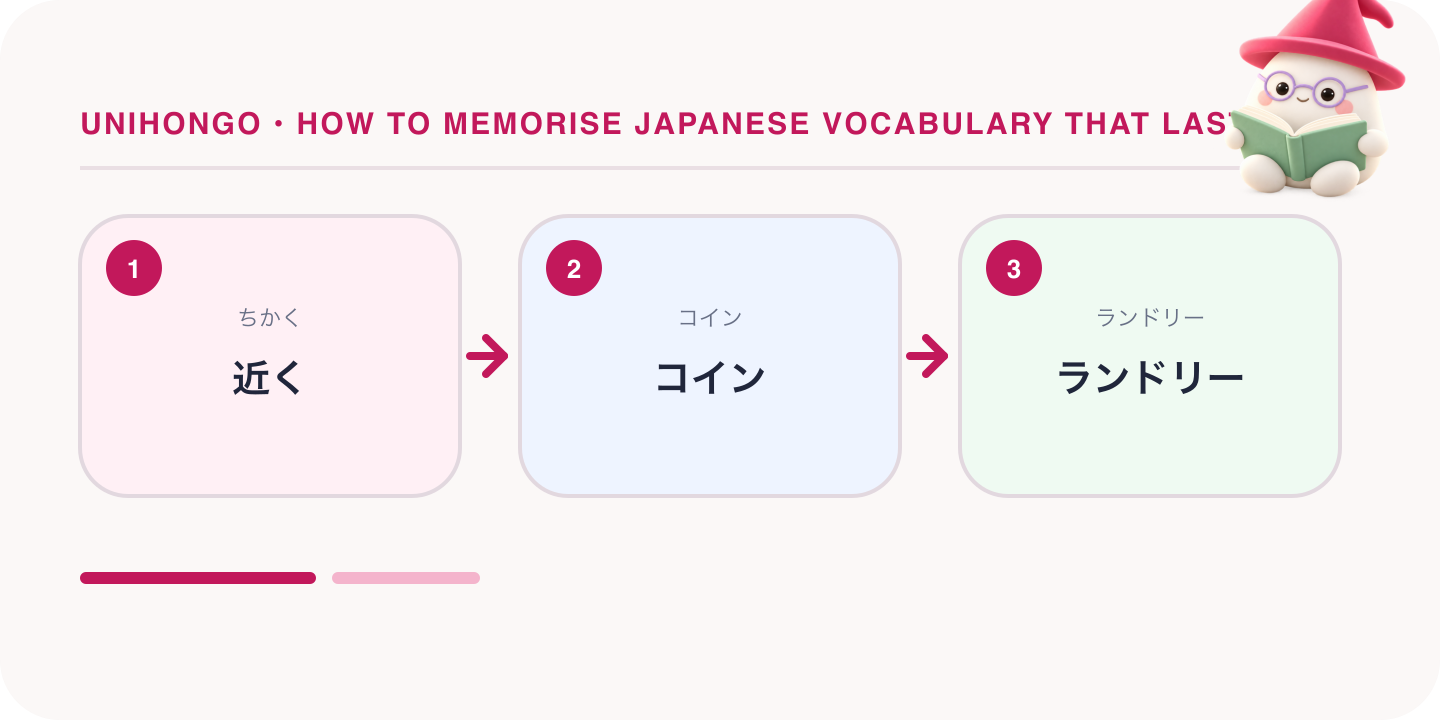
Learn the word inside a sentence you can say
The unit of learning should be a sentence short enough to say without preparing. Under ten words is a good ceiling. It should be true about your own life, because a true sentence recruits a memory of a real situation, and it should be something a real exchange would actually produce, which means you should also know the likely reply. A word you can only say in a sentence nobody would answer is still half-learned.
| Japanese | Romaji | Meaning |
|---|---|---|
| すみません、この近くにコインランドリーはありますか? | Sumimasen, kono chikaku ni koinrandorī wa arimasu ka? | Excuse me, is there a launderette near here? |
| はい、駅の向かいにあります。 | Hai, eki no mukai ni arimasu. | Yes, it is across from the station. |
| 袋はいりません。 | Fukuro wa irimasen. | I do not need a bag. |
| かしこまりました。 | Kashikomarimashita. | Certainly. |
| 少し考えさせてください。 | Sukoshi kangaesasete kudasai. | Please let me think about it for a moment. |
| ゆっくり見てください。 | Yukkuri mite kudasai. | Please take your time looking. |
| ここで召し上がりますか? | Koko de meshiagarimasu ka? | Will you be eating in? |
| 持ち帰りでお願いします。 | Mochikaeri de onegai shimasu. | Takeaway, please. |
The word being learned here is コインランドリー, but what makes it stick is the frame around it: kono chikaku ni X wa arimasu ka is a slot you will reuse for a chemist, a cash machine, and a post box. Learn the slot once and every new noun you drop into it arrives already usable. This is the difference between adding vocabulary and adding sentences you can vary.
Recognition and production are different skills
Recognition is answering the question, what does this mean. Production is answering the much harder question, what is the word for this. Nearly all convenient study builds the first: reading, flashcards seen Japanese-side first, subtitles, listening. That is useful and it is not enough, because a conversation only ever asks you the second question, and under time pressure.
- For recognition: read and listen widely, and let unknown words repeat in context rather than looking up every one.
- For production: prompt yourself in English or with a situation, and say the Japanese aloud before checking.
- Test production from the situation, not the translation: you are at a counter and the bag question comes; what do you say.
- Count a word as learned only when it comes out in a live conversation without a pause for retrieval.
- Keep a short list of words you recognise but never produce, and use that list as your speaking agenda.
What a usable word entry looks like
| Field | Bare entry | Usable entry |
|---|---|---|
| Word | 予約 yoyaku, reservation | 予約 yoyaku, a reservation or booking |
| Sentence | Not recorded | 七時に予約をお願いします。Shichi-ji ni yoyaku o onegai shimasu. |
| Particle | Not recorded | 予約をする, 予約が取れる, 予約を取り消す |
| Situation | Not recorded | Phoning a restaurant on a Friday evening |
| Likely reply | Not recorded | 何名様ですか。Nan-mei-sama desu ka. |
| Review state | Seen four times | Said aloud in a roleplay, corrected once, reused a week later |
The right-hand column takes about ninety seconds to write and is the reason the word will still be there next month. Note that the entry stores a reply as well as a line: knowing that the answer will be nan-mei-sama desu ka means the conversation does not collapse two seconds after your prepared sentence lands. That collapse, not the missing word, is what makes people avoid speaking.
Choose the words that will come back
Two filters decide whether a word is worth a slot in your memory. The first is frequency: the connective machinery of Japanese, such as ちょっと, たぶん, やっぱり, and the counters and time words, appears in nearly every conversation and pays you back constantly. The second is personal relevance: the nouns of your own job, neighbourhood, hobby, and health. A word that describes your actual Tuesday will recur naturally, and recurrence is free review.
- Take the frequency layer from what you keep hearing, not from a list you have not met yet.
- Add the words for the three situations you genuinely repeat each week, such as your commute, your lunch order, and your work updates.
- Skip decorative vocabulary that you cannot place in a situation, however satisfying the word is.
- Keep specialist terms for your own field, since nobody else's list contains them and you will need them constantly.
- Drop a word from active study if it has failed three cycles and you still cannot place a situation for it.
The particle is part of the verb
| Japanese | Romaji | Meaning |
|---|---|---|
| 電車に乗ります。 | Densha ni norimasu. | I get on the train. |
| 次の駅で降ります。 | Tsugi no eki de orimasu. | I get off at the next station. |
| 友達に会います。 | Tomodachi ni aimasu. | I am meeting a friend. |
| 薬を飲みます。 | Kusuri o nomimasu. | I take medicine. |
| 写真を撮ってもいいですか? | Shashin o totte mo ii desu ka? | May I take a photo? |
| 仕事に慣れました。 | Shigoto ni naremashita. | I have got used to the job. |
| 日本語が上手になりたいです。 | Nihongo ga jōzu ni naritai desu. | I want to become good at Japanese. |
| 道が混んでいます。 | Michi ga konde imasu. | The road is congested. |
A verb learned without its particle is an incomplete item, and the gap shows the moment you speak. Noru takes ni for the thing you board, and au takes ni for the person you meet, neither of which matches the English preposition. Store the particle in the same breath as the verb: densha ni noru, tomodachi ni au, never noru on its own. The particles guide explains why each one behaves as it does; for memorisation purposes you simply keep them glued together.
Words that travel together
| Japanese | Romaji | Meaning |
|---|---|---|
| 予約を取りたいのですが。 | Yoyaku o toritai no desu ga. | I would like to make a reservation. |
| 熱が出たので休みます。 | Netsu ga deta node yasumimasu. | I have a fever, so I will take the day off. |
| 約束を守ります。 | Yakusoku o mamorimasu. | I keep my promises. |
| 電話をかけてもいいですか? | Denwa o kakete mo ii desu ka? | May I make a phone call? |
| お風呂に入ってから寝ます。 | Ofuro ni haitte kara nemasu. | I take a bath and then go to bed. |
| 傘を差している人が多いです。 | Kasa o sashite iru hito ga ōi desu. | A lot of people are holding umbrellas up. |
| 風邪を引いたみたいです。 | Kaze o hiita mitai desu. | It seems I have caught a cold. |
| 昼ご飯を食べてから行きます。 | Hirugohan o tabete kara ikimasu. | I will go after eating lunch. |
Japanese chooses a specific verb for each of these nouns, and the choice rarely matches English. A fever comes out rather than being had, a cold is pulled rather than caught, a reservation is taken rather than made, a promise is protected rather than kept, and a phone call is hung rather than made. Learning netsu ga deru or kaze o hiku as a single item removes a whole class of sentences you would otherwise assemble wrongly under pressure.
Homophones and the context that sorts them
| Japanese | Romaji | Meaning |
|---|---|---|
| 今日は暑いですね。 | Kyō wa atsui desu ne. | It is hot today, isn't it. |
| このスープは熱いです。 | Kono sūpu wa atsui desu. | This soup is hot. |
| この本は厚いです。 | Kono hon wa atsui desu. | This book is thick. |
| お箸をもらえますか? | Ohashi o moraemasu ka? | Could I have some chopsticks? |
| あの橋を渡ってください。 | Ano hashi o watatte kudasai. | Please cross that bridge. |
| 予定を変えてもいいですか? | Yotei o kaete mo ii desu ka? | May I change the plan? |
| 何時に帰りますか? | Nan-ji ni kaerimasu ka? | What time are you going home? |
Japanese has many words that share a sound, and learners often treat this as a reason to panic. In practice the subject sorts them out instantly: soup is atsui in one way, a book in another, and no listener is confused. Some pairs such as hashi for chopsticks and hashi for bridge are separated further by pitch, which the pronunciation guide covers, but context does most of the work.
For memorisation, the lesson is simple. Never store a homophone as a bare sound with three meanings attached, because that is the arrangement that makes you hesitate mid-sentence while you pick. Store three separate sentences instead, each with its own noun and its own situation, and the sound will arrive already attached to the right meaning, because the noun brought it along with the picture of where you say it.
Spaced review without the jargon
Spacing means meeting a word again just as it is starting to slip. Reviewing something you still know perfectly is comfortable and does little; reviewing something you have completely lost is discouraging and slow. The useful moment is the one where you can retrieve the word only with effort, because effortful retrieval is what strengthens the memory rather than merely refreshing it.
You do not need software to do this, although software is convenient for large volumes. A workable manual spacing is same day, next day, three days later, a week later, a month later, with a word dropping out of the cycle once it has appeared in a real conversation twice. What matters far more than the exact intervals is that each review asks you to produce the word, not to recognise it.
- Review by saying the sentence from a situation prompt, with the Japanese hidden.
- Mark a word as failed if you needed more than about three seconds, even if you eventually got it.
- Put failed words at the front of tomorrow's set rather than at the end of a long backlog.
- Cap your daily review so that it takes under fifteen minutes; a backlog you dread is a backlog you abandon.
Keep a word bank from your own conversations
A generic deck teaches you the words its author needed. Your own conversations reveal the words you needed and did not have, which is a far shorter and far more valuable list. Every time you speak Japanese and reach for something that is not there, note what you were trying to say, in English if necessary, and look it up afterwards. That gap list is the most efficient study material you will ever assemble.
- After every spoken session, write down the two or three things you could not say.
- Look up one natural way to say each, not four synonyms, and write the sentence you would have used.
- Add the correction you received, in the corrected form rather than as a note about the mistake.
- Reuse the sentence deliberately in your next session, in the first two minutes, before you lose the nerve.
- Once a month, read the whole bank aloud; the words you now say without pausing can be archived.
A weekly cycle for turning new words into used words
| Day | Focus | What you actually do |
|---|---|---|
| Monday | Collect | Take six words from your own week and write one true sentence for each |
| Tuesday | Say | Read the six sentences aloud, then say them again with the page covered |
| Wednesday | Vary | Change one element in each sentence: the time, the place, or the person |
| Thursday | Use | Force all six into one spoken conversation, however clumsy it feels |
| Friday | Repair | Review the corrections and rewrite the two sentences that broke |
| Weekend | Recycle | Say last week's six in new sentences before adding anything new |
Six words a week sounds slow until you notice that these are six words you can use, which is not the same currency as six words you have seen. The cycle also has a built-in filter: any word that cannot survive Wednesday's variation step probably had no situation attached to it, and is better dropped than carried for another month.
Keep the cycle running even in a bad week. Two words fully absorbed beats a heroic session of forty that you never say aloud, and the habit of ending the week with a conversation is the part that makes the vocabulary permanent.