
Kawaisou and its kinder cousins
Kawaisō is one of four phrases you need for sad moments. The first two are pity, used naturally about animals, children and stories. The last two are sympathy you can safely say to an adult: one polite and formal, one warm and casual. Choosing between them is the real skill this post teaches.
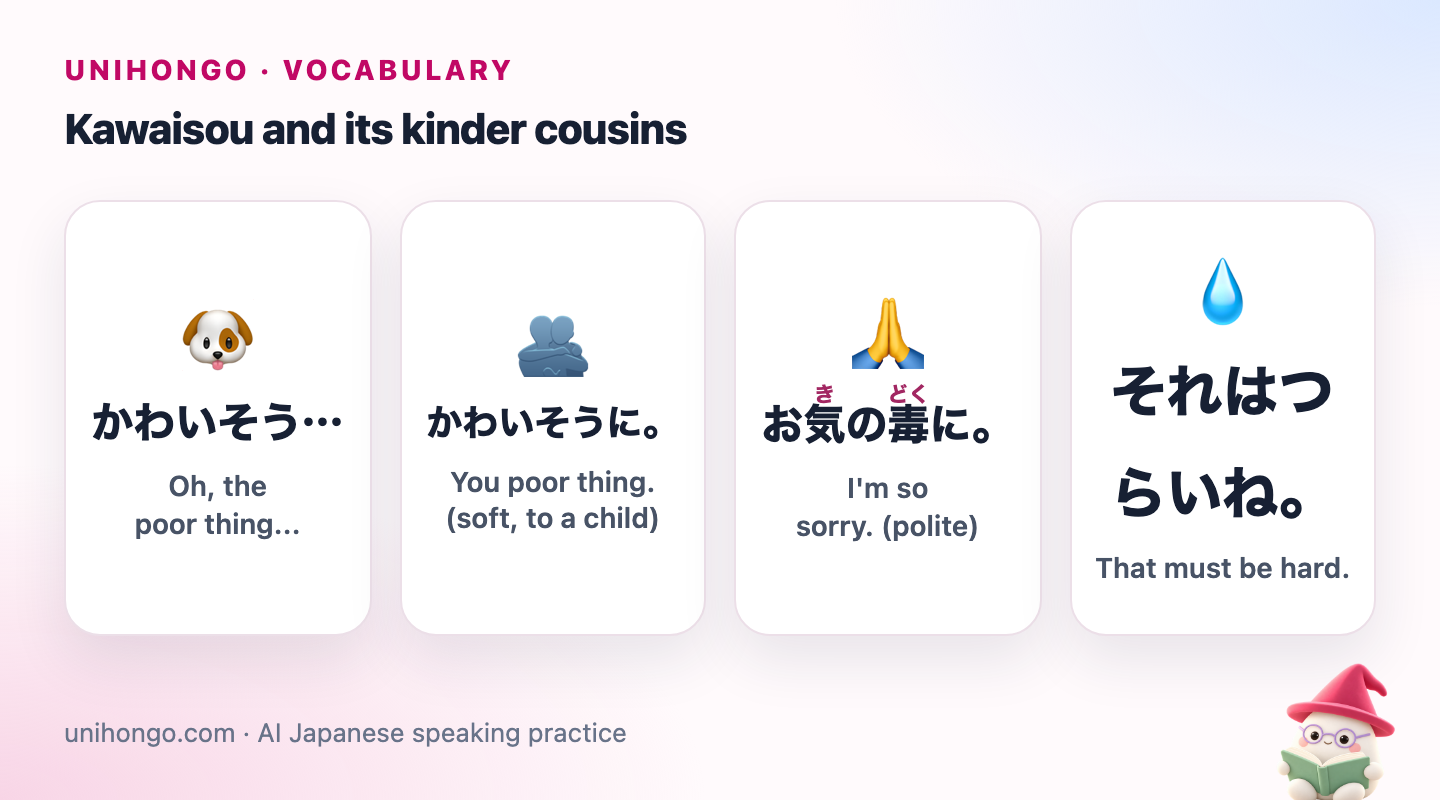
| Japanese | Romaji | Meaning |
|---|---|---|
| かわいそう… | Kawaisō... | Oh, the poor thing... |
| かわいそうに。 | Kawaisō ni. | You poor thing. (soft, to a child) |
| お気の毒に。 | Okinodoku ni. | I'm so sorry. (polite) |
| それはつらいね。 | Sore wa tsurai ne. | That must be hard. |
What kawaisō means, and how it relates to kawaii
Kawaisō is a na-adjective: kawaisō na neko, a poor cat; kawaisō da, it's pitiful. It is usually written in hiragana. The kanji spelling 可哀想 (also 可哀相) is a phonetic spelling, ateji, chosen for sound and for the meaning of 哀, sorrow. You will see it in novels and some news, but hiragana is far more common.
Kawaii and kawaisō really are related. Dictionaries usually trace kawaii to an older word that described a painful, pitiable feeling, the urge to protect something small and helpless. Over time kawaii moved towards 'cute', while kawaisō kept the sense of pity. So the two words share a root feeling, tenderness for the weak, but today they mean different things.
This also explains why there is no natural 'seems cute' form built on kawaii plus sō: that space is taken by kawaisō. If something looks cute, say kawaii, kawaii ne or kawairashii.
| Japanese | Romaji | Meaning |
|---|---|---|
| かわいそうな猫 | kawaisō na neko | a poor little cat |
| 見て、かわいい! | Mite, kawaii! | Look, how cute! |
| かわいらしいお店ですね。 | Kawairashii omise desu ne. | What a sweet little shop. |
Animals, children, characters and the news
Kawaisō is most natural when the one you pity cannot really be offended: animals, small children, people in a story, and people in the news whom you do not know. A dog left outside in the cold, a child who lost a balloon, a film hero who loses everything, a family whose home was damaged by a typhoon: kawaisō is the instinctive reaction.
With children, kawaisō ni, 'you poor thing', is a soft, comforting line, often said while picking up a toddler who fell. It sounds kind and parental. Among friends watching a sad film or reading the news, kawaisō is shared feeling, and nobody is being looked down on.
| Japanese | Romaji | Meaning |
|---|---|---|
| 雨の中で、かわいそうに。 | Ame no naka de, kawaisō ni. | Out in the rain, you poor thing. |
| 転んじゃったの?かわいそうに。 | Koronjatta no? Kawaisō ni. | Did you fall over? You poor thing. |
| あの主人公、かわいそうすぎる。 | Ano shujinkō, kawaisō sugiru. | That main character has it so rough. |
| 台風の被害、かわいそうだね。 | Taifū no higai, kawaisō da ne. | The typhoon damage, those poor people. |
For news about disasters, many speakers prefer more respectful words, such as hisaichi no kata-gata ga shinpai desu, I'm worried about the people in the affected area. Kawaisō is common in casual talk, but in polite or public settings it can sound a little light for a serious tragedy.
Why not say kawaisō to an adult's face
Pity has a direction: the one who feels it stands a little above the one who receives it. When you tell an adult kawaisō about their own situation, for example after a breakup or a failed exam, they may hear 'how pathetic' rather than 'I'm on your side'. Some friends will not mind, but many adults would rather receive sympathy than pity.
The kinder approach is to name the difficulty, not to judge the person. Sore wa tsurai ne, that must be hard, taihen datta ne, that sounds rough, and shinpai da ne, that's worrying, all stand beside the person instead of above them. In polite settings, okinodoku desu or sore wa okinodoku desu ne express formal sympathy.
There is one more trap: jibun ga kawaisō, 'I pity myself', can sound self-pitying. It is fine as a joke among friends, but in a serious conversation, tsurai or kanashii, sad, are more natural ways to say how you feel.
| Japanese | Romaji | Meaning |
|---|---|---|
| それは大変だったね。 | Sore wa taihen datta ne. | That sounds really rough. |
| 心配だね。何かできることある? | Shinpai da ne. Nanika dekiru koto aru? | That's worrying. Is there anything I can do? |
| それはお気の毒ですね。 | Sore wa okinodoku desu ne. | I'm very sorry to hear that. (polite) |
| 話してくれてありがとう。 | Hanashite kurete arigatō. | Thank you for telling me. |
Kawaisō, ki no doku, tsurai, zannen and mottainai
Several words cover sad or unfortunate moments, and each points in a slightly different direction. This table helps you choose.
| Japanese | Romaji | Meaning |
|---|---|---|
| 雨で中止?残念だね。 | Ame de chūshi? Zannen da ne. | Cancelled for rain? What a shame. |
| まだ食べられるのに、もったいない。 | Mada taberareru noni, mottainai. | It's still edible, what a waste. |
| お母様のこと、お気の毒でした。 | Okāsama no koto, okinodoku deshita. | I was so sorry about your mother. (polite) |
| Word | Feeling | Best used for |
|---|---|---|
| kawaisō | Tender pity | Animals, children, characters, strangers in the news |
| ki no doku | Restrained sympathy | Adults, polite or formal speech |
| tsurai | Hard, painful | A friend's difficult situation, said with them |
| zannen | What a shame, disappointing | Plans cancelled, results that missed |
| mottainai | What a waste | Food thrown away, unused talent or chances |
Notice that only kawaisō is about a living being you feel tender towards. Zannen and mottainai are about events and things, so they can never sound condescending, and ki no doku keeps a respectful distance. When you are unsure, describing the situation with tsurai or taihen is almost always safe.
Kawaisō dakara: it would be mean to...
A very useful pattern turns kawaisō into a reason. Kawaisō dakara means 'because it would be unkind', and it explains why you do or do not do something. Kawaisō dakara okosanaide okō, let's not wake him, it would be mean. Kawaisō dakara, mō sukoshi asobasete agete, let them play a bit longer, it would be a shame to stop them.
In the past, kawaisō na koto o shita means 'I did something unkind' or 'I feel bad for what I did'. People use it when they forgot a promise to a child, left a pet alone too long, or were too harsh with someone. It expresses regret, not pity.
| Japanese | Romaji | Meaning |
|---|---|---|
| かわいそうだから、起こさないでおこう。 | Kawaisō dakara, okosanaide okō. | Let's not wake him; it'd be mean. |
| かわいそうだから、もう少し遊ばせてあげて。 | Kawaisō dakara, mō sukoshi asobasete agete. | Let them play a bit longer; it's a shame to stop. |
| 約束を忘れて、かわいそうなことをした。 | Yakusoku o wasurete, kawaisō na koto o shita. | I forgot my promise; I feel awful about it. |
Mini dialogue: a kitten in the rain
Two friends walking home in the evening find a small kitten sheltering under a planter. Kawaisō is exactly the right word here, and the conversation quickly turns to what they can do, which is the kindest part of pity.

| Japanese | Romaji | Meaning |
|---|---|---|
| 見て、子猫がいる。 | Mite, koneko ga iru. | Aya: Look, there's a kitten. |
| びしょびしょだ。かわいそうに。 | Bishobisho da. Kawaisō ni. | Sam: It's soaked. Poor little thing. |
| お母さん猫、近くにいるかな。 | Okāsan neko, chikaku ni iru ka na. | Aya: I wonder if its mother is nearby. |
| 少し様子を見てみよう。 | Sukoshi yōsu o mite miyō. | Sam: Let's watch for a bit. |
| いなかったら、動物病院に連絡しようか。 | Inakattara, dōbutsu byōin ni renraku shiyō ka. | Aya: If not, shall we call an animal clinic? |
Bishobisho means soaking wet, one of many sound-symbolic words in Japanese. Pairing a vivid word like this with kawaisō ni is very natural in casual speech, and it makes your sympathy sound spontaneous rather than textbook.
Notice too that Sam softens his first reaction with ni at the end. Kawaisō alone is a plain statement; kawaisō ni sounds gentler, like a murmur to the kitten itself.
Common learner mistakes with kawaisō
- Using it to mean 'looks cute'. Kawaisō is always pity; for cute, say kawaii.
- Saying kawaisō to a friend about their own bad news. Try sore wa tsurai ne or taihen datta ne instead.
- Using it for serious tragedies in polite settings. It can sound light; choose more respectful words.
- Forgetting the na before nouns. It is kawaisō na inu, not kawaisō inu.
- Confusing it with zannen. Zannen is disappointment about events; kawaisō is pity for someone.
Sort pity from sympathy with Mocchi
Try this in Mocchi: 'Give me eight situations, a lost dog, a friend who failed an exam, a coworker's sick parent, and ask me to choose kawaisō, tsurai ne, okinodoku or zannen.' Mocchi explains why each answer is kind or awkward, remembers the ones you hesitate on, and can turn the best lines into flashcards with /create-flashcards, a photo for each. Then play Kotoba Tank with those cards, hitting the right phrase as you hear it.