
What kuchisabishii means
Kuchisabishii combines kuchi, mouth, and sabishii, lonely. The image is a mouth with nothing to do, wanting company. People say it when they notice themselves reaching for crisps, chewing a pen or opening the fridge for no real reason.
It belongs to a group of everyday food feelings that Japanese names neatly. Here are the four you will hear most often around snack time.
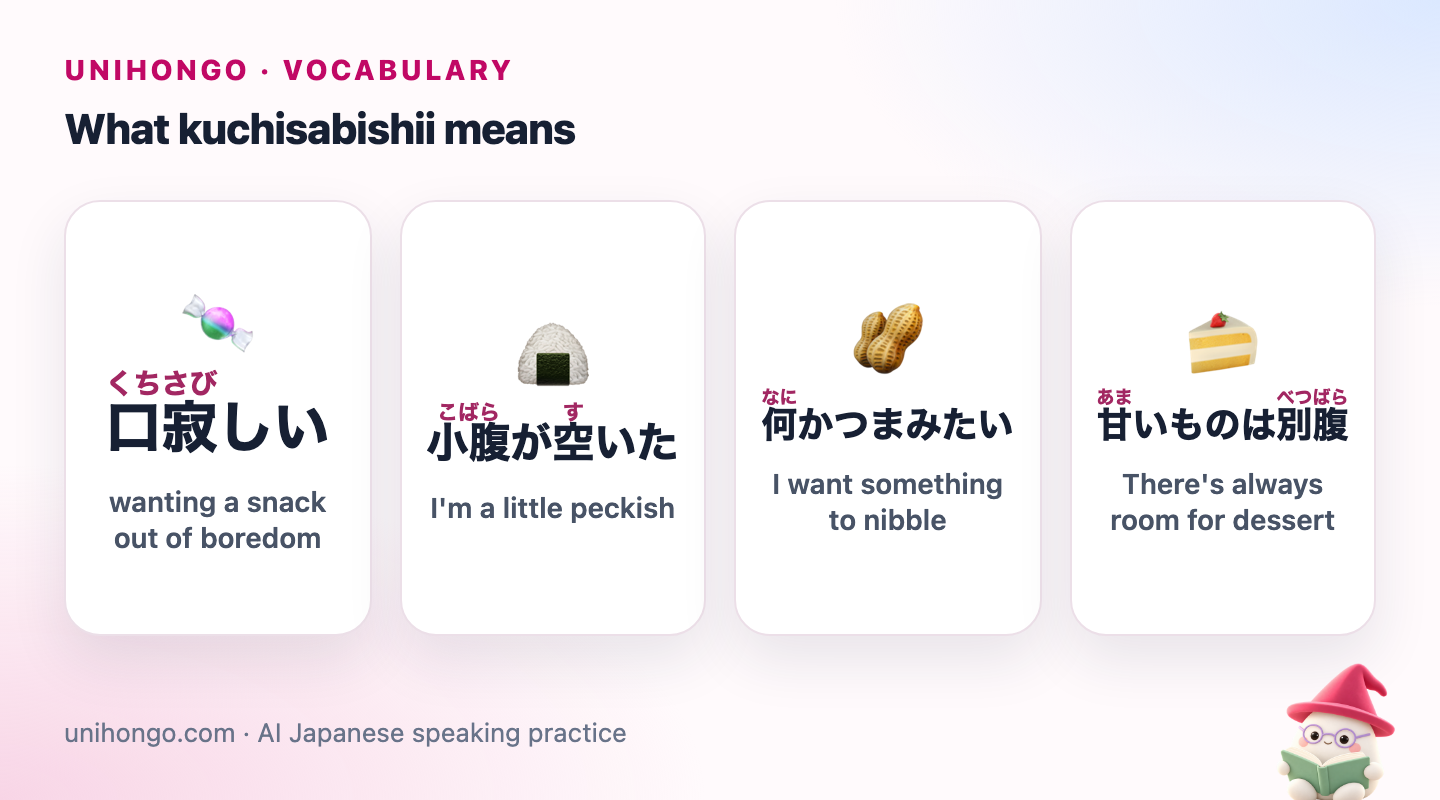
| Japanese | Romaji | Meaning |
|---|---|---|
| 口寂しい | kuchisabishii | wanting a snack out of boredom |
| 小腹が空いた | kobara ga suita | I'm a little peckish |
| 何かつまみたい | nanika tsumamitai | I want something to nibble |
| 甘いものは別腹 | amai mono wa betsubara | There's always room for dessert |
The kanji and the grammar
寂 is the kanji of sabishii, lonely, and the whole word behaves like an ordinary i-adjective. Its te form kuchisabishikute links a reason to an action, and kuchisabishiku naru means to start feeling it. You can also split the word into a sentence, kuchi ga sabishii, which sounds a little more playful.
Two spelling and sound variants exist. Some people write 口淋しい with a different kanji for lonely, and many say kuchisamishii, since samishii is a softer, very common pronunciation of sabishii. All are correct; kuchisabishii with 寂 is the most common in print.
| Japanese | Romaji | Meaning |
|---|---|---|
| 口寂しくてガムを噛んでいます。 | Kuchisabishikute gamu o kande imasu. | I'm chewing gum because my mouth wants something. |
| 口が寂しいなあ。 | Kuchi ga sabishii nā. | My mouth is bored. (playful, casual) |
| 夜になると口寂しくなる。 | Yoru ni naru to kuchisabishiku naru. | At night I start wanting snacks. |
| 口寂しい時は飴をなめます。 | Kuchisabishii toki wa ame o namemasu. | When I want a snack, I suck on a sweet. |
| 口さみしい | kuchisamishii | the same word, softer pronunciation |
When people say it
The word turns up in a few very typical situations. Studying or working late, when concentration makes your hands look for something. Watching a film or a match. Driving long distances, where gum or sweets keep you alert. And after quitting smoking, when the habit of having something at your lips is gone; this is one of the classic uses, and you may hear it from friends who are trying to stop.
It is often said with a small laugh, because the speaker knows they are not hungry. That self-mocking tone is part of what makes the word friendly.
Many people keep something small within reach for these moments: hard sweets, called ame, in a desk drawer, gum in the car, nuts or dried squid at home. In the Kansai region sweets are affectionately called ame-chan, and older women there are teasingly said to always carry some in their bag to share. It is a regional stereotype rather than a rule, but you may well be offered one.
If you are trying to cut down, the natural phrase for your strategy is kuchisabishisa o magirawasu, to distract a lonely mouth, usually with tea, gum or a short walk.
| Japanese | Romaji | Meaning |
|---|---|---|
| タバコをやめてから口寂しい。 | Tabako o yamete kara kuchisabishii. | Since I quit smoking, my mouth feels empty. |
| 勉強中、つい口寂しくなる。 | Benkyōchū, tsui kuchisabishiku naru. | When I'm studying, I always end up wanting a snack. |
| 運転中は口寂しいからガムが必要。 | Untenchū wa kuchisabishii kara gamu ga hitsuyō. | I need gum when I drive, my mouth gets bored. |
| 映画を見ながら何か食べたい。 | Eiga o minagara nanika tabetai. | I want to eat something while I watch the film. |
Kuchisabishii is not hunger
Japanese has a whole scale of hunger words, and kuchisabishii sits at the very bottom, where the stomach is not really involved. Choosing the right one makes you sound natural at the office snack drawer.
| Japanese | Romaji | Meaning |
|---|---|---|
| お腹が空いた。 | Onaka ga suita. | I'm hungry. |
| お腹ぺこぺこ! | Onaka pekopeko! | I'm starving! (casual) |
| お腹は空いてないけど、口寂しい。 | Onaka wa suitenai kedo, kuchisabishii. | I'm not hungry, I just want to munch. |
| Expression | Feeling | Typical moment |
|---|---|---|
| kuchisabishii | Not hungry, mouth wants something | Right after lunch, while working |
| kobara ga suita | A little hungry | Mid-afternoon, before a late dinner |
| onaka ga suita | Hungry | Before a meal |
| onaka pekopeko | Starving (casual, cute) | After sport or a long day |
| betsubara | Full, but room for something sweet | Dessert after a big meal |
Kobara (小腹) literally means small stomach and is used only in kobara ga suita and a few similar phrases. It is a very handy word for the four o'clock snack.
Onaka pekopeko sounds cute and is used by children and by adults in a playful mood, while some speakers, often men in casual speech, say hara hetta. All of these describe the stomach. Kuchisabishii is the odd one out, because it describes the mouth and the mind.
Snack words that come with it
When a mouth feels lonely, these are the words that follow. Oyatsu is a snack eaten at snack time, especially for children; okashi is sweets and crisps in general; otsumami is food to nibble with drinks. Nagara tabe, eating while doing something else, is exactly the habit that kuchisabishii describes.

| Japanese | Romaji | Meaning |
|---|---|---|
| おやつ | oyatsu | snack, snack time |
| お菓子 | okashi | sweets and snacks |
| おつまみ | otsumami | nibbles with drinks |
| ながら食べ | nagara tabe | eating while doing something else |
| ついつい食べちゃう。 | Tsuitsui tabechau. | I just end up eating. (casual) |
| 食いしん坊だね。 | Kuishinbō da ne. | You're such a foodie. (teasing, casual) |
Mini dialogue: the afternoon snack
| Japanese | Romaji | Meaning |
|---|---|---|
| なんか口寂しいなあ。 | Nanka kuchisabishii nā. | Coworker: I feel like munching on something. |
| チョコあるよ。食べる? | Choko aru yo. Taberu? | You: I've got chocolate. Want some? |
| いいの?さっきお昼食べたばかりなのに。 | Ii no? Sakki ohiru tabeta bakari na noni. | Coworker: Really? I only just had lunch, though. |
| わかる。午後は口寂しくなるよね。 | Wakaru. Gogo wa kuchisabishiku naru yo ne. | You: I know. Afternoons make you want snacks. |
| じゃあ、一つだけ。ありがとう。 | Jā, hitotsu dake. Arigatō. | Coworker: Just one, then. Thanks. |
Build a snack-word deck with Mocchi
Type to Mocchi: Make flashcards for kuchisabishii, kobara ga suita, betsubara, oyatsu and otsumami. With /create-flashcards Mocchi adds them to your Flash Card list, and you choose a photo for each one, a sweet, a rice ball, a dish of nuts, so the meaning is visual. /review-flashcards brings the tricky ones back first, and Mocchi remembers which words you tend to swap.
For a quick round between study sessions, load the same cards into Kotoba Tank: you hear a word and hit the right one, which is a fun test of whether kobara and kuchisabishii really feel different to you now.
Common learner mistakes
- Thinking it means a lonely person. Kuchisabishii is about snacking, not about missing someone; for loneliness use sabishii on its own.
- Using it for real hunger. If you skipped lunch, you are onaka ga suita, not kuchisabishii.
- Writing it as sabishii kuchi. The set word is kuchisabishii, or the sentence kuchi ga sabishii.
- Saying it in a formal meeting. It is a relaxed word for friends, family and friendly colleagues.
- Conjugating it like a na-adjective. Say kuchisabishikute and kuchisabishiku naru, not kuchisabishii na toki.