
Names you can read as kanji: Mitsubishi, Subaru, Nissan, Nintendo
Start with the names that are ordinary Japanese once you see the characters. Mitsubishi (三菱) is three plus water chestnut. The plant's name, hishi, also means the diamond shape, as in hishigata (菱形), rhombus, and the logo is the name drawn as a picture. The company describes the emblem as a blend of two family crests connected to its founder.
Subaru (昴) is an old native word for the Pleiades, the small bright star cluster. It was admired in Japan a thousand years ago: The Pillow Book opens its list of stars with it. Nissan (日産) is an abbreviation of Nihon Sangyō (日本産業), Japan Industries. Nintendo (任天堂) has its own section below.
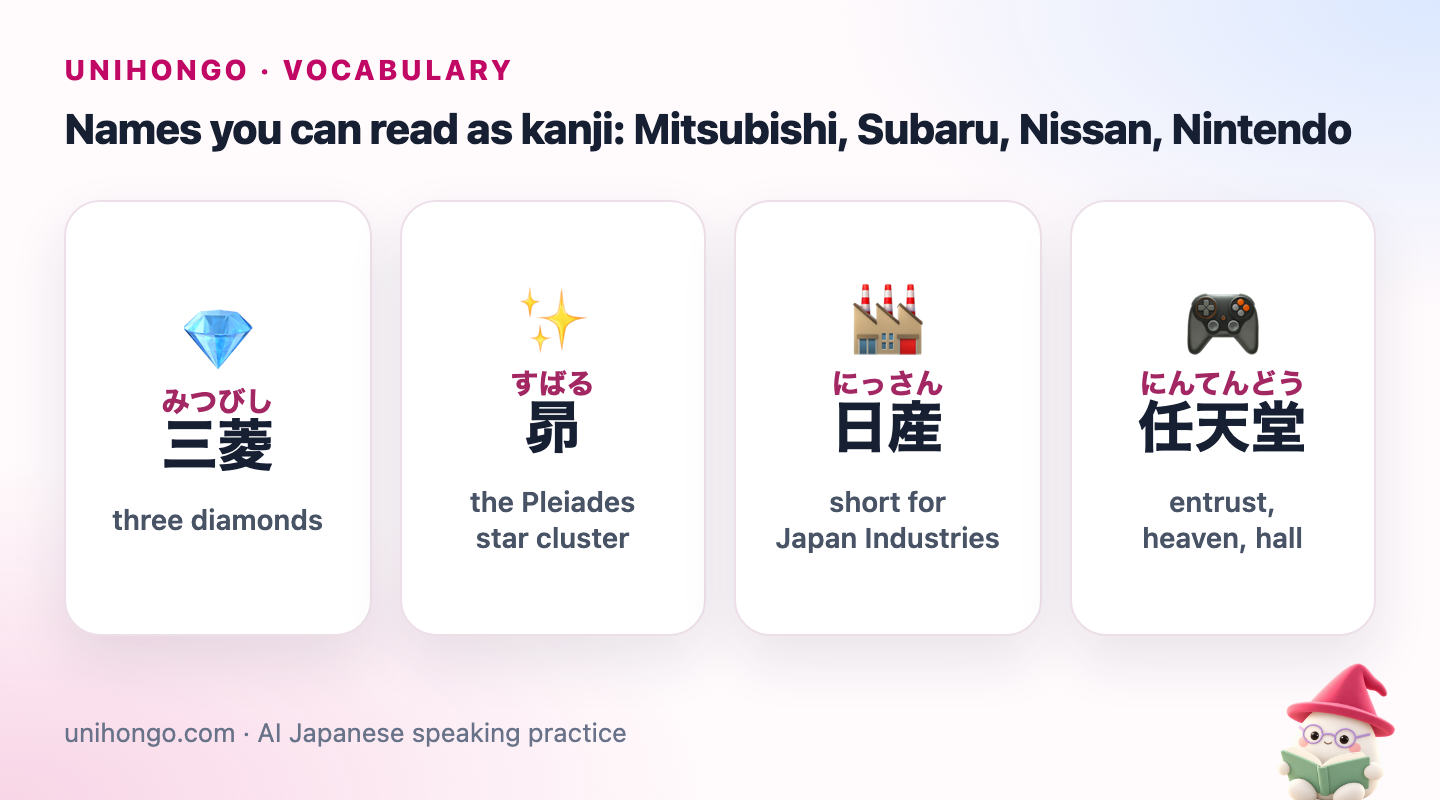
| Japanese | Romaji | Meaning |
|---|---|---|
| 三菱 | Mitsubishi | three diamonds |
| 昴 | subaru | the Pleiades star cluster |
| 日産 | Nissan | short for Japan Industries |
| 任天堂 | Nintendō | entrust, heaven, hall |
| 菱形 | hishigata | diamond shape, rhombus |
| 日本産業 | Nihon Sangyō | Japan Industries |
Family names in disguise: Toyota, Mazda and friends
Many of the largest makers are simply surnames. Honda (本田), Suzuki (鈴木) and Yamaha (山葉) are the founders' names unchanged. Toyota and Mazda are surnames with a twist.
Toyota comes from Toyoda (豊田), the family whose loom business gave birth to the car maker; toyo is abundant and ta is rice field. The d became a t when the brand was set up. Mazda is said Matsuda (マツダ) in Japan, the surname of founder Matsuda Jūjirō (松田). The spelling Mazda, by the company's account, also nods to Ahura Mazda, the chief god of the ancient Persian religion.
Bridgestone hides its founder too. His surname was Ishibashi (石橋): ishi, stone, and hashi, bridge, reversed in English.
| Japanese | Romaji | Meaning |
|---|---|---|
| 豊田 | Toyoda | Toyoda: abundant rice field |
| 松田 | Matsuda | Matsuda: pine rice field |
| 本田 | Honda | Honda: main rice field |
| 鈴木 | Suzuki | Suzuki: bell tree |
| 石橋 | Ishibashi | Ishibashi: stone bridge |
The kanji 田, rice field, read ta or da, is one of the most common building blocks of Japanese surnames. Learn it once and you will spot it everywhere.
Nintendo: three kanji and an open question
Nintendo began in Kyoto in the nineteenth century as a maker of hanafuda, flower playing cards. Its name, 任天堂, breaks into 任 (nin), to entrust or leave to someone, 天 (ten), heaven, and 堂 (dō), hall, a common ending for shop names.
The popular translation is leave luck to heaven, echoing the idiom un o ten ni makaseru (運を天に任せる). It fits a card maker nicely. Still, the founder left no clear explanation, so this is best presented as the usual interpretation.
| Japanese | Romaji | Meaning |
|---|---|---|
| 運を天に任せる | un o ten ni makaseru | to leave your luck to heaven |
| 任せてください。 | Makasete kudasai. | Leave it to me. |
Names that are not Japanese words: Sony, Canon, Uniqlo
Some founders deliberately avoided kanji. Sony was coined from the Latin sonus and the English sonny, replacing a long earlier name, Tōkyō Tsūshin Kōgyō, that was hard to say abroad.
Canon began as Kwanon, the name of an early camera, after Kannon (観音), the Buddhist figure of mercy. The spelling was later changed to Canon. In Japanese the company writes its name キヤノン with a full-size ヤ, though it is pronounced Kyanon.
Uniqlo is a contraction of Unique Clothing Warehouse, the name of the first shop. The story goes that the q replaced a c through a spelling mix-up during a company registration, and the firm liked the look. In Japan it is ユニクロ, Yunikuro.
Suntory and Kikkoman: a sun and a tortoise shell
Suntory joins the English word sun to the founder's surname, Torii (鳥井). The sun, in the company's telling, refers to the red circle on an early hit product, a sweet wine. You may hear that the name is Torii-san said backwards; that version is a popular joke more than a documented origin.
Kikkoman is written 亀甲萬 in kanji. Kikkō (亀甲) is a tortoise shell and also the hexagon pattern named after it; man (萬) is an old form of 万, ten thousand. The logo is exactly that: a hexagon with 萬 inside. The pairing is usually explained through the saying that a tortoise lives ten thousand years.
| Japanese | Romaji | Meaning |
|---|---|---|
| 亀甲 | kikkō | tortoise shell; hexagon pattern |
| 一万 | ichiman | ten thousand |
| 鶴は千年、亀は万年 | tsuru wa sennen, kame wa mannen | cranes live 1,000 years, tortoises 10,000 |
How solid is each origin story?
Name stories get polished over decades. This table separates what the kanji plainly say from what companies and fans like to tell.
| Brand | Type of name | How solid the story is |
|---|---|---|
| Mitsubishi | Kanji compound | Certain: the kanji mean three water chestnuts or diamonds |
| Subaru | Native Japanese word | Certain: it is the Pleiades; the count of stars is the company's account |
| Nissan | Abbreviation | Certain: short for Nihon Sangyō |
| Nintendo | Kanji compound | Kanji are clear; the intended meaning is an interpretation |
| Toyota | Family name, altered | Family origin certain; reasons for the change are company lore |
| Mazda | Family name plus a deity | Company's own account |
| Sony | Coined word | Company's own account |
| Canon | Respelled Buddhist name | Well documented |
| Uniqlo | Contraction | Contraction certain; the q story is widely told |
| Suntory | Sun plus family name | Company's account; the reversed-name tale is a joke |
| Kikkoman | Kanji compound | Kanji are clear; the long-life link is the usual explanation |
How the names sound in Japan
Said in Japanese, every name is split into even beats, with no strong stress. A doubled consonant is a one-beat pause and a long vowel is held for two beats.
| Japanese | Romaji | Meaning |
|---|---|---|
| トヨタ | Toyota | Toyota |
| ニッサン | Nissan | Nissan, with a short pause |
| マツダ | Matsuda | Mazda |
| スバル | Subaru | Subaru |
| ユニクロ | Yunikuro | Uniqlo |
| ソニー | Sonī | Sony, with a long final vowel |
| キヤノン | Kyanon | Canon |
| サントリー | Santorī | Suntory |
| キッコーマン | Kikkōman | Kikkoman |
Talking about brands in simple sentences
The useful words are mēkā (メーカー), maker or manufacturer, and nihonsei (日本製), made in Japan. To ask where a name comes from, use yurai (由来), origin.
| Japanese | Romaji | Meaning |
|---|---|---|
| どこのメーカーですか。 | Doko no mēkā desu ka. | Which maker is it? |
| これは日本製です。 | Kore wa nihonsei desu. | This is made in Japan. |
| トヨタの車に乗っています。 | Toyota no kuruma ni notte imasu. | I drive a Toyota. |
| このシャツはユニクロで買いました。 | Kono shatsu wa Yunikuro de kaimashita. | I bought this shirt at Uniqlo. |
| 任天堂のゲームが好きです。 | Nintendō no gēmu ga suki desu. | I like Nintendo games. |
| 名前の由来は何ですか。 | Namae no yurai wa nan desu ka. | Where does the name come from? |