
Happy anniversary in Japanese: the four key phrases
Kinenbi (記念日) means a day to remember: 記念 is commemoration and 日 is day. On its own it can be any anniversary, from a national holiday to the day you adopted your cat, so between partners kinenbi omedetō is understood at once as our anniversary. Omedetō is the congratulation word you also hear in tanjōbi omedetō, happy birthday.
The four cards below cover most situations: the everyday phrase, the wedding version, the way couples count their time together, and the shūnen form used for organisations and careers.
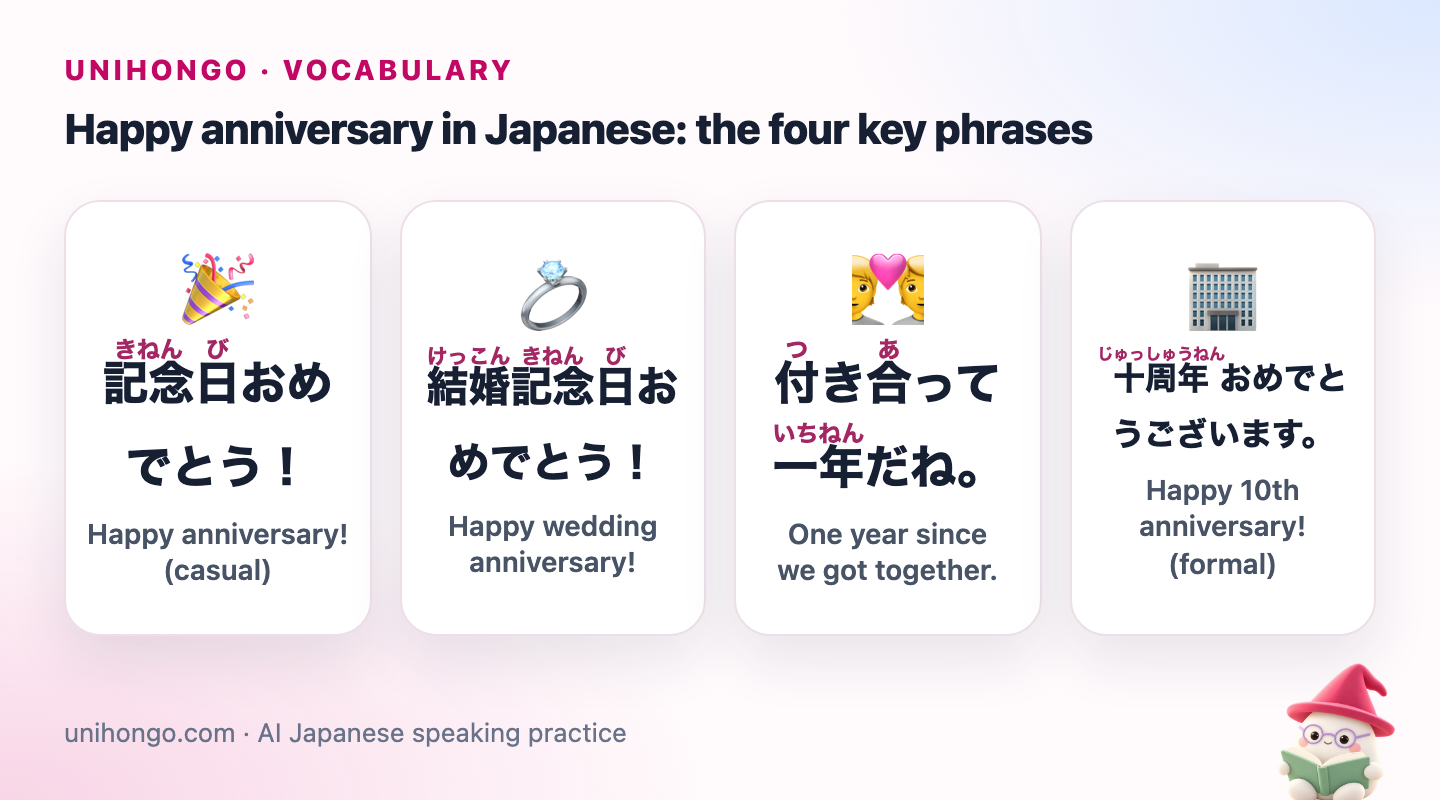
| Japanese | Romaji | Meaning |
|---|---|---|
| 記念日おめでとう! | Kinenbi omedetō! | Happy anniversary! (casual) |
| 結婚記念日おめでとう! | Kekkon kinenbi omedetō! | Happy wedding anniversary! |
| 付き合って一年だね。 | Tsukiatte ichi-nen da ne. | One year since we got together. |
| 十周年おめでとうございます。 | Jusshūnen omedetō gozaimasu. | Happy 10th anniversary! (formal) |
The ladder: from a message to your partner to a formal greeting
The words stay almost the same as you climb the ladder; what changes is the ending. Omedetō is casual and fits partners, close friends and family. Omedetō gozaimasu is polite and fits colleagues, your partner's parents, a teacher or a neighbour. For written greetings to a business partner, oiwai mōshiagemasu, I offer my congratulations, is the formal step at the top.
The honorific go- in go-kekkon is used when you speak about someone else's marriage politely. You would not say it about your own wedding.
| Japanese | Romaji | Meaning |
|---|---|---|
| 記念日おめでとう。 | Kinenbi omedetō. | Happy anniversary. (casual) |
| 記念日おめでとうございます。 | Kinenbi omedetō gozaimasu. | Happy anniversary. (polite) |
| ご結婚十周年おめでとうございます。 | Go-kekkon jusshūnen omedetō gozaimasu. | Congratulations on ten years of marriage. (respectful) |
| 創立五十周年を心よりお祝い申し上げます。 | Sōritsu gojusshūnen o kokoro yori oiwai mōshiagemasu. | We sincerely congratulate you on your 50th anniversary. (formal, written) |
| Level | Who you say it to | Typical phrase |
|---|---|---|
| Casual | Partner, close friends, family | Kinenbi omedetō |
| Polite | Colleagues, neighbours, a friend's parents | Kekkon kinenbi omedetō gozaimasu |
| Respectful | Your boss or teacher about their marriage | Go-kekkon jusshūnen omedetō gozaimasu |
| Formal written | A client company or organisation | Sōritsu gojusshūnen o kokoro yori oiwai mōshiagemasu |
Couples: counting the time with tsukiatte ~ nen
Tsukiau (付き合う) means to go out with someone, and tsukiatte is its te-form: since we started going out. Add a length of time and you have the most natural anniversary line between partners: tsukiatte ichi-nen, one year; tsukiatte san-nen, three years; tsukiatte hantoshi, half a year. Kyō de, as of today, makes it sound like a celebration of this exact date.
Some couples, often younger ones in their first months together, also mark each month: tsukiatte ikkagetsu, one month; tsukiatte sankagetsu, three months. Others only celebrate the yearly date, and plenty of couples barely mark it. There is no fixed rule, so treat the monthly custom as something you might meet rather than something expected.
Married couples count from the wedding: kekkon shite go-nen, five years since we married. Shūnen is possible for a marriage too, as in kekkon jusshūnen, but between the two of you the plain counting form sounds warmer.
| Japanese | Romaji | Meaning |
|---|---|---|
| 今日で付き合って二年だね。 | Kyō de tsukiatte ni-nen da ne. | As of today it's two years since we got together. |
| 付き合って一か月記念日だね。 | Tsukiatte ikkagetsu kinenbi da ne. | It's our one-month anniversary. |
| 結婚して五年になるね。 | Kekkon shite go-nen ni naru ne. | It's been five years since we married. |
| あっという間だったね。 | Atto iu ma datta ne. | That went by in a flash, didn't it? |
| これからもよろしくね。 | Kore kara mo yoroshiku ne. | Here's to more time together. (casual) |
What to say or write to your partner
In Japanese, the anniversary greeting is usually short, and the feeling is carried by thanks and by looking ahead. Itsumo arigatō, thank you for always being there, is the line that appears in most anniversary messages. Kore kara mo yoroshiku ne, roughly please keep being with me, closes the message the way English might say here's to many more years.
Direct declarations exist but are used sparingly. Daisuki da yo, I love you, is common between partners. Aishiteru is the strong, dramatic version that many people rarely say out loud, so in a message it can feel heavier than in English. Deaete yokatta, I'm so glad I met you, is a warm middle ground.
Texting versions are shorter and softer. Many people send kinenbi omedetō with a heart or a cake emoji, followed by one line of thanks, and save the longer words for when they meet.
| Japanese | Romaji | Meaning |
|---|---|---|
| いつもありがとう。 | Itsumo arigatō. | Thank you for everything, always. |
| 出会えてよかった。 | Deaete yokatta. | I'm so glad I met you. |
| これからもずっと一緒にいようね。 | Kore kara mo zutto issho ni iyō ne. | Let's always stay together. |
| 大好きだよ。 | Daisuki da yo. | I love you. (casual, common) |
| 今夜はお祝いしようね。 | Kon'ya wa oiwai shiyō ne. | Let's celebrate tonight. |
Wedding anniversaries for parents and friends
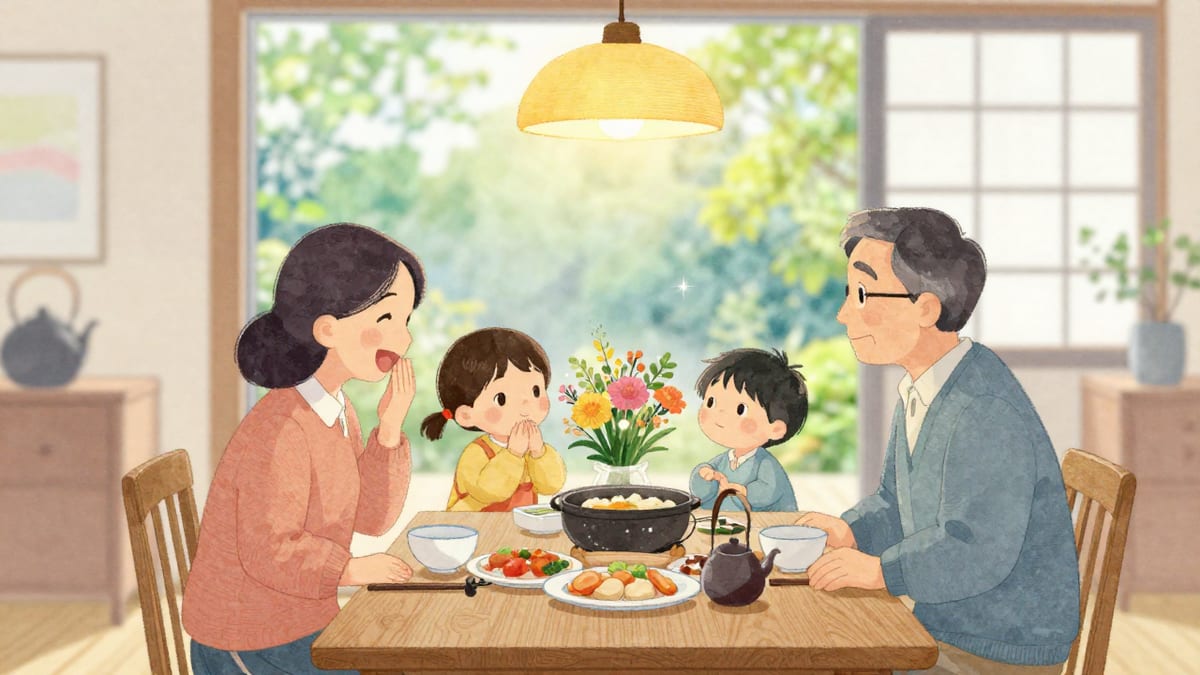
When the anniversary belongs to someone else, such as your parents or a married friend, the polite form is the safe choice unless you always talk casually with them. For your own parents, casual speech is normal: otōsan, okāsan, kekkon kinenbi omedetō.
Two milestones have special names that many people know: ginkonshiki (銀婚式), the silver wedding at twenty-five years, and kinkonshiki (金婚式), the golden wedding at fifty. Families sometimes mark them with a dinner or a small trip, and it is a nice moment to use the word if you know it is coming.
| Japanese | Romaji | Meaning |
|---|---|---|
| お父さん、お母さん、結婚記念日おめでとう。 | Otōsan, okāsan, kekkon kinenbi omedetō. | Mum, Dad, happy wedding anniversary. |
| 銀婚式おめでとうございます。 | Ginkonshiki omedetō gozaimasu. | Congratulations on your silver wedding. |
| 金婚式、本当におめでとうございます。 | Kinkonshiki, hontō ni omedetō gozaimasu. | Warmest congratulations on your golden wedding. |
| いつまでも仲良くね。 | Itsu made mo nakayoku ne. | Stay happy together forever. (casual) |
Work anniversaries and company milestones
For organisations, shops and careers, Japanese uses shūnen (周年), the number of full years. Note the sound changes in the readings: go-shūnen for five, jusshūnen for ten, nijusshūnen for twenty. Nyūsha (入社) is joining a company, and nyūsha jusshūnen is ten years since you joined.
Kinzoku (勤続) means continuous service and is often used at ceremonies for long service. The natural thing to add is otsukaresama desu or otsukaresama deshita, thanks for all your hard work, rather than a cheerful happy anniversary. For a client's company milestone, the written form oiwai mōshiagemasu belongs in a letter or email.
| Japanese | Romaji | Meaning |
|---|---|---|
| 入社五周年おめでとうございます。 | Nyūsha go-shūnen omedetō gozaimasu. | Congratulations on five years with the company. |
| 勤続二十年、お疲れさまでした。 | Kinzoku nijū-nen, otsukaresama deshita. | Twenty years of service: thank you for all your hard work. |
| おかげさまで、この店も十周年を迎えました。 | Okagesama de, kono mise mo jusshūnen o mukaemashita. | Thanks to you all, this shop has reached its tenth year. |
| これからもよろしくお願いいたします。 | Kore kara mo yoroshiku onegai itashimasu. | We look forward to your continued support. (formal) |
How people reply, plus a mini dialogue
The reply is thanks, often with the same wish turned back: arigatō, kore kara mo yoroshiku ne. If your partner remembered a date you thought they had forgotten, oboetete kureta n da, you remembered, is a happy reaction. At work, a simple arigatō gozaimasu followed by kore kara mo ganbarimasu, I'll keep doing my best, is the expected answer.
| Japanese | Romaji | Meaning |
|---|---|---|
| 記念日おめでとう! | Kinenbi omedetō! | Partner: Happy anniversary! |
| え、覚えててくれたんだ! | E, oboetete kureta n da! | You: Oh, you remembered! |
| もちろん。今日で三年だね。 | Mochiron. Kyō de san-nen da ne. | Partner: Of course. Three years as of today. |
| いつもありがとう。これからもよろしくね。 | Itsumo arigatō. Kore kara mo yoroshiku ne. | You: Thank you for everything. Here's to many more. |
Common mistakes with anniversary phrases
- Translating happy word for word: shiawase na kinenbi o sounds like a card, not a person. Use kinenbi omedetō.
- Using the katakana happī anibāsarī in conversation. It is fine on a cake, odd in your mouth.
- Saying shūnen for a couple's first few months. Shūnen is for full years; months use kagetsu.
- Adding the honorific go- to your own marriage. Go-kekkon is for other people's.
- Being stiff with your partner: kinenbi omedetō gozaimasu to a boyfriend or girlfriend sounds like a coworker, unless you are joking.
- Forgetting the thanks. A Japanese anniversary message without arigatō can feel oddly empty.