

The company ladder from kaichō to shain
Most Japanese companies use the same set of titles, and the order rarely changes, though small firms skip several rungs and large ones add a few. At the top is the kaichō, the chairman, often the founder or a former president who still holds influence. The shachō is the president and runs the company. Below come the executive directors: fuku-shachō, vice president; senmu, senior managing director; and jōmu, managing director. Together with the ordinary directors, torishimariyaku, they make up the board, yakuin.
The line management starts at the buchō, who heads a department, a bu. The jichō is the deputy department head. The kachō heads a section, a ka, and is the first real management rank in most careers. The kakarichō leads a team, a kakari, and the shunin is a senior staff member with some supervisory duty. Everyone below that is a shain, an employee, and a new recruit is a shinnyū shain. Titles are attached to a bu or ka name in official use: eigyō buchō, head of the sales department.
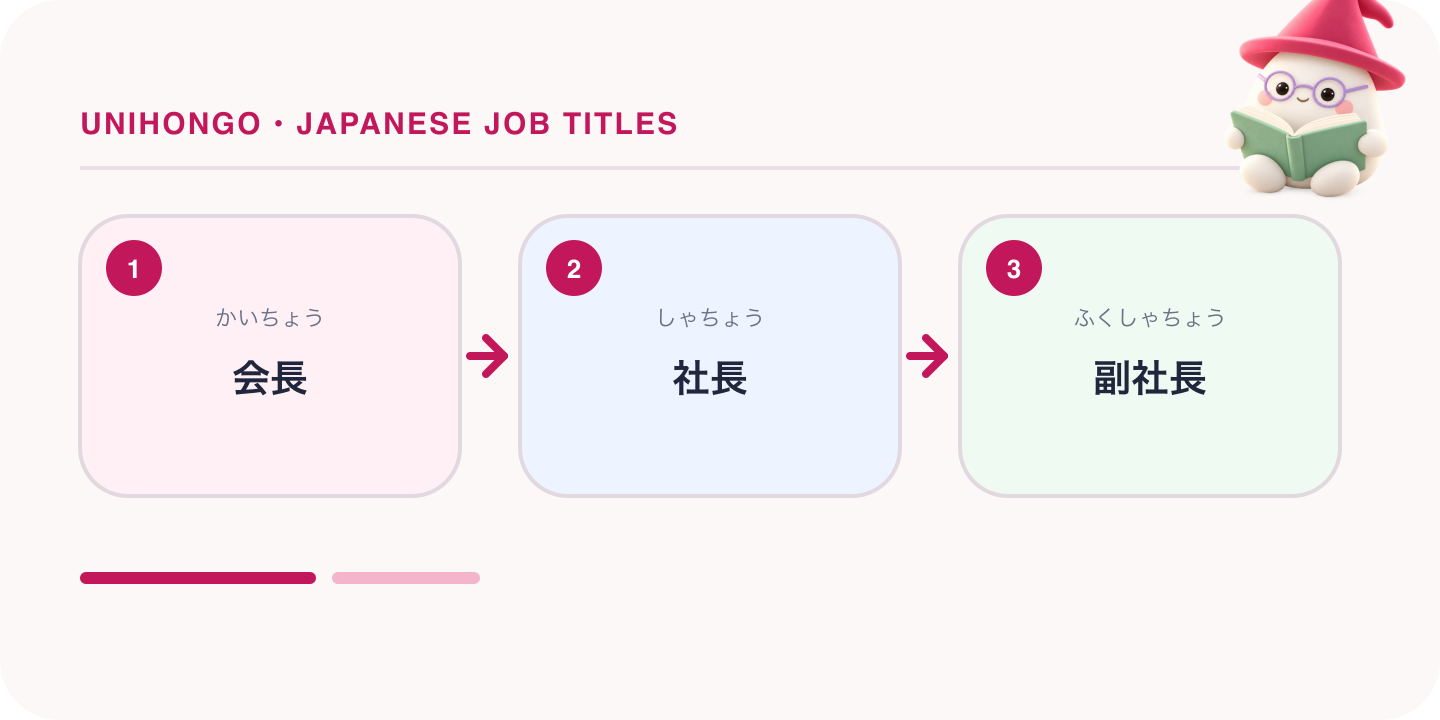
| Title | Reading | Meaning |
|---|---|---|
| 会長 | kaichō | Chairman |
| 社長 | shachō | President, chief executive |
| 副社長 | fuku-shachō | Vice president |
| 専務 | senmu | Senior managing director |
| 常務 | jōmu | Managing director |
| 部長 | buchō | Department head |
| 次長 | jichō | Deputy department head |
| 課長 | kachō | Section chief |
| 係長 | kakarichō | Team leader, subsection head |
| 主任 | shunin | Senior staff, supervisor |
| 社員 | shain | Employee |
| 新入社員 | shinnyū shain | New employee, new recruit |
Senmu and jōmu are short for senmu torishimariyaku and jōmu torishimariyaku. In speech nobody says the long form, but you will see it on name cards. Companies that have adopted English-style titles use loanwords too, manējā and dairekutā, and start-ups often have a CEO and a CTO written in Roman letters.
Using a title as a form of address
The most important thing about Japanese titles is that they replace names. You do not call your department head Mr Tanaka; you call him Tanaka-buchō, family name plus title, or simply buchō if there is only one in the room. The title works as a pronoun too: buchō wa kyō irasshaimasu ka, is the department head coming in today. This is why colleagues can talk about kachō for years without anyone using a first name.
The title goes after the name, never before, when you are addressing or naming someone inside the company. Yamada-kachō is right; kachō Yamada sounds like a list. The pattern extends to non-management roles that carry respect: sensei for doctors and teachers, and tenchō for a shop manager. People at or below your level get san: Suzuki-san, whether they are a shunin or a new recruit, and shunin itself is not commonly used as a form of address.
| Japanese | Romaji | Meaning |
|---|---|---|
| 田中部長、少しお時間よろしいでしょうか。 | Tanaka-buchō, sukoshi o-jikan yoroshii deshō ka. | Mr Tanaka, could I have a moment of your time? |
| 課長、この資料を確認していただけますか。 | Kachō, kono shiryō o kakunin shite itadakemasu ka. | Could you check this document, please? |
| 社長は今日、出張です。 | Shachō wa kyō, shutchō desu. | The president is on a business trip today. |
| 部長はまだ会議中です。 | Buchō wa mada kaigichū desu. | The department head is still in a meeting. |
| 山田係長に聞いてみます。 | Yamada-kakarichō ni kiite mimasu. | I will ask Mr Yamada, the team leader. |
| 鈴木さんは今年入った新入社員です。 | Suzuki-san wa kotoshi haitta shinnyū shain desu. | Suzuki is a new recruit who joined this year. |
The san-after-title mistake
Learners hear san everywhere and add it to titles for safety, producing buchō-san and kachō-san. To a Japanese ear this is odd, because the title already contains the respect: it is like saying Mr Doctor Smith. Say buchō, or Tanaka-buchō, and stop there. The same applies to sensei: sensei-san does not exist.
There is one exception you will hear. Shachō-san is used by outsiders, taxi drivers and shopkeepers, for the owner of a small business, and occasionally by staff in a small firm speaking casually. Even so, it is safest to leave it to native speakers. If you are unsure whether someone has a title at all, san is the safe default: it is far better to call a kachō Tanaka-san than to guess a wrong title.
| Japanese | Romaji | Meaning |
|---|---|---|
| 部長、お疲れさまです。 | Buchō, otsukaresama desu. | Good work today, sir. |
| 田中課長はどちらにいらっしゃいますか。 | Tanaka-kachō wa dochira ni irasshaimasu ka. | Where is Mr Tanaka, the section chief? |
| すみません、お名前と役職を教えていただけますか。 | Sumimasen, o-namae to yakushoku o oshiete itadakemasu ka. | Sorry, could you tell me your name and position? |
| 先生、質問があります。 | Sensei, shitsumon ga arimasu. | Doctor, I have a question. |
Your own side to outsiders: dropping the title
This is where Japanese titles diverge most from English. Inside the company your boss is Tanaka-buchō. On the phone to a client, that same person becomes Tanaka, bare family name, no title, no san. The logic is uchi and soto: people in your own group are humbled when you speak to someone outside it, and honorific titles are a form of raising, so they come off. The client, by contrast, gets full titles and honorific verbs.
If the role matters to the conversation, put the title in front of the name as a description: buchō no Tanaka, our department head Tanaka, or heisha no Tanaka, Tanaka of our company. Your own company is heisha or tōsha; the client's company is onsha or kisha. The verbs shift too: your boss orimasu, is here, in humble form, while the client's staff irasshaimasu.
| Japanese | Romaji | Meaning |
|---|---|---|
| 田中はただいま外出しております。 | Tanaka wa tadaima gaishutsu shite orimasu. | Tanaka is out of the office at the moment. |
| 部長の田中に確認してから、ご連絡いたします。 | Buchō no Tanaka ni kakunin shite kara, go-renraku itashimasu. | I will check with our department head, Tanaka, and get back to you. |
| 弊社の山田がご説明いたします。 | Heisha no Yamada ga go-setsumei itashimasu. | Our Yamada will explain. |
| 御社の佐藤部長はいらっしゃいますか。 | Onsha no Satō-buchō wa irasshaimasu ka. | Is your Mr Satō, the department head, available? |
| 田中に代わります。少々お待ちください。 | Tanaka ni kawarimasu. Shōshō o-machi kudasai. | I will put you through to Tanaka. One moment, please. |
Titles in emails and on business cards
In a business email the recipient's line follows a fixed order: company, department, title, name, then sama. Kabushiki-gaisha ABC eigyō-bu buchō Tanaka Tarō sama. Note that the title goes before the name in writing, and sama follows the name, not the title. Buchō sama is a mistake in emails just as buchō-san is in speech. When you write to a colleague inside your company, name plus title is enough: Tanaka-buchō, with no sama.
Business cards, meishi, show the same order, and the card exchange is where you learn who outranks whom. Read the title before you speak, because it decides how you address the person for the rest of the meeting. Yakushoku is the word for a position, and busho is a department in the abstract; both appear on forms.
- Company name: kabushiki-gaisha or the abbreviation kabu in brackets
- Department: eigyō-bu, jinji-bu, keiri-bu
- Title: buchō, kachō, tantō for the person in charge
- Name, then sama for outsiders or nothing for colleagues
- Your own signature: company, department, name, no title needed
If you do not know the recipient's title, go-tantō-sha sama, to the person in charge, is a safe address line. It is common on first contact and nobody minds it.
Common department names
Departments end in bu and sections in ka, so the sales department is eigyō-bu and the sales section within it is eigyō-ka. Many companies also have a shitsu, an office, for smaller units such as the shachō-shitsu, the president's office.
The core set is short. Eigyō is sales, jinji is human resources, keiri is accounting, sōmu is general affairs, which handles everything from building keys to company events, kaihatsu is development, seizō is manufacturing, hinshitsu kanri is quality control, kōhō is public relations, and hōmu is legal. Kikaku is planning, and a kikaku-bu often sits close to the top of the company. Adding the title tells you the person's place: keiri kachō is the accounting section chief.
| Japanese | Romaji | Meaning |
|---|---|---|
| 営業部の田中と申します。 | Eigyō-bu no Tanaka to mōshimasu. | I am Tanaka from the sales department. |
| 人事部はどちらですか。 | Jinji-bu wa dochira desu ka. | Where is the human resources department? |
| 経理課長に領収書を提出してください。 | Keiri kachō ni ryōshūsho o teishutsu shite kudasai. | Please submit the receipt to the accounting section chief. |
| 総務部に聞いてみましょう。 | Sōmu-bu ni kiite mimashō. | Let us ask general affairs. |
| 開発部の会議は三時からです。 | Kaihatsu-bu no kaigi wa san-ji kara desu. | The development department meeting starts at three. |
| どの部署にいらっしゃいますか。 | Dono busho ni irasshaimasu ka. | Which department are you in? |
Talking about promotions and roles
Careers move along the ladder, so the verbs of movement are worth knowing. Shōshin suru is to be promoted, and shōshin shimashita is the standard good news. Idō is a transfer between departments and tenkin is a transfer to another location. Ninmei sareru means to be appointed, and shūnin suru is to take up a post: kachō ni shūnin shimashita, he took up the section chief post. Retirement is taishoku, and a full career retirement at the standard age is teinen taishoku.
Congratulating someone uses omedetō gozaimasu with the new title: shōshin omedetō gozaimasu. Describing yourself as watashi wa kachō desu is fine inside the company but sounds boastful to outsiders; there, kachō o shite orimasu, I serve as a section chief, is softer.
| Japanese | Romaji | Meaning |
|---|---|---|
| 来月、課長に昇進します。 | Raigetsu, kachō ni shōshin shimasu. | Next month I will be promoted to section chief. |
| 昇進おめでとうございます。 | Shōshin omedetō gozaimasu. | Congratulations on your promotion. |
| 四月から大阪に転勤になりました。 | Shigatsu kara Ōsaka ni tenkin ni narimashita. | I have been transferred to Osaka from April. |
| 部長は今年、定年退職されます。 | Buchō wa kotoshi, teinen taishoku saremasu. | The department head retires this year. |
| 係長をしております。 | Kakarichō o shite orimasu. | I serve as a team leader. |
Mistakes to avoid
Four errors cover nearly everything. First, san after a title: buchō-san, kachō-san, sensei-san. Second, using a title for your own boss to an outsider: saying Tanaka-buchō on the phone to a client raises your own side, which sounds self-important. Third, putting the title before the name in speech, kachō Tanaka, which is written order, not spoken order. Fourth, guessing the ladder and calling a jichō a buchō; overpromoting someone is awkward and underpromoting is worse, so read the card or ask.
A quieter mistake is using a title where none is needed. Colleagues at your own level are san, and a shunin is usually just Suzuki-san. At a firm where everyone is san regardless of rank, insisting on buchō will feel stiff, so listen to how others address people for a day before you commit.
| Japanese | Romaji | Meaning |
|---|---|---|
| 田中部長、ではなく、お客様には田中と言います。 | Tanaka-buchō, de wa naku, o-kyaku-sama ni wa Tanaka to iimasu. | To a customer, say Tanaka, not Tanaka-buchō. |
| 部長さんではなく、部長です。 | Buchō-san de wa naku, buchō desu. | It is buchō, not buchō-san. |
| 失礼ですが、役職を伺ってもよろしいですか。 | Shitsurei desu ga, yakushoku o ukagatte mo yoroshii desu ka. | Excuse me, may I ask your position? |