
What iyashi literally means
Iyashi is the noun form of the verb iyasu (癒す), to heal, to ease or to soothe. Its partner verb ieru (癒える), means to heal by itself, as a wound does. Both verbs sound literary on their own. The noun iyashi, by contrast, is everyday vocabulary, and most people meet it in phrases rather than as a bare word.
The key point is the kind of healing. In modern Japanese, iyashi almost always means emotional or mental relief: stress falls away, your shoulders drop, you feel warm and restored. A cat on your lap, a forest walk or a slow bath can all be iyashi. A plaster on a cut or medicine for the flu is not.
You will see two spellings. 癒やし follows the official okurigana rule for the verb 癒やす, and newspapers and some textbooks use it. 癒し is the shorter spelling that fills shop shelves, magazines and social media. This post uses 癒し because it is what you will see most in daily life.
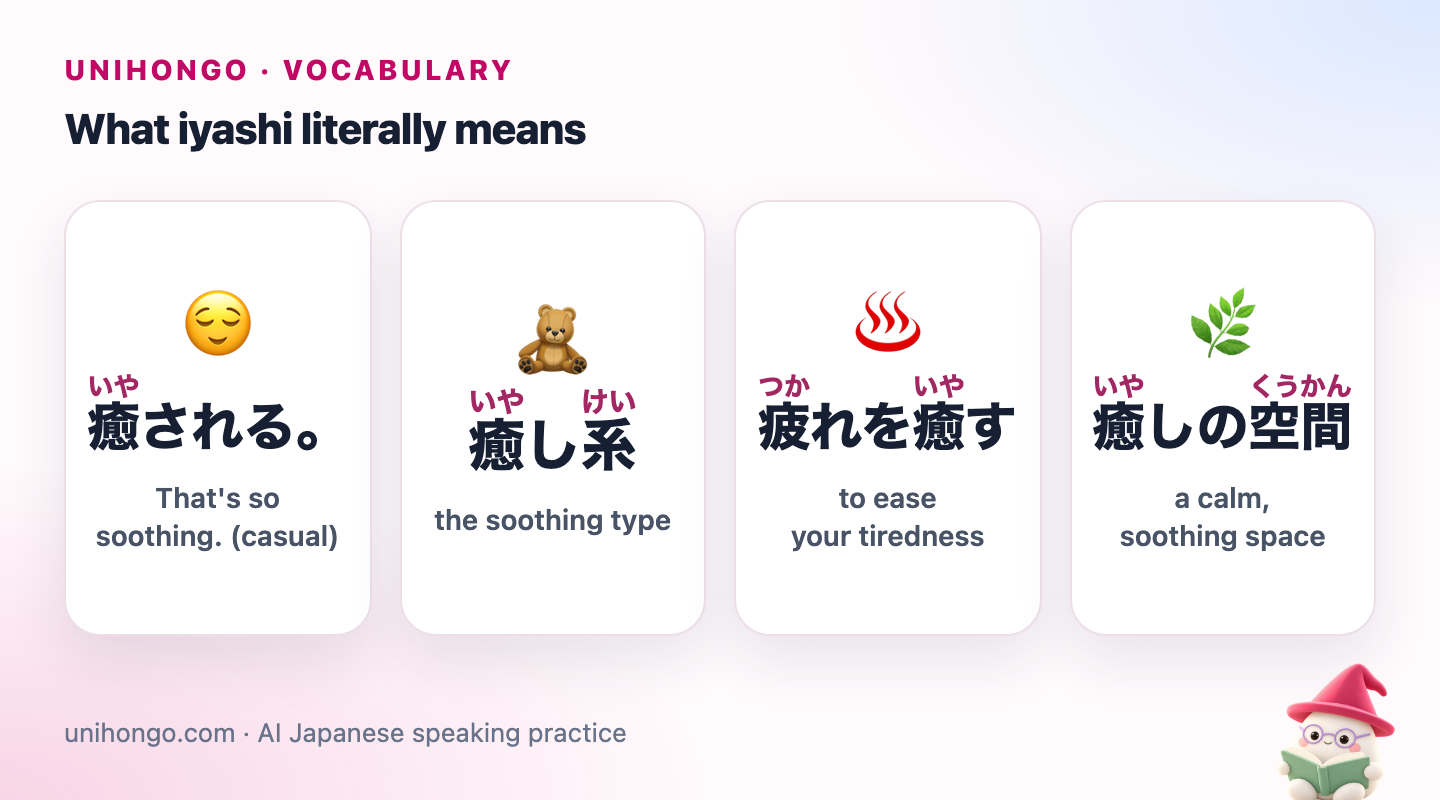
| Japanese | Romaji | Meaning |
|---|---|---|
| 癒される。 | Iyasareru. | That's so soothing. (casual) |
| 癒し系 | iyashi kei | the soothing type |
| 疲れを癒す | tsukare o iyasu | to ease your tiredness |
| 癒しの空間 | iyashi no kūkan | a calm, soothing space |
Iyasareru: the reaction you will hear most
The most common form by far is iyasareru (癒される), the passive of iyasu. Literally it means I am healed, but in practice it is a reaction, like saying aww or that's so relaxing in English. People say it when they see a sleeping puppy, hear a gentle song, or step into a quiet garden after a busy day.
Because it is passive, the thing that soothes you takes the particle ni: neko ni iyasareru, I am soothed by the cat. On its own, iyasareru or iyasareru nā is a casual exclamation. With friends you can stretch it out, iyasareru〜, with a sigh. In polite speech, iyasaremasu or iyasaremashita works well, for example when you thank a host for a peaceful stay.
| Japanese | Romaji | Meaning |
|---|---|---|
| 猫の動画に癒される。 | Neko no dōga ni iyasareru. | Cat videos are so soothing. |
| この音楽、癒されるね。 | Kono ongaku, iyasareru ne. | This music is so relaxing, isn't it? |
| 温泉に入って癒されました。 | Onsen ni haitte iyasaremashita. | The hot spring was really restoring. (polite) |
| 子どもの笑顔に癒されます。 | Kodomo no egao ni iyasaremasu. | Children's smiles warm my heart. (polite) |
| 本当に癒されるなあ。 | Hontō ni iyasareru nā. | This really is soothing. (said to yourself) |
Iyashi-kei: soothing people, music and characters
Add kei (系), type or family, and you get iyashi-kei, the soothing type. The phrase became widely used around the turn of the century for gentle singers, calm actors, relaxing music and soft, round characters, and it is still everyday vocabulary.
Said about a person, iyashi-kei is usually a compliment. It means their presence calms other people: they speak softly, smile easily and rarely seem stressed. Friends might call a classmate iyashi-kei, and dating profiles sometimes use it. A few people hear a hint of not very exciting in it, so it fits best when you clearly mean it warmly.
Iyashi-kei is also used for music, films, games and characters with slow pacing and gentle colours. A plush mascot, a nature documentary or a quiet farming game can all be iyashi-kei.
| Japanese | Romaji | Meaning |
|---|---|---|
| 彼女は癒し系だよね。 | Kanojo wa iyashi kei da yo ne. | She's the soothing type, isn't she? |
| 癒し系の音楽を聴いています。 | Iyashi kei no ongaku o kiite imasu. | I'm listening to relaxing music. |
| 一緒にいると癒されます。 | Issho ni iru to iyasaremasu. | Being with you puts me at ease. (polite) |
| このキャラ、癒し系でかわいい。 | Kono kyara, iyashi kei de kawaii. | This character is soothing and cute. |
Iyashi in shops, ads and travel
Marketing loves this word. An iyashi supotto (癒しスポット) is a place to unwind: a garden, a forest trail, a hot spring town or an animal café. Iyashi guzzu (癒しグッズ) are soothing goods such as aroma oils, soft cushions and bath salts. Spas promise iyashi no jikan, a time of relaxation, and travel magazines run whole issues on iyashi trips.
You will also see the katakana loanword hīringu (ヒーリング), healing, especially for music and spa treatments, and rirakkusu (リラックス), relax. Iyashi feels softer and more emotional than either. Shinrin'yoku (森林浴), forest bathing, often appears next to iyashi in travel writing.
| Japanese | Romaji | Meaning |
|---|---|---|
| 京都の癒しスポットを探しています。 | Kyōto no iyashi supotto o sagashite imasu. | I'm looking for relaxing places in Kyoto. |
| 癒しの時間をお過ごしください。 | Iyashi no jikan o osugoshi kudasai. | Please enjoy a time of relaxation. (spa, formal) |
| 森林浴で心が癒されます。 | Shinrin'yoku de kokoro ga iyasaremasu. | Forest bathing soothes the mind. |
| 癒しグッズが好きです。 | Iyashi guzzu ga suki desu. | I love soothing little things. |
When not to use iyashi: illness, injuries and fixing things
English heal covers a cut finger, a cold and a broken heart. Japanese splits these. For your body getting better, the everyday verb is naoru (治る), and for a doctor or medicine curing you it is naosu (治す). For recovery in general, kaifuku (回復) is the neutral noun. Saying kaze ga iyasareta for my cold got better sounds strange, because iyashi suggests comfort, not cure.
There are two overlaps. In written or poetic Japanese, a wound can heal with ieru, kizu ga ieru, and people speak of time healing a broken heart: jikan ga kokoro no kizu o iyashite kureru. Both sound literary, so in conversation stick to naoru for the body and iyasareru for the mood.
| Japanese | Romaji | Meaning |
|---|---|---|
| 風邪が治りました。 | Kaze ga naorimashita. | My cold has got better. |
| けがはもう治った? | Kega wa mō naotta? | Has your injury healed yet? (casual) |
| 体力が回復しました。 | Tairyoku ga kaifuku shimashita. | I've got my strength back. |
| Word | What gets better | Typical use |
|---|---|---|
| iyasu / iyasareru | Stress, tiredness, feelings | A bath, a pet, music, nature |
| naoru | Your body, by itself | A cold, a cough, a cut |
| naosu | Something you cure or fix | Medicine, a doctor, a repair |
| kaifuku | Recovery in general | After surgery, the economy, stamina |
| yasumu | You rest | Taking a day off, sleeping it off |
Related words: hotto suru, nagomu and ochitsuku
Iyasareru sits in a small family of calm words, and choosing the right one makes your Japanese sound natural. Hotto suru is the relief of a worry ending: the exam is over, your friend arrived safely. Nagomu describes a mood softening and a place feeling warm, often between people. Ochitsuku is settling down, feeling calm and steady. Kutsurogu is to make yourself comfortable, like a guest relaxing on a sofa.
A useful test: iyasareru needs a source of comfort, hotto suru needs a worry that has ended, and ochitsuku needs a state of calm that lasts.
| Japanese | Romaji | Meaning |
|---|---|---|
| 試験が終わってほっとした。 | Shiken ga owatte hotto shita. | The exam's over and I'm so relieved. |
| 和やかな雰囲気ですね。 | Nagoyaka na fun'iki desu ne. | What a warm, friendly atmosphere. |
| ここは落ち着きますね。 | Koko wa ochitsukimasu ne. | It feels calm and settled here. |
| どうぞくつろいでください。 | Dōzo kutsuroide kudasai. | Please make yourself comfortable. |
Mini dialogue: after a day at the hot spring
Two friends sit at a footbath in a hot spring town at dusk. One of them has had a hard month at work, and the other brought her here. Listen for iyasareru, hotto suru and the casual endings.

| Japanese | Romaji | Meaning |
|---|---|---|
| はあ、癒される。 | Hā, iyasareru. | Mia: Ahh, this is so soothing. |
| でしょ?ここ、私の癒しスポットなんだ。 | Desho? Koko, watashi no iyashi supotto nan da. | Yui: Right? This is my special place to unwind. |
| 今月ずっと残業だったから、ほっとした。 | Kongetsu zutto zangyō datta kara, hotto shita. | Mia: I've been working late all month, so this is such a relief. |
| お疲れさま。今日はゆっくりしよう。 | Otsukaresama. Kyō wa yukkuri shiyō. | Yui: You've earned it. Let's take it easy today. |
| ありがとう。ユイって本当に癒し系だね。 | Arigatō. Yui tte hontō ni iyashi kei da ne. | Mia: Thanks. You really are the soothing type, Yui. |
A slow, soothing review with Mocchi
Open Mocchi and type: give me six everyday situations and let me choose between iyasareru, hotto suru, nagomu and ochitsuku. Mocchi, a soft, round study companion that rather suits this topic, checks each answer, explains the nuance you missed, and keeps a note of it so a later review comes back to that word first.
Then turn the calm words into flashcards with /create-flashcards, picking a photo for each one: a cat for iyasareru, an empty exam hall for hotto suru, a warm family table for nagoyaka. Reviewing them with /review-flashcards brings back the ones you hesitate on a little sooner.
Common learner mistakes
- Using iyashi for medical healing. Say kaze ga naotta, my cold got better, not kaze ga iyasareta.
- Forgetting the particle ni with the passive. It is neko ni iyasareru, soothed by the cat, not neko o iyasareru.
- Saying iyashi-kei about yourself to sound modest or cute. It is fine as a joke, but it usually sounds better coming from someone else.
- Using iyasareru for relief after a worry. If the point is that something stressful ended, hotto shita is the natural choice.
- Overusing the word in formal writing. In a business email, a phrase such as yukkuri yasumemashita, I was able to rest well, sounds more natural than iyasaremashita.