

What moshikashite means
Moshikashite comes from moshi, if, the question particle ka and suru, to do. Together they mean something like if by chance, and in modern Japanese the word signals that you are about to make a guess. It is used when you have noticed something and have a suspicion about it, but you are not certain and want the other person to confirm.
The most common use is at the start of a question: moshikashite, Nihon no kata desu ka? are you Japanese, by any chance? It also appears in statements where you are thinking aloud: moshikashite, kagi o wasureta ka mo, maybe I've forgotten my keys. Said on its own with a rising tone, moshikashite...? means don't tell me... or wait, could it be...?
| Japanese | Romaji | Meaning |
|---|---|---|
| もしかして、田中さんですか。 | Moshikashite, Tanaka-san desu ka. | Are you Mr Tanaka, by any chance? |
| もしかして、日本の方ですか。 | Moshikashite, Nihon no kata desu ka. | Are you Japanese, by any chance? |
| もしかして、鍵を忘れたかも。 | Moshikashite, kagi o wasureta ka mo. | Maybe I've forgotten my keys. |
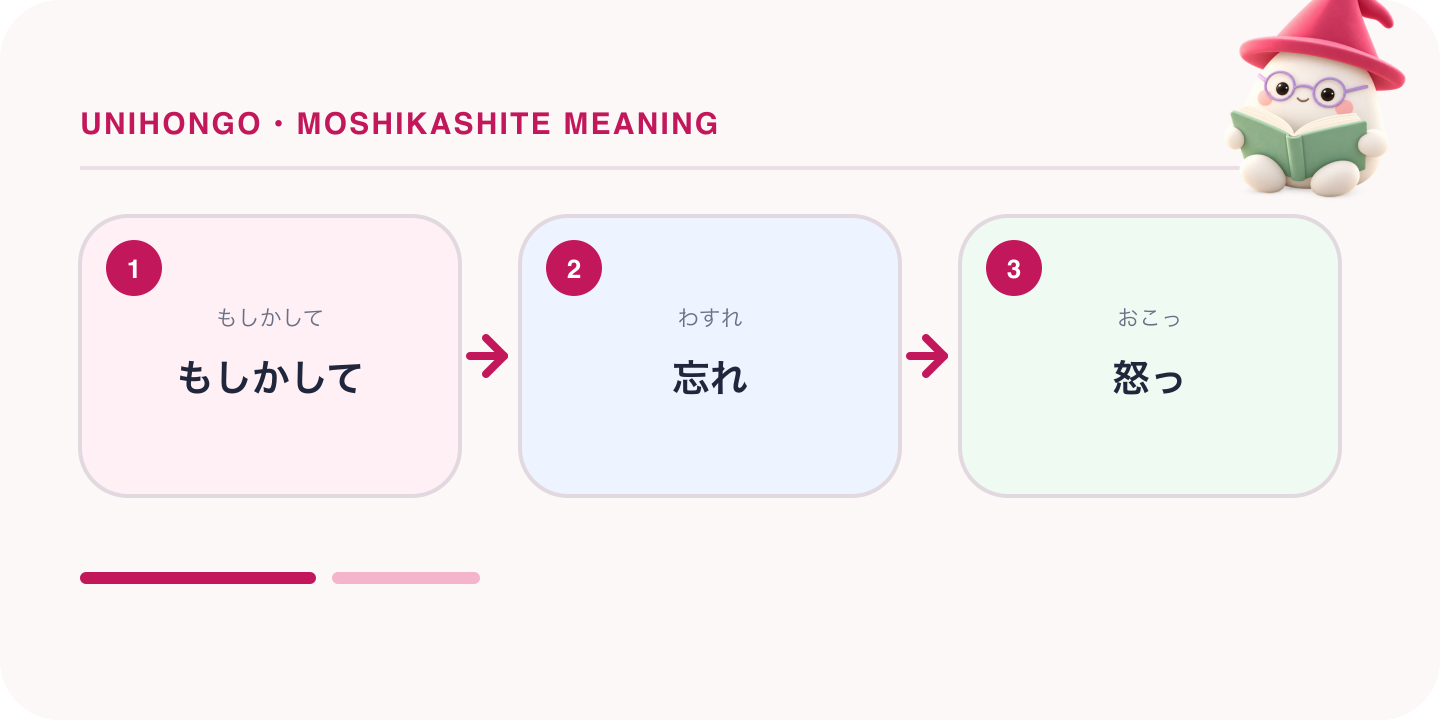
| もしかして、怒ってる? | Moshikashite, okotteru? | Are you angry, by any chance? |
| もしかして…? | Moshikashite...? | Wait, could it be...? |
Moshikashitara and moshikasuru to: perhaps
Moshikashitara and moshikasuru to are close relatives with a slightly different job. Instead of opening a question, they usually introduce a possibility in a statement, and they are almost always paired with kamoshirenai, might, or its polite form kamoshiremasen, at the end. Moshikashitara ashita wa ame kamoshirenai means it might possibly rain tomorrow.
The three forms overlap, and native speakers sometimes use them interchangeably, but a useful rule is this: moshikashite checks, moshikashitara and moshikasuru to speculate. Moshikasuru to sounds slightly more formal or written, and you will find it in news commentary and essays as well as speech. Moshikashitara is the most common in everyday conversation.
| Japanese | Romaji | Meaning |
|---|---|---|
| もしかしたら、明日は雨かもしれない。 | Moshikashitara, ashita wa ame kamoshirenai. | It might possibly rain tomorrow. |
| もしかしたら、少し遅れるかもしれません。 | Moshikashitara, sukoshi okureru kamoshiremasen. | I might be a little late. |
| もしかすると、彼はもう知っているかもしれない。 | Moshikasuru to, kare wa mō shitte iru kamoshirenai. | He might already know. |
| もしかしたら、間に合わないかもしれません。 | Moshikashitara, maniawanai kamoshiremasen. | We might not make it in time. |
| もしかすると、それが原因かもしれません。 | Moshikasuru to, sore ga gen'in kamoshiremasen. | That may be the cause. |
Kamoshirenai is the key partner. A sentence that starts with moshikashitara but ends with a plain statement sounds unbalanced, like perhaps it will rain, full stop.
The certainty scale: from moshikashite to kitto
Japanese has a range of adverbs that show how sure you are, and choosing the right one is part of sounding natural. Moshikashitara and hyotto shitara sit near the bottom: it is possible, but you would not bet on it. Tabun, probably, sits in the middle and is often followed by darō or deshō. Kitto, surely, and zettai, definitely, are at the top.
Hyotto shite and hyotto shitara are close synonyms of moshikashite and moshikashitara, with a slightly more colloquial or dramatic flavour. Osoraku, probably, is more formal than tabun and often used when predicting something undesirable. Keeping this scale in mind helps you avoid sounding either vague or overconfident.
| Word | Certainty | Typical ending |
|---|---|---|
| もしかしたら moshikashitara | Low: maybe, possibly | かもしれない kamoshirenai |
| ひょっとしたら hyotto shitara | Low: just possibly | かもしれない kamoshirenai |
| もしかして moshikashite | A guess to check | ですか desu ka / の? no? |
| たぶん tabun | Medium: probably | でしょう deshō / だろう darō |
| おそらく osoraku | Medium, formal: probably | でしょう deshō |
| きっと kitto | High: surely | でしょう deshō / と思う to omou |
| 絶対に zettai ni | Very high: definitely | Plain statement |
Polite guessing questions
Moshikashite is one of the most useful words for politeness because it turns a direct question into a gentle check. Asking someone anata wa Kimura-san desu ka? sounds abrupt; moshikashite, Kimura-san de irasshaimasu ka? sounds considerate, because it admits that you might be wrong. Shop staff, receptionists and colleagues use this pattern all the time.
Another common structure is moshikashite plus n desu ka or no desu ka, which asks for an explanation of something you have noticed. Moshikashite, o-isogi desu ka? are you in a hurry, by any chance? is a kind way to offer help or to let someone go first. The ja nai desu ka ending also works: moshikashite, kore, Suzuki-san no ja nai desu ka? isn't this yours, Mr Suzuki?
| Japanese | Romaji | Meaning |
|---|---|---|
| もしかして、木村様でいらっしゃいますか。 | Moshikashite, Kimura-sama de irasshaimasu ka. | Would you be Mr Kimura, by any chance? |
| もしかして、お急ぎですか。 | Moshikashite, o-isogi desu ka. | Are you in a hurry, by any chance? |
| もしかして、これ、鈴木さんのじゃないですか。 | Moshikashite, kore, Suzuki-san no ja nai desu ka. | Isn't this yours, Mr Suzuki? |
| もしかして、道に迷っていますか。 | Moshikashite, michi ni mayotte imasu ka. | Are you lost, by any chance? |
| もしかして、前にお会いしたことがありますか。 | Moshikashite, mae ni o-ai shita koto ga arimasu ka. | Have we met before, by any chance? |
Softening bad news and suggestions
Moshikashitara and moshikasuru to are also used to make unwelcome information easier to hear. At work, saying moshikashitara, shimekiri ni maniawanai kamoshiremasen, we might possibly miss the deadline, prepares the listener without sounding alarmed. It also leaves room for the problem to be solved.
The same softness works for suggestions and hints. Moshikashite, kono botan ja nai desu ka? isn't it this button, perhaps? corrects someone gently and lets them save face. This indirectness is valued in Japanese communication, especially towards people senior to you.
| Japanese | Romaji | Meaning |
|---|---|---|
| もしかしたら、締め切りに間に合わないかもしれません。 | Moshikashitara, shimekiri ni maniawanai kamoshiremasen. | We might possibly miss the deadline. |
| もしかして、このボタンじゃないですか。 | Moshikashite, kono botan ja nai desu ka. | Could it be this button, perhaps? |
| もしかすると、予定が変わるかもしれません。 | Moshikasuru to, yotei ga kawaru kamoshiremasen. | The plan may change. |
| もしかしたら、電車が遅れているのかもしれません。 | Moshikashitara, densha ga okurete iru no kamoshiremasen. | Perhaps the train is delayed. |
Moshikashite in casual speech
Among friends, moshikashite often ends with a casual question: moshikashite, okotteru? are you angry, by any chance? or moshikashite, wasureteta? did you forget? The no ending, as in moshikashite, kaze hiita no? did you catch a cold? asks about a situation you have picked up on.
Said slowly, with a knowing smile, moshikashite can also tease: moshikashite, kinchō shiteru? are you nervous, by any chance? You may also meet moshiya, a more literary relative that appears in phrases like moshiya to omotta, I wondered if it might be.
- Moshikashite, wasureteta? Did you forget, by any chance?
- Moshikashite, kaze hiita no? Have you caught a cold?
- Moshikashite, kinchō shiteru? Are you nervous, by any chance?
- Moshikashite, mō tabeta? Have you already eaten?
- Moshiya to omotta kedo... I wondered if it might be, and...
How to answer a moshikashite question
Because moshikashite introduces a guess, the natural reply confirms or corrects it. In polite speech, hai, sō desu is standard, and adding yoku o-wakari ni narimashita ne, you recognised me, is a friendly touch. If the guess is wrong, iie, chigaimasu is clear, and you can add the correct information.
Casually, un, sō or sō nan da yo confirm it, and uun, chigau or betsu ni deny it. Betsu ni, not particularly, is common in reply to moshikashite, okotteru? but said flatly it can sound as if the person is, in fact, a little annoyed.
| Japanese | Romaji | Meaning |
|---|---|---|
| はい、そうです。 | Hai, sō desu. | Yes, that's right. |
| いいえ、違います。 | Iie, chigaimasu. | No, I'm not. |
| うん、そうなんだよ。 | Un, sō nan da yo. | Yeah, that's right. |
| ううん、違うよ。 | Uun, chigau yo. | No, it's not that. |
| 別に。 | Betsu ni. | Not really. (can sound curt) |
Common learner mistakes
- Ending moshikashitara with a certain statement: add kamoshirenai or kamoshiremasen
- Using moshikashite for strong predictions: choose tabun or kitto when you are fairly sure
- Confusing moshikashite with moshi: moshi means if in conditionals, as in moshi ame nara
- Overusing moshikashite at work: it is polite, but too many guesses can sound unsure
- Forgetting the pause: moshikashite said too quickly loses its gentle, tentative tone
Moshi and moshikashite share a root but do different jobs. Moshi jikan ga attara, if you have time, sets up a condition; moshikashite, jikan ga arimasu ka, do you have time, by any chance, makes a guess.