

Why these words feel beautiful
A large part of the beauty is visual. Kanji carry meaning, so a compound such as 花火, flower plus fire, shows you the image before you even hear the word. Many seasonal words work like tiny poems: two or three characters, each an image, combined into a scene.
Sound matters too. Words built from soft native Japanese syllables, such as oborozuki or kogarashi, have a gentle rhythm, and many of them come from the tradition of seasonal words in haiku, kigo, which poets have used and refined for centuries. Learning them gives you words for noticing the world, not just naming it.
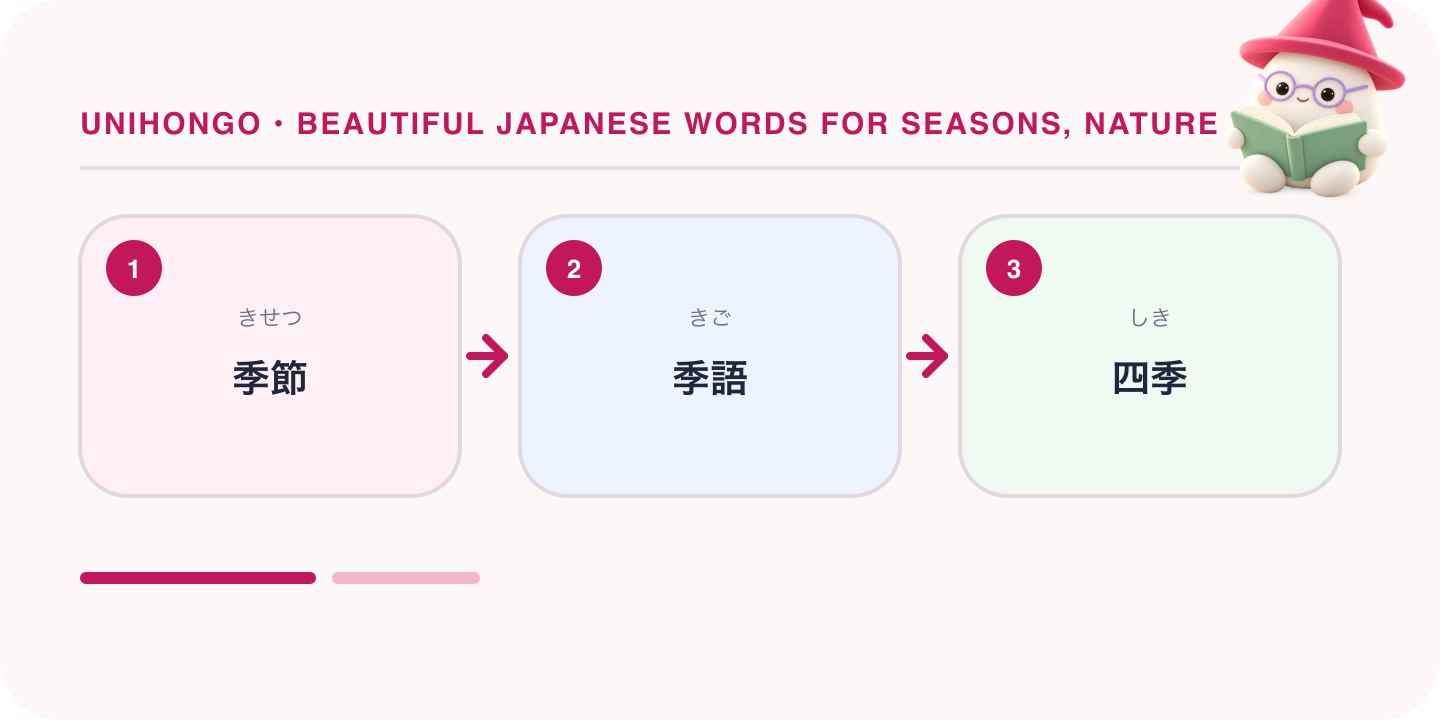
| Japanese | Romaji | Meaning |
|---|---|---|
| 季節 | kisetsu | Season |
| 季語 | kigo | Seasonal word in haiku |
| 四季 | shiki | The four seasons |
| きれいな言葉ですね。 | Kirei na kotoba desu ne. | What a beautiful word. |
Spring: petals, haze and soft rain
Spring words are dominated by cherry blossoms, but the language goes far beyond sakura. Sakura fubuki pictures petals falling so thickly they look like a snowstorm, fubuki. When those petals land on a river or moat and drift together, they become hanaikada, a flower raft.
Oborozuki is the hazy spring moon, softened by moisture in the air, and harusame is gentle spring rain. Yama warau, the mountains laugh, is a haiku expression for hills coming back to life with fresh green.
| Japanese | Romaji | Meaning |
|---|---|---|
| 桜吹雪の中を歩きました。 | Sakura fubuki no naka o arukimashita. | I walked through a shower of cherry petals. |
| 川に花筏ができていますね。 | Kawa ni hanaikada ga dekite imasu ne. | The petals have formed rafts on the river. |
| 今夜は朧月ですね。 | Kon'ya wa oborozuki desu ne. | The moon is hazy tonight. |
| Word | Reading | Kanji breakdown and meaning |
|---|---|---|
| 桜吹雪 | sakura fubuki | Cherry + blow + snow: a blizzard of falling petals |
| 花筏 | hanaikada | Flower + raft: petals drifting together on water |
| 朧月 | oborozuki | Hazy + moon: the soft, blurred moon of spring |
| 春雨 | harusame | Spring + rain: fine, gentle spring rain |
| 山笑う | yama warau | Mountains laugh: hills turning green in spring (haiku) |
| 花曇り | hanagumori | Flower + cloudy: overcast sky at cherry blossom time |
Summer: fireworks, evening showers and cicadas
Summer in Japan is hot, humid and noisy with insects, and its words capture both the heat and the relief from it. Hanabi, fireworks, is literally fire flowers, and summer fireworks festivals are among the most loved events of the year. Fūrin are glass or metal wind chimes whose sound is said to make a hot day feel cooler.
Yūdachi is a sudden heavy shower on a summer afternoon or evening, often after huge nyūdōgumo, towering cumulonimbus clouds, have built up. Semishigure, cicada rain, describes the sound of countless cicadas singing at once, rising and falling like a downpour.
| Japanese | Romaji | Meaning |
|---|---|---|
| 今年も花火を見に行きたいです。 | Kotoshi mo hanabi o mi ni ikitai desu. | I want to go and see fireworks again this year. |
| 風鈴の音が涼しいですね。 | Fūrin no oto ga suzushii desu ne. | The wind chime sounds so cool. |
| 夕立に降られてしまいました。 | Yūdachi ni furarete shimaimashita. | I got caught in an evening shower. |
| Word | Reading | Kanji breakdown and meaning |
|---|---|---|
| 花火 | hanabi | Flower + fire: fireworks |
| 風鈴 | fūrin | Wind + bell: a wind chime |
| 夕立 | yūdachi | Evening + rise: a sudden summer shower |
| 入道雲 | nyūdōgumo | Monk + cloud: a towering summer thundercloud |
| 蝉時雨 | semishigure | Cicada + passing shower: a chorus of cicadas |
| 蛍 | hotaru | Firefly |
| 木漏れ日 | komorebi | Tree + leak + sun: sunlight through leaves |
Komorebi appears in almost every list of beautiful Japanese words, and it is covered in the guide to words with no English equivalent. Here it simply belongs to summer, when leaves are thick enough to scatter the light.
Autumn: moon viewing, clear skies and red leaves
Autumn is the season of clear air and long evenings. Akibare is a clear, crisp autumn day, and aki no yonaga, the long autumn night, is associated with reading and quiet thought. Tsukimi, moon viewing, is the custom of admiring the full moon, especially on jūgoya, the fifteenth night of the eighth month in the old lunar calendar, which usually falls in September or early October.
Kōyō, the turning of leaves, is the autumn counterpart of cherry blossom season, and people go on momijigari, literally maple hunting, to see the colours. The same kanji 紅葉 can be read momiji, maple or red leaves.
| Japanese | Romaji | Meaning |
|---|---|---|
| 今日は気持ちのいい秋晴れですね。 | Kyō wa kimochi no ii akibare desu ne. | What a lovely clear autumn day. |
| お団子を食べながら月見をしました。 | O-dango o tabenagara tsukimi o shimashita. | We viewed the moon while eating dumplings. |
| 紅葉がちょうど見頃です。 | Kōyō ga chōdo migoro desu. | The autumn leaves are at their best right now. |
| Word | Reading | Kanji breakdown and meaning |
|---|---|---|
| 月見 | tsukimi | Moon + look: moon viewing |
| 十五夜 | jūgoya | Fifteen + night: the harvest moon night |
| 秋晴れ | akibare | Autumn + clear: a clear, crisp autumn day |
| 紅葉 | kōyō / momiji | Crimson + leaf: autumn leaves, maple |
| 紅葉狩り | momijigari | Autumn leaves + hunting: going to see autumn colours |
| 秋の夜長 | aki no yonaga | The long autumn night |
| 鈴虫 | suzumushi | Bell + insect: a cricket known for its bell-like song |
Winter: cold wind, first snow and flurries
Kogarashi is the cold, dry wind of late autumn and early winter that strips the last leaves from the trees; the kanji are tree plus wither. In some regions, forecasters announce kogarashi ichigō, the first kogarashi of the season, as a sign that winter has arrived.
Hatsuyuki is the first snow of the season, and yukigeshō, snow make-up, is the light dusting that whitens a landscape. Kazahana, wind flowers, are snowflakes drifting on a clear day, blown from snow falling somewhere far off. Koharubiyori, a small spring day, is a mild, sunny day in late autumn or early winter.
| Japanese | Romaji | Meaning |
|---|---|---|
| 今朝、初雪が降りました。 | Kesa, hatsuyuki ga furimashita. | The first snow fell this morning. |
| 山がすっかり雪化粧していますね。 | Yama ga sukkari yukigeshō shite imasu ne. | The mountains are completely dusted with snow. |
| 木枯らしが吹く季節になりました。 | Kogarashi ga fuku kisetsu ni narimashita. | It's the season of cold winter winds again. |
| 今日は小春日和で暖かいです。 | Kyō wa koharubiyori de atatakai desu. | It's a mild Indian-summer day today. |
| Word | Reading | Kanji breakdown and meaning |
|---|---|---|
| 木枯らし | kogarashi | Tree + wither: the cold wind of early winter |
| 初雪 | hatsuyuki | First + snow: the first snow of the season |
| 雪化粧 | yukigeshō | Snow + make-up: a light covering of snow |
| 風花 | kazahana | Wind + flower: snowflakes drifting on a clear day |
| 小春日和 | koharubiyori | Small + spring + fine weather: a mild day in late autumn |
| 霜柱 | shimobashira | Frost + pillar: needle ice rising from the ground |
Light, sky and rain
Some beautiful words belong to no single season. Yūyake is the red evening sky and asayake the morning glow; akane-iro, madder red, is the deep orange-red of a sunset. Tasogare is dusk, and a well-known folk explanation links it to tasokare, who is that?, the hour when faces blur in the half-light.
Japanese also has many words for rain. Tsuyu, the early summer rainy season, is written plum plus rain. Samidare is the long rain of the old fifth month, which corresponds to the rainy season, and shigure is a brief, cold shower of late autumn and early winter. The sound word shitoshito describes rain falling quietly and steadily.
| Japanese | Romaji | Meaning |
|---|---|---|
| 夕焼けがきれいですね。 | Yūyake ga kirei desu ne. | The sunset is beautiful. |
| 雨がしとしと降っています。 | Ame ga shitoshito futte imasu. | The rain is falling softly. |
| Word | Reading | Kanji breakdown and meaning |
|---|---|---|
| 夕焼け | yūyake | Evening + burn: a red sunset sky |
| 朝焼け | asayake | Morning + burn: red sky at dawn |
| 茜色 | akane-iro | Madder + colour: deep sunset red |
| 黄昏 | tasogare | Yellow + dusk: twilight |
| 梅雨 | tsuyu | Plum + rain: the early summer rainy season |
| 五月雨 | samidare | Fifth month + rain: the long rains of the rainy season |
| 時雨 | shigure | Time + rain: a brief cold shower in late autumn |
| 天の川 | amanogawa | Heaven + river: the Milky Way |
Words of feeling that go with the scenery
Seasonal scenes often trigger a feeling, and a few Japanese words capture those feelings precisely. Natsukashii is the warm pleasure of remembering something from the past: an old song, a school building, the smell of summer grass. It is overwhelmingly positive, which sets it apart from English nostalgic.
Yoin, lingering resonance, is the feeling that stays after something ends, like the echo of a temple bell or the mood after a good film. Setsunai is a sweet, aching sadness, often used for the end of summer or a fading love. Deeper aesthetic ideas such as mono no aware and yūgen are covered in the guide to words with no English equivalent.
| Japanese | Romaji | Meaning |
|---|---|---|
| この曲、懐かしい。 | Kono kyoku, natsukashii. | This song brings back memories. |
| 花火の後の余韻が好きです。 | Hanabi no ato no yoin ga suki desu. | I love the lingering feeling after fireworks. |
| 夏の終わりはなんだか切ないですね。 | Natsu no owari wa nandaka setsunai desu ne. | The end of summer feels somehow bittersweet. |
Common mistakes and how to review the words
- Using koharubiyori for spring. It describes a mild day in late autumn or early winter.
- Assuming samidare means rain in May. It refers to the old fifth month, so it means the rainy season, roughly June.
- Reading 紅葉 only as momiji. When talking about the season's colours, kōyō is the more general word.
- Treating natsukashii as sad. It is usually a happy word; for bittersweet, use setsunai.
- Overusing literary words in casual chat. Hanaikada and oborozuki are lovely but sound poetic; hanabi, akibare and hatsuyuki are everyday.
The kanji are the key to all of these words, so review them visually. Unihongo's free learning games let you drill kanji readings and meanings in short rounds; try one round per season, and after each round say one sentence about today's weather using a word you just practised.