

One word for funny and interesting
Omoshiroi is an i-adjective that describes something that catches your interest and gives you pleasure. English speakers tend to split that into two ideas: something that makes you laugh is funny, and something that engages your mind is interesting. Japanese keeps them together, so a stand-up comedian, a documentary about deep-sea fish and a clever solution to a problem can all be omoshiroi.
In practice, the context almost always settles it. If people are laughing, omoshiroi means funny. If someone is discussing a book, a job, a lecture or an idea, it usually means interesting. When you need to be precise, add words: warau hodo omoshiroi, so funny you laugh, or kyōmibukai, interesting in an intellectual sense.
The kanji 面白い combine face and white. A popular folk explanation says it comes from faces lit up by a fire as people gathered to enjoy a story, but that is a traditional story rather than settled etymology.
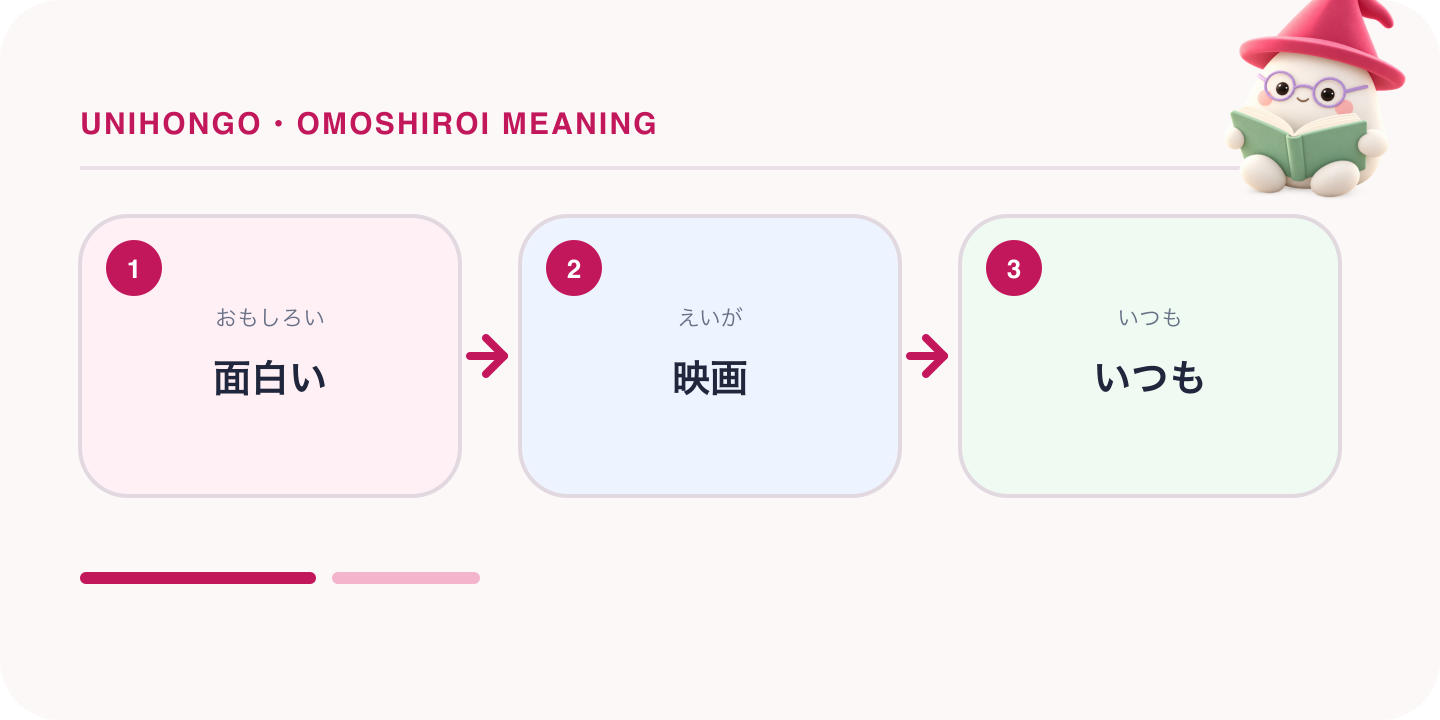
| Japanese | Romaji | Meaning |
|---|---|---|
| 面白い! | Omoshiroi! | That's funny! That's interesting! |
| この映画、面白いよ。 | Kono eiga, omoshiroi yo. | This film is good (interesting or funny). |
| 彼の話はいつも面白い。 | Kare no hanashi wa itsumo omoshiroi. | His stories are always entertaining. |
| 面白いアイデアですね。 | Omoshiroi aidea desu ne. | That's an interesting idea. |
| 歴史って面白いね。 | Rekishi tte omoshiroi ne. | History is fascinating, isn't it? |
Omoshiroi as funny
When the topic is jokes, comedy or a person's personality, omoshiroi means funny. Omoshiroi hito, a funny person, is a common compliment and is often listed as a quality people want in a partner or friend. Owarai, Japanese comedy, is judged by how omoshiroi it is.
To make the funny meaning unmistakable, Japanese speakers add laughter words: warau, to laugh, or waracchau, I can't help laughing. Ukeru and warota are slangier ways to say something is hilarious, used mainly by younger speakers and online.
| Japanese | Romaji | Meaning |
|---|---|---|
| 面白い人 | omoshiroi hito | A funny or fun person |
| この芸人、本当に面白い。 | Kono geinin, hontō ni omoshiroi. | This comedian is really funny. |
| 面白すぎて笑っちゃった。 | Omoshirosugite waracchatta. | It was so funny I burst out laughing. |
| それ、ウケる! | Sore, ukeru! | That's hilarious! (slang) |
| 面白いことを言うね。 | Omoshiroi koto o iu ne. | You say funny things. / That's an interesting thing to say. |
Omoshiroi as interesting
With books, lessons, jobs, research and ideas, omoshiroi means interesting, engaging or worthwhile. A teacher asking was the lesson interesting? says jugyō wa omoshirokatta? A colleague who likes their work might say shigoto ga omoshiroi, my work is interesting.
Omoshiroi also means curious or intriguing in the sense of unusual. A strange coincidence or an odd custom can be omoshiroi even if nobody laughs. Omoshiroi koto ni, interestingly, starts a sentence about a surprising fact.
For a more formal or academic tone, use kyōmibukai, deeply interesting, or kyōmi ga aru, I am interested. Note that I am interested in Japanese is Nihongo ni kyōmi ga arimasu, not Nihongo ga omoshiroi desu, although the latter is fine for Japanese is interesting.
| Japanese | Romaji | Meaning |
|---|---|---|
| 授業は面白かった? | Jugyō wa omoshirokatta? | Was the class interesting? |
| 今の仕事はとても面白いです。 | Ima no shigoto wa totemo omoshiroi desu. | My current job is very interesting. |
| 面白いことに、誰も気づかなかった。 | Omoshiroi koto ni, dare mo kizukanakatta. | Interestingly, nobody noticed. |
| 興味深い結果ですね。 | Kyōmibukai kekka desu ne. | That's an interesting result. |
| 日本の文化に興味があります。 | Nihon no bunka ni kyōmi ga arimasu. | I'm interested in Japanese culture. |
Omoshiroi or tanoshii? The most common confusion
Learners often use omoshiroi where Japanese speakers say tanoshii, and the other way round. Tanoshii means fun or enjoyable, and it describes your own feeling while doing something: a trip, a party, a day at the beach, playing a game. Omoshiroi describes a quality of the thing itself: a film, a story, a book, a person or an idea.
A good test: if you are participating, choose tanoshii; if you are watching, reading or thinking about something, choose omoshiroi. Pātī wa tanoshikatta, the party was fun. Eiga wa omoshirokatta, the film was good. Some things can take both, with a different focus. A game can be omoshiroi, well designed and engaging, and playing it with friends can be tanoshii.
| Situation | Natural word | Example |
|---|---|---|
| A film or book | 面白い omoshiroi | Kono hon wa omoshiroi. This book is interesting. |
| A trip or holiday | 楽しい tanoshii | Ryokō wa tanoshikatta. The trip was fun. |
| A party or drinks | 楽しい tanoshii | Kinō no nomikai, tanoshikatta ne. Last night's drinks were fun. |
| A lecture or talk | 面白い omoshiroi | Omoshiroi kōen deshita. It was an interesting talk. |
| A game you play | Both | Kono gēmu, omoshiroi. / Asobu no ga tanoshii. |
| A person | 面白い omoshiroi | Omoshiroi hito da ne. He's a fun guy. |
Saying ryokō wa omoshirokatta is not wrong, but it sounds as if the trip was interesting, like an educational experience, rather than enjoyable. Tanoshikatta is almost always what people want to say about holidays.
Okashii: funny, strange or wrong
Okashii, often written おかしい, also appears in dictionaries as funny, and in some contexts it does mean comical. But in everyday speech its most common meaning is strange, odd or not right. A machine making a strange noise, a calculation that does not add up or a person behaving oddly are all okashii.
Because of this, calling a person okashii usually suggests they are acting weird rather than being amusing. Atama ga okashii, literally the head is strange, means crazy and is rude. If you want to say someone is funny, use omoshiroi.
In older or written Japanese, okashii, sometimes spelt 可笑しい, often means laughable, and you will still hear okashikute warau, laughing because it is so funny. Context and tone decide, but for learners the safe assumption is that okashii means something is off.
| Japanese | Romaji | Meaning |
|---|---|---|
| このパソコン、ちょっとおかしい。 | Kono pasokon, chotto okashii. | Something's wrong with this computer. |
| 計算がおかしいです。 | Keisan ga okashii desu. | The calculation is off. |
| それはおかしいでしょう。 | Sore wa okashii deshō. | That's not right, surely. |
| おかしくて笑いが止まらない。 | Okashikute warai ga tomaranai. | It's so funny I can't stop laughing. |
| 体調がおかしい。 | Taichō ga okashii. | I don't feel right. |
Negative forms: omoshirokunai and tsumaranai
As an i-adjective, omoshiroi changes its ending for the negative and past. Omoshirokunai means not interesting or not funny, omoshirokatta means it was interesting, and omoshiroku nakatta means it was not interesting. The polite forms add desu: omoshirokunai desu or omoshiroku arimasen.
Omoshirokunai is milder than tsumaranai, which means boring or dull and sounds like a stronger judgement. Saying amari omoshiroku nakatta, it wasn't very interesting, is a softer way to give an honest opinion. Hmm, maa maa, so-so, is softer still.
| Form | Japanese | Meaning |
|---|---|---|
| Present | 面白い omoshiroi | Interesting, funny |
| Negative | 面白くない omoshirokunai | Not interesting, not funny |
| Past | 面白かった omoshirokatta | Was interesting |
| Past negative | 面白くなかった omoshiroku nakatta | Wasn't interesting |
| Too much | 面白すぎる omoshirosugiru | Too funny, hilarious |
| Stronger negative | つまらない tsumaranai | Boring, dull |
Polite and business uses
Omoshiroi is not slang and is fine in polite speech as omoshiroi desu. In meetings it is common in the phrase omoshiroi desu ne, which can express genuine interest in an idea. In some business contexts, though, it can also be a diplomatic way of not committing: that is interesting, followed by reasons it might not work.
When you praise a senior person's talk or story, focus on the content rather than calling them funny. O-hanashi, totemo omoshirokatta desu, your talk was very interesting, is warm and respectful. Benkyō ni narimashita, I learned a lot, is an even more deferential compliment for a presentation or advice.
| Japanese | Romaji | Meaning |
|---|---|---|
| 面白いですね。 | Omoshiroi desu ne. | That's interesting. |
| お話、とても面白かったです。 | O-hanashi, totemo omoshirokatta desu. | Your talk was very interesting. |
| 勉強になりました。 | Benkyō ni narimashita. | I learned a lot. |
| 興味深いご提案ですね。 | Kyōmibukai go-teian desu ne. | That's an interesting proposal. |
How to respond when someone says omoshiroi
When a friend tells you something is omoshiroi, the natural response is to show interest: e, hontō? donna hanashi?, oh, really? what's it about? If they are recommending a book or a series, you can say jā, yonde miru, I'll give it a read, or mite miru, I'll give it a watch.
If someone calls you omoshiroi, take it as a compliment. A light hō?, is that so?, or sō ka na, arigatō, you think so? thanks, sounds natural and modest.
| Japanese | Romaji | Meaning |
|---|---|---|
| え、本当?どんな話? | E, hontō? Donna hanashi? | Oh really? What's it about? |
| じゃあ、見てみる。 | Jā, mite miru. | Then I'll give it a watch. |
| そうかな。ありがとう。 | Sō ka na. Arigatō. | You think so? Thanks. |
| 確かに面白いね。 | Tashika ni omoshiroi ne. | It really is interesting. |
Common learner mistakes with omoshiroi
- Describing a trip or party as omoshiroi when tanoshii is what you mean.
- Using okashii to mean funny, when listeners usually hear strange or wrong.
- Saying Nihongo ga omoshiroi desu when you mean you are interested: use Nihongo ni kyōmi ga arimasu.
- Calling a superior omoshiroi: praise their story or idea instead.
- Using tsumaranai when a softer amari omoshiroku nakatta would be kinder.
- Assuming omoshiroi always means funny and missing a compliment about an idea.