
The core feeling adjectives
The words most learners meet first are i-adjectives: ureshii glad, kanashii sad, tanoshii fun or enjoyable, sabishii lonely, kowai scared or scary, hazukashii embarrassed, and kuyashii, the sting of losing or missing out. They conjugate like any i-adjective: present ureshii desu, past ureshikatta desu, negative ureshikunai desu. The past tense matters more here than with most adjectives, because feelings are usually reported after the event: kinō wa tanoshikatta desu.
Two of these need care. Ureshii and tanoshii are both translated happy, but ureshii is a reaction to something good and tanoshii is an enjoyable experience, so a party is tanoshii and receiving the invitation is ureshii. Kuyashii has no single English word. It is what you feel after losing narrowly, being beaten by someone you should have beaten, or failing by one point, and Japanese speakers use it far more than English speakers use frustrated.
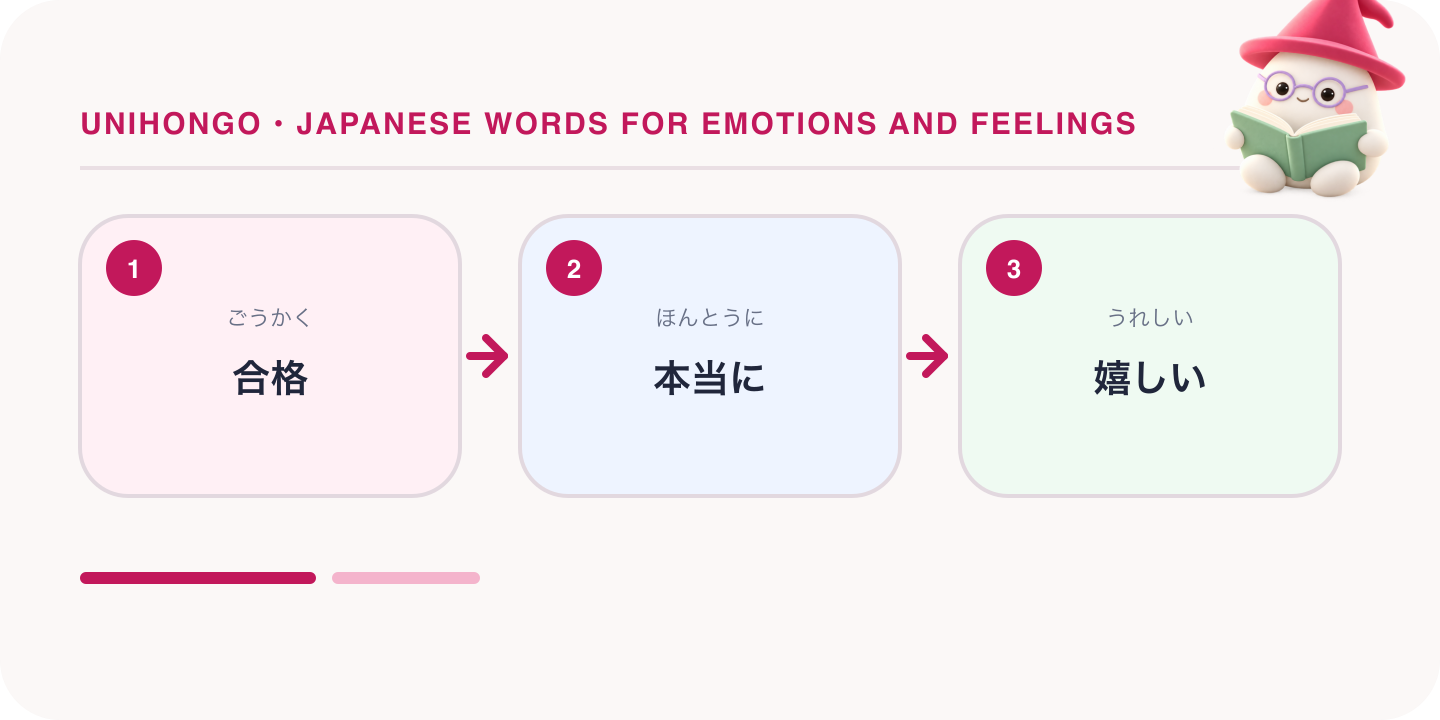
| Japanese | Romaji | Meaning |
|---|---|---|
| 合格して、本当に嬉しいです。 | Gōkaku shite, hontō ni ureshii desu. | I passed, and I am really glad. |
| 今日はとても楽しかったです。 | Kyō wa totemo tanoshikatta desu. | Today was really enjoyable. |
| 一人だと、ちょっと寂しいです。 | Hitori da to, chotto sabishii desu. | When I am alone, I get a bit lonely. |
| 私は犬が怖いです。 | Watashi wa inu ga kowai desu. | I am scared of dogs. |
| 人前で話すのは恥ずかしいです。 | Hitomae de hanasu no wa hazukashii desu. | Speaking in front of people is embarrassing. |
| 一点差で負けて、悔しいです。 | Itten-sa de makete, kuyashii desu. | We lost by one point, and it stings. |
Na-adjectives and suru verbs for feelings
The second group are nouns of feeling that work as na-adjectives, suru verbs, or both. Shinpai, worry, is shinpai desu as a state and shinpai shite imasu as something you are actively doing. Kinchō, nervousness, is almost always kinchō shite imasu. Anshin, relief, is anshin shimashita at the moment the worry ends. Fuan, unease, and zannen, regrettable, are na-adjectives: fuan desu, zannen desu.
The mimetic feelings take suru too: iraira suru to be irritated, bikkuri suru to be surprised, gakkari suru to be disappointed, wakuwaku suru to be excited, dokidoki suru for a pounding heart. The tense pattern is the useful part. Shimashita reports the moment it happened, bikkuri shimashita; shite imasu reports the state you are still in, iraira shite imasu. Learners often say bikkuri desu, which is heard casually but sounds unfinished in polite speech.
| Japanese | Romaji | Meaning |
|---|---|---|
| 明日の面接が心配です。 | Ashita no mensetsu ga shinpai desu. | I am worried about tomorrow's interview. |
| 今、すごく緊張しています。 | Ima, sugoku kinchō shite imasu. | I am really nervous right now. |
| それを聞いて安心しました。 | Sore o kiite anshin shimashita. | I was relieved to hear that. |
| 電車が遅れて、いらいらしました。 | Densha ga okurete, iraira shimashita. | The train was late and I got irritated. |
| 値段を見てびっくりしました。 | Nedan o mite bikkuri shimashita. | I was surprised when I saw the price. |
| 行けなくて残念です。 | Ikenakute zannen desu. | It is a pity I cannot go. |
| 旅行が楽しみで、わくわくしています。 | Ryokō ga tanoshimi de, wakuwaku shite imasu. | I am looking forward to the trip and feeling excited. |
Why feeling words are first-person only
Here is the rule English lacks. A bare feeling adjective states a direct inner experience, and you only have direct access to your own. So watashi wa kanashii desu is fine, but Tanaka-san wa kanashii desu sounds as if you can feel Tanaka's sadness from inside, and native listeners hear it as odd. The same applies in questions, but in reverse: kanashii desu ka to a listener is acceptable, because you are asking them to report, not reporting for them.
For other people, mark the evidence. Sō desu on the adjective stem means looks or seems: ureshisō desu, kanashisō desu, kowasō desu. Garu turns the adjective into a verb of visible behaviour, kowagaru, sabishigaru, hazukashigaru, usually in te imasu form. Alternatively quote them: kanashii to itte imashita. Suru verbs such as kinchō shite imasu describe observable states, so Tanaka-san wa kinchō shite imasu is fine as it stands, and so are verbs like yorokonde imasu and okotte imasu.
| Japanese | Romaji | Meaning |
|---|---|---|
| 田中さんは嬉しそうですね。 | Tanaka-san wa ureshisō desu ne. | Tanaka looks pleased, doesn't he? |
| 子どもが怖がっています。 | Kodomo ga kowagatte imasu. | The child is frightened. |
| 妹は一人で寂しがっています。 | Imōto wa hitori de sabishigatte imasu. | My younger sister is lonely on her own. |
| 彼は悲しそうな顔をしていました。 | Kare wa kanashisō na kao o shite imashita. | He had a sad look on his face. |
| 部長は結果を喜んでいます。 | Buchō wa kekka o yorokonde imasu. | The manager is pleased with the result. |
| 友達は緊張していると言っていました。 | Tomodachi wa kinchō shite iru to itte imashita. | My friend said they were nervous. |
Sō drops the final i of the adjective, so ureshii becomes ureshisō, and the adjective ii becomes yosasō. Garu forms take o where the adjective took ga: inu ga kowai desu but inu o kowagatte imasu. Get those two changes right and the whole system falls into place.
Physically tired versus emotionally tired
Tsukareru is a verb, to get tired, and the everyday form tsukaremashita literally means I have become tired, which is why the past tense describes your present state. Tsukarete imasu is the ongoing version. Both are neutral and cover a long day at work or a long walk. Kutakuta and hetoheto are mimetic words for being physically worn out, used with desu, and they are stronger and more vivid: kutakuta desu is the reply after moving house.
Mental tiredness is marked with seishinteki ni, mentally or psychologically: seishinteki ni tsukarete imasu. The related complaints are nemui, sleepy, and darui, heavy and sluggish, often used for feeling under the weather. Keep them apart, because a colleague who hears nemui will offer coffee and one who hears tsukareta will ask whether you are all right. The standard sympathetic reply to any of these is otsukaresama desu.
| Japanese | Romaji | Meaning |
|---|---|---|
| ちょっと疲れました。 | Chotto tsukaremashita. | I am a bit tired. |
| 今日は一日中歩いて、くたくたです。 | Kyō wa ichinichijū aruite, kutakuta desu. | I walked all day and I am worn out. |
| 引っ越しでへとへとです。 | Hikkoshi de hetoheto desu. | I am exhausted from moving house. |
| 最近、精神的に疲れています。 | Saikin, seishinteki ni tsukarete imasu. | Lately I have been mentally worn down. |
| 寝不足で眠いです。 | Nebusoku de nemui desu. | I am sleepy from lack of sleep. |
| なんだか体がだるいです。 | Nandaka karada ga darui desu. | My body feels heavy for some reason. |
Expressing feelings politely at work
At work, raw feeling words sound childish or dramatic, so Japanese speakers wrap them. The wrapper is usually a verb of perception: to kanjite imasu, I feel that, or ki ni natte imasu, it is on my mind. Komatte imasu, I am in a difficult position, is the standard way to say a problem is causing you stress without naming the stress. Tasukarimasu, that would help me, carries relief and gratitude in one word and is heard constantly in offices.
Disappointment and anxiety get the same treatment. Zannen desu ga introduces a bad result without complaint, and sukoshi fuan o kanjite imasu is an anxiety you can say to a manager. When a boss hears any of these, the typical reply is muri shinaide kudasai, please do not overdo it, or nanika areba itte kudasai, tell me if there is anything. The workplace greetings guide covers the fixed phrases; these are the ones that carry feeling.
| Japanese | Romaji | Meaning |
|---|---|---|
| 納期が少し気になっています。 | Nōki ga sukoshi ki ni natte imasu. | The deadline is on my mind a little. |
| 正直、少し困っています。 | Shōjiki, sukoshi komatte imasu. | Honestly, I am in a bit of a difficult position. |
| 手伝っていただけると助かります。 | Tetsudatte itadakeru to tasukarimasu. | It would really help if you could assist. |
| 新しい担当に少し不安を感じています。 | Atarashii tantō ni sukoshi fuan o kanjite imasu. | I feel a little uneasy about the new assignment. |
| 残念ですが、今回は見送ります。 | Zannen desu ga, konkai wa miokurimasu. | Unfortunately, we will pass this time. |
| 無理しないでくださいね。 | Muri shinaide kudasai ne. | Please do not overdo it. |
Asking how someone feels without prying
Japanese is careful about asking after feelings, because a direct question can force someone to disclose more than they want. Daijōbu desu ka, are you all right, is the safe opener for anything from a stumble to visible tears. Tsukarete imasen ka, aren't you tired, offers sympathy without demanding a reason. Chōshi wa dō desu ka asks about condition and works for health and mood alike. The small talk guide has the everyday openers; this is the follow-up layer.
The question to handle carefully is nanika atta n desu ka, did something happen. The n desu asks for an explanation, so it is warm between friends and pushy with a colleague you barely know. Expect deflecting answers and accept them: daijōbu desu, chotto tsukareta dake desu, I am fine, just a bit tired, closes the topic politely. A sentence that trails off with te, jitsu wa chotto shinpai na koto ga atte, invites you to ask more.
| Japanese | Romaji | Meaning |
|---|---|---|
| 大丈夫ですか? | Daijōbu desu ka? | Are you all right? |
| 大丈夫です。ちょっと疲れただけです。 | Daijōbu desu. Chotto tsukareta dake desu. | I am fine. Just a bit tired. |
| 疲れていませんか? | Tsukarete imasen ka? | Aren't you tired? |
| 最近、調子はどうですか? | Saikin, chōshi wa dō desu ka? | How have you been feeling lately? |
| 何かあったんですか? | Nanika atta n desu ka? | Did something happen? |
| 実は、ちょっと心配なことがあって。 | Jitsu wa, chotto shinpai na koto ga atte. | Actually, there is something I am a bit worried about. |
| よかったら話してください。 | Yokattara hanashite kudasai. | Tell me about it if you like. |
Small words that soften a strong feeling
Japanese speakers rarely deliver a feeling at full strength. Chotto and sukoshi, a little, go in front of almost any feeling word and lower the temperature without changing the meaning. Kamo shiremasen, maybe, and its casual form kamo, go on the end and turn a statement into a guess about yourself: sabishii kamo. N desu kedo, a framing but on the end, states the feeling and immediately leaves room for the other person to respond.
Casual speech adds nanka, somehow, at the front and ki ga suru, I have a feeling, at the end. The reverse tools, for when you do want strength, are totemo, hontō ni, and in casual speech sugoku and mechakucha. Learners tend to use only the strong set, which makes every feeling sound like a crisis. Practise the softeners first; a Japanese friend who hears chotto kanashii kamo will take it exactly as seriously as you mean it.
| Japanese | Romaji | Meaning |
|---|---|---|
| ちょっと悲しいです。 | Chotto kanashii desu. | I am a little sad. |
| なんか寂しいかも。 | Nanka sabishii kamo. | I feel kind of lonely, maybe. (casual) |
| 少し緊張しているかもしれません。 | Sukoshi kinchō shite iru kamo shiremasen. | I may be a little nervous. |
| 嬉しいんですけど、ちょっと不安です。 | Ureshii n desu kedo, chotto fuan desu. | I am glad, but a little anxious. |
| うまくいかない気がします。 | Umaku ikanai ki ga shimasu. | I have a feeling it will not go well. |
| 本当に嬉しいです。 | Hontō ni ureshii desu. | I am truly glad. |
Reference table of feeling words
| Japanese | Romaji | English | Grammar type |
|---|---|---|---|
| 嬉しい | ureshii | glad, happy about something | i-adjective |
| 楽しい | tanoshii | fun, enjoyable | i-adjective |
| 悲しい | kanashii | sad | i-adjective |
| 寂しい | sabishii | lonely | i-adjective |
| 怖い | kowai | scared, scary | i-adjective |
| 恥ずかしい | hazukashii | embarrassed | i-adjective |
| 悔しい | kuyashii | stung by a loss | i-adjective |
| 懐かしい | natsukashii | nostalgic | i-adjective |
| つらい | tsurai | hard to bear | i-adjective |
| 眠い | nemui | sleepy | i-adjective |
| だるい | darui | sluggish, heavy | i-adjective |
| 幸せ | shiawase | happy, content | na-adjective |
| 不安 | fuan | anxious, uneasy | na-adjective |
| 残念 | zannen | disappointing, a pity | na-adjective |
| 退屈 | taikutsu | bored, boring | na-adjective |
| 元気 | genki | well, lively | na-adjective |
| 心配 | shinpai | worried | na-adjective or suru verb |
| 満足 | manzoku | satisfied | na-adjective or suru verb |
| 緊張する | kinchō suru | be nervous | suru verb |
| 安心する | anshin suru | be relieved | suru verb |
| 感動する | kandō suru | be moved | suru verb |
| びっくりする | bikkuri suru | be surprised | mimetic plus suru |
| いらいらする | iraira suru | be irritated | mimetic plus suru |
| がっかりする | gakkari suru | be disappointed | mimetic plus suru |
| わくわくする | wakuwaku suru | be excited | mimetic plus suru |
| どきどきする | dokidoki suru | heart pounding | mimetic plus suru |
| くたくた | kutakuta | worn out | mimetic plus desu |
| へとへと | hetoheto | exhausted | mimetic plus desu |
| 疲れる | tsukareru | get tired | verb |
| 困る | komaru | be in difficulty | verb |
| 落ち込む | ochikomu | feel down | verb |
| 怒る | okoru | get angry | verb |
| 喜ぶ | yorokobu | be pleased, observable | verb |
| 悩む | nayamu | be troubled | verb |
A routine for using feeling words naturally
- Each evening, say one past-tense i-adjective and one shimashita verb about the day: tanoshikatta desu, bikkuri shimashita.
- Watch one scene of a drama and describe each character with sō desu or garu, never a bare adjective.
- Write your three most common feelings at work and build a polite wrapper for each with kanjite imasu or ki ni natte imasu.
- Practise the deflecting answer daijōbu desu, chotto tsukareta dake desu until it comes out without thinking.
- Say every strong feeling twice, once with totemo and once with chotto, and notice which one you would actually use.