

Itai: ouch and it hurts
Itai is an i-adjective, so it conjugates like takai or oishii. As a reaction, people say itai! or itta! when something suddenly hurts; the clipped itta or ite is very casual and more common among men. In a sentence, the pattern is body part plus ga itai: atama ga itai, my head hurts; ha ga itai, I have toothache.
To be polite, add desu. At a pharmacy or clinic, nodo ga itai desu, my throat hurts, is a complete and natural sentence. To ask someone else, say doko ga itai desu ka, where does it hurt?
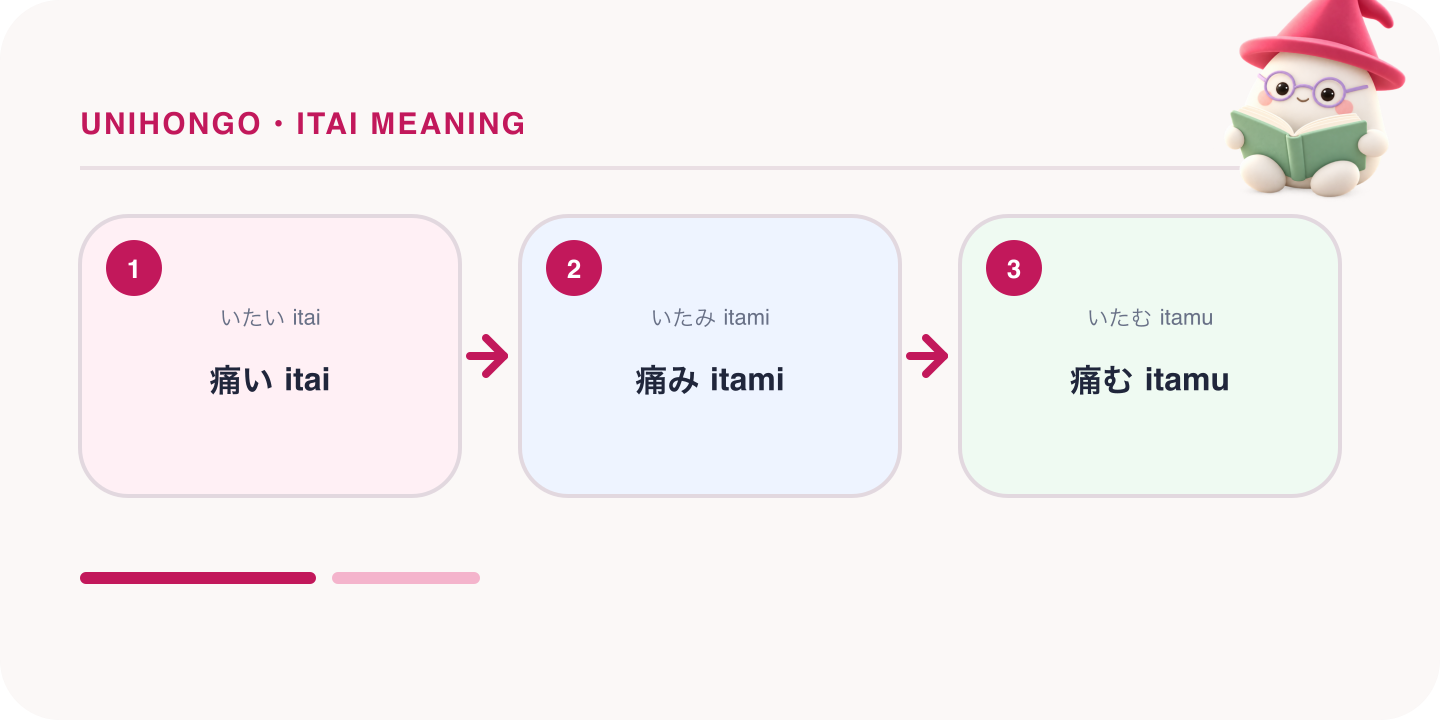
| Form | Japanese | Meaning |
|---|---|---|
| Present | 痛い itai | It hurts |
| Past | 痛かった itakatta | It hurt |
| Negative | 痛くない itakunai | It doesn't hurt |
| Past negative | 痛くなかった itakunakatta | It didn't hurt |
| Becoming | 痛くなった itaku natta | It started to hurt |
| Noun | 痛み itami | Pain |
| Verb | 痛む itamu | To ache |
Itami is the noun you need for medical conversation: itami ga tsuyoi, the pain is strong, and itamidome, a painkiller. Itamu, to ache, is slightly more formal than itai and common in written instructions.
Saying where it hurts
Most pain sentences are simply a body part plus ga itai. Learning the main body parts gives you dozens of useful sentences. For pain in several places, list them with to or ya: atama to nodo ga itai desu, my head and throat hurt.
If you cannot name the part, point and say koko ga itai desu, it hurts here. Doctors and pharmacists understand this instantly, so it is the most important sentence of all.
| Japanese | Romaji | Meaning |
|---|---|---|
| 頭が痛いです。 | Atama ga itai desu. | I have a headache. |
| お腹が痛いです。 | Onaka ga itai desu. | I have a stomach ache. |
| 喉が痛いです。 | Nodo ga itai desu. | I have a sore throat. |
| 歯が痛いです。 | Ha ga itai desu. | I have toothache. |
| 腰が痛いです。 | Koshi ga itai desu. | My lower back hurts. |
| ここが痛いです。 | Koko ga itai desu. | It hurts here. |
| どこが痛いですか。 | Doko ga itai desu ka. | Where does it hurt? |
Describing the kind of pain at a clinic
Japanese uses onomatopoeic words, called giongo and gitaigo, to describe the quality of pain, and doctors often ask donna itami desu ka, what kind of pain is it? These words are standard medical vocabulary, not baby talk, and using the right one helps the doctor narrow down the problem.
The words go before itai or with suru: zukizuki itai or zukizuki suru. Each has a typical use. Zukizuki is a throbbing pain in rhythm with the pulse, typical of headaches and toothache. Kirikiri is sharp and piercing, often for stomach cramps. Shikushiku is a dull, nagging ache that goes on and on. Hirihiri is a stinging or burning pain on the skin or tongue, as with sunburn or spicy food.
| Word | Kind of pain | Typical example |
|---|---|---|
| ズキズキ zukizuki | Throbbing, pulsing | Headache, toothache, a cut |
| ガンガン gangan | Pounding, hammering | Bad headache, hangover |
| キリキリ kirikiri | Sharp, piercing | Stomach cramps, stress |
| シクシク shikushiku | Dull, nagging, continuing | Mild stomach ache |
| ヒリヒリ hirihiri | Stinging, burning | Sunburn, scrape, spicy food |
| チクチク chikuchiku | Prickling, pins and needles | Itchy jumper, a splinter |
| ズキン zukin | A sudden sharp throb | Moving an injured joint |
If you are not sure which word fits, describe the pain in plain terms instead: surudoi itami, a sharp pain, or nibui itami, a dull pain. Doctors will understand both.
Full symptom sentences for the doctor
A good symptom description answers four questions: where, what kind, since when, and how strong. Kinō no yoru kara, since last night; mikka mae kara, for three days; and taerarenai hodo, unbearably, are the building blocks. Put them together and the doctor has most of what they need.
You will also hear questions about when the pain happens. Ugoku to itai means it hurts when I move, and taberu to itai means it hurts when I eat. These to patterns are worth practising because they come up constantly.
| Japanese | Romaji | Meaning |
|---|---|---|
| 昨日から頭がズキズキ痛いです。 | Kinō kara atama ga zukizuki itai desu. | I've had a throbbing headache since yesterday. |
| お腹がキリキリ痛みます。 | Onaka ga kirikiri itamimasu. | I have sharp stomach cramps. |
| 日焼けして肌がヒリヒリします。 | Hiyake shite hada ga hirihiri shimasu. | I'm sunburnt and my skin stings. |
| 歩くと膝が痛いです。 | Aruku to hiza ga itai desu. | My knee hurts when I walk. |
| 我慢できないほど痛いです。 | Gaman dekinai hodo itai desu. | It hurts so much I can't bear it. |
| 痛み止めをください。 | Itamidome o kudasai. | Could I have a painkiller, please? |
Itai no itai no tonde ike
When a small child falls over, Japanese parents often rub the sore spot and say itai no itai no tonde ike, pain, pain, fly away!, then flick their hand towards the sky as if throwing the pain away. It works much like kiss it better in English, and nearly every Japanese adult remembers hearing it.
The words vary slightly by family and region; some say itai no itai no tondeke, and some add a destination for the pain, such as a distant mountain. Parents also reassure children with daijōbu, daijōbu, it's all right, and itakunai yo, it doesn't hurt, before and after injections.
| Japanese | Romaji | Meaning |
|---|---|---|
| 痛いの痛いの飛んでいけ! | Itai no itai no tonde ike! | Pain, pain, fly away! |
| 大丈夫、大丈夫。 | Daijōbu, daijōbu. | It's all right, it's all right. |
| 痛くないよ。 | Itakunai yo. | It won't hurt. |
| 痛かったね。 | Itakatta ne. | That hurt, didn't it? |
| よく我慢したね。 | Yoku gaman shita ne. | You were so brave. |
Itai as painful loss and itai as cringe
Itai also describes things that hurt without touching the body. An unexpected expense is itai shuppi, a painful expense; a mistake that costs a team the game is itai misu. Itai tokoro o tsukareta means someone hit a sore spot, pointing out a weakness you already knew about. Atama ga itai can also mean a problem is giving you a headache.
In modern slang, itai describes behaviour that is painful to watch: embarrassing, trying too hard or out of touch. An itai hito is someone whose words or actions make others cringe, and itai fuku is an outfit that is trying too hard. This sense is common online and among younger speakers, and it is always critical, so use it carefully.
| Japanese | Romaji | Meaning |
|---|---|---|
| 痛い出費だった。 | Itai shuppi datta. | That was a painful expense. |
| あのミスは痛かった。 | Ano misu wa itakatta. | That mistake really cost us. |
| 痛いところを突かれた。 | Itai tokoro o tsukareta. | You've hit a sore spot. |
| 頭の痛い問題 | atama no itai mondai | A headache of a problem |
| あの人、ちょっと痛いね。 | Ano hito, chotto itai ne. | That person is a bit cringey. |
| 痛い発言 | itai hatsugen | A cringe-worthy remark |
The kanji 痛 and its compounds
The kanji 痛 is built on the sickness radical 疒, called yamaidare, which appears in many illness-related characters such as 病, illness, and 疲, tired. Its kun reading is ita- in itai and itamu, and its on reading is tsū, used in medical and formal compounds.
Many tsū words are useful at a pharmacy, because medicine boxes use them rather than itai. Zutsū-yaku is headache medicine, and fukutsū is abdominal pain. Tsūkai, on the other hand, means thrilling or deeply satisfying, a reminder that kanji meanings can stretch in surprising directions.
| Word | Reading | Meaning |
|---|---|---|
| 頭痛 | zutsū | Headache |
| 腹痛 | fukutsū | Abdominal pain |
| 歯痛 | shitsū | Toothache |
| 腰痛 | yōtsū | Lower back pain |
| 苦痛 | kutsū | Suffering, agony |
| 痛感 | tsūkan | Keenly feeling or realising |
| 痛快 | tsūkai | Thrilling, deeply satisfying |
| 痛み止め | itamidome | Painkiller |
Watch out for homophones. Itamu can also be written 傷む, to be damaged or go bad, as with fruit, and itameru written 炒める means to stir-fry. The kanji show which one you mean.