

Give the tutor the roles without private identities
You can describe a manager, colleague, teacher, customer, or friend without supplying names or confidential details. Tell Mocchi who performs the action and who receives the message. This gives the word-choice exercise the context it needs while keeping the lesson focused on language rather than unnecessary personal information.
State the purpose too. Reporting what happened, making a request, and inviting someone to do something can require different wording even with the same people involved. A register label such as business Japanese is less informative than a short description of the actual communication.
Compare eating with respectful and humble references
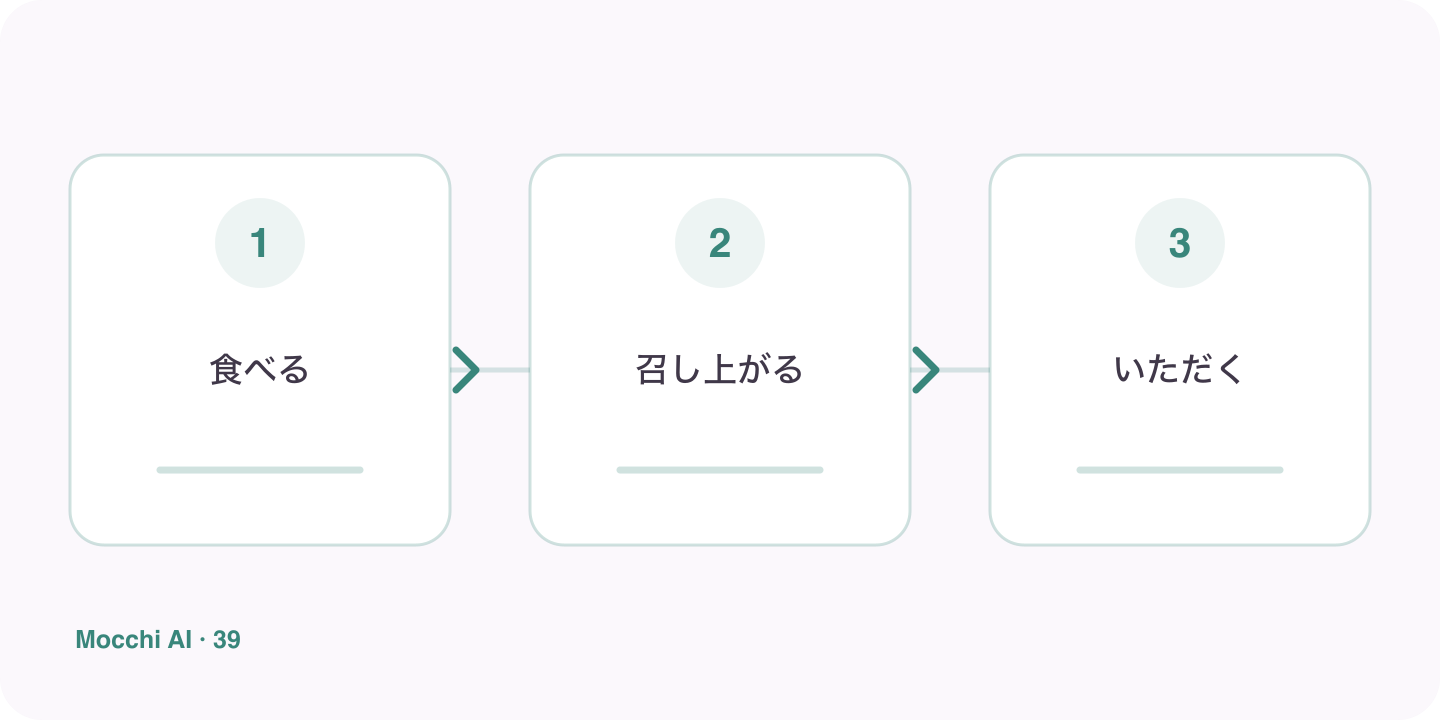
食べる is ordinary vocabulary for eating. 召し上がる is a respectful expression used for another person's action in an appropriate context, while いただく can be used humbly for one's own side in relevant meal contexts. Practice complete sentences and participant roles rather than treating the three verbs as interchangeable entries on a politeness ladder.
| Japanese | Romaji | Meaning |
|---|---|---|
| 先生はもう召し上がりました。 | Sensei wa mō meshiagarimashita. | The teacher has already eaten. |
| おいしくいただきました。 | Oishiku itadakimashita. | I enjoyed the meal. |
Keep the event stable while changing the relationship
Use the same simple action and change who performs it. Ask Mocchi to explain which part of the wording responds to that change. If the rewrite also changes the meaning, simplify the example and separate content from register. This makes it easier to see whether you understand the social relationship expressed by the vocabulary.
Distinguish an error from a style preference
A tutor may suggest a more formal alternative even when the original sentence is understandable and suitable for a friend. Ask whether the change fixes a role mistake, clarifies the intention, or merely offers another tone. This prevents you from learning that every ordinary expression is wrong and every elaborate expression is automatically more correct.
Review with a new audience and purpose
At a later visit, give a different invented scenario and choose the wording before seeing a model. Explain the actor and relationship in your answer. If you keep reversing respectful and humble roles, review that distinction directly. Mocchi's personalized practice can provide repeated low-pressure attempts, while a clear role explanation helps you carry the vocabulary beyond the first example.