
The four words you hear in every game
Shogi is played on a board of nine by nine squares, the shōgiban (将棋盤), with twenty pieces, koma (駒), on each side. All the pieces are the same colour. Each one is a small wedge, and the way it points shows whose it is.
The game has had a boom in recent years thanks to Sōta Fujii, who in 2023 became the first player to hold all eight major titles at once. You will see boards in parks, in community centres and on television.
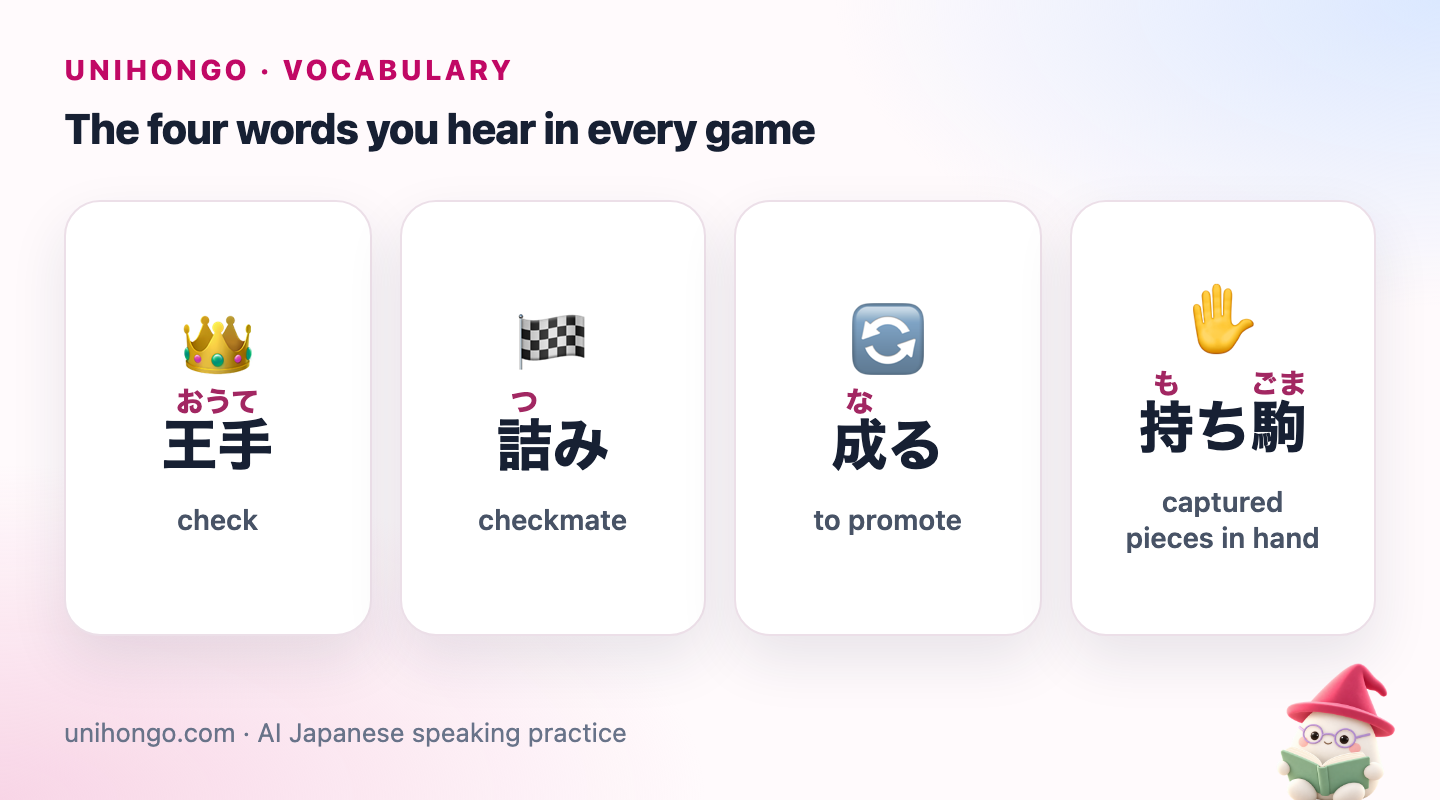
| Japanese | Romaji | Meaning |
|---|---|---|
| 王手 | ōte | check |
| 詰み | tsumi | checkmate |
| 成る | naru | to promote |
| 持ち駒 | mochigoma | captured pieces in hand |
| 駒 | koma | shogi piece |
| 将棋を指します。 | Shōgi o sashimasu. | I play shogi. |
The eight pieces and their readings
| Japanese | Romaji | Meaning |
|---|---|---|
| 王将 | ōshō | king |
| 玉将 | gyokushō | king, the second player's |
| 飛車 | hisha | rook, literally flying chariot |
| 角行 | kakugyō | bishop, literally angle mover |
| 金将 | kinshō | gold general |
| 銀将 | ginshō | silver general |
| 桂馬 | keima | knight |
| 香車 | kyōsha | lance |
| 歩兵 | fuhyō | pawn, literally foot soldier |
Nobody says the full names during play. They shrink to ō or gyoku, hisha, kaku, kin, gin, kei, kyō and fu. Each side starts with one king, one rook, one bishop, two golds, two silvers, two knights, two lances and nine pawns.
The kanji 玉 means jewel and differs from 王, king, by a single dot. If you can tell those two apart, you can already read the most important piece on the board.
Naru: promotion and the tokin
The three rows furthest from you are the enemy camp, tekijin (敵陣). When a piece moves into, inside or out of that zone, you may flip it over. This is naru (成る), literally to become, and the other face of the piece shows its promoted name, often in red.
A promoted pawn is called a tokin (と金) and moves like a gold general. Promoted silvers, knights and lances also move like gold. The rook becomes a dragon, ryū, and the bishop becomes a horse, uma; each keeps its old move and gains the king's one-step moves. Kings and golds do not promote.
| Japanese | Romaji | Meaning |
|---|---|---|
| と金 | tokin | promoted pawn |
| 竜 | ryū | promoted rook, the dragon |
| 馬 | uma | promoted bishop, the horse |
| 歩が成りました。 | Fu ga narimashita. | The pawn has promoted. |
| 成りますか。 | Narimasu ka. | Will you promote? |
Ōte, tsumi, sente and gote
Ōte (王手) is literally a hand on the king: check. Tsumi (詰み) is checkmate, from the verb tsumu (詰む), to be packed in with nowhere to go. Mate puzzles, called tsume shōgi (詰将棋), are printed in newspapers and are how many players train.
The player who moves first is sente (先手) and the other is gote (後手). In formal games this is decided by furigoma (振り駒): one player shakes five pawns and tosses them, and the faces that land upward decide who starts.
| Japanese | Romaji | Meaning |
|---|---|---|
| 王手です。 | Ōte desu. | That's check. |
| 詰みです。 | Tsumi desu. | That's checkmate. |
| 先手 | sente | the player who moves first |
| 後手 | gote | the player who moves second |
| どちらが先手ですか。 | Dochira ga sente desu ka. | Who moves first? |
Mochigoma: the rule that changes everything
In chess a captured piece leaves the game. In shogi it changes sides. Pieces you capture wait beside the board as your mochigoma (持ち駒), pieces in hand. On any turn, instead of moving, you may place one of them on an empty square as your own. That is why every piece is the same colour.
Three verbs keep this clear. You move a piece with sasu (指す), you capture with toru (取る), and you drop a piece in hand with utsu (打つ). The best-known restriction is nifu (二歩), two pawns: you may not drop a pawn on a file where you already have an unpromoted pawn. Doing so loses the game at once.
| Japanese | Romaji | Meaning |
|---|---|---|
| 駒を取ります。 | Koma o torimasu. | I capture a piece. |
| 歩を打ちます。 | Fu o uchimasu. | I drop a pawn. |
| 持ち駒は何ですか。 | Mochigoma wa nan desu ka. | What pieces do you have in hand? |
| 二歩は反則です。 | Nifu wa hansoku desu. | Two pawns on one file is illegal. |
Shogi idioms in daily Japanese
You can hear all of these in offices and on the sports news, from people who have never played a game.
| Japanese | Romaji | Meaning |
|---|---|---|
| 王手をかける | ōte o kakeru | to be one step from winning |
| 高飛車 | takabisha | high-handed, overbearing |
| 成金 | narikin | a person who got rich suddenly |
| 捨て駒 | sutegoma | a sacrificed piece, a pawn |
| 待った | matta | wait, a call to stop |
| 優勝に王手をかけました。 | Yūshō ni ōte o kakemashita. | They are one win from the title. |
| 高飛車な態度ですね。 | Takabisha na taido desu ne. | That's a high-handed attitude, isn't it? |
Takabisha is said to come from pushing the rook, the hisha, high up the board to press the opponent. Of a person it means talking down to others, and it is always a criticism. A sutegoma is a piece given away on purpose, so calling a person one means they were used and thrown away.
Matta is what you say to take back a move, which is bad manners in a real game. From it come matta o kakeru, to call a halt to a plan, and matta nashi, a situation with no second chances.
What to say when you play
A game begins with both players bowing and saying onegai shimasu. It ends when the loser says makemashita aloud. The winner does not announce the win. Both then say arigatō gozaimashita, and often go back over the game together, a review called kansōsen (感想戦).
| Japanese | Romaji | Meaning |
|---|---|---|
| 将棋を指しませんか。 | Shōgi o sashimasen ka. | Would you like to play shogi? |
| お願いします。 | Onegai shimasu. | Let's begin, literally please. |
| 負けました。 | Makemashita. | I have lost. |
| ありがとうございました。 | Arigatō gozaimashita. | Thank you for the game. |
| もう一局お願いします。 | Mō ikkyoku onegai shimasu. | One more game, please. |
| ルールを教えてください。 | Rūru o oshiete kudasai. | Please teach me the rules. |
Games are counted with kyoku (局), so one game is ikkyoku. Saying makemashita clearly is considered part of good manners, and children in shogi classes practise it from the first day.