
Yoi otoshi o in four lines
The phrase has three parts. 良い (yoi) means good. お年 (otoshi) is 年, year, with the polite prefix o. を (o) is the object particle, which tells you that a verb is missing. The complete sentence is 良いお年をお迎えください, please welcome a good year, and in everyday speech people simply stop after the particle, the same way English speakers say have a good one.
Because it wishes for something still to come, it is a goodbye, not a greeting. You never open a conversation with it. You end one, usually with a small bow or a wave, after the business of the conversation is done.
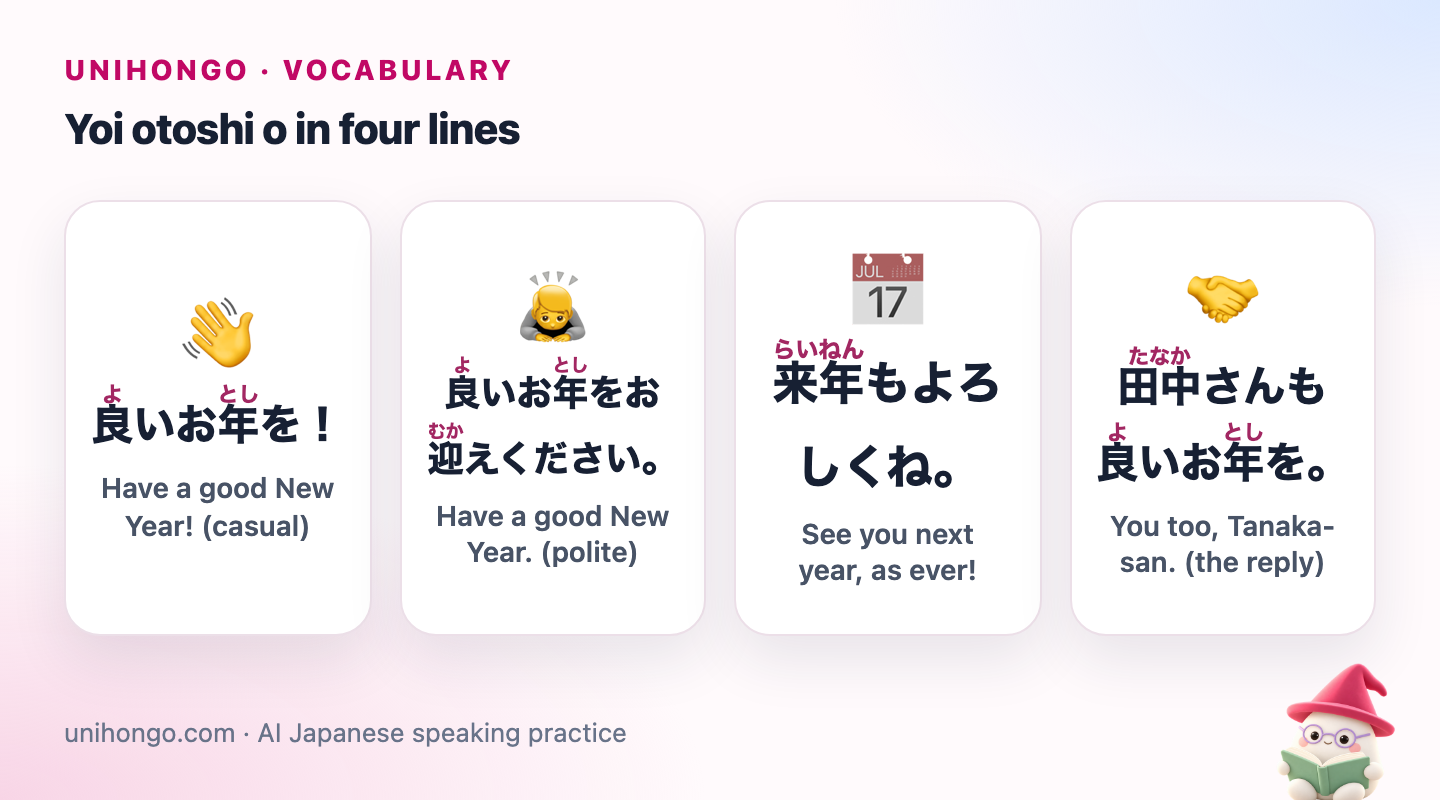
| Japanese | Romaji | Meaning |
|---|---|---|
| 良いお年を! | Yoi otoshi o! | Have a good New Year! (casual) |
| 良いお年をお迎えください。 | Yoi otoshi o omukae kudasai. | Have a good New Year. (polite) |
| 来年もよろしくね。 | Rainen mo yoroshiku ne. | See you next year, as ever! |
| 田中さんも良いお年を。 | Tanaka san mo yoi otoshi o. | You too, Tanaka-san. (the reply) |
When to say it, and when to stop
There is no fixed start date. Most people begin to say yoi otoshi o somewhere in mid-December, once it is clear they will not see the other person again before the holidays. The rule of thumb is simple: say it at your last meeting of the year. If you will see a colleague again on 28 December, a normal mata ashita is enough on the 25th.
The cut-off, on the other hand, is fixed. At midnight on 31 December, Ōmisoka, the wish expires. From that moment the right words are akemashite omedetō gozaimasu, and you keep using them for the first days of January when you meet people for the first time that year.
| Japanese | Romaji | Meaning |
|---|---|---|
| 今年はもう会えないね。 | Kotoshi wa mō aenai ne. | We won't see each other again this year, will we? |
| じゃあ、良いお年を。 | Jā, yoi otoshi o. | Well then, have a good New Year. |
| また来年。 | Mata rainen. | See you next year. |
| When | What people usually say | Why |
|---|---|---|
| Early December | Mata ne, or the usual goodbye | Too early: you will probably meet again |
| Your last meeting before the holidays | Yoi otoshi o | You will not see them until next year |
| 31 December, before midnight | Yoi otoshi o | The last chance to say it |
| From 1 January | Akemashite omedetō gozaimasu | The new year has arrived |
Casual, polite and very polite
The short form is warm and friendly, and it is not rude even to a boss when you are leaving in a hurry, because it is a set expression. Still, with customers, teachers, older neighbours and anyone you would speak to with desu and masu, the full form sounds more complete. Shop staff and hotel staff go one step higher and add mase, an extra-polite ending used in service.
You will also see 良い年をお迎えください, without the o before toshi. It is found in writing, especially business emails, and sounds slightly more neutral. In speech, otoshi with o is far more common.
| Japanese | Romaji | Meaning |
|---|---|---|
| 良いお年を〜! | Yoi otoshi o! | Have a good one! (friends, a bright casual tone) |
| どうぞ良いお年をお迎えください。 | Dōzo yoi otoshi o omukae kudasai. | Please do have a good New Year. (polite) |
| 良いお年をお迎えくださいませ。 | Yoi otoshi o omukae kudasaimase. | Staff: We wish you a happy New Year. (shop, hotel) |
| 良い年をお迎えください。 | Yoi toshi o omukae kudasai. | Have a good New Year. (neutral, often written) |
| 皆さん、良いお年を。 | Minasan, yoi otoshi o. | Have a good New Year, everyone. (to a group) |
How to reply
Answering is easy: say it back. The exchange is symmetrical, like goodbye and goodbye. To make it warmer, put the person's name or anata no hō mo in front, or begin with a thank you for the year. With customers in a shop, staff will usually say the very polite version, and a simple arigatō gozaimasu with a small nod is a perfectly good answer.
If someone says it to you and you are actually going to see them again before New Year, you can laugh and point that out. It is a nice, natural way to show you understood the timing.
| Japanese | Romaji | Meaning |
|---|---|---|
| 良いお年を! | Yoi otoshi o! | You too! (simply say it back) |
| ありがとうございます。良いお年を。 | Arigatō gozaimasu. Yoi otoshi o. | Thank you. Have a good New Year. |
| 今年もありがとうございました。 | Kotoshi mo arigatō gozaimashita. | Thank you for everything this year. |
| あ、まだ二十八日に会いますよ。 | A, mada nijūhachinichi ni aimasu yo. | Oh, we're still meeting on the 28th! |
| そうだった!じゃあ、またね。 | Sō datta! Jā, mata ne. | Friend: That's right! See you then. |
Mini dialogue: the last day at work
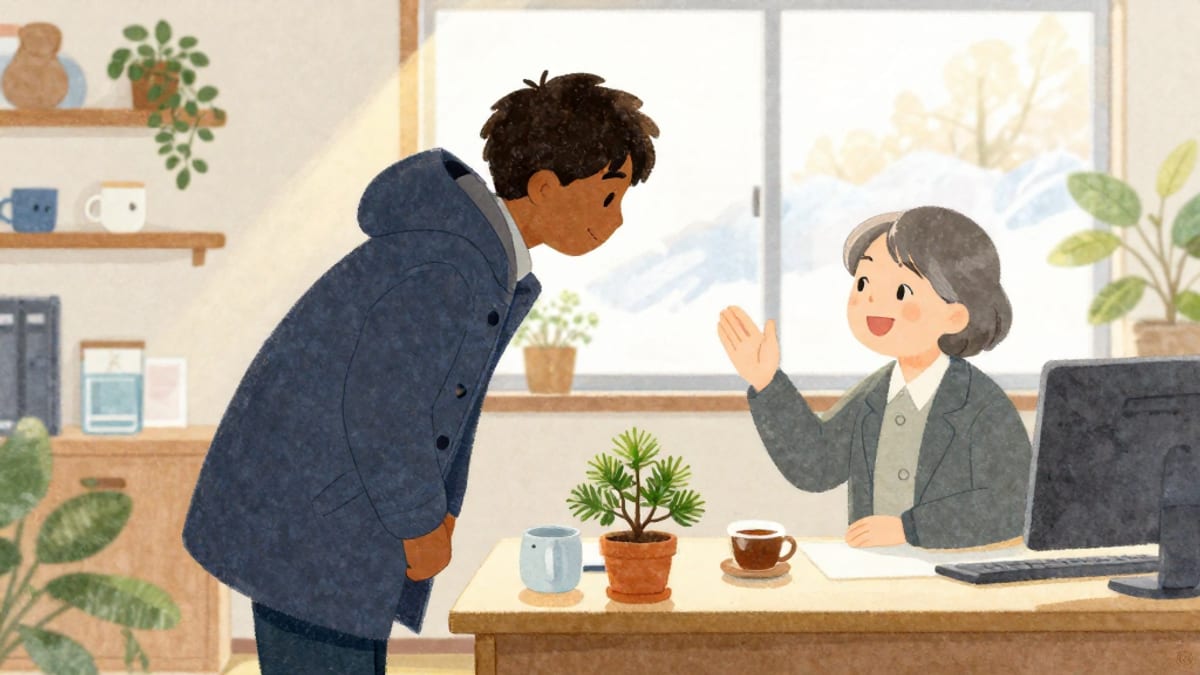
The most common place to hear yoi otoshi o is the office on the last working day before the break, often around 28 December. People leave a little earlier than usual, and on the way out they combine three things: thanks for the year, a request to keep working well together next year, and the wish itself. Here is how it sounds between a new team member and a senior colleague.
| Japanese | Romaji | Meaning |
|---|---|---|
| 今年もお世話になりました。 | Kotoshi mo osewa ni narimashita. | You: Thank you for all your help this year. |
| こちらこそ。来年もよろしくね。 | Kochira koso. Rainen mo yoroshiku ne. | Colleague: Likewise. Let's keep it up next year. |
| はい、来年もよろしくお願いします。 | Hai, rainen mo yoroshiku onegai shimasu. | You: Yes, I look forward to it. |
| 実家に帰るの? | Jikka ni kaeru no? | Colleague: Are you going back to your family? |
| はい、三日まで帰ります。 | Hai, mikka made kaerimasu. | You: Yes, until the 3rd. |
| いいね。じゃあ、良いお年を! | Ii ne. Jā, yoi otoshi o! | Colleague: Nice. Well, have a good New Year! |
| 良いお年をお迎えください。 | Yoi otoshi o omukae kudasai. | You: Have a good New Year. (polite) |
Common learner mistakes
- Saying yoi otoshi o after New Year. On 2 January it sounds as if you missed the holidays. Switch to akemashite omedetō gozaimasu.
- Using it as a hello. It closes a conversation; open with konnichiwa or the usual greeting, and save yoi otoshi o for the end.
- Writing 良いお年をを or adding another particle. The を is already there; the verb is what is missing.
- Translating Merry Christmas and a Happy New Year into one Japanese line. Christmas is not a holiday season in the same way in Japan, and yoi otoshi o alone is the natural end-of-year wish.
- Putting it in an email that the reader will open in January. If your message may be read after the holidays, use the New Year greeting or skip the wish.
- Saying omedetō instead. Omedetō is a congratulation, and it belongs to the new year itself, not to the days before it.
Lines that travel with yoi otoshi o
Yoi otoshi o rarely appears alone. Around it you hear a small family of year-end lines: thanks for the year, a wish for the coming one, and words about the busy last days. Learn them as a set and your December goodbyes will sound complete. The spoken versions are below; the business email versions are more formal and have their own post. The days around the change of year also bring their own customs, such as the big clean, first shrine visits and New Year food, which are worth reading about if you will spend the holidays with a Japanese family.
Some families who are in mourning avoid celebratory New Year words. Many people feel yoi otoshi o is still fine, because it is a wish rather than a congratulation, but if you know someone has lost a family member this year, a gentle line about taking care is always safe.
| Japanese | Romaji | Meaning |
|---|---|---|
| 年末は忙しいですね。 | Nenmatsu wa isogashii desu ne. | The end of the year is busy, isn't it? |
| 年内はいつまでですか。 | Nennai wa itsu made desu ka. | Until when are you open this year? |
| 良い年末をお過ごしください。 | Yoi nenmatsu o osugoshi kudasai. | Enjoy the rest of the year. (polite) |
| どうぞお体に気をつけて。 | Dōzo okarada ni ki o tsukete. | Please take care of yourself. |
| また来年、よろしくお願いします。 | Mata rainen, yoroshiku onegai shimasu. | I look forward to next year with you. |
Make the timing automatic with Mocchi
Knowing the words is the easy part; the hard part is choosing the right line for the day and the person. Sign in to Mocchi, Unihongo's study assistant, and type: /quiz year-end goodbyes, give me a date and a person and let me choose the greeting. Mocchi mixes friends, shop staff and bosses with dates on both sides of 1 January, explains each miss, and remembers which ones tripped you up so the next quiz starts there.
Then send the four card lines to your Flash Card list with /create-flashcards, picking a photo for each one, such as a station goodbye or a shop counter. When Mocchi reviews them with spaced repetition, the polite full form tends to come back soonest, which is exactly the one most learners forget.