

Days: ototoi, kinō, kyō, ashita, asatte
The five day words are the backbone of Japanese small talk. Ototoi is the day before yesterday, kinō yesterday, kyō today, ashita tomorrow and asatte the day after tomorrow. They are nouns, which is why they take no to modify another noun, kinō no ban, yesterday evening, and can stand alone as an answer: itsu, when; ashita, tomorrow. In a sentence they sit before the verb without any particle, and carry wa when they are the topic of a contrast: kyō wa isogashii kedo, ashita wa hima desu.
Each of them has a formal partner used in writing and announcements: sakujitsu for kinō, honjitsu for kyō, asu or myōnichi for ashita, myōgonichi for asatte. You will see honjitsu on shop notices and hear asu on the weather forecast. In conversation, stay with the everyday forms.
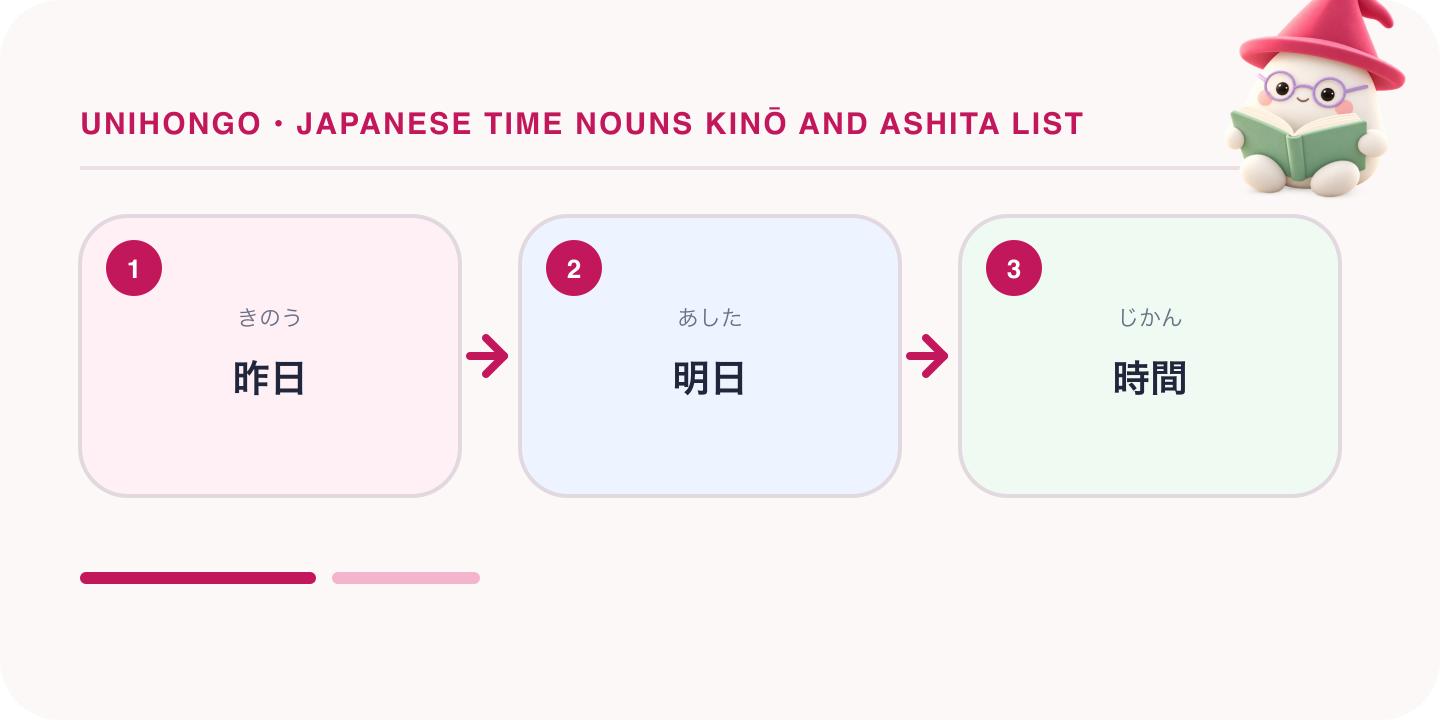
| Japanese | Romaji | Meaning |
|---|---|---|
| 昨日は一日中雨でした。 | Kinō wa ichinichijū ame deshita. | It rained all day yesterday. |
| 明日、時間ありますか。 | Ashita, jikan arimasu ka. | Do you have time tomorrow? |
| おととい友達に会いました。 | Ototoi tomodachi ni aimashita. | I met a friend the day before yesterday. |
| あさってまでに返事をください。 | Asatte made ni henji o kudasai. | Please reply by the day after tomorrow. |
| 今日は忙しいけど、明日は暇です。 | Kyō wa isogashii kedo, ashita wa hima desu. | I'm busy today, but free tomorrow. |
Weeks, months and years: sen, kon, rai
Once you leave the single day, Japanese becomes almost mechanical. Three prefixes carry the meaning: sen, last; kon, this; rai, next. Attach them to shū, week, and you get senshū, konshū, raishū. Attach them to getsu, month, and you get sengetsu, kongetsu, raigetsu. Years are the one place the pattern breaks: kyonen is last year and kotoshi is this year, while rainen, next year, follows the rule. Two steps away, sensenshū is the week before last and saraishū the week after next; months and years work the same way.
These words carry no particle either. They often start a sentence and take wa when the speaker is contrasting or setting the scene: raishū wa shutchō desu, next week I am on a business trip. When they modify a noun they take no: raishū no getsuyōbi, next Monday, and here the Monday takes ni because it is an absolute day: raishū no getsuyōbi ni kaigi ga arimasu.
| Japanese | Romaji | Meaning |
|---|---|---|
| 先週、京都に行きました。 | Senshū, Kyōto ni ikimashita. | I went to Kyoto last week. |
| 今週は残業が多いです。 | Konshū wa zangyō ga ōi desu. | There's a lot of overtime this week. |
| 来月から新しい仕事が始まります。 | Raigetsu kara atarashii shigoto ga hajimarimasu. | My new job starts next month. |
| 来年、日本語能力試験を受けるつもりです。 | Rainen, Nihongo Nōryoku Shiken o ukeru tsumori desu. | I plan to take the JLPT next year. |
| 再来週の月曜日に会議があります。 | Saraishū no getsuyōbi ni kaigi ga arimasu. | There's a meeting on Monday the week after next. |
Parts of today: kesa, konban, kon'ya
Within a single day, Japanese has compact words for the parts that belong to today. Kesa is this morning, konban is this evening, and kon'ya is tonight, with konban leaning toward the early evening and kon'ya toward the night. Konban wa, good evening, is the same konban with a topic particle. There is no one-word this afternoon: use kyō no gogo. For other days, combine the day word with no and the part: kinō no asa, ashita no yoru, ototoi no ban.
The parts themselves are asa, morning; hiru, midday; gogo, afternoon; yūgata, early evening; ban or yoru, evening or night. As habits they appear with wa or without a particle: asa wa pan o tabemasu, I eat bread in the morning. Mainichi, maiasa and maiban, every day, morning and evening, are particle-free too, as are itsumo, always, and saikin, recently.
| Japanese | Romaji | Meaning |
|---|---|---|
| 今朝、寝坊してしまいました。 | Kesa, nebō shite shimaimashita. | I overslept this morning. |
| 今晩、一緒にご飯を食べませんか。 | Konban, issho ni gohan o tabemasen ka. | Would you like to have dinner together this evening? |
| 今夜は早く寝ます。 | Kon'ya wa hayaku nemasu. | I'm going to bed early tonight. |
| 今日の午後は会議です。 | Kyō no gogo wa kaigi desu. | This afternoon I have a meeting. |
| 昨日の夜、電話しましたよ。 | Kinō no yoru, denwa shimashita yo. | I called you last night. |
| 毎朝六時に起きます。 | Maiasa rokuji ni okimasu. | I get up at six every morning. |
Short range: sakki, ima, ato de, kore kara
The words for the immediate past and future are the ones you use most, because most talk is about what just happened and what happens next. Sakki is a moment ago, the last few minutes or hours: sakki kita bakari, I just got here. Its polite form is saki hodo, which you will hear from staff: saki hodo no ken, the matter from earlier. Ima is now, and ima kara means from now. Kore kara is from here on, used for the plans immediately ahead. Ato de is later, and it always carries its particle, because ato is a noun meaning after and de marks the point: ato de renraku shimasu, I will get in touch later.
Sakki and ato de refer to the same day; for a more distant later, use kondo, next time or soon, and for earlier in general, kono mae, the other day. Mō sugu is very soon, and sono uchi is sometime, often a soft way to postpone.
| Japanese | Romaji | Meaning |
|---|---|---|
| さっき駅で田中さんを見かけました。 | Sakki eki de Tanaka-san o mikakemashita. | I saw Mr Tanaka at the station just now. |
| 後で電話してもいいですか。 | Ato de denwa shite mo ii desu ka. | May I call you later? |
| これから買い物に行きます。 | Kore kara kaimono ni ikimasu. | I'm going shopping now. |
| この前の話、覚えていますか。 | Kono mae no hanashi, oboete imasu ka. | Do you remember what we talked about the other day? |
| 今度、一緒に飲みに行きましょう。 | Kondo, issho ni nomi ni ikimashō. | Let's go for a drink sometime soon. |
When time words take ni and when they do not
The rule is short. Ni marks a fixed point on the clock or calendar: an hour, a date, a day of the week, a month by name, a year by number. It is not used after words that point from the speaker's now: kinō, kyō, ashita, konshū, raigetsu, kotoshi, kesa, sakki. A relative word already tells the listener where to look, so no anchor is needed, while a fixed point needs ni to attach it to the action.
Some words sit in between and take ni optionally: the seasons, haru ni or haru; the parts of the day, asa ni or asa; and expressions with a number of days, mikka ni for on the third versus mikka for three days. When a relative word modifies an absolute one with no, the absolute word decides: raishū no getsuyōbi ni.
- Clock times take ni: shichiji ni okimasu, I get up at seven
- Dates take ni: jūgonichi ni shiharaimasu, I pay on the fifteenth
- Days of the week take ni: kayōbi ni jugyō ga arimasu
- Months and years by name or number take ni: sangatsu ni, nisen sanjū nen ni
- Relative days never take ni: kinō, kyō, ashita, ototoi, asatte
- Relative weeks, months, years never take ni: senshū, kongetsu, rainen
- Parts of today never take ni: kesa, konban, kon'ya
- Sakki and ima take nothing; ato de always keeps de
- Frequency words take nothing: mainichi, maishū, itsumo, tokidoki
If you remember one line, remember this: if the English word contains yesterday, today, tomorrow, this, last or next, leave the ni out.
The full list of relative time nouns
The table collects every relative time noun from this post in one place, from the furthest past to the furthest future. The reading column gives the romaji, and the meaning column notes the formal variants where they exist.
| Word | Reading | Meaning |
|---|---|---|
| おととい | ototoi | The day before yesterday; formal issakujitsu |
| 昨日 | kinō | Yesterday; formal sakujitsu |
| 今日 | kyō | Today; formal honjitsu |
| 明日 | ashita | Tomorrow; formal asu, myōnichi |
| あさって | asatte | The day after tomorrow; formal myōgonichi |
| 先週 | senshū | Last week; sensenshū the week before last |
| 今週 | konshū | This week |
| 来週 | raishū | Next week; saraishū the week after next |
| 先月 | sengetsu | Last month |
| 今月 | kongetsu | This month |
| 来月 | raigetsu | Next month |
| 去年 | kyonen | Last year; formal sakunen; ototoshi two years ago |
| 今年 | kotoshi | This year |
| 来年 | rainen | Next year; sarainen the year after next |
| 今朝 | kesa | This morning |
| 今晩 | konban | This evening |
| 今夜 | kon'ya | Tonight |
| さっき | sakki | A moment ago; polite saki hodo |
| 後で | ato de | Later, on the same day |
Putting time nouns in the sentence
The natural position for a time word is early, before the subject or just after it; ashita at the very end sounds like an afterthought. Two time words stack from large to small, like a Japanese address: raishū no kin'yōbi no gogo sanji ni, at three in the afternoon next Friday. Only the last, absolute one carries ni.
Tense follows the time word. Kinō and senshū take the ta form; ashita and raishū take the plain or masu form, since Japanese has no separate future. Kyō can take either, depending on whether the event has happened yet: kyō asagohan o tabemashita, I ate breakfast today, is past because the eating is done.
| Japanese | Romaji | Meaning |
|---|---|---|
| 昨日は雨でしたが、今日は晴れです。 | Kinō wa ame deshita ga, kyō wa hare desu. | It rained yesterday, but today is sunny. |
| 来週の金曜日の午後三時に伺います。 | Raishū no kin'yōbi no gogo sanji ni ukagaimasu. | I'll visit at three next Friday afternoon. |
| 先月から日本に住んでいます。 | Sengetsu kara Nihon ni sunde imasu. | I've been living in Japan since last month. |
| 今日はもう疲れたので、明日やります。 | Kyō wa mō tsukareta node, ashita yarimasu. | I'm tired today, so I'll do it tomorrow. |
Common mistakes with time nouns
The first mistake is adding ni to relative words: kinō ni, ashita ni, raishū ni. Japanese speakers will understand you, but it marks you as a learner instantly.
The second is dropping ni from absolute times because you have learned to drop it from kinō. Sanji ikimasu is missing its anchor; sanji ni ikimasu is right. Days of the week are the usual casualty: getsuyōbi kaigi ga arimasu needs ni after getsuyōbi.
The third is mixing the direction prefixes. Sen and kyo point back; rai points forward; kon and ko point at now. Saying raishū when you mean senshū moves a meeting by two weeks, and a listener will not always catch it. When it matters, add the date: raishū, jūhachinichi desu ne, next week, the eighteenth, right?
| Japanese | Romaji | Meaning |
|---|---|---|
| 昨日、映画を見ました。 | Kinō, eiga o mimashita. | I watched a film yesterday. |
| 三時に駅で会いましょう。 | Sanji ni eki de aimashō. | Let's meet at the station at three. |
| 来週、十八日ですね。 | Raishū, jūhachinichi desu ne. | Next week, the eighteenth, right? |
| いつですか。あさってです。 | Itsu desu ka. Asatte desu. | When is it? The day after tomorrow. |
| 先週じゃなくて、先々週です。 | Senshū ja nakute, sensenshū desu. | Not last week, the week before last. |