
The ten manga sound effects you will meet first
These ten appear in almost any series, from school comedies to battle manga. Learn them as pictures: each one belongs to a typical panel.
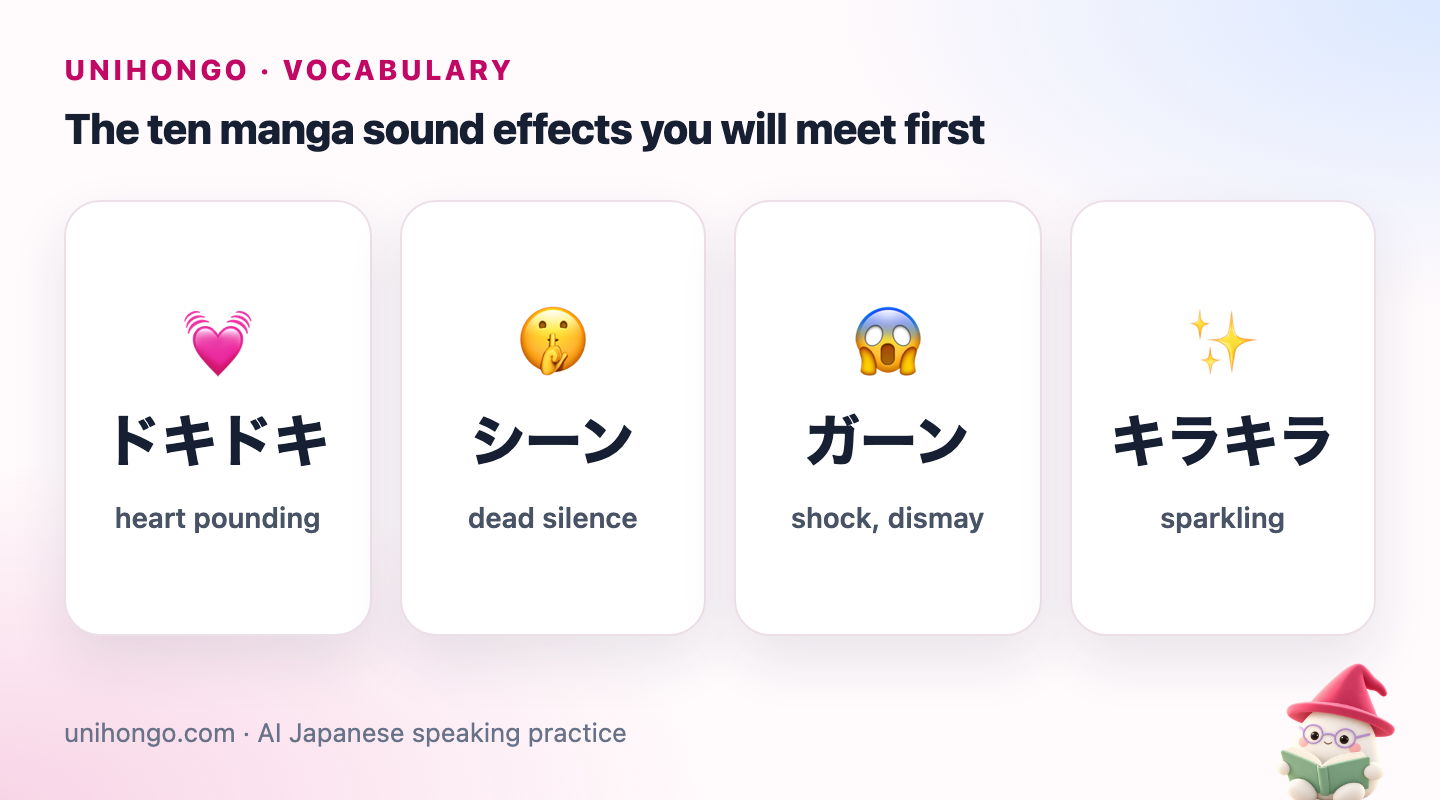
| Japanese | Romaji | Meaning |
|---|---|---|
| ドキドキ | dokidoki | heart pounding |
| シーン | shīn | dead silence |
| ガーン | gān | shock, dismay |
| キラキラ | kirakira | sparkling |
| ゴゴゴ | gogogo | rumbling menace |
| ニコニコ | nikoniko | smiling happily |
| ザーザー | zāzā | rain pouring down |
| バタン | batan | a door slamming |
| じーっ | jī | a long, fixed stare |
| ドン | don | a bang; a dramatic entrance |
Don deserves a note. It is a heavy thud or a drumbeat, and manga also places it behind a character who has just appeared or declared something bold, like a visual drum hit.
Giongo and gitaigo: sounds you hear and states you see
Japanese divides these words into two families. Giongo (擬音語) imitate real sounds: zāzā is rain, batan is a door, don is an impact. Gitaigo (擬態語) give a sound to things that are silent: kirakira for light, nikoniko for a smile, jī for a stare.
English comics have plenty of the first kind and few of the second, which is why untranslated effects can confuse readers. When a quiet panel carries lettering, ask what state it shows, not what noise it makes. The lettering itself has a name: kakimoji (描き文字), drawn characters.
| Japanese | Romaji | Meaning |
|---|---|---|
| 擬音語 | giongo | words that copy sounds |
| 擬態語 | gitaigo | words that mimic states |
| オノマトペ | onomatope | onomatopoeia, both kinds |
| 効果音 | kōkaon | sound effect |
| 描き文字 | kakimoji | hand-drawn lettering |
Why katakana, and when artists switch to hiragana
Katakana is the default for effects for the same reason it is used for emphasis elsewhere: its straight, angular strokes look hard and loud, and they stand apart from the dialogue. A sword clash or an explosion in soft, round hiragana would look wrong.
Hiragana appears when the mood is soft, slow or small: a sleepy yawn, a quiet stare, a child's steps. That is why jī is often drawn in hiragana as じーっ while don is nearly always ドン. Treat this as a tendency. Each artist has a personal style, and the same effect can appear in either script.
Reading the shapes: voiced marks, long bars and small tsu
You can often guess an effect you have never seen, because the spelling follows patterns.
| Japanese | Romaji | Meaning |
|---|---|---|
| トントン | tonton | a light knock |
| ドンドン | dondon | heavy banging |
| キラキラ | kirakira | a pretty sparkle |
| ギラギラ | giragira | a harsh glare |
| コロコロ | korokoro | something small rolling |
| ゴロゴロ | gorogoro | something heavy rolling; thunder |
- Two small dots, the voiced mark, make an effect heavier, louder or rougher: ton becomes don.
- A long bar stretches the sound or the state: gān is shock that keeps echoing.
- A small tsu at the end cuts the effect off sharply, like a held breath: jī ends in a tense stop.
- Repetition means the thing continues: dokidoki is a heart that keeps beating, zāzā is rain that keeps falling.
- A final n gives a ringing or bouncing finish: batan, don.
Silence, stares and menace: effects with no sound at all
Several of the core ten describe things no microphone could record, and three of them carry whole scenes. Shīn fills a panel where nobody answers a joke. Jī sits beside eyes that will not look away. Gogogo, which can be a real rumble, is more often the pressure a dangerous character gives off.
These are the effects that make manga feel different from other comics. The page is telling you about atmosphere directly, and the lettering size tells you how strong it is: thin, small characters for an uneasy hush, huge blocks for dread.
From the panel to conversation: add suru or to
In real speech these words need a little grammar. States usually take suru, to do: dokidoki suru, nikoniko suru. Sudden sounds take to before a verb: batan to shimaru, to shut with a bang. Ongoing sounds can stand directly before the verb.
The staring word changes slightly. In conversation the normal form is jitto (じっと); the stretched manga form shows a longer, more pointed stare.
| Japanese | Romaji | Meaning |
|---|---|---|
| ドキドキします。 | Dokidoki shimasu. | My heart is pounding. |
| 雨がザーザー降っています。 | Ame ga zāzā futte imasu. | It's pouring with rain. |
| ドアがバタンと閉まった。 | Doa ga batan to shimatta. | The door slammed shut. |
| 教室がシーンとなった。 | Kyōshitsu ga shīn to natta. | The classroom fell silent. |
| 星がキラキラ光っている。 | Hoshi ga kirakira hikatte iru. | The stars are twinkling. |
| 彼女はいつもニコニコしています。 | Kanojo wa itsumo nikoniko shite imasu. | She is always smiling. |
| じっと見ないでください。 | Jitto minaide kudasai. | Please don't stare. |
| 財布を忘れた。ガーン。 | Saifu o wasureta. Gān. | I forgot my wallet. Noooo. |
The polite sentences here are safe anywhere. Saying gān aloud is casual and playful, something for friends.
Reading one page aloud
Imagine a simple school scene and read its effects in order. Rain outside the window: zāzā. A door flies open: batan. Everyone stops talking: shīn. A new student stands in the doorway, light around her hair: kirakira. The boy in the back row feels his chest: dokidoki. His friend stares at him: jī.
Six effects, no dialogue, and you know the whole story. Try the same thing with a page of a manga you own: cover the bubbles, read only the lettering, and say each effect aloud before you check a dictionary. Existing guides on this blog cover general onomatopoeia and the order in which panels are read; this habit joins the two.