
What the word actually says
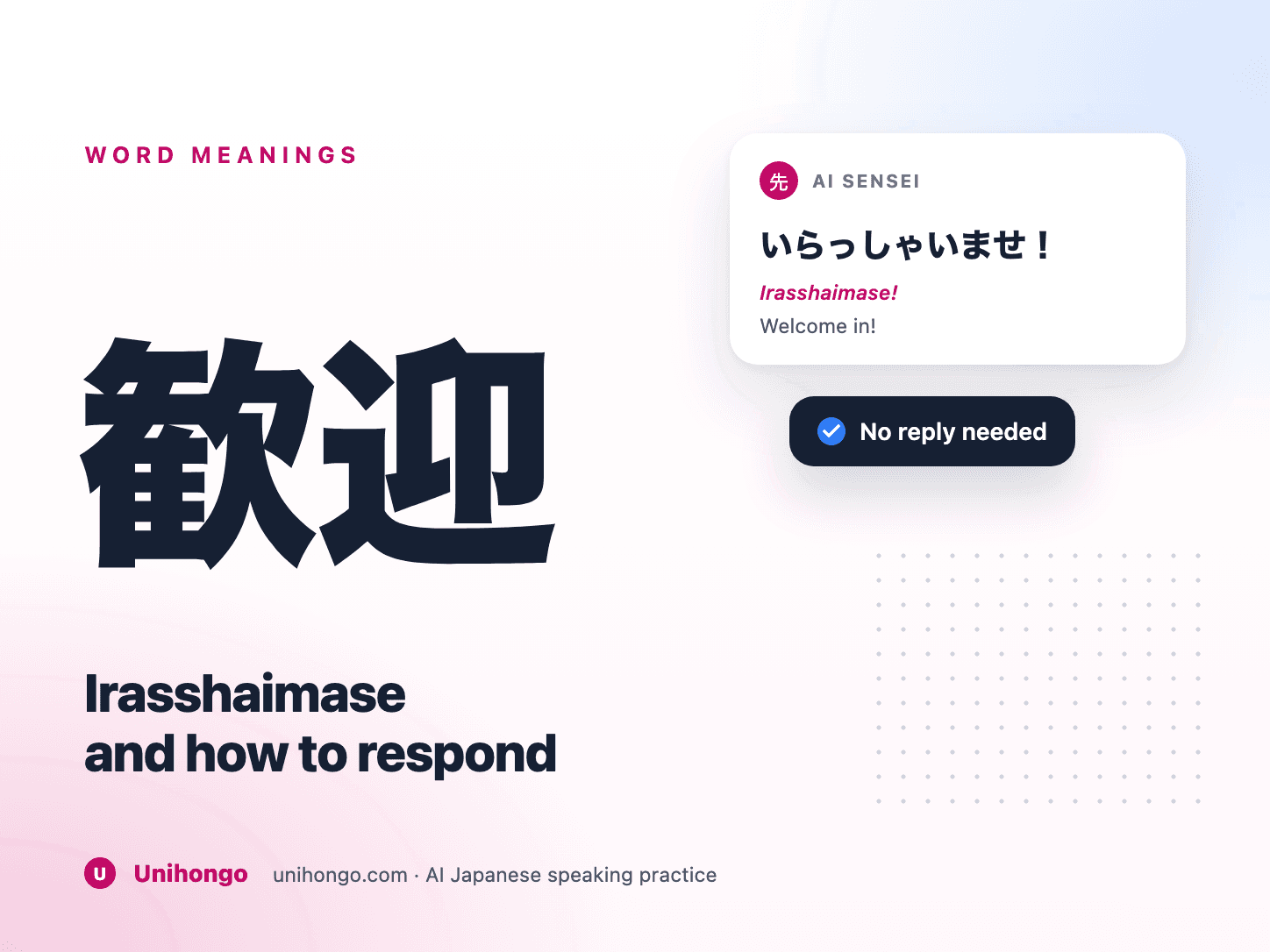
Irasshaimase is built from irassharu, the honorific verb that replaces iku, kuru and iru when you speak about someone you respect. Add the polite request ending mase and you get something close to please do come in, honoured customer.
Nobody hears that literal meaning any more, in the same way that English speakers do not hear may God be with you inside goodbye. What remains is a fixed welcome that marks the relationship: you are the customer and the speaker is serving you.
| Japanese | Romaji | Meaning |
|---|---|---|
| いらっしゃいませ | irasshaimase | Welcome: staff to a customer |
| いらっしゃる | irassharu | To come, go or be: honorific verb |
| いらっしゃいませ、こんにちは。 | Irasshaimase, konnichiwa. | Welcome, hello: a common chain-store greeting |
| いらっしゃいませ、どうぞ。 | Irasshaimase, dōzo. | Welcome, please come in |
Why nobody answers
Visitors often feel rude walking past a warm greeting in silence, but silence is exactly what Japanese customers do. The greeting announces that the shop has noticed you; it does not ask anything, so there is nothing to answer.
A slight nod, or simply meeting the eye of the person who said it, is the natural response. If you want to say something, keep it short and move straight to what you need.
| Japanese | Romaji | Meaning |
|---|---|---|
| こんにちは。 | Konnichiwa. | Hello: fine, but not expected |
| どうも。 | Dōmo. | Hi, thanks: a light, all-purpose acknowledgement |
| 二人です。 | Futari desu. | Two people: the useful reply at a restaurant |
| 見ているだけです。 | Mite iru dake desu. | I'm just looking |
Notice that the useful replies answer a question the staff are about to ask, not the greeting itself. That is the real skill: being ready for the second line.
How it sounds in different places
The same word changes character with the setting. Department stores deliver it softly and with a bow, convenience stores call it out automatically when the door chime rings, and busy izakaya turn it into a loud chorus.
In fast speech the ending stretches and blurs into something like irasshaimasē, and in some shops it shrinks almost to a single burst of sound. Recognising those versions matters more than producing them.
| Place | How it sounds | What you do |
|---|---|---|
| Department store | Quiet, clear, with a bow | Nod and keep walking |
| Convenience store | Automatic, often from the back | Nothing; carry on shopping |
| Izakaya or ramen shop | Loud, echoed by several staff | Show the number of people with your fingers |
| Small family shop | Sometimes the casual irasshai | A nod or a quick hello |
| Hotel lobby | Polite, sometimes with a welcome back | Nod and head to the desk |
Irasshai, yōkoso and okaeri nasai
Japanese has several words that English translates as welcome, and they are not interchangeable. The difference is the relationship and the place.
Irasshai is the casual version, used by a host welcoming a friend or by a relaxed local shop. Yōkoso welcomes someone to a place, an event or a country, and appears on signs and in speeches. Okaeri nasai means welcome home, and in service settings it becomes a special touch that treats the customer as someone returning.
| Japanese | Romaji | Meaning |
|---|---|---|
| いらっしゃい。 | Irasshai. | Come on in: a host, or a relaxed local shop |
| よくいらっしゃいました。 | Yoku irasshaimashita. | How good of you to come: a polite host |
| どうぞお上がりください。 | Dōzo o-agari kudasai. | Please come in: inviting a guest into a home |
| 日本へようこそ。 | Nihon e yōkoso. | Welcome to Japan |
| おかえりなさい。 | Okaeri nasai. | Welcome home |
| おかえりなさいませ。 | Okaeri nasaimase. | Welcome back: formal service to a returning guest |
The lines that come next
The greeting is usually followed within seconds by a real question, and that is the moment learners freeze. Knowing the two or three likely questions for each kind of shop turns the whole exchange into something predictable.
| Japanese | Romaji | Meaning |
|---|---|---|
| 何名様ですか。 | Nanmei-sama desu ka. | How many people? |
| 何かお探しですか。 | Nanika o-sagashi desu ka. | Are you looking for anything? |
| 大丈夫です、見ているだけです。 | Daijōbu desu, mite iru dake desu. | I'm fine, I'm just looking |
| お好きな席へどうぞ。 | O-suki na seki e dōzo. | Please sit wherever you like |
| 少々お待ちください。 | Shōshō o-machi kudasai. | Please wait a moment |
Answer the question, not the greeting. Futari desu with two fingers raised does more for you than any reply to irasshaimase.
When you are the one saying it
Learners working part-time in Japan need to produce the word, often dozens of times an hour. The difficulty is less the meaning than the delivery: it has to be clear, bright and fast without sounding mechanical.
The small tsu after ira creates a short held beat, and dropping it is the most common learner error. The word should sound like i-ra-s-sha-i-ma-se with a tiny pause before sha, not irashaimase.
- Hold the small tsu: a short silent beat before sha.
- Keep the pitch bright and slightly falling at the end.
- Look towards the customer even if you are busy.
- Say it when the door opens, not when the customer reaches you.
- Follow it with the next line of your shop, such as how many people.