
What uzai means in one minute
Uzai is an i-adjective that means annoying, irritating, in the way or a pain. It is the word people reach for when something keeps bothering them and they want to complain about it right now. The things you hear it about most are small and everyday: ads that will not go away, endless notifications, hot sticky weather, hair falling in your eyes, a mosquito at night.
It is strictly casual. You will hear it from teenagers, students and young adults talking with friends and siblings, and from characters in anime and dramas. It never appears in polite speech, and an adult who uses it at work sounds childish.
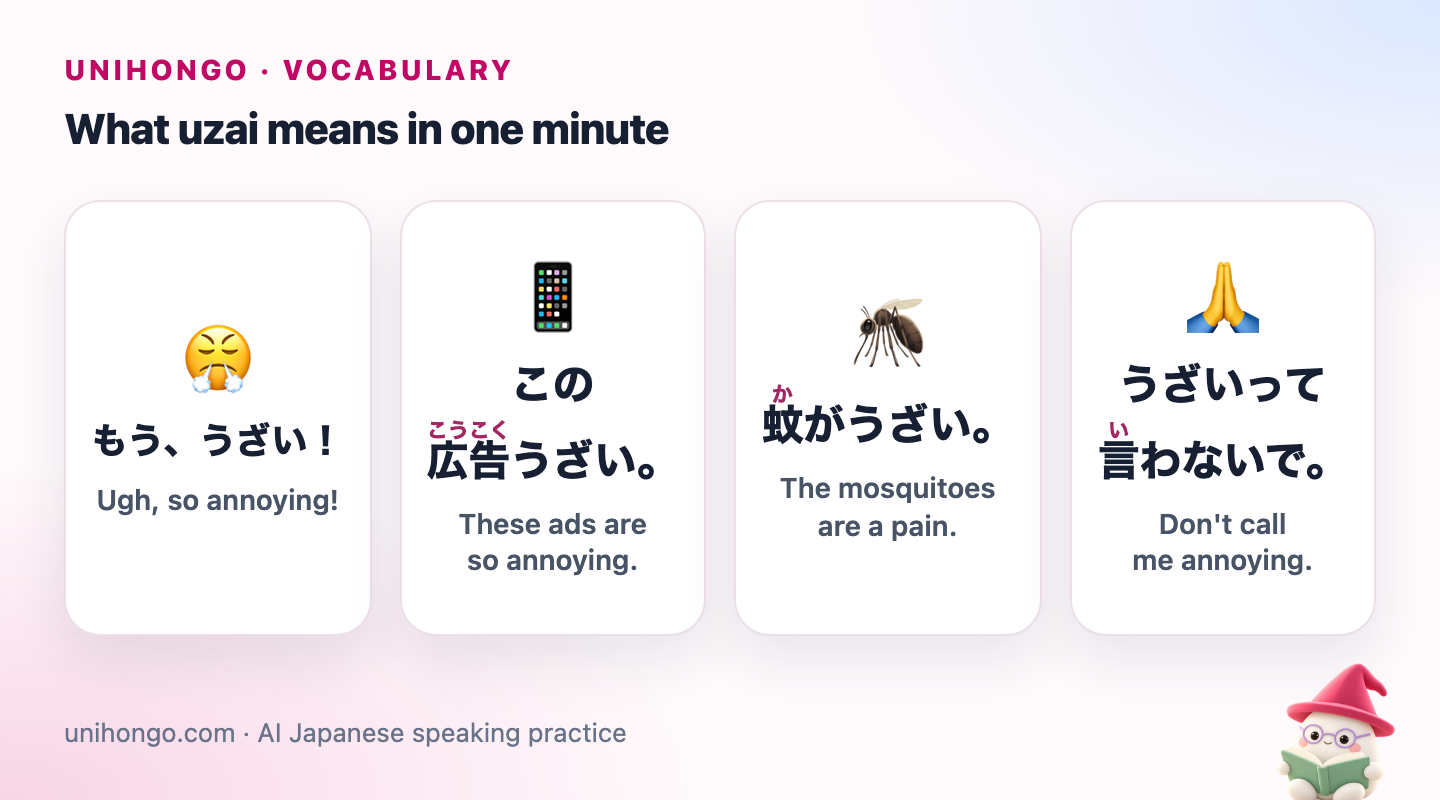
| Japanese | Romaji | Meaning |
|---|---|---|
| もう、うざい! | Mō, uzai! | Ugh, so annoying! |
| この広告うざい。 | Kono kōkoku uzai. | These ads are so annoying. |
| 蚊がうざい。 | Ka ga uzai. | The mosquitoes are a pain. |
| うざいって言わないで。 | Uzai tte iwanaide. | Don't call me annoying. |
Where uzai comes from, and its slangier forms
Uzai is usually explained as a shortened form of uzattai (うざったい), an older word for irritating or bothersome that is said to have come from the dialect of the Tama area in western Tokyo. Some people also hear an echo of urusai in it. The exact history is not settled, but by the 1990s the short form uzai had spread among young people across Japan, and it is now completely standard slang.
There is no everyday kanji for it, so you will see うざい in hiragana or ウザい in katakana. The katakana spelling looks sharper, like a raised voice. In speech it gets shorter and rougher still: uza on its own, often written with a small tsu at the end to show a clipped sound, and uzē, a rough, slangy pronunciation you hear mostly from male characters in anime.
| Japanese | Romaji | Meaning |
|---|---|---|
| うざったい | uzattai | irritating, bothersome (older form) |
| うざい | uzai | annoying (the standard slang form) |
| うざ。 | Uza. | Ugh. (a one-word reaction) |
| うぜえ。 | Uzē. | So annoying. (rough, slangy) |
Because it is an i-adjective, uzai conjugates like takai or samui: uzakatta (was annoying), uzakunai (is not annoying), uzasugiru (is far too annoying) and uzakute (annoying, and…).
Every real use of uzai, with examples
Most of the time, uzai is aimed at things and situations, not people. That is the safe, everyday use. People also use it about themselves, to admit that they are being a nuisance, which turns it into something almost gentle. And, of course, it is used about other people's behaviour, which is where you need to be careful.
| Japanese | Romaji | Meaning |
|---|---|---|
| 雨ばっかりでうざい。 | Ame bakkari de uzai. | All this rain is so annoying. |
| 通知がうざすぎる。 | Tsūchi ga uzasugiru. | These notifications are way too annoying. |
| 前髪がうざい。 | Maegami ga uzai. | My fringe keeps getting in my eyes. |
| 昨日の宿題、うざかった。 | Kinō no shukudai, uzakatta. | Yesterday's homework was a pain. |
| 私、うざいよね。ごめん。 | Watashi, uzai yo ne. Gomen. | I'm being annoying, right? Sorry. |
| 別にうざくないよ。 | Betsu ni uzakunai yo. | You're not annoying at all. |
How harsh is uzai? It depends on the target
The same word can be harmless or wounding. What changes is what you point it at, and how seriously you say it. Telling someone directly that they are uzai means you find them annoying and want them gone, and in Japan it is a word strongly associated with arguments and with being left out at school. Many adults remember being called uzai as a child.
| What you call uzai | How it lands |
|---|---|
| The weather, ads, a mosquito, your own hair | Fine among friends: you are venting about a thing |
| Yourself (watashi, uzai yo ne) | Self-mocking and usually friendly |
| A close friend, as a joke, with a smile | Often fine, but read the mood |
| A person, said seriously to their face | Hurtful; it sounds like rejection |
| A teacher, boss, customer or stranger | Never; it is rude and childish |
A good rule for learners: use uzai only about things, and only with people your own age whom you know well. If you want to complain about a person's behaviour, describe the behaviour with a softer word instead of labelling the person.
Softer words that do the same job
Japanese has plenty of milder ways to say that something bothers you. Each one is more precise than uzai, which also makes you sound more fluent. Urusai is for noise or nagging, mendokusai is for a hassle you cannot be bothered with, jama is for something physically in the way, and shitsukoi is for someone who keeps going on and on. In polite situations, chotto followed by a pause, or chotto komarimasu, does the job without any rudeness at all.
| Japanese | Romaji | Meaning |
|---|---|---|
| ちょっとうるさいね。 | Chotto urusai ne. | It's a bit noisy, isn't it? |
| めんどくさいなあ。 | Mendokusai nā. | What a hassle. |
| ちょっと邪魔だね。 | Chotto jama da ne. | It's a bit in the way, isn't it? |
| しつこいなあ。 | Shitsukoi nā. | You just won't let it go, will you? |
| ちょっと困ります。 | Chotto komarimasu. | That's a bit of a problem for me. (polite) |
| 今はちょっと…。 | Ima wa chotto... | Now isn't a great time... (soft refusal) |
How to reply when someone says uzai
If a friend says uzai about the rain, just agree: ne, uzai yo ne. If they say it to you as a joke, you can play along with a mock-offended e, hidoi! or an apology that is half a joke. If it seems serious, it is fine to say that it hurt. Japanese speakers often do this indirectly, with sore wa chotto kizutsuku na, rather than with an angry outburst.
| Japanese | Romaji | Meaning |
|---|---|---|
| ね、うざいよね。 | Ne, uzai yo ne. | Right? It's so annoying. |
| え、ひどい! | E, hidoi! | Hey, that's mean! (playful) |
| うざくてごめんね。 | Uzakute gomen ne. | Sorry for being annoying. (joking) |
| ごめん、しつこかったね。 | Gomen, shitsukokatta ne. | Sorry, I kept on at you, didn't I? |
| それはちょっと傷つくな。 | Sore wa chotto kizutsuku na. | That actually hurts a bit. |
- Mistake 1: using uzai about a person you have just met. Even as a joke, it sounds aggressive from someone who is not a close friend.
- Mistake 2: using it at work or with older people. Choose chotto komarimasu or describe the problem instead.
- Mistake 3: using uzai for noise. It works, but urusai is more precise and less harsh.
- Mistake 4: copying the anime pronunciation uzē. Many male characters say it, but from a learner it can sound like you are acting out a rough character.
Mini dialogue: notifications at a café
Two friends are studying together at a café when one phone will not stop buzzing. Notice that uzai is aimed at the notifications, not at a person, and that the conversation stays light.
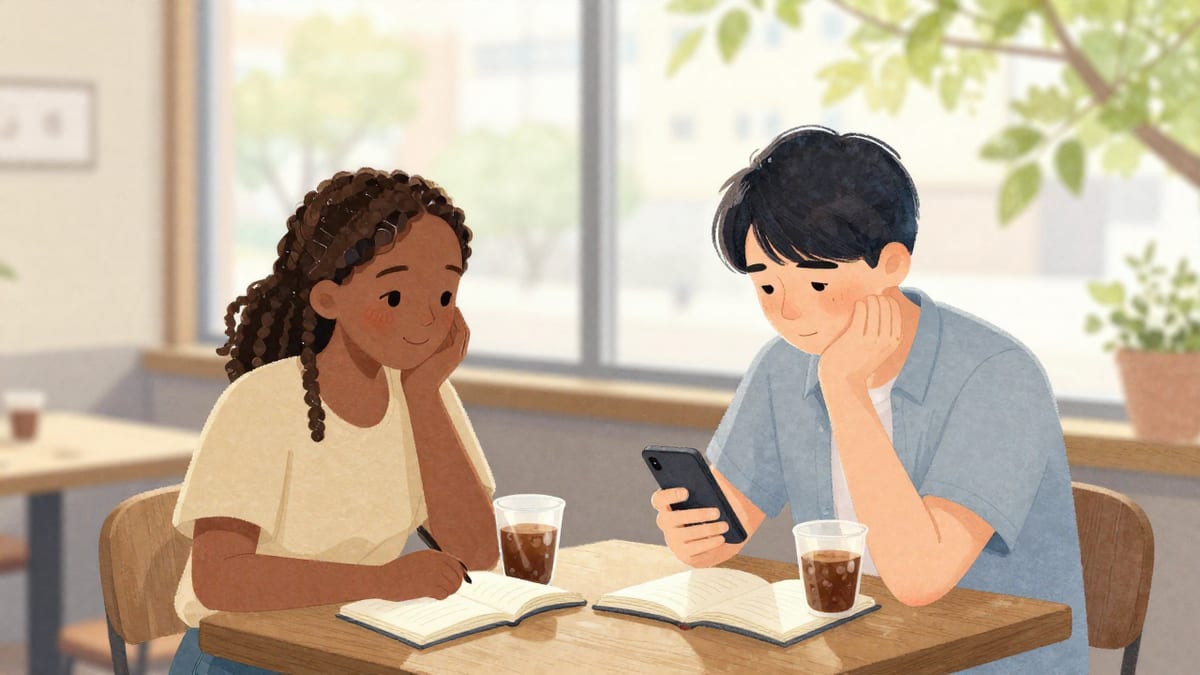
| Japanese | Romaji | Meaning |
|---|---|---|
| またスマホ鳴ってる。 | Mata sumaho natteru. | Mia: Your phone's going off again. |
| ごめん、グループの通知がうざくて。 | Gomen, gurūpu no tsūchi ga uzakute. | Kenta: Sorry, the group chat notifications are driving me mad. |
| 通知、切ったら? | Tsūchi, kittara? | Mia: Why not turn them off? |
| そうする。あ、また来た。うざ! | Sō suru. A, mata kita. Uza! | Kenta: I will. Oh, another one. Ugh! |
| よし、マナーモードにしよう。 | Yoshi, manā mōdo ni shiyō. | Kenta: Right, silent mode it is. |
| えらい。じゃ、勉強しよう。 | Erai. Ja, benkyō shiyō. | Mia: Good for you. Okay, let's study. |