
Four faces of erai
Most uses of erai fit into four groups: praise, rank, attitude and trouble. The picture underneath is always size: a big effort, a high position, a big head, a big problem. Learn these four lines and you can recognise erai almost anywhere.
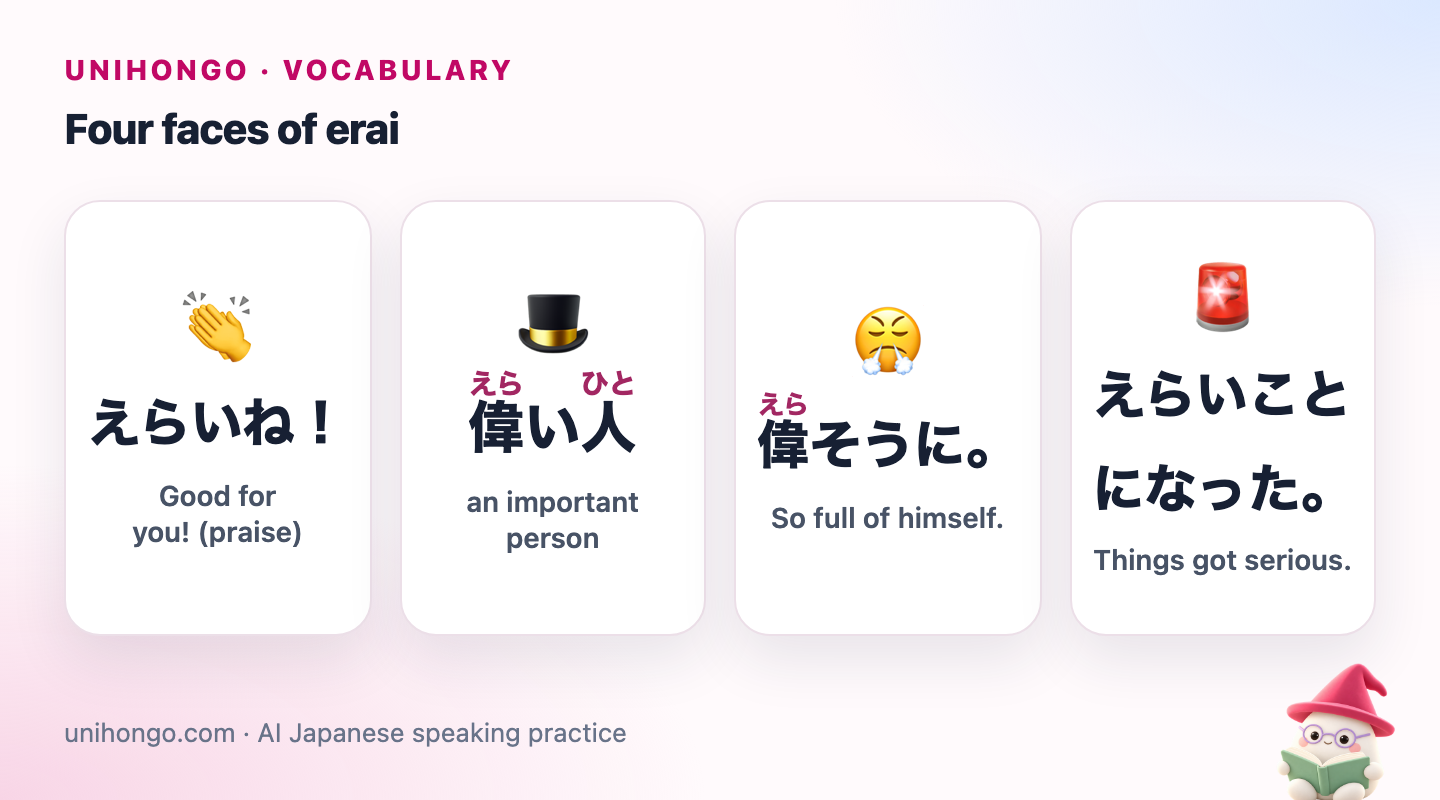
| Japanese | Romaji | Meaning |
|---|---|---|
| えらいね! | Erai ne! | Good for you! (praise) |
| 偉い人 | erai hito | an important person |
| 偉そうに。 | Erasō ni. | So full of himself. |
| えらいことになった。 | Erai koto ni natta. | Things got serious. |
The kanji 偉 and the core idea
The kanji is 偉, read i in compounds and era in erai. It means great or outstanding, and you will find it in words such as idai (偉大), great or mighty, and ijin (偉人), a great person in history. These words are formal and admiring.
In daily life erai is very often written in hiragana, えらい, especially for the casual meanings: praise to a child, trouble, and regional uses. When people write about rank or a great person, the kanji is more common. Either way, it is an i-adjective, so the past is erakatta and the negative is eraku nai.
| Japanese | Romaji | Meaning |
|---|---|---|
| 偉大な科学者 | idai na kagakusha | a great scientist |
| 偉人の伝記 | ijin no denki | a biography of a great figure |
| えらかったね。 | Erakatta ne. | You did so well. (past) |
Erai ne: praising effort, and who can say it
The most common everyday use is short praise for good behaviour or effort: you tidied your room, you did your homework, you got up early, you went to the gym in the rain. Erai ne is what a parent, grandparent or teacher says to a child, and friends use it with each other too, often half joking: you studied on a Saturday? erai!
Because erai ne judges the other person's behaviour, it flows naturally downwards or sideways: from adults to children, seniors to juniors, and between close friends. Said upwards, to a boss or teacher, it can sound like you are grading them. For people above you, admire the result with sasuga desu ne, or simply thank them.
You can also say it about yourself with a laugh, jibun erai, 'go me', when you manage something small like cooking instead of buying a convenience store bento. Among friends this self-praise is common and playful.
| Japanese | Romaji | Meaning |
|---|---|---|
| ちゃんと片付けたの?えらいね! | Chanto katazuketa no? Erai ne! | You tidied up properly? Well done! |
| 毎日勉強して、えらいね。 | Mainichi benkyō shite, erai ne. | Studying every day, good for you. |
| 雨なのにジム行ったの?えらい! | Ame na noni jimu itta no? Erai! | You went to the gym in the rain? Impressive! |
| 今日は自炊した。自分えらい。 | Kyō wa jisui shita. Jibun erai. | I cooked at home today. Go me. |
| さすがですね。 | Sasuga desu ne. | That's just like you. (safe to a senior) |
Erai hito, oeraisan and erasō
Erai hito means a person of high rank or importance: executives, officials, the senior people who make decisions. It is neutral in most sentences, but it often carries a hint of distance: shachō to ka, erai hito ga kuru, 'the president and other big shots are coming'.
Oeraisan (お偉いさん) adds a polite o and a friendly san, but the effect is ironic: 'the big shots', 'the bigwigs'. It is used among colleagues and friends, never to the people themselves.
Erasō, with the suffix sō meaning 'seems', is a criticism: acting superior, bossy or arrogant. Erasō ni iu is to speak in a superior way, and erasō na taido is an arrogant attitude. It is about behaviour, not real rank: a new employee can be erasō, and a company president can be kind and not erasō at all.
| Japanese | Romaji | Meaning |
|---|---|---|
| 今日は本社から偉い人が来る。 | Kyō wa honsha kara erai hito ga kuru. | Someone important is coming from head office. |
| お偉いさんたちの会議だよ。 | Oeraisan-tachi no kaigi da yo. | It's a meeting of the big shots. (ironic) |
| 偉そうに言わないでよ。 | Erasō ni iwanaide yo. | Don't talk to me like that, so superior. |
| あの人、全然偉そうじゃないね。 | Ano hito, zenzen erasō ja nai ne. | He's not stuck-up at all, is he? |
Erai as awful: when things get serious
Erai also describes something extreme in a bad way. Erai koto ni natta means a situation has turned serious: the last train has gone, the basement flooded, a mistake has reached the client. Erai me ni atta means you had an awful experience, from a terrible journey to a frightening storm. The tone can be grave or a little comic, depending on the voice.
These phrases are casual and a little dramatic. In neutral or polite Japanese, taihen na koto ni narimashita and hidoi me ni aimashita say the same thing.
| Japanese | Romaji | Meaning |
|---|---|---|
| 終電、行っちゃった。えらいことになった。 | Shūden, itchatta. Erai koto ni natta. | The last train's gone. Now we're in trouble. |
| 旅行で、えらい目にあったよ。 | Ryokō de, erai me ni atta yo. | I had an awful time on that trip. |
| 大変なことになりました。 | Taihen na koto ni narimashita. | Something serious has happened. (polite) |
Notice that the bad meaning usually comes in these fixed phrases, erai koto and erai me. On its own, erai said to a person is almost always praise, so you rarely need to worry about confusing the two in a real conversation.
Regional erai: very, and exhausting
In Kansai, erai is often used as an intensifier, close to 'awfully' or 'really': erai komu na, it's awfully crowded, erai samui na, it's really cold. You will also hear the famous exclamation erai kotcha, a Kansai way of saying erai koto da, 'this is a disaster' or 'what a commotion'. In Kansai speech, erai sumimasen means 'I'm terribly sorry'.
In many other regions, especially from the Nagoya area westwards and in parts of western Japan, erai can mean tiring or hard, close to shindoi: ā, erai, 'oh, I'm worn out', after climbing a hill. Usage differs from place to place, and a Tokyo listener may at first hear it as 'great'. If a friend from these regions says erai after something physical, they most likely mean they are exhausted.

| Japanese | Romaji | Meaning |
|---|---|---|
| 今日はえらい混んでるなあ。 | Kyō wa erai konderu nā. | It's awfully crowded today. (Kansai) |
| えらいこっちゃ! | Erai kotcha! | This is a disaster! (Kansai) |
| えらいすんません。 | Erai sunmasen. | I'm terribly sorry. (Kansai) |
| ああ、坂がえらい。 | Ā, saka ga erai. | Oh, this hill is exhausting. (regional) |
Mini dialogue: which erai is it?
In this short exchange, two coworkers use erai in three different ways within a minute. Try to name each one before reading the glosses.
| Japanese | Romaji | Meaning |
|---|---|---|
| 昨日の資料、全部一人で作ったの?えらいね。 | Kinō no shiryō, zenbu hitori de tsukutta no? Erai ne. | Coworker: You made all those slides alone? Well done. |
| うん、でもえらい目にあったよ。徹夜。 | Un, demo erai me ni atta yo. Tetsuya. | You: Yes, but it was awful. I stayed up all night. |
| 今日はお偉いさんも見るらしいよ。 | Kyō wa oeraisan mo miru rashii yo. | Coworker: Apparently the big shots are looking at it today. |
| え、それはえらいことだ。 | E, sore wa erai koto da. | You: What? That's serious. |
The first erai is praise, sideways between colleagues. The second is an awful experience. Oeraisan is the ironic 'big shots', and the last erai koto is trouble. Context did all the work.
Common learner mistakes with erai
- Praising a superior with erai desu ne. It sounds like you are evaluating them. Use sasuga desu ne or thank them.
- Translating erai as only 'great'. When things go wrong, erai koto and erai me mean awful.
- Confusing erai hito with erasō na hito. The first is a person of rank; the second is someone who acts superior, whatever their rank.
- Using oeraisan to the people themselves. It is ironic and belongs in conversations among peers.
- Panicking at a regional erai. If a friend from Nagoya or Kansai uses it in an unexpected way, ask: tsukareta tte koto? 'You mean you're tired?'
A Mocchi check-in for erai
Erai is a word you sort by meaning, so a quiz is the fastest teacher. Type '/quiz erai: ten sentences, tell me if it means praise, rank, attitude, trouble or regional.' Mocchi explains each answer, notes the meanings you mix up, and folds them into a later /review. If you are learning for a stay in Osaka or Nagoya, tell Mocchi, and it can add regional words like erai and shindoi to your personal plan.
For the praise meaning, speaking matters more than reading. Ask AI Sensei, for example Hana-sensei, to play a younger coworker who tells you about small wins all week, and practise answering with erai ne, sugoi ne and yoku ganbatta ne in a natural, warm voice.